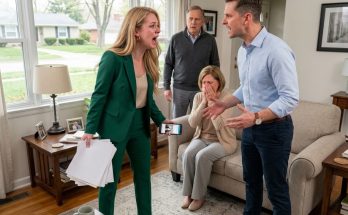
“What did she say?”
“On the second call, she told me she was pregnant. With twins.”
Twins.
I thought of the four children on Elena’s rug and felt sick. At that point, she may not even have known she was carrying quadruplets.
“What did you do?”
“Your mother had called the main desk earlier that week. She told us to route any personal calls from Elena to her, not to you.” Lucia’s voice shook. “I called Mrs. Vance. I thought I was following instructions.”
I closed my eyes.
Elena had not disappeared without explanation. She had reached for me while sick, frightened, and pregnant.
And my mother had built a wall between us.
Later that afternoon, Elena agreed to meet me for twenty minutes at a coffee shop near her office. She sat across from me with both hands around a paper cup.
“When the next ultrasound showed four babies,” she said, “I tried again to find you.”
“I never knew.”
“That explains why you never answered,” she replied. “It does not explain why you left.”
I had no defense.
She told me the babies were born early and spent weeks in intensive care. She showed me one photograph: four tiny infants in separate incubators, surrounded by wires and monitors.
“I had four babies fighting to survive,” she said. “I could not keep begging a man to care.”
Then she stood to leave.
“You missed years, Alex,” Elena said. “I survived them alone.”
As I watched her walk away, I understood something worse than my mother’s betrayal.
She had stolen the chance for me to know my children.
But I had given her the power to do it when I chose to leave their mother first.
Part 3: The Report That Should Have Changed Everything
After meeting Elena, I could not sleep.
I went through old storage boxes in my home office: legal files, tax records, medical folders I had not opened since our marriage ended. Near the bottom of one box, beneath documents from our fertility clinic, I found a report I had never seen before.
It was from my first specialist appointment.
The report stated that my own fertility results had been concerning and required follow-up testing. It did not say I could never become a father.
But it made one thing painfully clear.
The difficulty Elena and I faced had never been hers alone.
For years, I had let her carry every ounce of shame. I had listened as my mother described Elena as the reason my future was disappearing.
Meanwhile, evidence that the problem was shared had been hidden in a file I was never shown.
At the bottom of the report was the doctor’s name: Dr. Julian Vance.
He had overseen our care years earlier. He had also been a longtime friend of my mother.
Elena agreed to meet me at the doctor’s private office only because she wanted answers too. She placed both medical reports on his desk—hers and mine—and asked him one question.
“Why did Beatrice Vance know my private medical information?”
Dr. Vance stared at the papers for a long time.
Then he admitted that my mother had called him repeatedly. She had worried about the family name, my future, and the grandchildren she believed she was owed.
He told her Elena’s results suggested possible difficulty conceiving. He also told her mine required follow-up.
“But she asked me not to tell Alex about his results,” he said quietly. “She believed it would damage his confidence.”
Elena’s face went still.
“So protecting his pride mattered more than protecting my name?”
The doctor did not deny it.
It was easier, I realized, for everyone involved to let Elena believe she was broken than to admit I might share the problem.
The doctor revealed something worse.
After the divorce, my mother returned to his office and asked whether Elena could become pregnant unexpectedly. He confirmed it was medically possible.
Then she asked whether the child might belong to someone else.
That accusation became my mother’s last defense when I confronted her again. She claimed she had seen Elena with an unfamiliar man near an apartment in Cambridge and believed she was having an affair.
Elena gave a hollow laugh.
“That was my brother, Sergio. He came from Chicago to help me when I was pregnant and alone.”
My mother had met Sergio at our wedding.
She knew exactly who he was.
“You didn’t need proof,” I told her. “You only needed an excuse.”
For the first time, Beatrice looked small.
“I had no right,” she whispered.
But the truth was not finished with us.
Three days later, she came to my apartment carrying a sealed yellow folder. Inside was a private DNA compatibility report conducted two months after the children were born.
It confirmed a close familial match.
My children were mine.
My mother had known that when they were still infants.
“How did you get this?” I asked.
She lowered her eyes.
She had gone to the hospital while the babies were in intensive care. Through her connection to Dr. Vance, she obtained lab information and confirmed what she already feared was true.
Then she said nothing.
For five years.
“Why?” I asked.
“Because I had already done too much damage,” she said. “I thought I would tell you later.”
“Later when?” I said. “When they were grown?”
She had no answer.
My mother had not only pushed me to leave Elena.
She had known I had four children fighting for their lives in a hospital—and allowed me to remain a stranger to them anyway.
Part 4: The Father They Did Not Know
Elena did not let me meet the children immediately.
She was right not to.
For five years, I had been a name on a birth certificate and nothing more. I could not walk into their lives with flowers, toys, and apologies, then expect four children to recognize me as their father.
“I won’t let you confuse them,” Elena told me.
“I understand.”
“You can’t buy your way into this, Alex.”
“I know.”
The truth was, I did not know how to do any of it. I knew contracts, courtrooms, negotiations, and how to speak confidently when I wanted something.
None of that mattered when the thing I wanted was a relationship with children who had spent their entire lives without me.
I hired no private investigators. I made no threats. I did not demand a DNA test, even though my mother’s report and the children’s faces told me what I already knew.
Instead, I accepted Elena’s conditions.
I began therapy. I met with a parenting counselor. I paid child support voluntarily without attaching demands to it, and I stayed away from the children until Elena felt they were ready.
Meanwhile, I cut my mother out of my life.
Beatrice wrote letters. She apologized, explained, blamed fear, and said she had only wanted to protect me.