Alana’s confidence began to fade as soon as she saw his face. For the first time since I arrived, she seemed unsure of what Parker was about to say.
“What exactly did Clarissa tell you?”
Parker reached into his pocket, took out his phone, and placed it on the table between them.
“She didn’t have to tell me anything.”
Then he pressed play and let Alana hear her own voice filling the room. By the time the recording reached the part about pushing Dustin away on purpose, there was no argument left for her to make and no version of the story she could still control.
PART 4: WHAT PARKER FINALLY TOLD HIS MOTHER
Alana stood completely still while the recording played, and Ellie’s expression changed almost as quickly as hers. Neither of them could claim they had been misunderstood because their own voices had captured the plan clearly enough for everyone in the room to hear.
When the audio ended, Parker picked up his phone and looked at his mother for several seconds before speaking. He did not raise his voice, but the disappointment in it was far more powerful than anger would have been.
“You deliberately made a seven-year-old child feel unwanted so you could push him away from me.”
Alana immediately tried to defend herself by insisting that she had only been protecting the family. She said Dustin was not Parker’s biological son and suggested that I had made everything more complicated by expecting them to treat him exactly like Mason.
“He isn’t your blood, Parker. You can care about him, but that doesn’t make him the same as real family.”
Parker’s expression hardened, but he remained calm. He reminded her that biology had never been the thing that made Dustin his son, because he had been raising him for years and had already made that commitment long before Alana decided she was entitled to redefine it.
“You don’t get to decide who my son is.”
Ellie interrupted and accused me of manipulating Parker against them, but Parker stopped her before she could finish. He told her that nothing I had said could erase the fact that she had been recorded planning to provoke me and use Dustin as a weapon in their family conflict.
“This is not Clarissa turning me against you. This is me hearing exactly what you said when you thought no one else was listening.”
Alana’s confidence finally cracked, and she began insisting that they had only wanted more time with Parker without constant tension. Parker told her that if spending time with him required humiliating his wife and making his child question whether he belonged, then she had misunderstood him completely.
Then he turned toward Dustin and asked him to come closer. Dustin hesitated before walking over, and Parker placed an arm around his shoulders.
“This is my son. Clarissa is my wife. They are my family, and if you cannot respect both of them, then you do not get access to me.”
Alana stared at him as though she could not believe what she was hearing. For years, Parker had avoided forcing her to face consequences because he had always believed keeping peace was easier than confrontation.
This time, he did not retreat.
He told Alana and Ellie that they would leave the country house exactly as I had instructed. He also made it clear that there would be no visits with Dustin, no phone calls to him, and no family gatherings until they were prepared to acknowledge what they had done and apologize without excuses.
“You wanted him to feel like he wasn’t family. Until you understand why that was wrong, you won’t be part of his life.”
Ellie immediately protested that I had already thrown them out and now Parker was taking things too far. He reminded her that the house belonged to me and that neither she nor Alana had any right to treat it as their private family property.
Alana looked toward me then, clearly expecting me to soften the decision now that Parker had taken my side. I did not argue with her or add anything because there was nothing left that needed explaining.
Less than an hour later, their suitcases were loaded into a taxi headed toward the station. Dustin stood beside Parker and me in the doorway while the car disappeared down the road.
Afterward, Parker knelt beside him again.
“I should have protected you from this sooner.”
Dustin looked at him carefully.
“Are you still my dad?”
Parker pulled him into his arms.
“Always.”
For the first time that afternoon, Dustin smiled.
And that was when I realized the real damage Alana and Ellie had caused was not about a meal, a country house, or even their plan to push us away. They had made a child question the one relationship he had always believed was safe, and Parker knew rebuilding that trust would matter far more than winning any argument.
PART 5: WHAT REAL FAMILY MEANT
The house felt strangely quiet after Alana and Ellie left, but none of us seemed ready to return to normal. Parker stayed close to Dustin for the rest of the afternoon, answering every question patiently because he understood that one reassurance would not immediately erase weeks of being told he mattered less than Mason.
Later that evening, after Dustin had finally fallen asleep, Parker and I sat together in the kitchen. He looked exhausted, and for the first time he admitted that his habit of avoiding conflict with his mother had allowed her behavior to continue much longer than it should have.
“I kept telling myself I was protecting everyone by staying out of it.”
I reminded him that silence had never actually kept the peace. It had only taught Alana and Ellie that they could cross boundaries without worrying that Parker would challenge them.
Parker nodded and told me there was something else he wanted me to understand. He had never considered Dustin temporary, and although biology had been important to his mother, it had never determined how he saw the boy he had helped raise.
“Dustin isn’t someone I tolerate because I married you. He’s my son because I chose to become his father.”
Those words mattered, but Parker knew they needed to become more than something said after a crisis. Over the following weeks, he became much more deliberate about protecting the family we had built instead of constantly trying to preserve his mother’s approval.
Alana called several times, but Parker refused to let the conversation become another debate about whether I had overreacted. He told her that the issue was not my response but the deliberate decision to make a child feel unwanted so that she and Ellie could gain more control over him.
Ellie tried another strategy and sent messages claiming that the entire situation had been exaggerated. Parker answered only once, reminding her that he still had the recording and that nothing she said afterward could change what she had admitted when she thought nobody was listening.
For a while, Dustin refused to talk about the country house. Whenever Mason’s name came up, he became quiet, and Parker and I decided not to push him into contact with anyone before he felt ready.
Instead, we focused on rebuilding the sense of safety that had been damaged. We spent weekends together, returned to his soccer games, cooked dinner as a family, and made sure he never again had to wonder whether he was somehow less important because Parker was not his biological father.
Several months later, Dustin asked Parker a question while they were repairing his bicycle in the garage.
“Do you think Grandma will ever like me again?”
Parker set down the wrench and looked at him carefully.
“This was never about whether you were good enough for Grandma. You were always good enough. She was the one who made a bad choice.”
Dustin seemed to think about that for a moment before returning to the bicycle. I watched from the doorway and realized that Parker had finally learned how different protecting peace was from protecting people.
Alana eventually sent a written apology, but we did not rush to restore the relationship. Parker told her that forgiveness could happen without immediately returning everything to the way it had been, and any future contact would depend on whether Dustin felt comfortable.
The country house changed after that summer. It stopped being the place where Parker’s relatives expected unlimited access simply because they shared his last name, and it became what I had originally intended it to be: somewhere my child could feel safe.
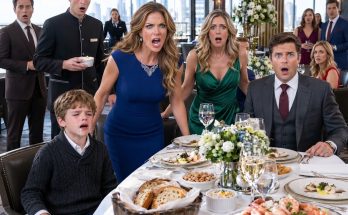
I still remembered the sight of Dustin sitting alone with that small plate in his hands. At the time, I thought the cruelest thing I had discovered was that adults had denied a seven-year-old a seat at their table.
I had been wrong.
The real cruelty was that they had tried to convince him he did not belong in the family at all. What finally mattered was that Parker stopped allowing other people to define his family for him.
Real family was never about whose blood matched whose.
It was about who stayed, who protected you, and who made sure you never had to earn your place at the table.