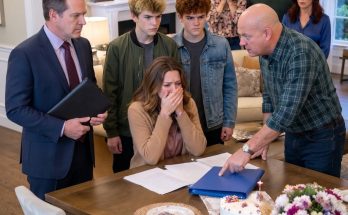
“He hated disruptions,” she said in her statement. “When Mrs. Fairchild called, he told me to manage it.”
Her words did not excuse her. They explained the culture that had made her scheme possible.
The board placed Brendan on administrative leave while the audit continued. Gideon agreed to independent oversight of all patient-related payment systems and notified the hospital of the findings.
Brendan asked to see me one more time.
We met in a conference room at Elena’s office. He looked older than he had a month earlier, as though the cost of finally seeing himself had arrived all at once.
“I did not know Chloe would die,” he said.
“No,” I replied. “You only knew she needed help and decided it could wait.”
He lowered his head. “I was trying to protect the merger. I thought one delay would not matter.”
“One delay was seven days,” I said. “And I was alone for every one of them.”
Tears moved down his face, but I could not carry them for him. Grief had already taken enough from me.
“I’m sorry,” he whispered.
“I believe you are sorry now.”
He looked up, perhaps expecting that sentence to become forgiveness. It did not.
“I am filing for divorce,” I continued. “All communication will go through Elena. I also want the Fairchild Foundation to fund an independent emergency-care program, not because it repairs what happened to Chloe, but because another parent should not be trapped by the same system.”
Brendan nodded slowly. “I’ll sign whatever you need.”
“Good,” I said. “Then sign because it is right, not because you hope it will change what I think of you.”
The divorce process began the following week. The board negotiated a settlement with the trust and adopted the emergency-care reforms proposed by independent clinicians and family advocates.
None of it brought Chloe back. None of it made the nursery less empty.
But it turned the records of her last days into more than a private tragedy. They became proof that a system had failed, and a reason to make it answer for that failure.
Three months later, Elena called with the final audit report.
Ximena’s theft had been confirmed. Brendan had been removed as chief executive officer, and the board had voted to separate the company’s healthcare administration from its corporate finance division.
Then Elena paused.
“There is one thing you should see before we close this file,” she said.
It was a photograph recovered from Brendan’s office.
Chloe was laughing in it, one hand reaching toward the camera.
On the back, Brendan had written a date from years earlier—and four words that broke my heart all over again.
For when she is better.
Part 5: The Promise He Was Too Late to Keep
I held the photograph for a long time.
Chloe was sitting on Brendan’s shoulders at a summer fair, her curls escaping from beneath a yellow sunhat. She looked healthy in the picture, or at least healthy enough to laugh with her whole face, and Brendan was smiling at her as though nothing in the world could matter more.
On the back, he had written: For when she is better.
I understood what the photograph meant. Somewhere inside Brendan, there had been love for our daughter. But he had kept it in the future, saved for a day when she was easier to love, easier to visit, easier to fit around his work.
Chloe had needed him in the present.
I placed the photograph beside her urn in my apartment. I did not throw it away, and I did not call Brendan to tell him I had found it.
Some things could be remembered without being repaired.
The divorce was finalized two months later. Brendan did not fight the settlement, and he agreed to the reforms Elena negotiated with the Fairchild Foundation: independent review of emergency medical requests, a direct payment pathway to hospitals, and family advocates who could escalate urgent cases without seeking corporate approval.
The criminal investigation into Ximena continued beyond my divorce. I followed it through Elena when necessary, but I stopped making it the center of my life.
Justice mattered. It just could not become the only thing Chloe left behind.
With my father’s trust, I returned to work gradually. I did not become the head of Vance Capital overnight, and I did not want to.
Instead, I joined its risk-review team as a consultant, using the skills I had once believed I had lost. Numbers did not frighten me anymore. They told stories, and I had learned how dangerous it was when people with power refused to read them.
A year after Chloe’s death, Vance Capital partnered with several children’s hospitals to create the Chloe Fairchild Emergency Access Fund. It was not a grand monument or a public act of revenge.
It paid for transportation, medications, temporary housing, and care coordinators for families facing urgent pediatric treatment. Every application was reviewed by clinicians and social workers, not by a corporate assistant protecting a quarterly budget.
The first time I visited one of the hospitals, a mother met me in the hallway. Her son was receiving treatment for a serious heart condition, and she held both of my hands while trying not to cry.
“They approved the medication the same day,” she said. “I didn’t have to beg.”
I thought of the seven days I had spent refreshing a portal. Then I thought of Chloe, who had taught me more about courage in three years than I had learned in all the years before her.
“That is how it should be,” I told her.
Later, I drove to the lake with Chloe’s urn on the passenger seat. The afternoon was clear, and the water stretched silver-blue beneath a wide September sky.
I did not scatter her ashes. I was not ready, and I finally understood that I did not have to force myself into a symbolic goodbye simply because other people expected one.
Instead, I sat on a bench and told her about the fund. I told her that children she would never meet would receive help faster because her story had made people look more closely at the systems they trusted.
“I wish I could have protected you better,” I whispered.
The wind moved gently across the water.
For a long time, I sat there with grief beside me. It was no longer the sharp, breathless thing it had been when I left the hospital carrying her home.
It was love, changed into something I would carry forward.
When I finally stood, I held the urn carefully against my chest.
I had lost my daughter. No court ruling, audit, or apology could make that loss fair.
But I had found my voice again.
And I would spend the rest of my life using it before another parent had to beg to be heard.