Chapter 3: The Countdown to Cruelty
The Disneyland conspiracy was birthed within a digital echo chamber—a family group chat obnoxiously titled Abbott Adventures.
There were twelve participants in this digital arena, including spouses. In late January, my mother deployed a message announcing her grand vision: an exclusive “cousin trip” to the Magic Kingdom in June. No parents allowed, with the sole exceptions of herself and Mallerie, who had magnanimously volunteered to serve as the chaperones.
The roster was established: Harper, Sutton, Tyler, and Ren. Four grandchildren. They planned to leverage our shared timeshare points for the bulk of the lodging, capping it off with two nights at a premium hotel adjacent to the park gates. Eager to contribute, I immediately offered to fully fund Ren’s round-trip airfare and her multi-day park hopper passes.
My mother reacted with three pulsing red heart emojis.
For the ensuing six weeks, Disneyland consumed Ren’s entire consciousness. We constructed a massive paper chain out of construction paper—eighty-six interlocking loops, representing the agonizing wait until departure. Every morning before she brushed her teeth, she would ceremoniously rip one link free.
She debated endlessly over which princess gown to pack. She strategized her ride order, deciding to tackle the Dumbo elephants first because, after watching a YouTube walkthrough, she concluded they looked “brave, but not scary-brave.” She hoarded $14.62 in a sparkly purple Velcro wallet, fiercely determined to purchase her own sequined Mickey ears.
She even authored a masterpiece with her markers—a drawing destined for Harper. It depicted two stick figures, one with frantic yellow scribbles for hair, the other brown, clasping hands before a jagged blue castle. A massive yellow sun dominated the corner, uniquely featuring long eyelashes because Ren had decided the sun was definitively female. Across the top, written in wobbly, triumphant purple letters, was the word: COUSINS.
I still have that drawing. It serves as my anchor.
Approximately three weeks prior to the scheduled departure, the frequency in the group chat shifted. It wasn’t a sudden, violent pivot. Familial exclusion rarely announces itself with a trumpet blast; it creeps in through the subtle modification of tone.
Mallerie initiated the shift. “Harper and Sutton are practically vibrating. They are SO ready for their big girl trip!”
My mother immediately validated her. “Yes! Finally old enough to traverse the parks and really absorb the full experience.”
Ren was six. Sutton was seven. I stared at the screen, a faint alarm bell ringing in my subconscious.
Then, Mallerie uploaded a screenshot of a coveted dining reservation at a character breakfast. Table for four.
I typed rapidly: “Shouldn’t that reservation be for five? (You, Mom, Harper, Sutton, Ren?)”
Radio silence reigned for seventeen agonizing minutes. Finally, my mother replied: “Still finalizing logistics. Don’t panic.”
A week later, I requested the flight confirmation numbers so I could align Ren’s ticket. Instead of replying in the chat, my mother bypassed the digital trail and called my cell.
“We are encountering some friction. We may need to adjust the roster,” she began, her voice dripping with artificial sympathy.
“Define adjust,” I demanded, standing behind the register at Abbott House while my floor manager, Lena, unpacked ceramic vases a few yards away.
My mother expelled a heavy, theatrical sigh. It was her signature auditory weapon, designed to make her impending cruelty sound like a massive burden she was reluctantly bearing. “She is just incredibly sensitive, Key.”
“She is six years old.”
“Everything escalates into a massive production with her,” my mother continued, her frustration bleeding through.
I let out a sharp, incredulous laugh. I genuinely thought I had misheard her. “What exactly does that entail, Mom?”
“She becomes overstimulated. She requires frequent rests. She interrogates everyone with endless questions.”
“Again, she is six. Has she actively ruined a previous excursion?”
“That is an uncharitable way of framing it.”
“Then frame it accurately.”
“I am attempting to tell you that Mallerie has legitimate concerns that the older children will be robbed of the full Disney experience if they are constantly tethered to a toddler’s pace.”
The older children. Seven, eight, and nine.
“Is Mallerie aggressively campaigning to strip Ren from this itinerary?” I asked, my voice dropping to a dangerous register.
“Do not use inflammatory words like strip!” my mother snapped, instantly irritated that her narrative was being challenged. “This is precisely why engaging with you is so utterly exhausting, Key.”
That specific manipulative tactic had successfully paralyzed me for decades. I bit my tongue, tasting copper.
“Nothing is carved in stone,” she retreated hastily. “We will convene and hash it out on Sunday.”
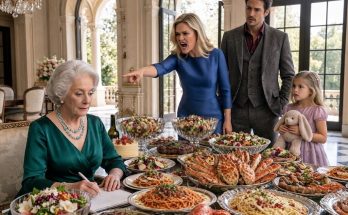
Sunday was the grand celebration for my father’s sixty-fourth birthday. My parents had invited fifteen relatives to their Eagle estate. The air was thick with the smell of slow-roasted pot roast, buttered potatoes, and a massive supermarket sheet cake bearing the words Happy 64th, Dennis in electric blue frosting.
Ren was contentedly sequestered beneath the kitchen island, meticulously coloring, while the adults swirled around her, sipping wine and oblivious to her presence.
That was the exact moment my mother chose to drop the guillotine. I will never know if she and Mallerie had premeditated the ambush, or if the wine simply loosened her filter.
Mallerie was casually leaning against the stainless-steel refrigerator, nursing a Pinot Grigio. My father was focused on carving the roast. Ryan was visible through the sliding glass doors, helping his son Tyler adjust a basketball hoop.
My mother wiped her pristine hands on a linen dish towel, turned to me, and delivered the execution order.
“We’ve decided it’s best to amend the passenger list. We are uninviting your daughter from the cousin trip.”
My physiology reacted before my brain did. My body temperature plummeted. There are manifestations of rage that burn like a wildfire; this was not one of them. This felt like stepping into a walk-in freezer. The air in my lungs crystallized.
My eyes instinctively darted downward. Ren was mostly concealed by the heavy wooden barstools, but she was there.
My mother tracked my gaze, realizing her catastrophic spatial error. She hastily dropped her volume to a conspiratorial whisper, but the damage was irreversible.
“She simply doesn’t align with the trip’s vibe, you understand.”
Mallerie contorted her face into an expression that hovered nauseatingly between forced sympathy and sheer annoyance. “Mom…”
“What?” my mother defended herself. “That is verbatim what we discussed.”
Mallerie locked eyes with me. “Keely, I am begging you, do not escalate this into a dramatic spectacle.”
I have a photographic memory for dialogue when under duress. I committed her exact phrasing to memory because it confirmed my mother had not acted as a lone wolf. This was a synchronized assassination of my child’s joy.
“Please define the vibe,” I said, my voice eerily flat.
Mallerie shifted her weight, crossing her ankles. “The other kids have matured into a different phase. Your daughter is essentially a year younger. It slows the momentum.”
“It is an eleven-month difference. It is not an age gap. What is the actual grievance?”
My father finally abandoned his carving knife. The metal clattered against the porcelain platter. “Key.”
I snapped my gaze to him. He was projecting his patented warning look—the exact glare he deployed when I was a rebellious teenager. The look that telegraphed: Your reaction to our disrespect is about to become the primary issue.
Mallerie exhaled loudly. “Fine. Ren requires an exhausting amount of emotional management.”
My vision tunneled. I looked beneath the counter again. Ren was staring blankly at Cinderella. The crayon had stopped moving.
“Elaborate on emotional management,” I demanded.
“Key, stop,” my father warned.
“No. I want it on the record. Explain it.”
“She weeps over trivialities,” Mallerie fired back. “She is six. She completely melted down at Tyler’s birthday party because the older boys wouldn’t let her participate in their game. They told her she was a baby, and she cried.”
Mallerie offered a dismissive shrug. “Exactly. It drains the energy.”
A seismic shift occurred in my psychological architecture. Not because Mallerie was being inherently malicious, but because she possessed zero self-awareness. She had constructed an elaborate mental defense wherein Ren’s entirely age-appropriate sorrow at being bullied and excluded by her older cousins was presented as the ultimate justification for permanently excluding her.
My mother reached across the island, her fingers brushing my forearm. “Please, darling, do not warp this into something ugly.”
I recoiled violently, stepping out of her reach. “Did you already deliver this verdict to her?”
“No.”
“Well, you just did. She heard every word.”
The adults froze. Every head swiveled toward the floor beneath the overhang.
Ren slowly lifted her head. The image is branded onto my retinas. She was not weeping. In a twisted way, a tantrum would have been easier to witness. Instead, she was attempting to contort her trembling lips into a smile. It is a defense mechanism abused children use—smiling to de-escalate the terrifying tension radiating from the adults holding their fate. It shattered me.
“I don’t have to go to the castle,” my tiny daughter squeaked, her voice paper-thin.
My mother immediately dropped to a knee, adopting a sickly-sweet cadence. “Oh, my precious sweetheart, it’s not—”
“Do not speak to her,” I commanded. I didn’t shout. I didn’t need to. The absolute zero temperature of my tone silenced her instantly.
I bypassed my mother, crouching beside the stools. “Gather your crayons, my love. Put them in your backpack.”
“Are we leaving before Grandpa blows out his candles?” she asked, her big hazel eyes wide with confusion.
My father finally interjected, his voice dripping with disappointment. “Keely, do not punish this child by dragging her away just because your ego is bruised.”
That was the kill shot.
Not the exclusion. Not the grotesque invocation of a “vibe.” It was the reality that within sixty seconds of inflicting deep, psychological trauma upon my daughter, my father had successfully manipulated the narrative to frame my protective extraction as the true abuse.
I stood up to my full height. “We are leaving.”
Mallerie released a sharp, derisive scoff. “For the love of God. Such a martyr.”
I locked eyes with my sister until she physically looked away. I had spent my entire professional life negotiating with ruthless freight brokers and aggressive suppliers who believed a woman pushing sofas could be intimidated into accepting damaged cargo, extortionate shipping rates, and broken contracts. I had learned a profound truth: the individual resorting to shouting has already forfeited the high ground.
I remained utterly silent. I methodically zipped the crayons into Ren’s pink pouch. I helped her thread her arms through her yellow rain jacket. I looked at my father, said, “Happy birthday, Dennis,” and walked out the front door.
During the silent drive back to our house, Ren stared out the passenger window at the passing streetlights. Finally, she asked a single question.
“Mommy? Can we still go somewhere else this summer?”
“Yes,” I promised.
“Okay.”
That night, after the bedroom confession, after I assured her she was perfect, I sat on the carpeted floor beside her bed for twenty agonizing minutes. I watched the plastic moon cycle through its spectrum—from stark white, to deep blue, to pale lavender.
I mentally reviewed every financial bailout, every coerced payment, every instance my family had camouflaged their extraction of my resources as a welcoming embrace.
I focused on the timeshare. The grand promise of family vacations. The emotional pitch that convinced a lonely single mother to authorize a $31,000 cashier’s check. Not because I desired fractional ownership of a resort, but because my mother had weaponized my daughter’s future to secure her own luxury. Imagine Ren growing up with family vacations.
At 10:04 P.M., I soundlessly exited Ren’s room.
At 10:11 P.M., I descended the stairs to my home office.
At 10:17 P.M., I unlocked the steel lateral file cabinet and exhumed the original vacation ownership dossier. I scrutinized all twenty-nine pages. I analyzed the legally binding amendments executed two years prior. I cross-referenced the annual fee ledger.
Then, I booted up my secure laptop and authenticated my credentials into the resort’s online administrative portal.
My family had made one catastrophic, structural miscalculation. Because my mother gleefully handled the logistics of selecting destinations and booking dates, they labored under the delusion that she controlled the asset.
She did not. I did.
During the marathon closing session five years ago, the underwriter strongly advised designating a singular “Managing Owner” to act as the primary fiduciary for billing and overarching administration. Because I had furnished exactly fifty percent of the liquid capital and possessed an immaculate credit score, I demanded that designation.
My parents possessed authorization to book dates. I possessed the nuclear launch codes.
I scrolled to Section 8, Clause B. The contract explicitly empowered the Managing Owner to initiate a “Voluntary Surrender” of their specific equity tranche, contingent upon the account being current on dues. Crucially, exercising this clause immediately terminated any unutilized reservations funded by points originating from the surrendered equity.
The impending Disneyland reservation was heavily subsidized by the points generated by my half of the contract.
I looked at the digital clock. It was midnight. I had eight hours until the customer retention department opened, and I was going to burn my mother’s magic kingdom to the ground.