Chapter 4: The Ambush and The Archive
We didn’t drive straight to Dale Nyquist’s property the next morning.
Grandpa ordered me to detour to the county land assessor’s office and the local bank branch. “Not officially on the pasteboard card,” he grunted, adjusting his coat. “Just some preliminary housekeeping.”
That ‘housekeeping’ took exactly fifteen minutes and legally re-routed a lifetime of labor. Four hundred and eighty acres of prime, irrigated agricultural ground. Every single deed, title, and financial instrument that touched that soil was now legally bound by the Power of Attorney document, featuring my fresh signature on the acceptance line.
While I was finalizing the paperwork at the teller’s window, Grandpa quietly instructed the bank manager to run my hospital discharge folder through their commercial copier. He took the duplicates and shoved them into his coat. I didn’t ask what tactical purpose the copies served.
We were backing out of the bank’s parking lot when my dashboard display lit up.
Incoming Call: Uncle Brent.
It had been eighteen days of utter radio silence since the hospital had first notified him of his father’s stroke. And here was his voice, finally crackling through the speakers. It was fast, breathless, and pressed entirely flat of any familial warmth.
“What exactly did you force him to sign this morning, Kristen?”
No Hello. No How is his heart?
My thumb instinctively jammed the speakerphone button on the console. It was the involuntary reflex of a woman whose life is dedicated to preserving the record.
“You’ve got him isolated up there in that farmhouse, legally binding him to things he doesn’t understand,” Brent accused, his voice rising in panic. “That is the legal definition of manipulating a sick, vulnerable old man.”
Grandpa sat perfectly still in the passenger seat. His eyes remained fixed straight ahead on the towering grain elevator at the edge of town. His right hand rested gently over the breast pocket of his coat. He didn’t lunge for the phone. He didn’t need to defend his honor.
I leaned toward the microphone and delivered a single, devastating sentence.
“He was lying alone in a hospital bed for three days, Brent. You had the room number.”
I tapped the red icon and severed the connection. Eighteen days of silence, and his primary concern was the ink on a contract.
The word manipulating was still hovering like a foul odor in the cabin when we turned onto the Nyquist property, one mile down the dirt section road. Grandpa unbuckled his belt and climbed out of the car, moving significantly slower than he wanted me to witness.
Dale Nyquist stepped off his wraparound porch to greet us. He wore a faded 1970s agricultural seed cap and possessed a handshake that felt like getting your fingers caught in a mechanical fence stretcher.
Grandpa squared his shoulders, standing as straight as his battered spine would allow, and proceeded to pay a debt that was forty-seven years overdue.
He spoke plainly, without embellishment, and in doing so, he introduced me to a version of my grandfather I had never known existed.
It was the brutal winter of 1978. Gunner’s own father—my great-grandfather—was losing his cognitive faculties by terrifying inches. He had started wandering the frozen farmyard at three in the morning, dressed only in his thin thermal union suit, hallucinating about dead friends. Grandpa was forty-three years old at the time. The farm was mortgaged past the brink of bankruptcy, he had just suffered through a catastrophic crop failure, and a ruthless meeting with the bank loan officers was looming.
He was drowning. He physically and financially could not carry the weight of a dying man.
So, Dale Nyquist’s father had stepped in. He took my great-grandfather into his own home for six months. The final six months of the man’s life were spent under another family’s roof.
“I never had the spine to say it out loud to him, Dale,” Grandpa said, his voice thick with unwept tears. “But your father carried my father when my own legs gave out.”
Dale looked at the older man for a long moment. Then, he executed the deepest kindness available to a stoic Nebraska farmer: he utterly refused to accept the weight of the apology.
“Gunner, don’t be a fool,” Dale smiled softly. “My dad just enjoyed the old man’s company.”
It hit me like a physical blow. That was the origin of his eerie grace in the hospital room. That was why there had been no bitter monologues about his ungrateful children. He had stood on the opposite side of the chasm once. He didn’t condemn a person for being overwhelmed and unable to cope.
What he condemned was the cowardice. The refusal to admit it. The act of whispering one excuse into a telephone and presenting a false narrative at the Sunday dinner table.
We turned to walk back to the sedan, but Dale held open the glass storm door. “Before you head out, Gunner. There’s a piece of furniture your family really ought to lay eyes on.”
We stepped into the Nyquist living room. Sitting perfectly angled in the corner, looking as though it had grown roots through the floorboards, was a massive wingback chair. It was upholstered in deep blue wool that had faded to a ghostly silver at the ends of the armrests. The fabric was worn completely through in two distinct oval patches—the exact geographical locations where a terrified old man’s hands would have gripped the arms day after day.
“That was his,” Dale said quietly. “Winter of ’78 right through to the blazing summer. He loved sitting by that window so he could watch the headlights come down the section road.”
Forty-seven years.
The Nyquist family had preserved it for nearly half a century. They hadn’t shoved it in a damp basement or sold it for scrap. They had maintained it in their formal front room, angled perfectly toward the glass, as if the ghost of my great-grandfather might wander in and desire his old view.
Grandpa slowly crossed the carpet and placed one trembling hand on the back of the wingback chair. He stood there for an eternity, enveloped in silence, his thumb gently tracing the frayed oval where his father’s hands used to rest.
My grandfather, the man who had declared he now did the talking for his dead wife, had absolutely no vocabulary for this level of grace.
I looked at the blue chair, and then I looked at the eighty-nine-year-old man weeping silently beside it. He was recovering from a stroke, clutching a cryptic pencil list in his pocket. I was looking at the ‘before’ and ‘after’ photographs of the exact same tragedy.
A neighbor had preserved a chair for his father for five decades. Yet, his own flesh and blood refused to preserve a single afternoon for him.
As Dale walked us back to my car, he clapped Grandpa on the shoulder. “Your family paid that tab in full back in 1978, Gunner.” He gently pushed my car door shut, the sound echoing like the final, resonant chord of a church hymn.
Some debts don’t require a checkbook. They just require a human being willing to stand in the room and bear witness.
The Lindall family finally decided to come and stand in the room exactly ten days later.
But it wasn’t a room built on grace, and their arrival wasn’t built on love.
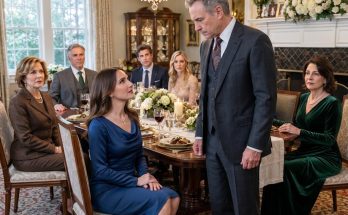
They ambushed us on a Sunday afternoon, completely unannounced. A convoy of four pristine SUVs aggressively kicked up dust in the yard, looking like a corporate delegation arriving for a hostile takeover.
My father and his new wife stepped out first. Aunt Janelle followed, balancing an enormous, foil-wrapped sheet cake on her hip. Uncle Todd, the wealthy orthodontist, had driven down from Grand Island. They marched through the front door, their hands overflowing with glass Pyrex dishes of lukewarm casseroles. It was a perfectly choreographed, theatrical delivery of warmth.
Exactly four weeks too late.
They spoke at deafening volumes, utilizing that patronizing, syrupy cadence people reserve for toddlers and the severely impaired. They complimented the cleanliness of the living room. Janelle forcibly arranged everyone around Grandpa’s recliner, snapping a staged photograph, and instantly uploading it to her megachurch’s Facebook group before the coffee pot had even finished percolating.
A truly blessed Sunday surrounded by family, caring for our beloved Dad! the caption read.
I stood silently by the kitchen counter, slipping seamlessly into my courtroom persona. I didn’t participate; I observed. I noted who strategically positioned themselves nearest the exits. I tracked how many times Todd’s eyes darted toward the locked oak filing cabinet in the corner of the den. I counted the frequency of the word paperwork surfacing in their suffocating small talk, constantly dressed up in different, casual disguises.
Grandpa received the invading force like a weary monarch granting an audience. He addressed every single person by their proper name. He inquired about the profit margins of Todd’s dental practice. He politely asked my father’s wife about her sister’s health down in Lincoln. He was so undeniably, provably lucid that I watched Todd’s medical confidence shatter in real-time. Todd’s eyes darted nervously between the diminished, senile father he had anticipated and the razor-sharp tactician currently keeping score from the recliner.
Janelle peeled the aluminum foil off a steaming dish. “We brought the tater-tot hot dish, Dad! The exact recipe Mom used to make.”
“Your mother never contaminated her hot dish with frozen tater-tots, Janelle,” Grandpa stated, his voice devoid of emotion.
The entire kitchen went dead silent for exactly two beats. It was the terrifying sound of a conspiracy hastily recalculating its trajectory.
Todd couldn’t handle the tension. He abandoned his coffee mug on the counter, laced his manicured fingers together, and instantly transformed into the authoritative Parish Council Chairman.
“Dad, let’s get down to brass tacks. We need to discuss a long-term care plan.”
And then, they unleashed the barrage. They talked about him. They talked over him. They talked around him. They discussed his failing body in the third person while he sat two feet away.
He can’t possibly survive out here in isolation.
He requires structured, institutional care. 24/7 medical supervision.
We can lease the farmland out, split the revenue clean four ways. The dirt pays for the nursing home facility. It is the only financially responsible maneuver.
Grandpa sat at the head of his own dining room table. He placed both of his massive hands flat against the polished oak, palms down—the exact posture he assumed when leaning against a fence rail to judge an incoming storm front.
He didn’t say a word. But his silence wasn’t born of weakness. It was a precise, terrifying measurement of their greed.
Only once did one of them direct a sentence at him. It was delivered by my father, using a tone dripping with toxic condescension. “Isn’t that the smartest move, Dad? Won’t it be so nice to have nurses wait on you?”
Curtis stepped forward and placed a heavy, reassuring hand squarely on Grandpa’s frail shoulder. He looked around the room, delivering a line that would echo in my nightmares for months.
“This family takes care of its own.”
I stared at that hand resting on that shoulder. I stared at the phone burning a hole in my back pocket—the phone containing a digital record of what this family actually did with ‘its own’ when the cameras were off.
This family takes care of its own, declared the man who wouldn’t drive four miles to pick up his stroke-riddled father from a loading zone.
Curtis’s hand was still resting on the wool of the coat when Grandpa began to stand.
It was a slow, agonizing process. He braced one trembling palm against the oak table, locking his knees until he achieved his full, imposing height. The chaotic chatter in the room instantly evaporated.
He delivered four short, devastating sentences. He never raised his voice above a conversational murmur.
“This is my house. The name stamped on the county deed is mine. The legal papers you are fishing for have already been signed, and they belong to me as well. Kristen is staying the night.”
He paused, his eyes sweeping over his terrified children.
“The rest of you know where the highway is.”
He turned his back on them, walked slowly down the hallway to his master bedroom, and pulled the door shut. The click of the latch was softer than a whisper, but it sounded like a gunshot in the silent house.
The chairman of the board had abruptly adjourned the meeting.
The delegation instantly swiveled their heads toward me. The theatrical warmth vanished, replaced by venom.
“You need to fix this right now,” Curtis growled, his voice dropping an octave.
“You are humiliating this family in front of the entire congregation!” Janelle hissed, her face flushed with rage.
Todd didn’t say a word, which terrified me more than the screaming. His silence was the calculated quiet of a wealthy man pricing out the cost of a ruthless litigation attorney.
I stood my ground. I did the one thing I had never, ever done at a Lindall family gathering. I didn’t try to smooth the edges.
I walked directly to the front entryway, pushed open the heavy wooden door, and held the screen wide open.
“He communicated his boundaries in complete sentences,” I said icily. “You all heard him.”
Curtis stopped on the porch steps. The charismatic salesman persona dissolved into pure, unadulterated menace.
“There are ways to handle stubborn men his age, Kristen,” he threatened softly. “Legal ways.”
They climbed into their SUVs and sped off, leaving a cloud of dust choking the lilac bushes.
I locked the deadbolt. I walked back into the kitchen and aggressively scrubbed Janelle’s hot dish pan with steel wool until the aluminum shone like a mirror. Some trauma responses die slower than others, and I desperately needed to keep my hands occupied while my spinal cord adjusted to its newfound rigidity.
A voice floated out from behind the closed bedroom door.
“We go to the bank tomorrow, Kristen. Third stop.”
And when they opened the steel vault, I realized the true depth of the betrayal wasn’t about the land at all. It was about me.