Chapter 6: The Investigation and The Ambush
They gathered, alright.
They swarmed his rehab room in highly publicized, meticulously documented shifts. Janelle taped a neon-pink visitation schedule to the church bulletin board, treating it like a community casserole rotation.
That Sunday, Gunner’s name was prominently featured on the printed prayer list, broadcasted over the loudspeakers to the entire congregation.
Pray for Gunner Lindall, that his family may be restored to him in his time of darkness.
Restored to him. Six carefully curated words. Instantly, I was recast for an audience of three hundred parishioners as the manipulative villain his family desperately needed restoring from.
The head pastor called me on Tuesday morning. His tone was as sickeningly soothing as warm milk.
“Kristen, my dear, nobody in this community doubts the purity of your heart,” the pastor purred. “But sometimes, the truly Christian, kind thing to do is to step back into the shadows. Let his rightful children take the lead.”
Cousins I hadn’t spoken to since middle school began texting me endless variations of the exact same guilt trip.
Don’t make waves, Kris.
Think of the family’s reputation.
Just let Curtis have this; he’s hurting.
Every single message acted like a needle, finding the oldest, deepest psychological groove inside me. The groove that whispered that keeping the peace was vastly more valuable than maintaining my own dignity. The groove that had been violently carved into my brain when I was fifteen, learning that the quiet, compliant girl gets to sleep indoors.
I listened to all the voicemails. I archived all the texts. I wrote every single word down. The lifelong habit of documentation had hardened into Kevlar armor.
I offered the pastor a single, load-bearing sentence. “Pastor, my grandfather still possesses a voice. It’s quiet right now, but it belongs to him. If you want the truth, I suggest you start by asking him.”
Restored to his family, the church bulletin begged. But nobody bothered to ask which specific family members were actually showing up on Tuesdays.
Tuesdays, as the universe orchestrated it, belonged to the people no neon schedule had assigned.
Dale Nyquist had claimed Thursdays. Every week, for exactly one hour, Dale sat by the bed reading the agricultural grain prices aloud from the co-op manifest. “A man ought to know what his dirt is worth,” Dale insisted, while Grandpa listened, his eyes sharp and his mouth resting in a crooked half-smile.
Beth Carlson, the discharge coordinator, swung by after her grueling shifts. No fanfare, no Facebook posts. She pulled a plastic chair close to the bed and solved the daily crossword puzzle out loud, deliberately making mistakes so Grandpa could grunt his disapproval at her wrong answers.
And at the bank, where I had gone to process some basic Power of Attorney logistics, the teller—the same woman who had morally located me on my first Monday—finalized my paperwork.
Then, she paused.
Unhurried, she slid one additional piece of paper across the marble counter, face up. It was Gunner’s primary account statement. Twenty-four months of financial history.
She pointed a manicured finger at the column where Uncle Brent’s semi-annual land lease payments were supposed to be deposited.
Blank. Blank. Blank. All the way down the ledger.
Brent hadn’t paid rent on the farmland in two solid years. The money simply ceased to exist.
“You are officially authorized on his account now,” the teller whispered, not breaking eye contact. “Which means you have a legal right to see what hasn’t been coming into it.”
She squared the edges of the paper with two fingers. “Paper doesn’t gossip, Kristen. Paper just sits there.”
Kindness, I was rapidly learning, takes more profound shapes than aluminum-wrapped casseroles. Sometimes kindness looks like reading grain prices. Sometimes it looks like intentionally failing a crossword. And sometimes, it looks like a bank teller violating protocol to slide a single, devastatingly true document across a counter.
Paper doesn’t gossip. It just sits there. I was ready to build a new religion around that philosophy. The paper sat there in the vault. The family didn’t.
Two Sundays later, Aunt Janelle ambushed me in the church parking lot. She cornered me between two dusty minivans, ensuring we were visible to the departing congregation, but out of earshot. Or so she thought.
“Do you have any concept of what this is like for us?” her voice escalated, cracking with genuine hysteria. “Half this damn county knows it was you who drove him from the hospital! They stare at me in the fellowship hall, Kristen. Every single Sunday. Do you know how humiliating that is?”
And there it was. The ugly, naked truth.
This wasn’t about seizing the land. This wasn’t even about Brent’s missing rent money. That was just Brent’s personal, greedy fever.
What the rest of the Lindall clan could not psychologically endure was the existence of a living, breathing witness.
I had never publicly accused anyone of neglect. I had simply fueled up my car and driven. And every single mile I logged on my odometer was a silent testimony that someone in the fellowship hall could read.
An elderly woman exiting the church doors paused, half-turning, her hand clutching her hat as she witnessed Janelle’s meltdown. Whatever horrific realization was plastered across my face, I watched the old woman register it.
I drove home that afternoon, my hands trembling on the wheel. As I approached the head of the farm’s driveway, my stomach plummeted.
Uncle Brent’s massive industrial skid loader had been driven through the property, allegedly “opening access” for heavier farming equipment. His lawyer would later claim it was standard procedure because “the ground is getting sold anyway.”
But the heavy rubber tracks hadn’t just cleared mud. They had driven in a perfectly straight line directly over Grandma’s lilac row.
An entire stretch of 1958 lay brutally snapped, crushed, and pressed deep into the freezing mud. Sixty-seven-year-old roots, budding with new spring life when they were mercilessly slaughtered.
I did not scream. I did not call the police. I retrieved my camera, photographed the destruction from multiple angles, and noted the exact date and time like the cold professional I had become.
Then, I did the very first thing in this entire saga that nobody had assigned me to do.
I walked to the tool shed, grabbed a pair of rusted pruning shears, and meticulously cut the surviving green slips from the shattered branches. I placed them in a bucket of fresh water on the back porch, praying they would root.
When I finally confronted Brent over the phone, he offered a careless, sociopathic shrug. “You can’t hear the ground screaming, Kristen. Dirt gets worked. Deal with it.”
They weren’t fighting me for the inheritance. They were trying to eradicate the witness. The lilacs just happened to be standing in the line of fire.
Their next tactical strike arrived taped to the front screen door in early May.
It was a formal court notice. A Petition for Emergency Guardianship of Gunner Lindall, filed aggressively by his children. All four signatures were present: Curtis, Brent, Janelle, Todd.
The petition was a masterclass in legal fiction. It alleged that I was isolating him, that he was suffering severe cognitive diminishment, and it hinted at “questionable financial transactions” executed by a granddaughter with unsupervised access to his vault.
But the kill shot was located in the sworn affidavit at the bottom of the page. One sentence, typed in bold Arial font:
We have always stood ready and willing to care for our father in his time of need.
I read the notice twice, standing on the warped wooden porch as the packing tape fluttered in the wind.
The first time I read it, I read it as a heartbroken granddaughter, and the betrayal sliced through my chest like razor wire.
But the second time I read it, I read it as a seasoned court reporter.
And on that second read, my eyes locked onto the phrase always stood ready. I felt the frantic beating of my heart slow down, shifting into a realm of pure, absolute ice.
Because I knew exactly what was currently sitting in a hospital basement archive. A call log. Verbatim quotes. Stamped with a date and time.
For the first time in my miserable existence, a legal document bearing my family’s name did not induce a panic attack.
We have always stood ready, they swore under penalty of perjury.
That sworn, fatal sentence rode in the passenger seat with me to a cramped, windowless office at the county courthouse. The judge had appointed a Guardian ad Litem—a neutral, third-party investigator tasked with answering one fundamental question: What does the incapacitated man actually require, and who is genuinely providing it?
Her name was Sandra Voss.
She wore a rigid gray blazer, wielded a yellow legal pad, and possessed handwriting that looked like tangled barbed wire. She interviewed every family member separately.
My interrogation lasted ninety grueling minutes. She asked rapid-fire, surgical questions and took extensive notes.
I didn’t argue. I didn’t cry. I simply opened my briefcase and handed over the exhibits.
The hospital discharge folder. The contact log with the four refusals. Grandpa’s preemptive February Power of Attorney designation. My meticulous mileage column. Every single faded gas receipt from the center console.
And finally, the transcripts.
Hundreds of pages of my evening sessions at the steno machine. His stories, dated and transcribed verbatim. The undeniable, legal voice of a man who was more than lucid enough to farm the memories of his own past.
Sandra Voss read in total silence for twenty minutes.
Finally, she looked up, her pen hovering. “Who sent you the text message on March 14th?”
“My father,” I said.
“Do you still have the digital file?”
“I keep everything,” I replied, my voice dead. “I transcribe for a living.”
One corner of Sandra Voss’s mouth twitched upward by a quarter of an inch. It was the closest approximation to a smile this entire nightmare had produced.
Before I left her office, she requested one final piece of evidence. The official visitor sign-in logs from both the hospital and the rehab facility. I signed the HIPAA release forms without asking why she needed them.
Paul Angstrom was handling Grandpa’s legal defense. When I nervously inquired about his hourly retainer, Angstrom waved a dismissive hand. “Your grandfather paid my invoice in advance with thirty years of exclusive access to the best pheasant hunting in Nebraska, kid. Don’t insult me.”
I didn’t launch a counter-attack. I didn’t scream at my cousins on Facebook. I submitted the evidence to the court, I waited in the shadows, and I kept driving.
I keep everything, I had told the investigator. Sandra Voss had underlined that sentence twice.
I couldn’t predict what she planned to do with the facility sign-in logs. But I knew exactly what my family was planning, because they had the audacity to print it on heavy cardstock and mail it to the farm.
It was an invitation.
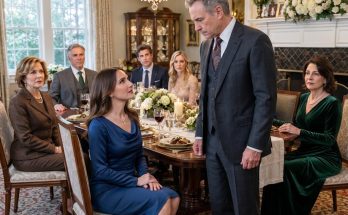
Celebrate Gunner’s 90th Birthday! May 17th. Hosted by his loving, devoted children in the Church Fellowship Hall.
The date was strategically set exactly five days before the guardianship hearing was scheduled before the judge.
Curtis was presiding as the master of ceremonies. They had invited two hundred guests from the community. But their ultimate, arrogant masterstroke?
They had officially invited Sandra Voss.
They were attempting to walk the court’s own neutral investigator through a highly choreographed, live-action performance of their sworn affidavit. Come see the family in its natural habitat, Ms. Voss! Witness the abundance of love! See how dedicated we are!
Todd personally collected Grandpa from the rehab facility that morning in his luxury SUV. It was the absolute first time any child of Gunner’s had driven him anywhere in two solid months. The timing was purely for the audience.
I had visited Grandpa the evening before the ambush. He was propped up in his mechanical bed, the battered wool coat draped reverently over the chair beside him. He used his functioning left hand to write on a dry-erase whiteboard in massive, shaky, deliberate letters. He turned the board to face me.
YOU DRIVE. I RIDE.
The pact was still intact.
Then, he reached over and tapped the breast pocket of the wool coat exactly twice. The pocket where the sealed envelope lived.
My father called me later that night. His voice radiated the artificial warmth of a closer who knows the commission check is already printed.
“Family means showing up when it counts, Kristen,” Curtis purred. “Be there tomorrow. And remember to smile for the cameras.”
He chose those exact words. Be there and smile.
For the first time in twenty-eight years, I fully intended to follow his instructions to the letter.