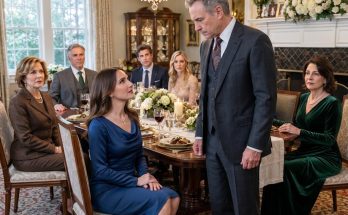
Chapter 3: The Empty Table
Saturday dawned crisp and cloudless, the quintessential Tennessee autumn day. Typically, my kitchen would be a war zone by 7:00 AM. There would be frantic lists taped to the cabinets, industrial-sized pots soaking in the sink, and the overwhelming scent of caramelized onions.
Today, the kitchen was immaculately clean and deathly silent.
I toasted a slice of sourdough, scrambled a single egg, and sat at the island, eating in profound peace.
At 7:02 AM, Rob descended the stairs, clad in faded sweatpants, his hair sticking up in chaotic tufts. He stopped at the threshold of the kitchen, his eyes darting frantically across the empty, pristine countertops.
“When are you starting?” he asked, a note of desperation creeping into his voice.
“Starting what?”
He gestured wildly at the island. “The food, Diane! The prep!”
I took a slow bite of my toast. “I’m not making any food, Rob. We discussed this.”
He stared at me, waiting for the punchline. When none arrived, he let out a hollow, terrified laugh. “You’re actually going through with this psychotic game? People are arriving at five!”
“I know.”
“Twenty people!”
“I know.”
He lunged for the refrigerator, tearing it open. Inside sat my mundane reality: half a carton of almond milk, some wilting spinach, a Tupperware of leftover rice, and three yogurts. Absolutely nothing capable of sustaining a crowd.
He slammed the door, his face flushing a deep, dangerous crimson. “So, where is the barbecue?”
“I didn’t order it.”
“Where is the cake?!”
“I didn’t order one.”
“The rental chairs?!”
“No.”
He grabbed the edge of the granite counter, his knuckles turning white. “You have completely lost your mind.”
“No,” I said, my voice dropping to a deadly calm register. “I finally found it. Three weeks ago, you looked me in the eye and told me to stop acting like a parasite on your bank account. You demanded I pay for my own existence. Now, you are throwing a tantrum because I am refusing to finance your birthday party with the money you claim I haven’t earned.”
He backed away, pointing a trembling finger at me. “Fine. I’ll handle it myself. You don’t have to lift a finger.”
I watched him march upstairs. By 8:10 AM, I could hear his muffled, frantic voice booming through the floorboards.
“No, I need it for today… What do you mean you’re fully booked?… It’s just twenty people!… Look, I’ll pay double the rush fee!”
At 9:30, he trudged back downstairs, his shoulders slumped in defeat. “Every decent caterer in a thirty-mile radius is booked solid for fall weddings.”
I didn’t look up from my laptop. “I could provide you with the numbers of the backup delis I usually rely on.”
“That isn’t helping, Diane!” he barked, grabbing his keys.
By noon, the panic had fully settled in. Rob returned from a frantic raid on the local Kroger. He dumped three crushed bags of generic potato chips, two packs of suspiciously cheap hot dogs, and a massive, industrial-sized tub of neon-yellow potato salad onto the pristine island.
He stared at his pathetic bounty, his chest heaving. “This… this isn’t enough.”
“No,” I agreed quietly. “It isn’t.”
His phone buzzed. It was his older brother, Mark. I could hear Mark’s booming voice through the receiver. “Hey Robbie! We’re hitting the highway now. Mom said you guys have everything locked and loaded!”
Rob swallowed hard, shooting a panicked glance at the hot dogs. “Yeah, Mark. Everything’s… it’s good to go.”
He hung up, the lie hanging thickly in the air.
At 4:45 PM, I descended the stairs wearing a simple navy silk blouse and tailored slacks. Rob was pacing the foyer, sweating through his polo shirt.
“Please, Diane,” he begged, his arrogance completely shattered. “Please don’t make this weird. Just act normal.”
“I am acting completely normal,” I assured him.
At exactly five o’clock, the doorbell chimed. Mark and his wife burst through the door, carrying a massive wrapped box and a bottle of expensive bourbon. Evelyn followed closely behind, trailed by Linda and a swarm of restless teenagers.
Within twenty minutes, the house was packed. Twenty relatives were milling about the living room, holding wrapped gifts and expecting the legendary scent of slow-smoked hickory brisket to waft from the kitchen.
Instead, the house smelled faintly of my morning coffee and the sharp tang of artificial mustard from the potato salad tub.
Linda wandered into the kitchen, her eyes scanning the empty counters. “Hey, Rob? Where’s the famous brisket setup?”
Rob offered a laugh so tight it sounded like a cough. “Oh, it’s… it’s coming. Minor delay.”
Linda raised an eyebrow, looking at me. I offered a serene, polite smile. “Happy birthday, Rob,” I said smoothly, stepping out of the kitchen and taking a sip of my sparkling water.
By 5:40 PM, the atmosphere had shifted from festive to restless. The generic chips had been devoured. The hot dogs, boiled hastily by Rob, were gone. Someone’s toddler was crying for a juice box that didn’t exist.
One by one, like moths drawn to a dying flame, the relatives drifted toward the kitchen, seeking answers.
I stood near the dining room archway, watching the spectacle unfold. Twenty people had formed a tight circle around the massive, empty island. No chafing dishes. No ice buckets. No cake. Just a graveyard of empty Kroger bags.
Rob stood trapped in the center of his family. Evelyn looked bewildered. Mark crossed his arms, his brow furrowed.
“Robert,” Evelyn finally asked, her voice trembling slightly. “Where on earth is the dinner?”
Rob didn’t look at his mother. He looked directly at me, his eyes wide with a mixture of terror and fury. He took a threatening step forward. “What did you do?” he hissed.
The entire room went dead silent. The only sound was the hum of the refrigerator.
I set my glass down. “I didn’t do anything, Rob. That is precisely the point.”
“You knew they were coming!” he exploded, his voice echoing off the tile. “You knew there was no food!”
“Yes.”
“Why?!”
I took a deep, centering breath. I looked at the twenty faces staring at me—the people who had spent decades assuming my invisible labor was a naturally occurring phenomenon.
“Because,” I said, my voice carrying clearly through the tension, “you explicitly ordered me not to pay for your things.”
Rob’s jaw locked. “This isn’t about that!”
“It is to me.”
Evelyn stepped between us, her hands fluttering anxiously. “What… what did Robert tell you, Diane?”
Before I could answer, Rob panicked. “Mom, drop it. This is not the time or place for her theatrics.”
But Evelyn wasn’t deterred. She fixed her gaze on me. “What did he say to you?”
I looked at my husband, offering him no mercy. “He told me, ‘Don’t expect me to pay for anything of yours. Be independent. Stop living off me.’”
A collective gasp sucked the oxygen from the room. Mark stared at his younger brother in sheer disbelief. “Rob… you actually said that to your wife?”
Rob’s face flushed a violent, mottled purple. “I… I didn’t mean it like this!”
“Then what did you mean?” I challenged, stepping into the light.
He opened his mouth, but no words materialized. For the very first time in our marriage, the family wasn’t looking at me to magically fix the crisis. They were looking at him to explain the cruelty. And in that terrifying silence, the truth became undeniable: the empty table wasn’t the humiliating part.
The humiliating part was that everyone finally realized whose shoulders had been breaking to keep it full.