Chapter 9: The Reckoning
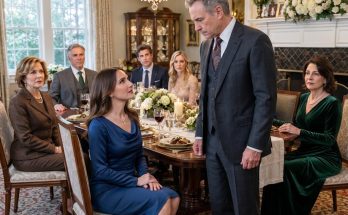
Sunday evening arrived. The dining table was set with our finest China, the silver polished to a blinding shine.
Judith sat at the head of the table, looking uncomfortable but resolute. Harold sat beside her, his eyes fixed firmly on his lap. Steve and Karen sat across from me, radiating a nervous energy that was practically humming. Mark sat directly to my right, pouring a robust Cabernet.
For the first twenty minutes, it was a masterclass in American suburban denial. Judith complained about the hospital food. Mark lamented the rising cost of property taxes. Steve forced a joke about Harold’s driving. Everyone offered hollow, polite laughter.
As Mark reached for the bread basket, I reached beneath my chair.
I pulled out a thick, black leather folder and dropped it squarely onto the center of the table with a heavy thud.
The polite laughter died instantly. The silence was absolute.
“What is that?” Mark asked, his hand hovering over the rolls.
I didn’t look at the folder. I looked at the man who had promised to love me. “Answers.”
His practiced smile vanished.
I unclasped the folder. First, I pulled out the independent laboratory report, sliding it toward Judith. “A chemical analysis of the chicken soup you served me last week. Positive for a heavy Class IV cognitive suppressant. The exact drug that causes severe dizziness and memory loss.”
Judith’s hand trembled, but she didn’t touch the paper.
Next, I pulled out the life insurance policy, sliding it toward Mark. “A two-million-dollar policy, with a forged signature, taken out two months before I started feeling sick.”
Mark’s chair scraped violently against the hardwood as he half-stood. “Diane, what the hell is this?”
“Sit down, Mark,” Harold commanded. His voice wasn’t weak; it was the boom of a patriarch who had finally found his spine. Mark froze, looking at his father in shock, and slowly lowered himself.
I pulled out the guardianship research printouts from Judith’s files and laid them out like a royal flush. “And the legal framework to declare me medically incompetent, ensuring Mark would gain immediate control of my estate before I even died.”
Karen gasped, covering her mouth with both hands. Steve stared at his brother with an expression of pure, unadulterated disgust.
“This is insane,” Mark stammered, his face pale, sweat beading on his forehead. “You’re having another episode, Diane. You’re paranoid. These documents are… they’re fake. You’ve lost your mind!”
I picked up the television remote. “Let’s see if my mind made this up.”
I hit a button, and the seventy-inch television on the living room wall flared to life, mirroring Steve’s hidden camera footage.
Judith and Mark’s voices filled the house.
“Once she starts forgetting things more often, we can move forward. I want her equity liquidated by Christmas.”
The color drained from Judith’s face entirely. She looked like a ghost. Mark stared at the screen, his mouth opening and closing like a suffocating fish, unable to formulate a single syllable of defense.
“This proves nothing,” Mark finally choked out, his voice cracking. “You don’t know the whole story. You’re taking it out of context!”
“Actually, we know the whole story.”
Everyone whipped their heads toward the entryway. Tom Reynolds stood in the archway, holding a badge wallet and a small digital recorder.
Mark jumped up. “Who the hell are you? Get out of my house!”
“I’m a private investigator hired by the homeowner,” Tom replied calmly, stepping into the dining room. “And before anyone calls their lawyer, there’s one more piece of evidence you need to digest.”
Tom pressed play on his device. It was an audio file recovered from Judith’s own digital backups—the ultimate insurance policy she had kept against her own son.
Mark’s voice, panicking: “Mom, what if the toxicology comes back? What if the cops look at my brokerage accounts? They’ll know I needed the money.”
Judith’s voice, cold as ice: “Then we deny everything. We say she’s a hysterical, menopausal woman who bought the drugs herself for anxiety and accidentally overdosed. She’s crazy, Mark. We just have to stick to the story.”
The recording clicked off. The silence that followed was heavier than a tomb.
Harold stood up slowly, bracing his hands on the table. He didn’t look at his son. He looked directly at the woman he had been married to for fifty years.
“How long, Judith?” Harold’s voice shook with a devastating mix of sorrow and rage.
She stared at the tablecloth, her jaw locked.
“I spent half a century defending your cruelty,” Harold whispered, tears spilling over his wrinkled cheeks. “I told myself you were just strong-willed. Protective of this family. But there is no protection here. You are evil.”
Judith raised her chin, defiance flashing in her eyes for one final moment. “I did what was necessary to save our son from ruin.”
“You tried to murder my wife,” Steve spat, his voice shaking with fury, standing up to shield Karen. “You’re a monster, Mom.”
Tom stepped forward, pulling a folded piece of paper from his jacket. “We also pulled the carrier logs for a burner phone purchased three days ago. The same phone that sent a death threat to Diane. The purchase was made with a credit card registered to Judith Foster.”
Judith closed her eyes. Checkmate.
The flashing red and blue lights illuminated our dining room windows twenty minutes later. There were no dramatic arrests, no shouting matches, no grand monologues. Just the quiet, methodical clicking of handcuffs, the reading of Miranda rights, and the heavy thud of the front door closing as Mark and Judith were escorted out to separate squad cars.
Before stepping out the door, Mark stopped. He turned to look at me, flanked by two uniformed officers. His eyes were red, the arrogance stripped away, leaving only a broken, terrified boy facing decades in federal prison.
For a fleeting second, I saw the man I had married. The man who had danced with me in our first apartment. The man who had held me when my father died.
“I’m sorry, Diane,” he whispered.
And the tragic part was, I think in that exact moment, he genuinely meant it.
I looked at him, feeling nothing but a profound, hollow pity. “I’m sorry too, Mark. I’m sorry I ever believed I knew you.”
I turned away before he was led into the night.
Epilogue: The Cleared Fog
The aftermath of a hurricane is never clean. People watch movies and assume that once the villain is vanquished in the grand climax, the hero immediately lives happily ever after. The reality is far messier.
There were still mornings I woke up in cold sweats, my heart racing, convinced I was dizzy, convinced the poison was still in my veins. There were days of grueling depositions, endless meetings with lawyers, and the emotional exhaustion of dismantling a twenty-six-year marriage piece by piece.
But the fog in my mind—the literal, chemical fog, and the emotional fog of being gaslit—finally cleared.
Harold filed for a divorce immediately following Judith’s indictment. He sold the house on Geist Reservoir, moved to a quiet condo in Florida, and spent his remaining years trying to make amends for a lifetime of silence. “Silence doesn’t keep the peace, Diane,” he told me the day he left. “It just builds a fortress for the wrong people.”
Steve and Karen remained a steadfast support system, though the trauma of what their family had done fractured them deeply.
As for me, I sold the sprawling brick ranch in Carmel. The walls held too many ghosts. With the proceeds, and my untouched assets, I bought a small, sunlit cottage nestled in the rolling hills of Brown County, Indiana. It isn’t grand. It doesn’t impress anyone. But it has a wraparound porch, a sprawling garden where I grow my own herbs, and, most importantly, it is entirely mine.
I spend my mornings painting in the sunroom. I volunteer at the local library. I breathe clean air.
Looking back at that Sunday dinner, I realize the most profound change didn’t happen because I swapped two bowls of soup. It didn’t happen because I outsmarted a sociopathic mother-in-law or exposed a desperate husband.
It happened because, for the first time in my life, when that tiny, quiet voice inside my gut whispered that I was in danger, I didn’t ignore it. I didn’t rationalize it away to keep the peace. I stood up, I fought back, and I saved my own life.
And that is a victory no one can ever steal from me again.
Like and share this post if you find it interesting, and trust your instincts—they might just save your life.