PART 3 — WHAT MY GRANDFATHER HAD LEFT BEHIND
The next morning, Dalton called.
“Come to my office.”
I went immediately.
He placed a small envelope on the desk.
“Your grandfather left instructions.”
“For me?”
“Yes.”
I opened it.
Inside was a letter.
The handwriting was unmistakable.
My grandfather.
I hadn’t seen it in years.
I read the first line.
If you are reading this, something has gone very wrong.
I stopped breathing for a moment.
Dalton remained silent.
I continued.
My grandfather explained that he had created the trust because he knew my father had repeatedly asked him for financial assistance.
He had refused.
Not because he hated my father.
Because he believed my father had become too dependent on other people’s resources.
The letter continued.
The house is not a reward. It is protection.
My eyes burned.
Grandpa had written that he wanted me to have one place in the world that nobody could take from me simply because they believed they deserved it more.
Then came the sentence that changed everything.
If Richard ever asks you to sign anything concerning the property, do not sign it without independent legal advice.
Dalton looked at me.
“He knew.”
“He suspected.”
The next page contained instructions for the trustee after his death.
The trust required that no transfer, sale, mortgage, or encumbrance could occur without my independent written consent.
Not my father’s.
Not my mother’s.
Not my sister’s.
Mine.
There was also a clause requiring the trustee to notify me personally of any attempt to change the property’s legal status.
That explained why Dalton had found the recent filings suspicious.
Someone had tried to bypass procedures.
And they had failed.
Then I noticed one final paragraph.
If anyone attempts to remove you from the property by force or deception, document everything. Do not fight them emotionally. Let the records speak.
I smiled through my tears.
“That sounds like him.”
Dalton nodded.
“He knew your family.”
“Better than I realized.”
Then he gave me the final piece.
A second envelope.
This one contained an old photograph.
My grandfather stood in front of the house with me when I was nineteen.
On the back, he had written:
One day this will be yours. But more importantly, one day you’ll understand why.
I folded the photograph carefully.
Then my phone rang.
My father.
I answered.
“What?”
His voice was cold.
“You need to come home.”
“Why?”
“Because your sister is moving forward with the house.”
“She can’t.”
“We already have the paperwork.”
“No.”
Silence.
Then:
“You’ve been talking to lawyers.”
“Yes.”
“You had no right.”
I almost laughed.
“My house. My right.”
“You’re going to regret this.”
“No.”
I said it quietly.
“I think you are.”
He hung up.
An hour later, investigators arrived at the house.
I wasn’t there.
That was intentional.
They met with my parents, Chloe, and Vance.
According to the later report, my father insisted that I had authorized the transfers.
Then investigators asked him a simple question.
“Where is the original power of attorney?”
He couldn’t produce it.
“Who notarized it?”
He named a notary.
The notary was contacted.
She denied witnessing my signature.
Then investigators asked Chloe about the $45,000.
She claimed she didn’t know.
Vance claimed it was repayment for expenses.
Then they showed him the bank records.
The money had been transferred directly into his personal account.
The story changed.
He said it was a loan.
Then they asked for the loan agreement.
There wasn’t one.
My mother finally broke down.
She admitted that she had known my father was preparing documents.
She said she believed the house would be transferred voluntarily.
Investigators asked:
“Why was the power of attorney signed while your daughter was deployed?”
My mother had no answer.
Then came the question that broke the entire family apart.
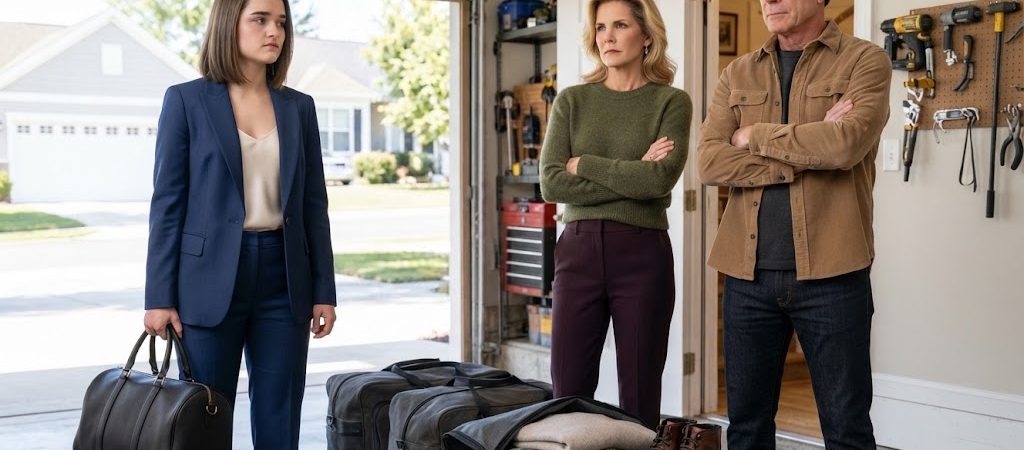
“Why did you move her belongings into garbage bags?”
My mother started crying.
Chloe suddenly stood.
“This is ridiculous!”
One investigator looked at her.
“Sit down.”
She did.
The house became silent.
The evidence was no longer theoretical.
It was sitting in front of them.
Bank records.
Forged signatures.
False filings.
Attempted financing.
Unauthorized property changes.
Everything they had done while I was overseas had left a trail.
That evening, I received another call.
Captain Morales.
“They’ve confirmed enough to begin formal proceedings.”
“What happens now?”
“That depends on the civilian investigation.”
I nodded.
Then she said:
“There’s something else.”
“What?”
“Your father contacted someone about your promotion.”
My heart sank.
“What did he say?”
“He claimed you were unstable after deployment and financially irresponsible.”
I closed my eyes.
So that was the threat.
He wasn’t only trying to steal my property.
He was trying to damage my career if I resisted.
Captain Morales continued.
“We documented the communication.”
I exhaled.
“Thank you.”
Then she said:
“Don’t let them provoke you.”
“I won’t.”
That night, I went home.
For the first time, the house was quiet.
My sister’s decorations were still on the walls.
Her shoes were still near the stairs.
My belongings were still stuffed into trash bags.
I picked up one bag.
My old PT shirts were inside.
I took them out one by one.
Then I found a small object at the bottom.
A photograph.
My grandfather.
I sat on the basement floor and held it.
And for the first time, I cried.
Not because they had tried to steal the house.
Because I finally understood what Grandpa had been trying to protect.
He wasn’t protecting a building.
He was protecting me from becoming trapped in the same cycle that had controlled our family for decades.
The next morning, everything changed.