PART 3 — THE BOX
The ceremony had been beautiful.
At least that was what Caleb said.
Flowers lined the aisle.
Clara wore an ivory gown.
Daniel wore a dark suit.
Guests applauded.
Photographs were taken.
Then came the reception.
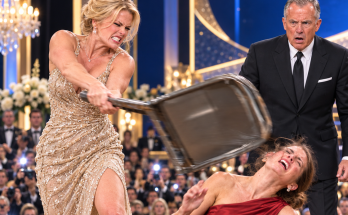
Daniel stood beside Clara beneath a wall of white roses.
They looked happy.
Or at least they looked like people who had convinced themselves happiness was permanent.
The boys waited until dinner ended.
Then Caleb approached the microphone.
“Dad,” he said, “we brought you something.”
Daniel smiled.
“I knew you boys wouldn’t forget me.”
Caleb looked at him.
“We could never forget you.”
The room quieted.
Caleb carried the wooden box to the table.
“It took me months to make this.”
Daniel touched the lid.
“What is it?”
“Our family.”
A few guests smiled.
Clara leaned closer.
Daniel opened the box.
The first thing he saw was an old photograph.
It showed Daniel at the hospital the day Caleb was born.
He was twenty-six years old.
Exhausted.
Smiling.
Holding his newborn son.
Underneath the photograph was a card.
YOU SAID THIS WAS THE BEST DAY OF YOUR LIFE.
Daniel stopped breathing for a moment.
He picked up another.
Daniel and Noah on a bicycle.
Caption:
YOU SAID YOU WOULD TEACH US HOW TO STAY UPRIGHT.
Another.
Daniel and Eli sleeping on a couch.
YOU SAID WE WERE WORTH LOSING SLEEP FOR.
Another.
Daniel holding Mason after a soccer match.
YOU SAID WE WERE YOUR TEAM.
Then Lucas.
Then Owen.
Then Ben.
Seven photographs.
Seven memories.
Seven promises.
And behind them, seven envelopes.
Daniel opened the first.
Inside was a school drawing Caleb had made at age six.
A little house.
A mother.
A father.
Seven children.
At the bottom:
MY FAMILY.
Daniel’s hands began to shake.
Clara noticed.
“What is this?”
Caleb turned to her.
“It’s what he said we were.”
Clara frowned.
Daniel opened the second envelope.
A handwritten note from Noah.
Dad, you taught me that when something matters, you don’t walk away when it becomes difficult. I believed you.
Daniel closed his eyes.
The room had become completely silent.
Third envelope.
Eli’s report card.
A note beside it:
Dad came to every parent-teacher meeting until he decided seven children were too complicated.
Fourth envelope.
A photograph from Mason’s championship.
Fifth.
A picture of Lucas in the hospital after breaking his arm.
Sixth.
A drawing from Owen:
Daddy is my hero.
Seventh.
A tiny note written by Ben.
The spelling was uneven.
Daddy come home.
Daniel stared at it for a long time.
Then he began to cry.
But Caleb wasn’t finished.
There was one final envelope.
Larger than the others.
Daniel opened it.
Inside was a printed timeline.
Not of the marriage.
Of his choices.
18 YEARS — WHAT YOU GAVE, WHAT YOU TOOK, WHAT YOU LEFT
Birth of Caleb.
Birth of Noah.
Birth of Eli.
Birth of Mason.
Birth of Lucas.
Birth of Owen.
Birth of Ben.
Every major milestone was listed.
First words.
First steps.
Graduations.
Hospital visits.
Soccer championships.
Broken bones.
Christmas mornings.
School plays.
Parent-teacher conferences.
Each year Daniel had once been present.
Then, near the end:
DAY 1 — DAD SAID LIFE WITH SEVEN SONS WAS TOO COMPLICATED.
DAY 23 — DAD MISSED NOAH’S SCHOOL AWARD.
DAY 41 — DAD CANCELED DINNER WITH ELI.
DAY 65 — DAD MOVED IN WITH AUNT CLARA.
DAY 89 — DAD ANNOUNCED THE WEDDING.
And finally:
TODAY — DAD MARRIES THE WOMAN HE CHOSE BECAUSE SHE HAD NO CHILDREN.
Daniel looked up.
Caleb stood across from him.
“I didn’t make this to embarrass you.”
Daniel’s eyes were red.
“Then why?”
“Because one day, when you’re old, you’re going to tell yourself a story.”
Daniel said nothing.
“You’re going to say you had no choice.”
Caleb’s voice remained steady.
“You’re going to say the marriage was bad. You’re going to say life was complicated. You’re going to say Mom pushed you away. You’re going to say you deserved another chance.”
Caleb placed one last item on the table.
A digital tablet.
He pressed play.
A montage began.
Daniel at the hospital.
Daniel at birthdays.
Daniel at Christmas.
Daniel teaching bicycles.
Daniel holding babies.
Daniel laughing with all seven boys.
And then came a recording from eighteen years earlier.
Daniel’s own voice.
“If I ever become the kind of father who walks away, don’t let me make excuses. Hold me accountable.”
The room went silent.
Daniel covered his face.
Clara whispered,
“Where did you get that?”
Caleb answered,
“From our old tapes.”
She stared at Daniel.
“You said that?”
Daniel didn’t respond.
Clara looked back at the screen.
One by one, guests lowered their eyes.
The man who had wanted a simpler life suddenly had nowhere to hide from the complicated truth.
Caleb leaned down.
“You can keep the box.”
Daniel looked up.
“Caleb…”
“No.”
Caleb shook his head.
“We’re not asking you to choose us tonight.”
Daniel cried harder.
“Then what do you want?”
Caleb’s answer was simple.
“We want you to stop pretending you didn’t choose.”
Then the boys walked away.
But there was something inside the box Daniel hadn’t noticed.
A sealed envelope.
On the front were six words.
OPEN THIS WHEN YOU ARE READY.
Daniel didn’t open it that night.
He took the box home.
Three days later, Clara found him sitting on the floor of their new living room.
The wooden box was open.
The envelope was still sealed.
She looked at him.
“You should read it.”
Daniel whispered,
“What if I don’t like what it says?”
Clara answered,
“Maybe that’s the point.”
He opened it.
Inside was a single letter from Caleb.
And it changed everything.
PART 4 — THE LETTER FROM HIS OLDEST SON
Daniel read the letter alone.
It began:
Dad,
I am not writing this because I hate you.
I am writing it because I remember you before you became the man who left.
Daniel stopped.
He wiped his eyes.
The next paragraph continued.
You once told me that being a father meant staying when things were hard. You told me that love wasn’t something you said when everything was easy. You said love was what you did on the days when you were tired, frustrated, broke, scared, or angry.
Daniel lowered the letter.
Those had been his words.
Words he had forgotten.
Caleb hadn’t.
You taught us those lessons, Dad. Then you broke every one of them.
Daniel began to cry again.
I don’t expect you to come back to Mom. I don’t even know if Mom would let you. And I don’t expect my brothers to forget what happened.
But someday, when we’re adults, we will remember what you did.
Not because we want to punish you.
Because what fathers do becomes part of their children’s lives.
Daniel stared at that line.
He read on.
You said life with Aunt Clara would be simpler. Maybe it is.
Maybe a house with no children is quieter.
Maybe dinner without seven interruptions is easier.
Maybe nobody asks you for money, rides, help with homework, a ride to practice, or a glass of water five minutes after you sit down.
But Dad, those things were never the cost of having us.
They were the proof that you had us.
Daniel covered his mouth.
Then he read the final paragraph.
So here is your wedding gift.
Not the box. Not the pictures. Not the recordings.
The gift is the truth.
You are going to spend the rest of your life knowing exactly what you traded for “simple.”
At the bottom was one final sentence.
And if you ever come back into our lives, come back because you have learned how to stay—not because you suddenly miss what you lost.
Daniel folded the letter.
That night, Clara confronted him.
“Do you regret marrying me?”
Daniel looked at her.
“I regret the way I left.”
“That isn’t what I asked.”
He remained silent.
Clara’s face hardened.
“You told me we were starting over.”
“We were.”
“No.”
She shook her head.
“You were escaping.”
Daniel looked away.
“You wanted a life without noise. Without responsibilities. Without seven children.”
“I was unhappy.”
“You were overwhelmed.”
“Maybe.”
“And now?”
Daniel looked toward the wooden box.
“Now I’m alone in a full house.”
Clara laughed bitterly.
“You wanted simplicity. You got it.”
“What do you want from me?”
“I want you to stop looking at me like I’m the reason you destroyed your family.”
Daniel said nothing.
Clara walked closer.
“You made the choice.”
“I know.”
“Then live with it.”
The wedding lasted less than a year.
Not because of one dramatic explosion.
Because the simplicity Daniel had imagined was hollow.
Clara had no children.
But she had expectations.
She wanted dinners out.
Trips.
Freedom.
A husband who was emotionally present.
Daniel discovered that removing seven children from his house did not remove his loneliness.
It only made it louder.
He began missing birthdays.
Not because he wasn’t invited.
Because the boys were increasingly reluctant to see him.
He attended Noah’s graduation.
Noah shook his hand politely.
“Congratulations,” Daniel said.
“Thank you.”
Daniel expected a hug.
None came.
Eli barely spoke to him.
Mason refused to take a family photograph.
Lucas accepted a birthday present and said,
“You don’t have to buy me things.”
Owen asked whether Dad was coming to his school performance.
Daniel said yes.
He didn’t.
That was the moment Caleb finally stopped defending his father.
Meanwhile, our own household slowly changed.
The boys grew older.
They helped me rebuild our finances.
Noah learned to cook.
Eli started repairing things around the house.
Mason took care of the younger boys.
Lucas became protective of Ben.
Owen joined a music program.
Caleb graduated from high school and took a scholarship to study engineering.
Life did not become easy.
But it became ours.
Then, nearly two years after Daniel left, I received a phone call.
It was from a hospital.
Daniel had collapsed at work.
I went because, despite everything, I couldn’t ignore the fact that he was their father.
He looked smaller in the hospital bed.
Older.
Fragile.
He opened his eyes when I entered.
“You came.”
“Yes.”
“Why?”
“Because you have seven sons.”
He looked down.
“Will they come?”
“I don’t know.”
He closed his eyes.
Later that night, I called Caleb.
I told him Daniel was in the hospital.
There was a long silence.
Then Caleb asked,
“Does he want us there?”
“Yes.”
“Does he need us?”
“Yes.”
Another silence.
Finally, Caleb said,
“We’ll come.”
All seven boys arrived the next morning.
Daniel cried when he saw them.
Even the boys who had been distant stood beside the bed.
Daniel looked at each one.
“I was wrong.”
No one spoke.
“I thought leaving would make my life easier.”
He looked at Caleb.
“It didn’t.”
He looked at Noah.
“I thought I could become a different person somewhere else.”
He looked at Eli.
“I was still me.”
His voice shook.
“I hurt all of you.”
Mason crossed his arms.
“Yes.”
Daniel nodded.
“I know.”
Then he looked at me.
“I hurt you the most.”
I said nothing.
He took a deep breath.
“I don’t deserve forgiveness.”
Caleb answered quietly,
“Not yet.”
Daniel nodded.
“That’s fair.”
Caleb pulled a chair closer.
“But you can earn trust.”
Daniel looked up.
“How?”
Caleb said,
“Start by showing up.”
It was the simplest sentence anyone had spoken to Daniel in two years.
And it was the hardest promise he had ever been asked to keep.