PART 5 — WHAT A MARRIAGE REALLY WAS
The next morning, I sat at the kitchen table with the photograph in front of me.
I had spent sixty years believing our wedding began with a kiss.
Now I learned it began with a warning.
Adrian returned with the final file.
“This is everything Irene wanted you to have.”
“Everything?”
“Everything.”
He placed a handwritten statement beside the photograph.
It was from Irene’s mother.
Her name was Margaret.
The woman Irene had believed was dead.
I began reading.
Walter,
By the time you read this, I will be gone again, just as I disappeared when Irene was young.
But before I leave you with the truth, I want you to know something about the day you married my daughter.
My hands tightened.
I watched from the back of the church.
I remembered that day.
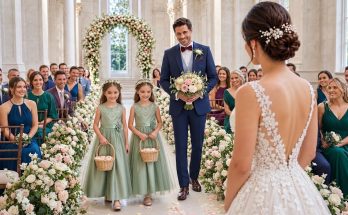
A church with wooden floors.
Summer heat.
A broken fan.
My friends teasing me because I was sweating through my shirt.
Irene turning around before the ceremony and smiling at me.
I had never known there was another pair of eyes watching.
Margaret continued:
Irene wanted to register the marriage.
She had the papers.
She had signed them.
But I told her not to.
Why?
The next sentence answered it.
Victor was still alive.
I already knew that.
But there was more.
And he was looking for you.
Margaret had discovered that Victor had put my name into his ledger.
Why?
Because Victor intended to use me.
He knew Irene loved me.
He knew I had no idea about her past.
He planned to approach me and tell me that Irene had married him and stolen family money.
He wanted money from me.
If I refused, he intended to make the family secret public.
Margaret believed the legal marriage would give Victor additional leverage.
So she gave Irene a cruel choice.
She could tell me everything.
Or she could leave the papers unfiled and keep our relationship legally invisible.
Irene chose the second.
But Margaret’s letter contained another revelation.
Irene believed that one day she would tell you.
She never did.
At first, she stayed silent because of Victor.
Then because of Samuel.
Then because of the people who remained from your father’s criminal network.
Eventually, she stayed silent because sixty years had passed and she could not bear to destroy the life you believed you had lived.
I lowered the letter.
“She should have told me.”
Adrian nodded.
“She knew.”
“And her mother?”
“Margaret blamed herself.”
There was one more page.
Walter,
If I failed my daughter by teaching her that silence was protection, then I am asking you not to repeat my mistake.
I read that twice.
Then:
Tell Emily everything.
Tell the grandchildren everything.
Let them know that fear can protect a person for a night, but it can also become a prison for a lifetime.
I looked at Adrian.
“That’s why Irene told me all this?”
“Yes.”
“Not because she wanted forgiveness.”
“No.”
“Then what did she want?”
He answered:
“She wanted the truth to belong to you.”
That sentence stayed with me.
For six decades, Irene had chosen what I was allowed to know.
Now she was finally giving that choice back.
I spent the next several weeks going through everything.
I read every letter.
Listened to every recording.
Studied every photograph.
The more I learned, the less simple my anger became.
I learned that Irene had spent years quietly paying for the education of two children whose names were connected to Victor’s victims.
I learned that she had anonymously helped an elderly woman whose husband had lost his business because of the stolen-car ring.
I learned that in 1993, after Samuel died, Irene had finally contacted a lawyer about making our marriage legal.
She had even filled out the forms.
Then she stopped.
I found the unfinished application inside her desk.
At the bottom of the page, she had written:
How do I tell the man I love that I have been afraid of the truth for thirty years?
She had never mailed it.
I sat there staring at that sentence.
For the first time, I understood something painful.
Irene had not stayed silent because the lie was easy.
The lie had become harder every year.
She had simply become more afraid of the moment when the truth would finally have to be spoken.
And that moment never came while she was alive.
I was angry with her for that.
I still am.
Some wounds don’t disappear simply because you understand where they came from.
But anger was no longer the only thing I carried.
One Sunday, I went to the cemetery alone.
I brought two flowers.
One for the grave.
One for the little girl Irene had once been.
I sat beside her headstone.
The stone said:
IRENE MARGARET WALKER
I looked at the name.
Legally, “Walker” had never been hers through our marriage.
But that was the name she had used for sixty years.
Our children carried it.
Our grandchildren carried it.
Every Christmas card.
Every family photograph.
Every birthday.
Every memory.
That name had become her home.
“Irene,” I said softly, “I found out the truth.”
The wind moved through the trees.
“I was angry.”
I paused.
“I am still angry.”
Then I smiled.
“But you were wrong about one thing.”
I put my hand against the stone.
“You didn’t have to be afraid of me.”
For a moment, I could almost hear her answer.
Of course she’d say:
I know that now.
I stayed there until sunset.
When I returned home, Emily was waiting for me.
She had brought the grandchildren.
The house was full.
Noise everywhere.
Children running.
Someone laughing.
A spoon falling onto the floor.
Music playing.
The exact opposite of the silence that had filled the house after Irene died.
Emily handed me a fresh cup of coffee.
I looked at it.
“Milk?”
“And one teaspoon.”
I smiled.
“Your mother trained you well.”
Emily laughed.
We sat together around the kitchen table.
For years, I had believed Irene was the center of our family.
But that evening, I realized she had not left me with an empty house.
She had left me with people.
Our children.
Our grandchildren.
The stories.
The photographs.
The lessons.
Even the painful truth.
And perhaps that was why her final letter had been divided into five parts.
She wasn’t asking me to rewrite our life.
She was asking me to see all of it.
The first part was the shock.
The second was the fear.
The third was the hidden past.
The fourth was the betrayal.
The fifth was forgiveness.
Not forgiveness of what happened.
Forgiveness of the people who had been afraid.
Months later, I framed one thing in my living room.
Not our wedding certificate.
Not the legal documents.
Not the newspaper clippings.
I framed a photograph.
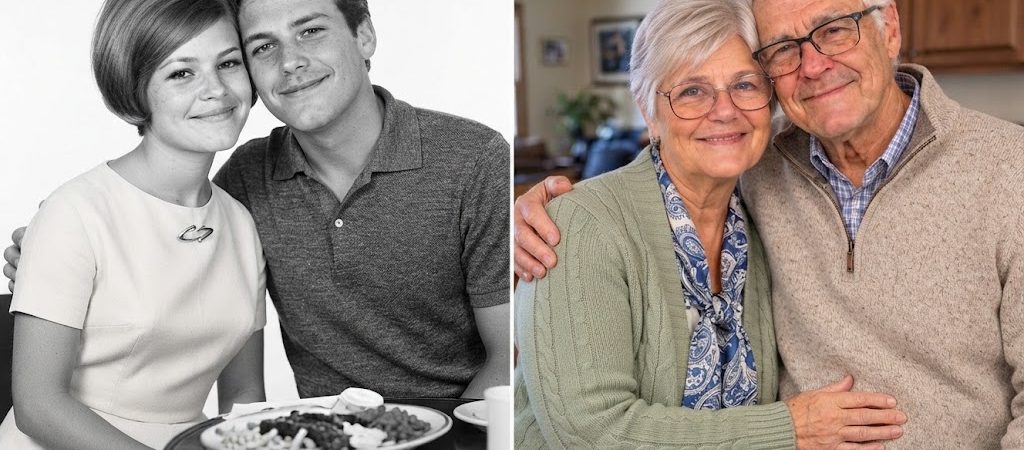
It was the oldest photograph in Irene’s box.
Taken the night we met.
We were standing outside that little restaurant.
Irene had her hair tied back.
I was wearing the only decent jacket I owned.
We were both laughing.
On the back, in Irene’s handwriting, were seven words:
This was the day I chose my real husband.
I looked at it for a long time.
Then I hung it above the fireplace.
People occasionally ask me now how long Irene and I were married.
I know what the law would say.
I know what a county record would say.
I know what a courthouse database would say.
But I answer differently.
“Sixty years.”
Sometimes they smile.
Sometimes they ask about the legal marriage.
And I tell them the truth.
“There wasn’t one.”
Then I tell them about the woman who loved me enough to spend sixty years afraid that the truth would destroy us.
And I tell them something else.
Love does not make every lie right.
A lifetime cannot erase a betrayal.
But neither can a missing piece of paper erase a lifetime.
Irene was never legally my wife.
That is the truth.
And she was my wife every day of the sixty years we shared.
That is also the truth.
The two things can exist together.
On the anniversary of the day we met, I made two cups of coffee again.
Black, no sugar for me.
Milk and one teaspoon for Irene.
I put hers on the empty chair.
Then I sat across from it.
“I forgive you,” I said.
The house was quiet.
But this time, it didn’t sound like a tomb.
It sounded like a home that had finally learned the truth.
And for the first time since Irene died, I didn’t feel alone.
Because after sixty years together, I finally understood what she had spent her entire life trying to tell me:
A marriage can be written on paper.
A marriage can be witnessed in a church.
A marriage can be recognized by the law.
But a life together is made in thousands of ordinary choices.
And Irene had chosen me every single day.
Even on the days when fear made her choose silence.
Even on the days when the truth was too heavy to speak.
Even in the final days of her life, when she knew she was leaving me behind.
She chose one last thing for me.
Not silence.
Not protection.
Not another lie.
The truth.
And that was the final gift my wife ever gave me.