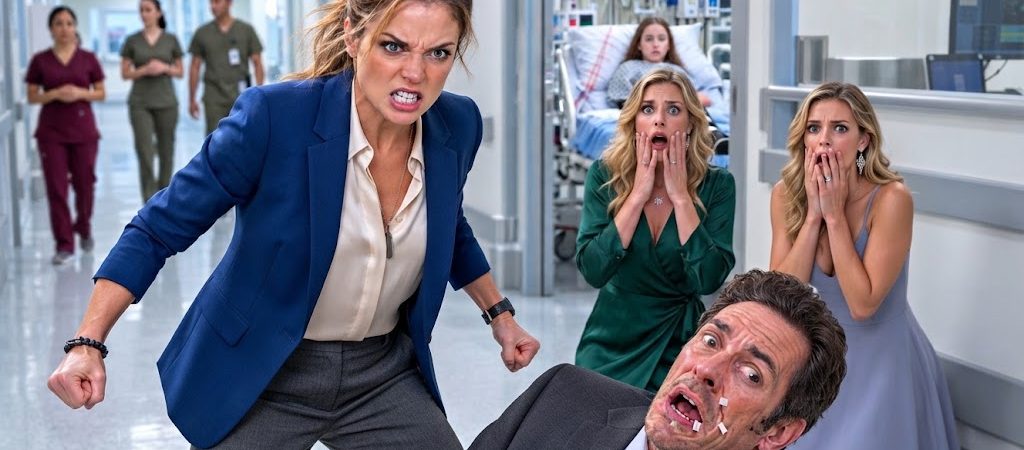
Chapter 6: The Forensic Truth
Days bled into a blur of medical charts and legal briefings. Finally, Elise was discharged into my sole physical custody. The road ahead was a mountain range of orthopedic follow-ups, aggressive pain management tapers, and grueling physical therapy.
Our first night back in my quiet, suburban house, she was a bundle of raw nerves. She asked me to leave the harsh overhead hallway light burning. Ten minutes later, she asked if the deadbolts were thrown. Fifteen minutes after that, she called out to ask again.
I walked into her room every single time. I didn’t sigh. I didn’t show fatigue.
I also consciously stopped repeating the empty phrase, “You’re safe.” Repeating it over and over felt like a demand for her nervous system to calm down, an expectation she couldn’t meet.
Instead, I offered her undeniable, verifiable facts.
“The front door is locked. The back door is locked. I am sitting right here in the hallway.”
Facts. Tangible realities she could physically trust when her brain told her she was in danger.
Ryan eventually petitioned the court for an emergency visit. When my lawyer gently broached the subject with Elise, she simply shook her head and whispered, “No.”
Ryan looked at me across the mediator’s table as if I possessed a magic wand that could override her trauma. I simply stared back, stone-faced. I did not intervene.
A family court judge swiftly issued a temporary, sweeping protective order restricting his access, stripping him of custody while the criminal case against his sisters progressed.
When Ryan realized his charm and money couldn’t fix it, the excuses poured out. He blamed Tessa’s temper. He blamed Morgan’s weakness. He blamed his mother’s overbearing nature. He even subtly tried to blame my deployment schedule for creating the “stress” in the family.
Only when he had exhausted every possible scapegoat did he finally slump in his chair, defeated, and whisper, “I should have been there to stop it.”
“Yes. You should have.”
“I never, in a million years, thought they would actually hurt her, Nia.”
“You didn’t have to possess a crystal ball to predict this exact outcome, Ryan. You just had to know you were lying to my face about where my child was sleeping.”
He put his head in his hands and wept. I watched his shoulders shake. I felt a fleeting, clinical pang of pity for the man I had once loved. But pity did not render him a safe parent. Those were two entirely separate truths, and for the first time in my life, I refused to let my empathy confuse them.
The Hale family, meanwhile, was receiving a brutal, accelerated education in the physics of consequence.
Victor’s arrogant, threatening phone call to me was subpoenaed and entered into evidence as a textbook example of witness intimidation.
Celeste’s frantic networking triggered a formal ethics inquiry into the local zoning and school boards she sat on, freezing her social assets.
But the final, fatal blow came from within their own ranks.
Detectives pulled Tessa and Morgan in for separate, isolated interrogations. That classic prisoner’s dilemma was the exact wedge that shattered their arrogant unity.
Tessa, ever the aggressive narcissist, fiercely maintained that Elise had thrown a violent fit and grabbed the metal rebar first, forcing Tessa to disarm her in self-defense.
Morgan, sweating through her designer blouse in the next room, claimed Elise had never touched the metal bar at all, but had tripped backwards over a paint can.
Tessa insisted the argument started because Elise used horrific profanity against their mother.
Morgan claimed the fight started because Elise stubbornly refused to cooperate with a harmless family video they were making.
Neither woman knew that the detectives had already extracted the pristine audio from the cloud backup. Neither knew exactly how much of their timeline Ryan had already compromised to save his own skin. Sitting in windowless rooms, isolated from their mother’s coaching, the sisters began to catastrophically doubt each other.
Morgan cracked first.
She didn’t confess out of a sudden, miraculous surge of moral bravery. She broke because she was deeply, fundamentally terrified that Tessa was going to orchestrate a deal that left Morgan holding the bag for felony child abuse.
Through tears and hyperventilation, Morgan admitted that the recording was a premeditated plot, hatched by Tessa after several hushed conversations with Celeste regarding a strategy to win full custody for Ryan.
She admitted that Elise bravely refused to read the script.
She admitted that Tessa, humiliated by an eight-year-old’s defiance, snapped and struck the first blow.
Then came the single, damning sentence that incinerated the Hale family’s last shred of deniability.
Morgan stared at the linoleum floor and whispered, “I helped hold her down.”
She frantically tried to justify it, of course. She babbled that everything happened too fast, that the blood made her panic, that Tessa was screaming like a banshee and she just wanted the noise to stop.
None of her pathetic justifications altered the physics of what she had done to a child, but they completely fundamentally changed what the District Attorney could prove beyond a reasonable doubt in front of a jury.
By the time Elise’s official forensic interview was scheduled at the Child Advocacy Center, I was practically vibrating with anxiety. I desperately, fiercely wanted to be inside that soundproof room. I wanted to hold her hand.
I was politely, but firmly, barred from entry.
It was infinitely harder than enduring enemy mortar fire. I had structured my entire adult existence around preparation, surveillance, and seizing control of volatile environments. Now, the most precious thing in my world was walking through a heavy wooden door with a stranger holding a clipboard, and the absolute best thing I could do as her mother was stay out of her way.
Before the interviewer opened the door, Elise stopped in the hallway and looked up at me, her good hand gripping the hem of my shirt.
“Mom… what if I say the story wrong?”
I knelt down on the carpet so we were exactly eye-level. “Bug, you don’t have to perform. You don’t have to get it perfect.”
“What if I forget what day it was?”
“Then you look that nice lady in the eye and you say, ‘I forgot.’”
“What if… what if they ask me why I hid my phone and recorded it?”
I smoothed a stray hair behind her ear. “You tell them the absolute truth.”
She swallowed hard, her little throat bobbing. “I did it because I was scared Grandma would tell the police I was lying.”
“Then that is exactly what you tell the microphone.”
She looked nervously at the closed door, then back at me. “Will you be here when I’m done?”
“When that door opens, I will be standing right on this exact spot.”
It was a promise I could finally keep.
Her interview did not magically produce new, bombshell evidence. It did something far more devastating to the defense. It perfectly, innocently corroborated every piece of the puzzle we had already assembled.
Elise didn’t use legal jargon. She didn’t recount the timeline in flawless chronological order. She spoke like a terrified eight-year-old. But her disjointed memories of the script they forced on her, Tessa’s explosive rage, Morgan grabbing her arm, and the agonizing strike of the cold metal perfectly matched the audio file, the deleted text messages, the orthopedic surgeon’s X-rays, and Morgan’s own tearful confession.
The wealthy, powerful adults who had arrogantly banked on her being too young, too small, and too traumatized to matter quickly discovered that being small did not make her invisible to the law.