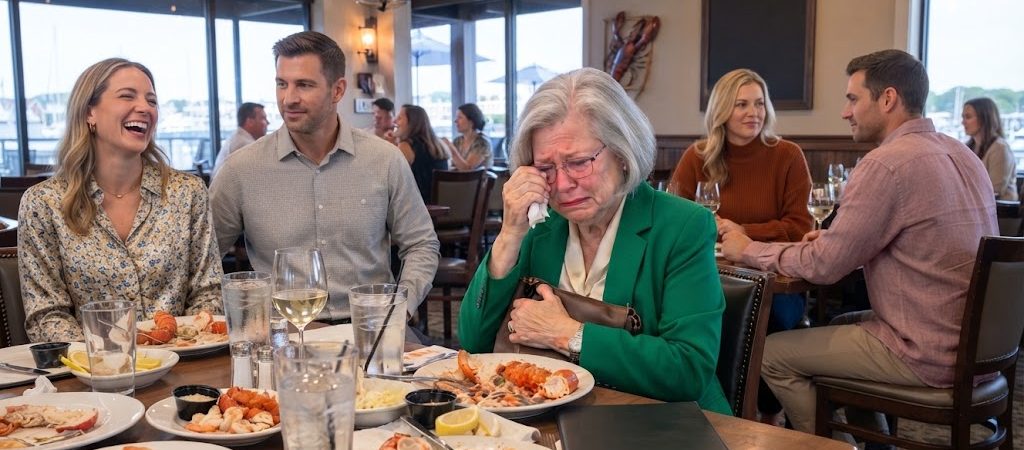
“You’ve been taking from her for years, and she has never once asked for any of it back because she loves you and because she doesn’t know how to stop giving, even when the people she gives to don’t deserve it. So you’re going to start deserving it. Or I keep showing up like this. With receipts.”
There was a long silence.
“Okay,” Alan finally said. “We’ll do it.”
I ended the call.
Within an hour, messages from Alan and Daria began appearing in the family group chat. This time, they weren’t vague apologies designed to avoid responsibility, but detailed acknowledgments naming specific people, specific debts, and specific plans for repayment.
Nobody pretended that one conversation had repaired years of damaged trust. Still, something important had changed because everyone could finally see the complete pattern instead of carrying their own isolated experience in silence.
Then my phone displayed a payment notification.
$412.
Alan and Daria had split the restaurant bill between them and reimbursed me in full. I stared at the notification briefly, put my phone down, and made coffee.
Later that afternoon, Grandma called. She wasn’t part of the family group chat and had no interest in joining it, so she had no idea what had happened after I brought her home.
“I don’t know what you did, but I just got a call from Alan and Daria.”
“Yeah?”
“They apologized. Properly. For everything. And they sent me money.”
She sounded almost surprised by the idea.
“Two hundred dollars. Half each. They said they’ll keep helping.”
Then she lowered her voice.
“What did you do?”
I glanced toward the enormous receipt still spread across my kitchen table, nearly three feet of itemized evidence printed in black ink.
“I just helped them understand things better.”
Grandma laughed softly.
“Well, whatever it was, it worked.”
We spent the next few minutes discussing ordinary things. She told me that a plant on her windowsill had finally bloomed after appearing dead for three months, then inevitably asked whether I had eaten.
After we hung up, I considered throwing away the oversized receipt. The money had been returned, apologies had been made, and there seemed to be no reason to keep it.
Instead, I carefully folded it.
I placed it in the bottom drawer of my desk beneath old tax returns and paperwork I rarely needed. I didn’t keep it as a trophy or because I wanted to preserve my anger.
I kept it as a record.
The receipt documented what had happened in a form that couldn’t be softened into a misunderstanding later. If Alan and Daria ever returned to their old habits, nobody would need to debate whether the pattern had really existed.
The family had finally seen it together.
And now Alan and Daria knew something else too.
If they ever decided to forget, I still had the receipt.
Part 5: The Receipt I Never Needed Again
In the weeks that followed, Alan and Daria did not suddenly become completely different people. Real change rarely happens that neatly, but the way they behaved within the family began to shift in small, noticeable ways.
They started showing up more often and calling Grandma Rose on Sundays. The calls weren’t perfectly consistent, but they happened frequently enough that eventually Grandma stopped treating them as surprising events and began accepting them as part of her normal week.
One Saturday, Daria brought Grandma groceries without being asked. Grandma called me afterward and mentioned it with the quiet happiness of someone who had received an unexpected kindness and was cautiously allowing herself to believe it might be genuine.
Alan began paying back other relatives as well. First came the cousin who had spoken up in the group chat, then another family member, with repayments arriving in modest amounts of fifty or a hundred dollars at a time.
They weren’t dramatic gestures, but that was exactly why they mattered. Each transfer forced Alan and Daria to recognize that what they had previously dismissed as “just money” had belonged to someone else, and that every unpaid debt carried weight even when the person owed had been too polite to demand it.
I couldn’t know whether the change would last. Maybe the next holiday, financial problem, or moment of temptation would make it easier for them to fall back into the habits they had practiced for years.
But I knew Grandma had soup in her refrigerator, flowers blooming on her windowsill, and a phone that rang more often than it once had. I also knew that the enormous folded receipt remained inside my desk drawer, untouched because I had not needed to bring it out again.
The last time I visited Grandma, I drove over on a quiet Sunday afternoon. She was already waiting in her kitchen with tea and homemade cookies, and she had placed two cups on the table because she knew I was coming.
We sat together while she told me about her week. She talked about the neighbor’s cat that kept sleeping in her garden, a book she had been reading, and the scarf she was knitting for a great-niece she had never met.
None of those things were important in the dramatic sense.
That was exactly what made them important.
Grandma was speaking without worrying that she was taking too much of my time or becoming a burden. She believed that the person sitting across from her genuinely wanted to hear about the cat, the book, the scarf, and all the ordinary pieces of her life.
For years, Grandma Rose had expressed love by making sure everyone around her was fed, warm, remembered, and cared for. Her kindness had never been the problem.
The problem had been people who accepted that kindness without understanding its value.
Grandma reached across the table and refilled my tea without asking, exactly as she always did. This time, I didn’t protest or tell her I had enough.
I simply held out my cup.
I had finally understood that some people give because giving is part of how they love. Protecting someone like Grandma didn’t mean stopping her from being generous.
It meant making sure the people receiving that generosity never mistook kindness for weakness.
The receipt remained folded in my desk.
It wasn’t a trophy, and it wasn’t revenge. It was proof of the night our family finally stopped looking at separate incidents and recognized the pattern connecting them.
Maybe Alan and Daria would remember the lesson forever, and maybe someday they would need reminding.
Either way, I knew exactly where I had put the receipt.