PART 5 — WHAT THEY COULDN’T TAKE
The investigation lasted for months.
There were interviews.
Financial reviews.
Legal examinations.
Phone records.
Property documents.
Statements from relatives who suddenly remembered conversations they’d forgotten to mention.
Some family members tried to distance themselves from Linda.
Others claimed they had never supported the plan.
But the messages told a different story.
Facts became harder to erase.
The state ultimately pursued charges related to the deliberate withholding of Emma’s medication and other conduct uncovered during the investigation. The financial matters surrounding the house were handled separately through attorneys and the courts.
Daniel’s role became complicated.
He admitted that he knew the inhaler had been withheld.
He admitted that he had discussed using the situation to pressure me.
He denied intending for Emma to become seriously ill.
The distinction did not make the betrayal smaller.
My attorney helped me secure the house legally and separate our finances.
Daniel moved out.
Linda was ordered to have no unsupervised contact with Emma while the investigation proceeded.
For months, Emma asked the same question.
“Why did Grandma do it?”
I never gave her the adult details.
I told her the truth in a way a child could understand.
“Sometimes people make terrible choices because they care more about what they want than about what other people need.”
Emma thought about that.
“Did Daddy know?”
I took a breath.
“Yes.”
Her eyes became wet.
“But he still loves you.”
“I loved him too.”
“Do you still?”
I looked at her.
“Love doesn’t make harmful choices safe.”
She nodded slowly.
That answer seemed to satisfy her more than any complicated explanation could.
A year later, Emma was doing well.
We had a small garden in the backyard.
She had learned to ride a bicycle without training wheels.
She kept a box under her bed filled with drawings, friendship bracelets, and the ridiculous handwritten jokes she loved.
One afternoon, she came into the kitchen holding an envelope.
“What is this?”
I looked at it.
A letter.
From Linda.
Emma asked, “Can I read it?”
I shook my head.
“Not yet.”
“Why?”
“Because some things should wait until you’re old enough to understand them.”
She accepted that.
Then she hugged me.
“Can we go to the lake?”
I smiled.
“The lake?”
“Yeah. But not Grandma’s lake club.”
I laughed.
“Why not?”
“Because that place gives me bad feelings.”
We chose a public lake instead.
We packed sandwiches.
We brought towels.
We rented a small paddleboat.
And for the first time, Emma got to see a lake without hearing adult arguments in the background.
She stood at the edge of the water and smiled.
“Mom?”
“Yes?”
“This is better.”
I knew what she meant.
No pretending.
No family politics.
No secret plans.
No locked cabinets.
Just sunlight on the water.
A few weeks later, I received one final update from the detective.
The recovered messages had established a timeline.
The deleted conversations had confirmed what the family had tried to deny.
And the security footage had filled the remaining gaps.
The detective said something I’ll never forget.
“Your decision to preserve the messages changed the investigation.”
He was right.
At first, I had saved the messages because I was angry.
Then because I was scared.
Eventually, I realized I had saved them because I didn’t want anyone to tell me again that I had imagined what happened.
Evidence had given me something fear never could.
Certainty.
The last time I saw Linda was outside a courthouse.
She looked smaller than I remembered.
Older.
Tired.
She stood behind her attorney and watched Emma walk past holding my hand.
For a moment, our eyes met.
She whispered something.
I couldn’t hear it.
I kept walking.
Emma squeezed my hand.
“Mom?”
“Yes?”
“Where are we going?”
“Home.”
She smiled.
The word felt different now.
Home.
Not a property.
Not an inheritance.
Not something another person could threaten to take.
Home was the place where my daughter could breathe without being told she was ruining someone’s weekend.
Home was where nobody had to earn the right to be cared for.
And home was where I finally understood something I should have learned years earlier:
When people tell you that you’re overreacting, sometimes they are trying to make you question the very thing you know is true.
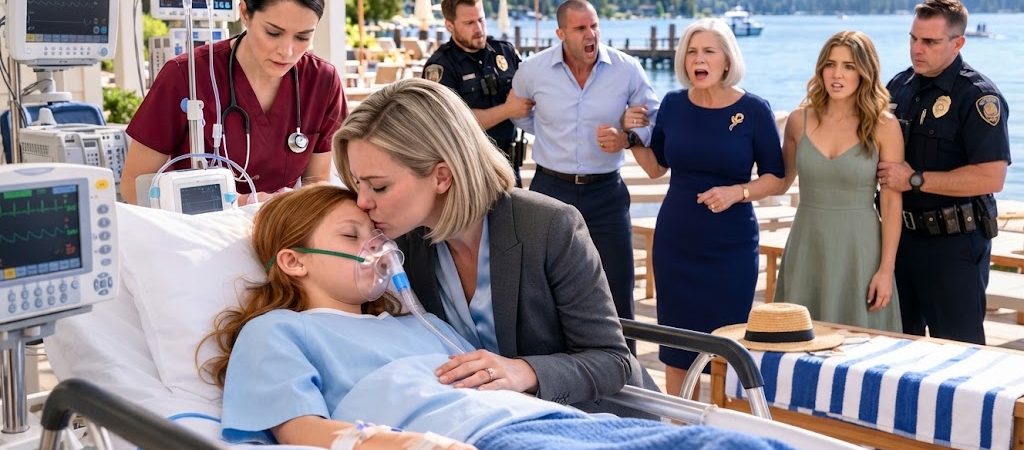
The morning Emma couldn’t breathe, my husband’s family had chosen their lake club.
They thought the photographs, the laughter, and the locked cabinet would matter more than one frightened little girl.
They were wrong.
Because I kept their messages.
I kept the evidence.
And when the police asked Linda one question—one she could not explain away—her entire story collapsed.
“Why did you knowingly hide a child’s emergency medication after you were told she couldn’t breathe?”
She never gave them an answer that made sense.
There wasn’t one.
And that was the truth that finally set us free.
Years later, Emma asked me whether I regretted anything.
I told her the truth.
“I regret not trusting myself sooner.”
She smiled.
“Then trust yourself now.”
I looked at my daughter.
My ten-year-old girl who had once struggled for every breath.
And I realized she had given me something that day without even knowing it.
She had forced me to stop begging people to believe me.
She had taught me to look at what was right in front of me.
And she had reminded me that protecting your child sometimes means protecting the truth first.
I reached for her hand.
“Always.”
And this time, when we walked home, I knew exactly where we were going.
Home.