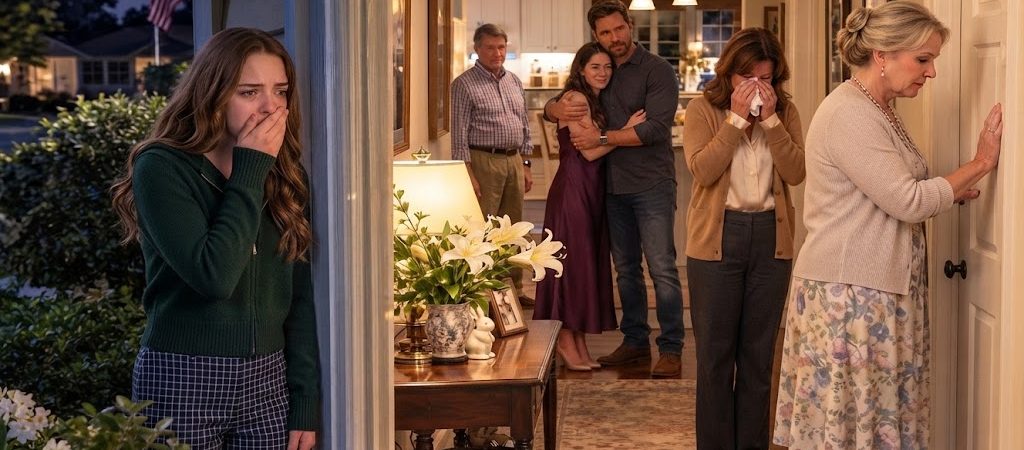
PART 2 — THE WEEKEND I DISAPPEARED
After that night, I began noticing things.
Little things.
The kind of things you don’t see when you’re busy blaming yourself.
My father never kept family photographs in the living room.
The framed pictures in the hallway started at Noah’s birth.
There were no pictures of me as a baby.
When I once asked about it, Dad said, “Most of them were damaged.”
I found that strange.
Because I’d seen an old photograph once in my grandmother’s belongings.
It showed my mother holding a newborn baby.
Me.
And standing beside her was a man I didn’t recognize.
I had always assumed he was a doctor.
Now I wasn’t so sure.
Then there were the strange phone calls.
Whenever Claire’s parents were expected, my father became tense.
He would step outside to answer his phone.
He always used the same words.
“We agreed.”
“I kept my side.”
“No one needs to know.”
Once, I followed him.
He was standing behind the garage.
I heard him say:
“Edward, you promised this was over.”
I froze.
Edward.
Claire’s father was named Edward Whitmore.
My father knew him.
Not casually.
Personally.
Very personally.
That night, I searched the internet for old local newspaper articles.
Edward Whitmore had been the owner of Whitmore Construction for nearly thirty years.
His first wife had been named Julia.
Julia Whitmore had died sixteen years earlier.
The official cause was listed as a car accident.
I read the article three times.
The accident had happened on a rainy November night.
A woman had been struck while crossing a narrow road near an old warehouse district.
The driver had fled.
Police never identified the vehicle.
A witness reportedly saw a dark sedan.
The case was eventually closed.
I stared at the date.
Sixteen years ago.
I was four years old.
For some reason, my stomach tightened.
That night, I opened the old notebook where I’d written down my childhood memories.
Most were meaningless.
A red balloon.
My first day of school.
Noah teaching me how to ride a bicycle.
Then I found one sentence I had written years earlier after a school assignment about my earliest memory.
“Daddy’s car was shaking and Mommy told him not to stop.”
I had always assumed that memory belonged to some childhood nightmare.
Now I wasn’t sure.
The next morning, I confronted my father.
“Did you know Julia Whitmore?”
His face changed.
Just for a second.
But I saw it.
“Where did you hear that name?”
“Answer me.”
“That’s none of your business.”
“She was killed in a hit-and-run.”
My father stood up.
“You need to drop this.”
“Why?”
“Because you don’t understand what you’re talking about.”
“Then explain it.”
He walked toward me.
For the first time in my life, I saw fear in my father’s eyes.
Not anger.
Fear.
“Mara,” he said quietly, “you don’t know what you saw when you were four.”
My hands went cold.
“What did I see?”
He said nothing.
“What happened that night?”
He looked toward the kitchen.
Mom was standing there.
She had heard everything.
Her eyes filled with tears.
Then she said:
“Your father made a mistake.”
“A mistake?”
“A terrible one.”
I looked between them.
“Did Dad hit Julia Whitmore?”
Neither answered.
That was answer enough.
I couldn’t move.
My father’s voice cracked.
“It was an accident.”
I stepped backward.
“You killed her.”
“It was dark. She stepped into the road. I panicked.”
“And you left?”
“I was terrified.”
“You left her there?”
He covered his face.
My mother started crying.
I couldn’t hear anything for several seconds.
All I could hear was the sentence Claire’s voice had spoken years ago.
Every time I come here, Mara disappears.
Then I understood.
It wasn’t because I embarrassed them.
It was because I knew something.
Or worse—
I had seen something.
Something a frightened four-year-old child remembered only in fragments.
Something my parents had spent sixteen years burying.
But why was Claire involved?
Why did my mother say I couldn’t meet her father?
I demanded answers.
My father finally told me part of the truth.
He had been driving the night Julia died.
He had struck her.
He had panicked.
Edward arrived at the scene minutes later.
Instead of calling the police, my father had begged him to protect him.
My father claimed Edward had agreed because he believed his wife’s death would destroy their business and reputation.
They buried the truth.
And my parents had carried it ever since.
But something still didn’t make sense.
“Why me?” I asked.
My father stared at the floor.
“You were in the car.”
I felt dizzy.
“What?”
“You were four. Your brother was with your grandparents that night. You were with us.”
I remembered.
Rain.
Headlights.
My mother screaming.
My father gripping the steering wheel.
A woman lying in the road.
And then—
Silence.
“But I’m your daughter,” I whispered.
“You are.”
“Then why did you hide me?”
My mother answered.
“Because you kept repeating what happened.”
“What did I say?”
Her lips trembled.
“You kept saying Daddy hit the lady. You kept saying Mommy told him to drive away.”
I stared at her.
“And Claire?”
My mother closed her eyes.
“Claire was just a little girl then.”
“What does she have to do with me?”
Nothing.
Again, they said nothing.
I understood that there was still another piece missing.
And I was done waiting for them to tell me.
Three nights later, I packed one suitcase.
I left my car.
I took the small amount of cash I had.
I left my college textbooks.
I left the jewelry my grandmother had given me.
I left everything except my identification, my clothes, and an old photograph of myself as a child.
I went to the bus station before sunrise.
My mother called me once.
I didn’t answer.
My father called twelve times.
I turned off my phone.
Noah called that afternoon.
His voicemail said:
“Mara, Mom says you’re being dramatic. Please come home.”
I deleted it.
I never went back.
I changed my phone number.
I moved to another state.
I worked in a diner.
Then a bookstore.
Eventually, I studied bookkeeping and built a quiet life.
It wasn’t glamorous.
But nobody asked me to leave when guests arrived.
Nobody introduced me as “the difficult daughter.”
Nobody hid me.
For the first time, I could walk into a room without wondering whether someone wished I wasn’t there.
And for four years, nobody in my family found me.
I assumed they had given up.
Then, on an ordinary Tuesday in October, a man I’d never seen before walked into the bookstore.
He was in his late sixties.
Gray hair.
Dark coat.
A weathered leather folder under his arm.
He looked at me for several seconds before speaking.
“Are you Mara Bennett?”
I stiffened.
Nobody had called me by my full name in years.
“Who are you?”
He sat the folder on the counter.
“My name is Thomas Reed.”
He took a breath.
“I knew your grandmother.”
Then he said something that made the room tilt beneath my feet.
“She asked me to find you if your parents ever made you disappear.”