PART 5 — THE WOMAN WHO FINALLY STOPPED LEAVING
Six months later, the old case was officially reopened.
The police reviewed the original accident file.
The hospital records had never disappeared.
The photographs had never disappeared.
And neither had my father’s confession.
My testimony from childhood was no longer dismissed as the confused memory of a four-year-old.
The new investigation found witnesses who remembered seeing my father’s car near the scene.
One former paramedic remembered my father arriving later at the hospital pretending to be “a concerned family friend.”
Another witness remembered Edward Whitmore telling police that he believed his wife had been walking alone.
The case became public.
My mother cooperated.
So did Claire.
Noah did too.
Edward was already facing separate legal consequences related to evidence tampering and obstruction.
My father’s role in the death was established through the reopened investigation.
There was never a dramatic courtroom ending.
Life rarely gives people endings that clean.
There were hearings.
Depositions.
Years of legal paperwork.
And grief.
Especially for Claire.
She had spent years believing her mother’s death was tragic.
Now she knew it was connected to a secret involving everyone she trusted.
She visited Julia’s grave every Sunday for months.
I went with her once.
We stood there in silence.
Finally, Claire said:
“She would have hated what they did to you.”
I nodded.
“I think she would have hated what they did to everybody.”
Claire smiled faintly.
“That sounds like her.”
Then she asked:
“Do you ever think about what would have happened if you had stayed?”
“All the time.”
“What do you think?”
I looked at the gravestone.
“I think I would have disappeared eventually.”
She looked at me.
“You did disappear.”
“Yes.”
“But you came back.”
I shook my head.
“No.”
She frowned.
“The girl who came here is gone.”
I touched my coat pocket.
Inside it was the old photograph I had carried with me when I left.
The picture of me at four years old.
I had finally found the original.
My mother had kept it in a box.
I had taken it after the investigation began.
In the photograph, I was sitting on my father’s shoulders.
He was smiling.
I was smiling.
Neither of us knew what was coming.
I stared at the child in the picture.
“She thought she was the problem,” I said.
Claire’s eyes filled with tears.
“She wasn’t.”
“I know that now.”
That was the difference.
For years, I thought healing meant going back and making my family love me properly.
I had been wrong.
Healing meant realizing I didn’t need their permission to exist.
I built my own home.
I started my own accounting business.
I made friends who knew my entire story and never once asked me to disappear when guests arrived.
I kept Christmas small.
I stopped answering calls that came with guilt attached.
And I learned to recognize the difference between forgiveness and access.
My mother wrote to me often.
Sometimes I answered.
Sometimes I didn’t.
She eventually moved into a smaller apartment.
She sold the house.
She said the old place held too many ghosts.
She was right.
Noah and I slowly rebuilt a relationship.
It took time.
Years, really.
He never demanded forgiveness again.
That mattered.
He apologized without asking me to make him feel better.
Once, during a quiet lunch, he said:
“I used to think family meant protecting each other from consequences.”
I looked at him.
“What do you think now?”
“That family means protecting each other from lies.”
I didn’t tell him he was forgiven.
Not that day.
But I stayed for dessert.
That was enough.
As for Claire, she became one of the closest people in my life.
Not because we shared blood.
Not because our families had been connected.
Because we had both been lied to.
And because neither of us chose to continue the lie.
One afternoon, more than a year after everything came out, I received a package.
Inside was another letter from Thomas Reed.
He had found one final note from my grandmother.
It contained only a few lines.
Mara,
One day, people will tell you that the reason they pushed you away was because you were difficult, embarrassing, inconvenient, or too much.
Do not believe them.
Sometimes the person being pushed out is not the problem.
Sometimes they are being pushed out because they are carrying the truth everyone else is afraid to face.
Stand still long enough for the truth to catch up.
Then choose where you want to stand.
I cried when I finished reading it.
Not because I was hurt.
Because for the first time, the story of my life finally made sense.
For eight years, whenever Claire came over, my mother had told me to leave.
“Don’t embarrass us.”
For four more years, I disappeared completely.
They couldn’t find me.
But the truth found me anyway.
A stranger brought me the documents.
A woman I thought was my enemy turned out to be another victim.
A dead woman finally got the truth told about her.
And the family that had spent years trying to control what I revealed could no longer control anything.
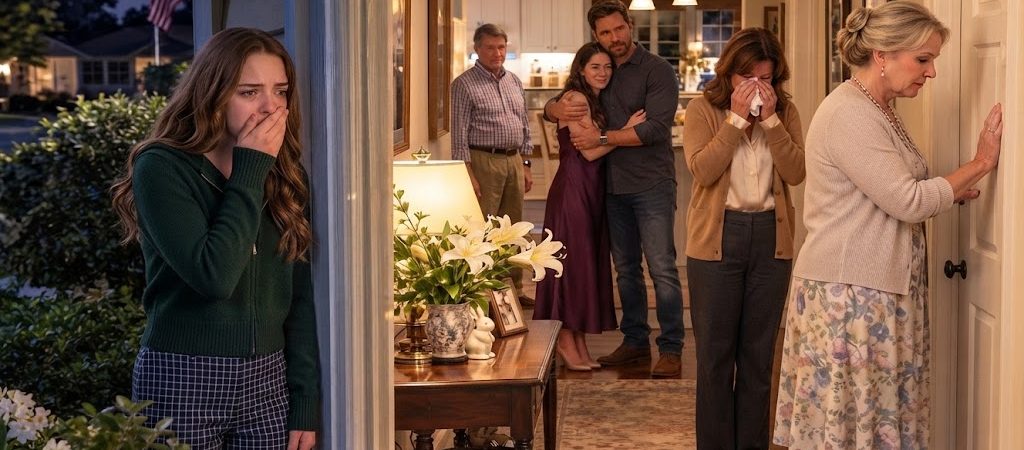
The final time I visited my parents’ old house, I stood in the hallway where I had once hidden while Claire’s family arrived.
I remembered being eighteen.
Clutching my backpack.
Trying not to cry.
Wondering what terrible thing about myself made my own mother ashamed.
Then I looked at the empty living room.
No guests.
No whispers.
No locked doors.
No one telling me to leave.
I walked to the front door.
And for the first time in my life, I realized something.
I wasn’t leaving because they wanted me gone.
I was leaving because I wanted to.
I opened the door.
Stepped outside.
And closed it behind me.
This time, I was not disappearing.
I was choosing where I belonged.
And for the first time, I knew exactly where that was.
With myself.