PART 7 — THE LAST LOCK
My father’s records were stored in an old law office outside the city.
We found them after a retired attorney contacted us.
He had represented my father twenty-four years earlier.
“I’ve waited a long time for someone to ask,” he said.
“Ask what?”
“Why your father changed his will.”
He handed me a sealed envelope.
Inside was my father’s final letter.
It explained everything.
My father had discovered that Margaret had been secretly taking money from a family business account.
He had confronted her.
She denied it.
Then he told her he was leaving her.
But he didn’t.
Because he learned she was pregnant with me.
So he stayed.
He created a separate trust.
Not for Margaret.
For me.
A trust designed specifically to protect me from anyone attempting to control my inheritance through my parents.
My mother had destroyed the original paperwork.
Or so she thought.
The attorney had kept copies.
My father had also left a second letter.
This one was for me to read when I became an adult.
It said:
Son, there are people who confuse love with control. They will tell you they sacrifice everything for you. Sometimes they do. But sacrifice does not give anyone ownership of your future.
I had to stop reading.
Those words were my father speaking across decades.
And suddenly everything made sense.
My mother’s obsession with control had started long before Elena.
She had not become this person because of my wife.
She had always been this person.
Elena had simply become the first person who refused to surrender to her.
The retired attorney told us my father’s original trust was still valid.
My mother had never legally controlled it.
She had been pretending for years.
The money my mother claimed belonged to her actually belonged to me under conditions designed to prevent exactly what she had attempted.
The irony was almost unbearable.
She had built an entire conspiracy to control a trust she never truly owned.
And because of the evidence from the old attorney, the court ordered a full accounting of my mother’s finances.
Millions in hidden transactions came to light.
My mother had been moving money between accounts.
Using shell companies.
Paying consultants.
Funding the private investigator.
Even financing the fake evidence.
The case against her became much larger.
By the end, she had lost almost everything.
But I never celebrated.
Because there was one final thing I needed to do.
I went to see her in prison.
She walked into the visitation room looking smaller than I remembered.
For a long time neither of us spoke.
Finally she said:
“You came.”
“Yes.”
“I knew you would.”
I looked at her.
“That was your problem, Mom.”
Her expression hardened.
“What does that mean?”
“You always assumed I would come back.”
Silence.
“You thought I belonged to you.”
She looked away.
“I was protecting you.”
“No.”
I shook my head.
“You were controlling me.”
Her eyes filled with tears.
“I loved you.”
“I believe you.”
That surprised her.
I continued.
“But love doesn’t excuse what you did.”
She looked at me.
“Will you forgive me?”
I didn’t answer immediately.
Then I said:
“I hope one day I can forgive you.”
She nodded.
“And will you bring Nora to see me?”
I stood.
“No.”
Her face collapsed.
“Andrew—”
“She deserves to grow up without fear.”
I walked toward the door.
Behind me, my mother called my name.
I stopped.
She whispered:
“I never wanted to hurt you.”
I turned around.
“But you were willing to hurt everyone around me to keep me.”
She said nothing.
I left.
Outside, Elena was waiting with Nora.
Our daughter was asleep in her stroller.
I bent down and kissed her tiny forehead.
Then I kissed Elena.
“It’s over,” I said.
She looked at me.
“Really?”
I looked back at the house we had once rented, the places we had once trusted, the family members who had once seemed permanent.
“Yeah.”
This time, it was true.
We changed our locks again after moving.
Not because we were afraid.
Because boundaries mattered.
The new house had no hidden cameras.
No family trust controlling our decisions.
No relatives with keys.
No one monitoring when we left or returned.
And no one telling us what our marriage should look like.
Years later, Nora would ask why there were so few pictures of our old house.
We would tell her that sometimes people outgrow places.
That some doors need to close.
And that protecting someone you love doesn’t mean locking the world out.
It means choosing who gets a key.
Elena kept the photograph of my mother at the dinner table.
Not because she wanted to remember the pain.
But because she wanted us never to forget what ignoring warning signs could cost.
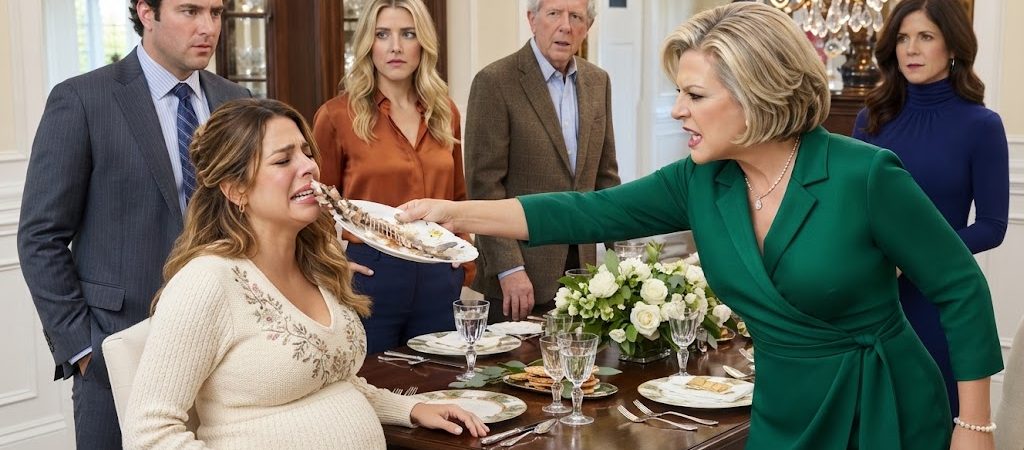
Sometimes, late at night, when our daughter was asleep upstairs, I would remember Elena beneath that table, coughing while six people watched.
I would remember my mother’s voice.
You’re embarrassing yourself.
And I would remember the moment I finally said:
Move.
That one word changed my life.
Because sometimes the hardest thing a person can do is stop obeying the person who taught them to obey.
My mother had spent years tracking every moment I was away.
She knew when I left.
When I returned.
Where my wife went.
When our baby had appointments.
What we bought.
What we said.
She thought knowing everything meant she had control.
She was wrong.
Control was never knowing where we were.
Control was believing we had nowhere else to go.
Now we did.
We had each other.
We had our daughter.
And we had a home where every lock opened from the inside.
That was the final lock my mother could never pick.
And the first one I had ever chosen for myself.