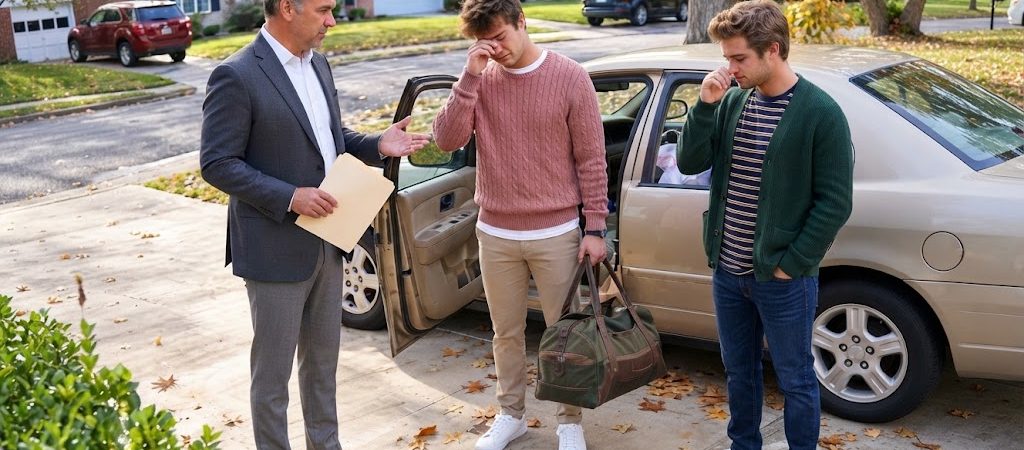
Richard explained that conversation had taken place only six weeks before my eighteenth birthday.
Suddenly, everything made sense.
Dad hadn’t thrown me out because adulthood magically began the morning I turned eighteen. He knew James was dying, knew the estate would soon start searching for me, and needed me gone before anyone could reach me at home.
I looked at Richard.
“What happens now?”
“You have thirty days.”
“And after that?”
“You meet the board of Brooks Holdings and decide whether you want what your grandfather left you.”
Richard closed his briefcase, then paused.
“There is one advantage, Nathan.”
“What?”
“Your father doesn’t know we’ve found you.”
I looked at the broken car where I had spent nine nights believing I had nothing.
Thirty days earlier, my father had taken my savings.
Nine days earlier, he had handed me three plastic bags and sent me away.
Now I knew the truth.
I wasn’t the unwanted son with nowhere to go.
I was the heir my father had spent years trying to hide.
Part 3: Thirty Days With Nothing
The next thirty days were nothing like what people imagine when they hear the word inheritance. I didn’t move into a mansion, buy new clothes, or touch a single dollar from my grandfather’s accounts.
I kept going to school and working part-time while staying in a small room at a youth shelter Richard helped me find. The estate could cover only basic necessities under the terms of my grandfather’s instructions, which meant no luxury and no early access to the fortune waiting for me.
At first, I resented James for the condition.
But somewhere between classes, work shifts, and nights spent thinking about everything my father had hidden from me, I began to understand what my grandfather wanted. He needed me to discover who I was before money had the chance to decide for me.
On the thirtieth morning, Richard arrived outside the shelter in a black sedan.
“You ready?”
I looked down at my clean white shirt, dark trousers, and the only decent shoes I owned.
“As ready as I’ll ever be.”
Richard drove me downtown toward Brooks Holdings headquarters, a thirty-two-story tower of glass and steel. Seeing my grandfather’s company rise above the skyline made everything I had learned suddenly feel real.
“What if they don’t accept me?” I asked.
“They will.”
“How can you know that?”
Richard glanced toward me.
“Because your grandfather planned for everything.”
The boardroom occupied the top floor and was larger than the house where I had grown up. Seven executives, attorneys, accountants, and senior partners sat around a long table, with an elderly woman named Margaret Ellis at the far end.
She stood when I entered.
“Nathan Brooks. Your grandfather spoke very highly of you.”
Hearing that still hurt in a strange way. I had spent eighteen years believing James never knew me, only to discover he had apparently known far more about my life than I ever knew about his.
Before the meeting could begin, Richard announced there was one unresolved matter.
Then the boardroom door opened.
My father walked in.
His wife and my stepbrother followed him.
Dad stopped the moment he saw me, and the color disappeared from his face. For several seconds, neither of us spoke.
“What is he doing here?” he demanded.
Richard calmly explained that I had been invited.
Dad looked directly at me.
“You’ve been looking for me?”
“No.”
His expression tightened.
“I didn’t find you,” I said. “They found me.”
My stepmother immediately changed her tone, claiming Dad had been worried about me and that forcing me out had only been intended to teach me responsibility.
I almost laughed.
Instead, I looked at Richard.
“Then let’s talk about responsibility.”
He placed a folder on the table.
Dad recognized it immediately.
Inside were photographs documenting years of intercepted correspondence: Dad at the mailbox, carrying away envelopes addressed to me, destroying letters, and holding birthday cards I never received.
My stepmother stared at him.
“What is this?”
Dad tried to explain that he had been protecting me because he didn’t trust James’s intentions.
Margaret Ellis wasn’t convinced.
“Concern doesn’t explain destroying thirty-two documented pieces of correspondence.”
My stepbrother looked increasingly confused. Then Richard placed my bank records beside the photographs.
That was when everything changed for him too.
“Dad, did you really take Nathan’s savings?”
Dad remained silent until my stepbrother mentioned the three thousand dollars.
“It was family money,” he finally said.
“No,” I replied. “It was mine.”
Richard stated the exact amount: $3,214.63.
My father admitted the money had gone toward legal fees connected to his fight over Brooks Holdings.
My stepmother stared at him in disbelief.
“You told me it paid for Ethan’s college applications.”
My stepbrother’s face went pale.
“You lied to me too?”
Dad slammed his palm against the table and pointed at me.
“You think because some dead man left you a company, you’re suddenly better than us?”
I looked at him calmly.
“No. I’m exactly the same person I was thirty days ago.”
His anger faltered.
“But now I know the truth.”
Richard reached for a remote.
The boardroom lights dimmed, and a large screen descended behind Margaret.
My grandfather appeared on it.
Dad immediately froze.
The recording began with James telling him that I would inherit everything.
Then my father’s voice filled the room.
“Then I’ll make sure he never knows.”
The recording continued.
James accused him of being willing to destroy his own son for money.
My father’s answer was even worse.
“He’s not my son anymore.”
The video stopped.
Nobody spoke.
My stepmother slowly turned toward him, realizing that the story she had been told about me had been another lie.
Then Margaret slid a document across the table toward me.
My grandfather had left me sixty-eight percent of Brooks Holdings.
Controlling ownership.
And with it came one decision nobody in that room could make for me.
Whether my father would still have a place in the company.
Part 4: The Choice My Father Never Expected
I stared at the document Margaret had placed in front of me.
Sixty-eight percent of Brooks Holdings belonged to me. My grandfather hadn’t simply left me money; he had given me controlling ownership of the company and the authority to decide whether my father would remain part of it.
Dad finally looked at me.
“Nathan.”
For the first time I could remember, his voice didn’t sound commanding. It sounded afraid.
“You wouldn’t do this.”
“Do what?”
“Destroy my career.”
I shook my head.
“You destroyed your own career.”
Dad insisted he had made mistakes, but I corrected him. Taking my savings, intercepting thirty-two letters, lying about my grandfather’s death, and throwing me out when he knew the estate would soon search for me weren’t mistakes.
They were choices.
“I am your father,” he said.