“And I was your son.”
That silenced him.
I placed the bank statement on the table and reminded him that he had taken money I earned working after school. Then I placed the photographs beside it, followed by copies of the letters my grandfather had tried to send me.
“You knew Grandpa was alive. You stole every chance I had to know him, and when you realized he was leaving everything to me, you threw me out.”
Dad lowered his eyes.
“I was scared.”
“Of what?”
“That you would leave me behind.”
For a moment, I couldn’t believe he had actually said it.
“You were the one who left me.”
Margaret finally announced that the board had reviewed the evidence. Effective immediately, Daniel Brooks would be removed from every executive position at Brooks Holdings.
Dad stared at her.
“You can’t do that.”
“The controlling shareholder can.”
Everyone turned toward me.
I took a breath.
“Yes.”
Margaret explained that Dad’s access to company accounts and confidential records would also be suspended while the legal investigation continued. He looked at me and quietly said a word I had almost never heard from him.
“Please.”
I didn’t feel powerful.
I felt exhausted.
“I won’t interfere with the investigation.”
Dad nodded slowly, but I wasn’t finished.
“You thought taking everything from me would make me disappear. Instead, you taught me how to survive without you.”
Richard then handed me one final envelope.
Inside was a letter from my grandfather.
James wrote that if I was reading it, I had survived the thirty days. He wished he could have protected me from what my father had done, but there was one thing he desperately wanted me to understand.
You were never unwanted. You were never forgotten. And you were never the burden they made you believe you were.
My vision blurred.
The final lines were even harder to read.
You were my grandson. And I was always proud of you.
For eighteen years, I had wondered why nobody from that side of my family ever came looking for me. Now I knew someone had been trying all along.
I folded the letter carefully.
“I’ll accept the inheritance.”
Dad looked up.
“But I have one condition of my own.”
Margaret smiled slightly.
“What condition?”
“I finish high school.”
Three months later, I walked across the graduation stage first in my class.
Dad wasn’t there. Neither was my stepmother, but my stepbrother came and sat quietly near the back.
When my name was called, I briefly looked toward the empty seats where my father should have been.
Then I smiled.
Not because I was wealthy or because I controlled a company, but because I finally understood that my worth had never depended on whether my father chose me.
After graduation, I returned to Brooks Holdings.
I kept the company, but I changed what it stood for.
We created scholarships for students with nowhere to turn and established emergency housing support for young people who suddenly found themselves without a safe home.
Every year on my birthday, I made a donation to a shelter in my grandfather’s memory.
I never forgot those nine nights in my car.
I even kept the three plastic bags Dad had handed me on my eighteenth birthday—not as reminders of what he took from me, but of what I survived.
Years later, people sometimes asked how I learned to lead a company so young.
They expected an answer about investments, strategy, or business school.
Instead, I always told them the truth.
“I learned how to build something when I had nothing.”
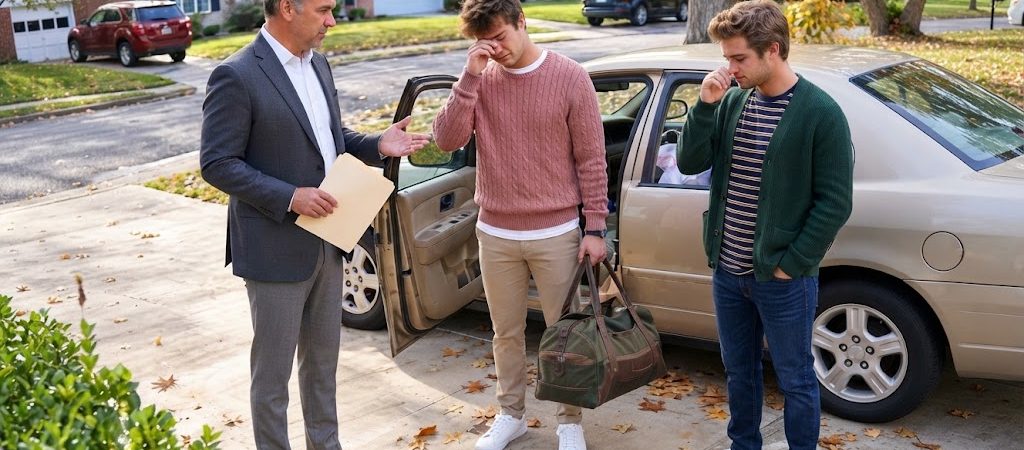
My father had given me three plastic bags and a driveway.
My grandfather had given me a future.
But the life I eventually built belonged to neither of them.
It belonged entirely to me.
Part 5: The Life That Finally Belonged to Me
My father stood across the boardroom waiting for me to save him.
For most of my life, he had been the person with all the power. He decided what I deserved, what truths I was allowed to know, and eventually whether I was even welcome in his house.
Now everyone was waiting for my decision.
Margaret confirmed that Dad would be removed from every executive position at Brooks Holdings immediately. His access to company accounts and confidential records would also be suspended while attorneys investigated the intercepted correspondence, my missing savings, and his attempts to gain control of my grandfather’s estate.
Dad looked at me.
“Please, Nathan.”
I had imagined confronting him countless times during those thirty days, but standing there, I didn’t feel the satisfaction I expected.
“I won’t stop the investigation.”
His shoulders dropped.
“You thought taking everything from me would make me disappear,” I said. “All you did was teach me that I could survive without you.”
Richard stepped forward before anyone could respond.
“There is one final matter.”
He handed me a small envelope.
My name was written across the front in my grandfather’s handwriting.
I opened it carefully.
James wrote that if I was reading those words, I had survived the thirty days. He wished he could have protected me from my father’s choices, but he couldn’t erase hardship from my life; he could only leave me the opportunity to build something afterward.
Then I reached the lines that stopped me.
You were never unwanted. You were never forgotten.
You were my grandson, and I was always proud of you.
I lowered the letter.
For eighteen years, I had believed nobody on that side of my family wanted me. Every unanswered birthday and every empty mailbox had seemed like proof.
But my grandfather had written thirty-two times.
Someone had been trying to tell me I mattered all along.
“I’ll accept the inheritance,” I finally said.
Margaret nodded.
“But I want to finish high school first.”
Three months later, I walked across the graduation stage as the top student in my class.
My father wasn’t there. Neither was his wife.
My stepbrother came.
He sat quietly near the back, and when our eyes met, he gave me a small nod. I returned it because I had learned enough by then to understand that Dad’s lies hadn’t only manipulated me.
When my name was announced, I accepted my diploma and glanced toward the empty seats where my father might once have sat.
For the first time, they didn’t hurt.
My worth had never depended on whether he chose me.
After graduation, I returned to Brooks Holdings and accepted the responsibility my grandfather had left behind. I kept the company, but I decided that inheriting his business didn’t mean I had to preserve everything exactly as it had been.
We established scholarships for students facing unstable homes and created an emergency housing program for young people who suddenly had nowhere safe to stay.
Every year on my birthday, I also made a donation to a shelter.
I knew what it felt like to sit inside a broken-down car wondering where the next meal would come from. I knew how quickly a teenager could go from having a bedroom to carrying everything he owned in plastic bags.
I never threw those three bags away.
Years later, they were still stored safely—not because I wanted to remember my father’s rejection, but because I wanted to remember the boy who survived it.
People eventually began asking how someone so young had learned to lead a company.
They expected me to mention business school, investment strategies, or some secret my grandfather had passed down.
My answer was always simpler.
“I learned how to build something when I had nothing.”
And whenever someone asked about my father, I didn’t hide the truth or spend my life trying to punish him.
I simply said, “He taught me what kind of man I never wanted to become.”
My father had given me three plastic bags and a driveway.
My grandfather had given me a future.
But the most important thing wasn’t something either man had given me.
I had built it myself.
A life no inheritance could define, no family could control, and no one could ever take away.
A life that finally belonged entirely to me.