Mom, however, didn’t like being excluded from that conversation.
“So I’m supposed to leave without even knowing what she’s accusing me of?”
I looked at her and realized the question itself revealed the problem. My wife had just regained consciousness after collapsing, yet Mom’s concern was still centered on what Clara’s words might mean for her.
“This isn’t about you getting an explanation tonight.”
Her jaw tightened, and I could see how badly she wanted me to reassure her. In the past, I probably would have added that we could talk tomorrow or that I knew she hadn’t intended for things to become so serious.
I said none of those things.
Clara didn’t need me to soften the boundary for the person who had ignored her. She needed to know that when she eventually told me what had happened during the times I wasn’t home, I would listen without immediately searching for an excuse.
Our son shifted against my chest, and I carefully adjusted him. When I looked toward Clara, her eyes were clearer than before, and she watched me with an expression I couldn’t immediately identify.
Then I realized what it was.
Relief.
That hurt more than Mom’s anger because Clara shouldn’t have been surprised to see me defend her. She shouldn’t have needed to wonder whether I would believe her or whether I would once again explain that Mom was simply blunt, traditional, difficult, or misunderstood.
I couldn’t change the times I had failed to recognize that pattern.
I could change what happened next.
“You’re really doing this?” Mom asked.
“Yes.”
“I’m your mother.”
“I know.”
She stared at me, apparently waiting for those words to carry the same power they once had. Being my mother was part of our history, but it wasn’t permission to disregard my marriage, my home, or the wellbeing of my wife and child.
Mom had raised me, and I would never pretend otherwise. I could acknowledge everything she had done for me without allowing gratitude to become a lifetime exemption from consequences.
That afternoon had made the difference impossible to ignore.
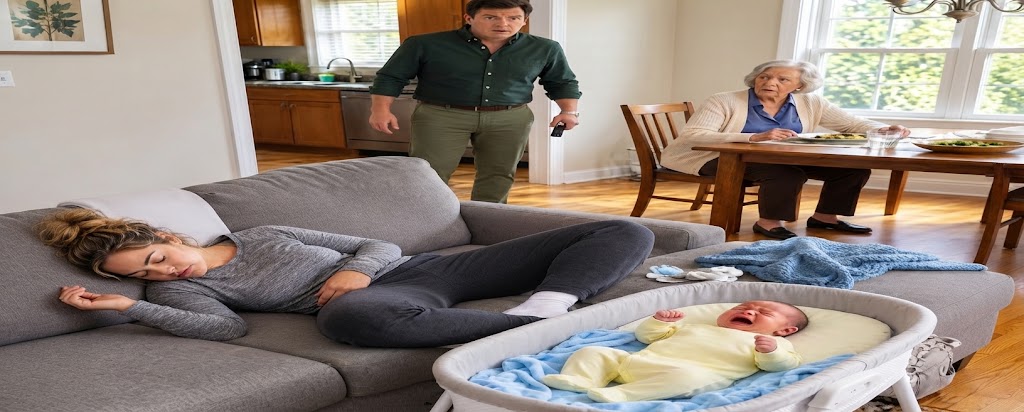
I had walked through the front door expecting to surprise Clara and give her a few hours of rest. Instead, I found our newborn screaming, my wife unconscious on the sofa, and my mother calmly eating the elaborate meal she had pressured an exhausted new mother to prepare.
When I asked what happened, Mom called Clara dramatic.
When I called an ambulance, she thought I was overreacting.
When professionals arrived, she was more offended by being told to step aside than concerned about why Clara wouldn’t wake up.
Those facts were enough.
I didn’t need to exaggerate them, and I didn’t need to know every detail of the past before protecting my family in the present. Whatever Clara eventually revealed would matter, but my responsibility didn’t begin only after she provided enough evidence to convince me.
It should have begun much earlier.
I sat beside Clara again and took her hand while the paramedics finished their assessment. Mom remained across the room, and for once nobody rushed to comfort her, defend her intentions, or ask Clara to make the situation easier.
The house didn’t feel peaceful.
It felt clear.
Only four hours separated the afternoon I expected to have from the one I actually came home to. If my meeting had ended on schedule, I might never have witnessed any of it, and Mom might have explained everything before I ever saw Clara lying there.
That possibility stayed with me.
I looked at my wife and thought about all the times I had assumed silence meant everything was fine. From that day forward, I knew I could never make that assumption again.
Clara’s fingers tightened weakly around mine, and I stayed beside her.
Whatever she eventually told me, I would listen before defending anyone else. I would stop asking her to accept disrespect simply because confronting it made family gatherings uncomfortable.
Mom was still my mother.
But Clara and our son were the family depending on me to make our home safe.
This time, I finally understood the difference.
Part 5: What Clara Finally Told Me
Clara waited until the following evening to tell me what she had been trying to say when she first opened her eyes. Our son was asleep in his bassinet, the house was finally quiet, and Mom had been gone since the night before.
I sat beside Clara on the bed and told her she could stop whenever she wanted. She looked down at her hands for several seconds before explaining that the pressure hadn’t begun with the dinner I had walked in on.
It had started shortly after our son was born.
Whenever Mom visited while I was at work, she criticized the way Clara cared for the baby. She questioned how often he needed to be fed, complained that the house wasn’t clean enough, and repeatedly told Clara that women in her generation had managed newborns without making such a production out of being tired.
Clara hadn’t told me because each incident seemed too small on its own. She knew how often I explained Mom’s behavior as bluntness, and she didn’t want every visit to become another argument between us.
That admission was difficult to hear because she wasn’t accusing me of ignoring her.
She was explaining why she had stopped expecting me to understand.
The afternoon I came home early had simply been worse than usual. Mom arrived expecting dinner, and when Clara said she was exhausted and wanted to order food, Mom began criticizing the way we had been living since the baby arrived.
Eventually, Clara got up and started cooking because arguing required more energy than giving Mom what she wanted. Halfway through preparing the meal, she became dizzy and told Mom she needed to sit down.
Mom accused her of being dramatic.
Clara remembered reaching the sofa before everything went dark.
“When I woke up and saw you,” she whispered, “I thought maybe I was imagining it.”
I took her hand and asked why she had looked toward Mom before whispering to me. Clara hesitated before admitting that she had been afraid Mom would immediately tell me a different version of what happened.
That answer stayed with me.
My wife had collapsed in our own living room, yet when she regained consciousness, one of her first concerns was whether I would believe her. I couldn’t blame Mom alone for that because I had spent years teaching Clara, unintentionally, that whenever conflict involved my mother, I would search for the least confrontational explanation.
“I’m sorry,” I said.
Clara shook her head, but I didn’t let myself escape the truth simply because she wanted to comfort me. I told her that I should have noticed how often she became quiet after Mom’s visits and that keeping peace should never have required her to tolerate disrespect inside her own home.
We agreed that Mom would not return unless Clara genuinely wanted that someday. There would be no surprise visits, no private access to our son, and no family gathering where Clara was expected to pretend nothing had happened simply to keep other relatives comfortable.
Some people in my family didn’t understand.
Within days, I received calls telling me Mom was devastated and that separating a grandmother from her grandson was cruel. A few relatives suggested Clara was taking advantage of the situation to push Mom out of my life permanently.
For once, I didn’t argue with them.
I simply told them the boundary wasn’t open for discussion.
Mom called several times too. Her first messages were angry, the next ones defensive, and eventually they became emotional apologies mixed with explanations about how difficult motherhood had been in her generation.
I listened to one message and deleted the rest.
Maybe someday Mom would understand that an apology wasn’t supposed to explain why the person she hurt should forgive her. Until then, distance was the healthiest thing I could give my wife, my son, and even myself.
Weeks passed, and our home slowly became ordinary again.
Clara recovered, our son began sleeping for longer stretches, and I reorganized my work schedule so she had guaranteed time each week when nobody needed anything from her. Some evenings we ordered takeout and ate directly from the containers while the baby slept between us.
Nobody demanded a proper meal.
Nobody inspected the house.
Nobody made Clara prove that exhaustion was real.
One night, I came home and found her asleep on the sofa again.
For half a second, the memory of that afternoon hit me so hard that I stopped in the doorway. Then I noticed our son sleeping peacefully in his bassinet and Clara breathing softly beneath a blanket.
There were two takeout containers on the coffee table and a note beside them.
Your turn to warm dinner. I’m taking a nap.
I smiled and quietly carried the food into the kitchen.
Months earlier, I might have thought protecting my family meant avoiding conflict between the people I loved. Now I understood that sometimes protecting your family meant being willing to create conflict when someone repeatedly refused to respect them.
Mom was the woman who raised me, and that would always be true.
But Clara was my wife, our son depended on us, and this was their home too.
That evening, I didn’t wake Clara.
I warmed dinner, picked up our son when he began to stir, and let my wife sleep.
This time, nobody expected her to get up and serve anyone.