Chapter 6: Paper That Can Steal a Life
By four that afternoon, Ethan had posted bond and walked out of the Iredell County Jail with a lawyer at his side and a court order not to contact me. Denise had my phone. Calvin Ror hadn’t been mentioned to a single person in uniform, and none of them had been charged with harming me because no one could prove anyone had harmed me. All I had was a doctor’s suspicion, a bruised wrist, and a bandage on my elbow where the IV used to be. They admitted me that afternoon. The detective came in the evening. Her name was Lena Brooks. She was in her forties with short gray-streaked hair and a notebook she actually wrote in with a pen. She sat by my bed for an hour and a half and let me tell her everything from the dinner and the brochure to the tea and the pen in my hand and the voices through the laundry room vent. When I finished, she closed the notebook. “I believe you,” she said. “I want you to hear that first, and I need you to hear the second part, too. What you’ve told me, plus your symptoms, is not enough for a judge to give me a warrant to search that house tonight. I need the lab results. When Dr. Hail has numbers on paper, I can move.”
“Until then, the people you’re describing are free and they know you went to a hospital and they know police were called, so they’ll clean up,” I said. She didn’t pretend otherwise. “They might.” After she left, I lay in the dark and realized I had no phone and no way to reach anyone. Everyone I knew lived inside that phone, and the phone was in Denise’s coat pocket, except one number. I’d known it since I was seven years old. It used to belong to the Delgado family marina. And when the marina sold, Frank’s father kept the number. And when his father passed, Frank kept it, too. I dialed it a thousand times as a kid to ask if Frank could come out and swim. I picked up the hospital phone beside the bed and dialed it at eleven-forty that night, not knowing if he’d even answer an unknown number. He answered on the second ring. “Delgado.” “Frank,” I said. “It’s Tori.” There was a pause, then just, “Where are you?”
He got there at two in the morning. He came straight from a late repair job, still in his work shirt with a grease stain on the pocket and the smell of outboard motor oil on him. He was carrying a white paper box from Ida’s bakery in Davidson, the cinnamon rolls my father used to buy every Saturday. He stood in the doorway and looked at me at the bandages, at my thin arms, at my hair. I watched his jaw go tight. He didn’t ask what happened. He just pulled the visitor’s chair over to the door, sat down facing the hallway, and set the bakery box on his knees. “Go to sleep, Tori,” he said. “I’ve got the door.” I slept for six hours straight. It was the first real sleep I’d had in a week. Janet Okoro came in the next morning. Janet was sixty-one and had been my mother’s friend since college. She drafted my parents’ wills and then mine. She wore reading glasses on a chain. She sat down and opened her leather folder without any small talk. “I got your email,” she said last Wednesday, postponing our meeting indefinitely. Very polite. Very you.” She turned the printout around so I could read it. “Except you didn’t write it, did you?”
I read it. It was signed Tory with a little smile at the end. I have never in my life signed an email with a smile. “Ethan,” I said. “Mhm.” She took off her glasses. “Tori, I need to say something unpleasant. The will you signed four years ago is still in force. If you had died this week, your husband would have inherited every single thing your parents left you. The house, the building, the account, all of it.” She let that sit. “Monday’s meeting was going to change that.” I looked out the window at the parking lot. I thought about Calvin on the porch at midnight. Friday at the latest. After Monday, it’s paper we can’t touch. It wasn’t about a land deal. It had never been about a land deal. It was about whether I would still be alive to sign anything at all.
The results came back on the ninth day. Dr. Hail didn’t make me wait for him to sit down. He came in holding a single sheet of paper and said it standing at the foot of my bed because I had asked him to always tell me things straight. “Inorganic arsenic,” he said. “Not the kind you get from food, which is the first thing a defense lawyer will say. So we ran the test that tells the difference. Your levels are high, very high, and your nails tell me this has been happening for months with a big jump recently.” He paused. “We’ve started treatment. It works. It’s slow, and some of the nerve damage in your feet may not come all the way back, but you’re going to live, Victoria. Seven days ago, I wasn’t sure of that.” I thanked him. I actually said thank you politely, the way my mother raised me to. Then he left and I asked the nurse if I could shower.
The hair came out in the hospital shower the way it had been coming out at home for months. A soft dark nest in my palm. At home I had blamed grief. I had blamed the hard water, the new shampoo. Turning thirty-five. Now I stood under that thin hospital spray and counted backward. Five months of evenings. Denise knocking with her hip because her hands were full. The V mug warm. Ethan taking it from her at the door so she wouldn’t have to climb the stairs. Ethan kissing my forehead while I drank. Ethan waiting until I’d finished. I used to think he waited because he loved watching me rest. I turned off the water and stood there holding that nest of my own hair. And I understood that he had been waiting for the cup to be empty. I didn’t cry when Dr. Hail said the word arsenic. I cried then, sitting on the plastic shower chair with water dripping off my chin. And it wasn’t because I was afraid of dying. It was shame. Five months. I’m a woman who can find a missing initial on page eleven of a lease. I’d sat in that bed every night and swallowed what they handed me and said thank you.
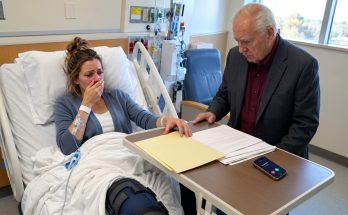
That afternoon, Janet came back, and she wasn’t alone. She had a stack of paper an inch thick, and her face told me before her mouth did. “While you’ve been in here,” she said, “they’ve been busy.” She laid it out for me one piece at a time, like cards on a table. The first was a durable power of attorney naming Ethan Marsh as my agent, with full authority over my property and my accounts. It was dated the fifth night, the night of the pen in my hand. It had been notarized by a notary in Cornelius I’d never heard of. And on the afternoon of the seventh day, while I was lying in the emergency room with blood running down my arm, someone had walked it into the Iredell County register of deeds and recorded it. I held it up to the window. It was clean, crisp, no tear through the signature block, no tea stain. My name was signed at the bottom in a careful, round imitation of my handwriting. The kind of signature you get when someone practices from a birthday card. “That’s not the one he tried to make me sign,” I said. “That one is torn in half and soaked in tea. This is a copy somebody made afterward.”
The second page was a statement from my investment account. Two days earlier, using that power of attorney, Ethan had transferred six hundred forty thousand dollars to a company called Ror Shoreline Partners LLC. The memo line said Investment. The third was a contract for the sale of my father’s building in Davidson. The buyer was the same company. The price was low, the terms were fast, and the closing was set for the following Friday. Ida Bell, who had run her bakery on the ground floor for twenty-two years, had already received a letter informing her that the building was under contract and her lease would be reviewed by new ownership. “Ida called me crying,” Janet said quietly. “She thought you’d sold her out.” The fourth thing was the one that took the air out of the room. Ethan had filed a petition with the clerk of court in Statesville, asking to have me declared incompetent. He wanted to be named my emergency guardian. Attached was a sworn statement from Denise, and attached to that were screenshots of text messages sent from my phone to my friends the day after the ER. So sorry for the drama yesterday, everyone. I’m very confused right now. Ethan is taking care of me. Please don’t worry. Love, T. My phone, the one Denise had taken out of my purse while Ethan pulled the IV out of my arm.
And there was more, though it wasn’t on paper. Ethan had posted on social media, a long post with a photo of us on our wedding day about how hard it is to watch someone you love lose her grip on reality and how he was asking for prayers and privacy for his wife’s health crisis. Janet showed me on her tablet. It had three hundred twelve reactions. Women from my book club had commented. Praying for you both. You’re a good man, Ethan. Tori is lucky to have you. I put the tablet face down on the blanket. That was the moment I understood what they had built. The poison wasn’t the only weapon. The story was. Every true thing I said from now on would sound exactly like the woman in Ethan’s petition. If I said, “My husband harmed me,” it sounded like suspicion. If I said, “My mother-in-law forged my texts,” it sounded like suspicion. If I got angry, that was proof. If I cried, that was proof. They’d made it so that I couldn’t defend myself without confirming everything they said about me.