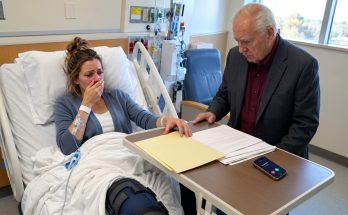
Chapter 7: The Hearing and the Well
The hearing was on the twelfth day. They discharged me that morning, which felt like a strange joke. I walked out of the hospital with a cane Dr. Hail insisted on in clothes Leah Delgado had bought for me at a discount store because I had nothing of my own. Frank drove me to Statesville. Janet met us on the courthouse steps. It wasn’t a courtroom like on television. It was a small hearing room with a long table and an American flag in the corner and a clerk of Superior Court, a tired woman named Ms. Pope, sitting at the head of it. On one side, Janet and me. On the other side, Ethan in a navy suit I had bought him for his cousin’s wedding with a lawyer named Greer who had very white teeth and a very soft voice. Denise sat behind them holding a tissue. Behind her in the chairs along the wall were four or five people I knew. One of them was Carol from my book club. She wouldn’t meet my eyes.
Denise testified first. She was very good. She cried at all the right places. She described a daughter-in-law she had loved like her own, who had stopped sleeping, stopped eating, who had wandered the house at night. Then Greer asked her about the night of the fifth day. “She threw a mug at my son,” Denise said, and dabbed her eyes. “A full mug of hot tea. He was only trying to help her with her medical forms. She was screaming. I had to clean up the glass.” I sat very still. I had promised Janet I would sit very still. Greer went on. He talked about my mother’s long illness and how caring for a dying parent can leave scars. He talked about my father’s sudden death. He held up the screenshots of my texts. He talked about my outburst in the emergency room where he said I had shouted at hospital staff and accused my husband of a crime in front of a waiting room full of strangers. “Mrs. Grayson is a sick woman,” he said softly. “Nobody in this room disputes that her husband loves her. He’s asking for the authority to protect her from herself.”
And that was where I broke the promise. I stood up. I didn’t decide to. The cane fell over and hit the floor with a crack that made Ms. Pope flinch. “That tea was harming me,” I said. My voice filled that little room. “She put something in my tea every night for five months, and he carried it up the stairs, and he sat on my bed and watched me drink it.” Silence. Carol from book club had her hand over her mouth. Greer turned toward the clerk, sorrowful, and opened one hand in my direction as if presenting an exhibit. “Your honor,” he said. “You see what we’re dealing with?” Janet put her hand on my arm and pressed down gently until I sat. Then she stood up and her voice was so quiet that everyone had to lean forward to hear her. “What we’re dealing with,” she said, “is this.” She slid two pages across the table to Ms. Pope. Lab results from Lake View Regional showing inorganic arsenic in Ms. Grayson’s body at levels consistent with repeated exposure over months. And a written statement from Dr. Samuel Hail, the emergency physician who examined her, stating that her confusion, her numbness, and her headaches are the known effects of that exposure, not a separate illness.
Ms. Pope read both pages. It took a long time. Greer didn’t miss a beat. “Nobody disputes that Mrs. Grayson is ill,” he said. “But the family home sits on a private well, your honor. Arsenic in well water is documented throughout the North Carolina Piedmont. The husband and his mother had no way of knowing. They’re victims of this, too.” Ethan nodded slowly, his eyes wet. The grieving husband. “The well water’s already been sent for testing,” Janet said. “Results are due this week.” Ms. Pope set the pages down. She denied the emergency guardianship. She said there was no basis to strip a woman of her rights when a credible medical explanation for her symptoms was on the table. Then she ordered an independent evaluation of my capacity and set a full hearing for three weeks out. It was a win. It didn’t feel like one. I walked out of that building past Carol and Carol said, “Take care of yourself, Tori,” in the voice you use for someone in a hospital bed. And I understood that half the people I knew now thought I was unwell in my mind. In the hallway, Ethan passed me with Greer at his elbow. He didn’t speak. He wasn’t allowed to. But as he went by, his lips moved very slightly, shaping two words only I could see. You’re fine.
Detective Brooks executed her search warrant at the lake house that same afternoon. I had told her she didn’t even need it. It was my house and she had my permission to search every inch. She got the warrant anyway because she said she wanted every piece of this to hold up. She called me at seven that night on the cheap new phone Frank had bought me. “The kitchen is spotless,” she said. “Your mother-in-law offered my officers coffee. There’s no tea canister with a V on it. There’s no ginger tea at all. Actually, there are three boxes of store brand chamomile unopened. No pill bottles that shouldn’t be there. Nothing in the trash. Nothing in the recycling. She was ready for us.” I closed my eyes. “So nothing.” “So nothing in the house,” Brooks said, “which is its own kind of something. People who have nothing to hide don’t usually throw out every box of tea they own the day after the hospital calls the police.”
The next morning, Frank got the well water results. I had been sleeping in the guest room at his house in Cornelius since the hospital let me go and he laid the paper on Leah’s kitchen table so I could see it with my own eyes. My father’s well was clean, no arsenic, nothing. And Ethan’s been drinking from that tap for six years, Frank said. Denise for six months. Calvin every other night. Nobody else in that house lost their hair. So the well was gone as an excuse. That should have felt like winning, too. But Brooks had more news that afternoon, and it changed everything about what kind of danger I was in. “Calvin Ror,” she said, “doesn’t exist before 2019. No credit history, no addresses, no tax records. But I ran his photo through a database and Florida came back with a match. Carl Benning in 2019. He was living with a widow in Sarasota named Margaret Ives. She died that spring. Stomach trouble, weeks of it.” Brooks let that sit. “He inherited her condo. Nobody ever looked twice.” I was standing in Leah’s kitchen holding the phone and I had to put my other hand flat on the counter. “He’s done this before,” I said. “I think he might have,” Brooks said. “And Victoria, listen to me. You’re not just a patient in this case. You’re the only living witness to it.”
The Delgado house in Cornelius was small and loud and full of life in a way I had forgotten houses could be. There were rain boots by the door in three sizes. There was a dog named Biscuit who slept against the guest room door every night as if somebody had assigned him the job. And there was Rosie, eight years old, with a gap where her front teeth were coming in, who had decided on my second day there that I was hers. That evening, she brought me a card she’d made at the kitchen table. Construction paper folded crooked. On the front, she had drawn a dock with a girl standing at the end of it and a red can on a post with lines coming out of it to show it was loud. “Daddy says your dad had a horn,” she said. “That’s it. That’s the horn.” I held that card for a long time. Leah was kind to me in those days, but careful. She made up the guest bed with good sheets. She left a toothbrush on the sink, still in its package. And twice I caught her standing at the front window after dark, looking out at the street with her arms folded. She never said she was scared. She didn’t have to.
After dinner, Frank washed and I dried because I couldn’t stand being useless. He was quiet. Then with his hands in the soapy water, he stopped moving. “Tori,” he said, “your dad’s pantry camera. What about it?” “We didn’t wire it to the cloud. Your dad didn’t trust the cloud. He said if a burglar could steal his outboard, a burglar could steal a password.” Frank turned around, dripping. “So we ran a cable from the pantry through the wall under the yard in a conduit to a little recording drive in the loft of the boathouse. So nobody breaking into the house could grab the recording. It records whenever something moves. When it fills up, it writes over the oldest stuff.” He swallowed. “I never took it out. I don’t think anybody ever turned it off.” I set down the plate I was holding. I saw that pantry in my mind. The corner of the ceiling where the little camera sat behind a coil of extension cords. The shelf right across from it at eye level. The shelf where Denise kept her tea. “It’s pointed at the tea shelf,” I said. “It’s pointed at the tea shelf.” For the first time since the hospital, I felt something besides fear and shame. I felt my father, two years gone, and he was still standing guard over that house.