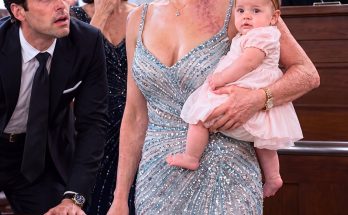
Behind me, I heard my father clear his throat roughly, the way men from the country do when they’re trying very hard not to cry in public.
“Does he have a name?” Gloria asked gently.
I hadn’t let myself pick one. Every time I’d suggested a name, Carter had laughed at it, and Mrs. Eleanor had insisted the baby would be named Carter Whitmore III, after his father and grandfather. I had stopped arguing.
I looked at my son’s fist, wrapped around my finger.
“Samuel,” I said. “Samuel Thomas Reed.”
My father made a choked noise behind me.
“Reed?” Gloria asked, writing on her clipboard.
“Reed,” I said firmly. “That’s my maiden name. And it’s the only name he’s going to need.”
The visitors started arriving that afternoon.
The first was Detective Harold Kim of the Alexandria Police Department, a soft-spoken man in a rumpled suit, who sat down beside my hospital bed with a notepad and a box of tissues.
“Mrs. Whitmore—”
“Reed,” I said. “Please.”
He nodded without missing a beat. “Ms. Reed. I need to ask you about last night. And if you’re willing, I need to ask you about the last two years.”
My father stood up from his chair. “I’ll wait outside.”
“Daddy, you can stay.”
“No, sweetheart.” He touched my hair. “This is your story. Tell it your way. I’ll be right outside the door.”
So I told it.
I told Detective Kim about the first time Carter shoved me, three months after our wedding, because I had gotten a speeding ticket. I told him about the screaming, the name-calling, the way Carter controlled our bank accounts even though I earned my own paycheck as a respiratory therapist. I told him about Mrs. Eleanor moving into our guest room “temporarily” a year ago and never leaving. I told him how she inspected the dishes I washed and made me do them again. How she told me I was too ugly and too poor and too common for her son. How Carter always took her side.
And I told him about the journal.
“What journal?” Detective Kim asked, looking up from his notes.
“After the first time he hurt me, I bought a little notebook at a drugstore. A green one, with flowers on the cover. I wrote down every incident. Dates, times, what was said, what happened. I took pictures of bruises with my phone and emailed them to an account Carter didn’t know about.” I took a deep breath. “My mother was a nurse. When I was little, she told me that if anyone ever hurt me, I should write everything down, because memories fade, but paper doesn’t.”
Detective Kim set down his pen. “Where is the journal now, Ms. Reed?”
“In my locker at work. At the hospital in Fairfax. Locker 214. The combination is my mother’s birthday.”
He wrote that down very carefully.
“Ms. Reed,” he said, “in nineteen years on this job, I’ve worked a lot of domestic cases. Do you know the hardest part of them?”
I shook my head.
“Proving the pattern. Proving it wasn’t one bad night. Defense attorneys love one bad night. They’ll say he was stressed, she was emotional, it was a misunderstanding.” He tapped the notepad. “What you just told me about is two years of documentation. Plus the recording of the call. Plus physical evidence at the scene. Plus your medical records from last night.”
He paused.
“Plus one more thing you don’t know about yet.”
“What?”
“Your neighbor across the street. Mrs. Dorothy Patterson. Retired schoolteacher, about eighty years old. She came down to the station this morning on her own, holding a USB drive in a plastic sandwich bag.”
I knew Mrs. Patterson. She was the sweet widow who waved at me every morning from her porch, who sometimes left zucchini bread on our doorstep. Carter called her a nosy old bat.
“Her grandson installed a doorbell camera on her house last Christmas,” Detective Kim said. “It points straight at your front door. And it records audio.”
I put my hand over my mouth.
“At 8:20 p.m. last night, it caught you walking up your front steps with a grocery bag. It caught the door opening. It caught the sound of the slap and you falling against the wall. And it caught every word your husband screamed at you.”
“She brought that to you?”
“She did. And she brought something else.” He smiled slightly. “She told me she’s heard yelling from your house for two years and always regretted not calling anybody. She said, and I’m quoting her here, ‘I was a coward once. I won’t be a coward twice.’”
I cried again. I was getting very tired of crying, but I couldn’t help it.
For two years, I had believed I was alone. I had believed nobody saw, nobody heard, nobody cared.