“Thirteen surgeries,” I said. “I counted them, in case you forgot. You were at two.”
A reporter lowered her camera and wiped her eyes.
Part 4: The Fall
Preston tried one more time. He always did.
“Vivian, please,” he whispered, stepping toward me. “Whatever you think I did, we can fix it. We’re married. You can’t testify against your husband.”
“That’s not how the law works,” said a new voice.
A woman in a gray suit had come up the staircase quietly, flanked by two men in dark coats. She held up a badge. “Preston Hale? Special Agent Dana Whitfield, Securities and Financial Crimes. We’d like to speak with you.”
“Not here,” Preston said hoarsely. “Not in front of…”
“Here is fine,” she said. “We have a warrant for your records and your devices, and Ms. Vaughn’s. Please hand me your phone.”
The crowd made no sound. Even the photographers lowered their cameras a few inches, as if some part of them understood this wasn’t entertainment anymore.
Preston looked at me. For the first time in five years, I saw him without the arrogance, without the mask, without the suit. He looked like what he was, a frightened man who had mistaken a stranger’s kindness for a debt he’d never have to pay.
“You planned this,” he whispered.
“I audited you,” I said. “You planned the rest.”
The agents took his phone. They took Cassidy’s too. She tried to pull away, and her clutch fell open on the red carpet. A small white card slid out, and a photographer near the barricade snapped a picture of it before she could grab it.
It was an appointment card from a medical clinic, dated last week. The photographer zoomed in, and the headline would appear online within an hour.
Negative.
“You’re not pregnant?” Preston said blankly.
Cassidy’s eyes filled with tears. “I… I was going to be. I thought if I…”
“You told me,” he said. “You told me, for three months…”
“I thought you’d leave her faster!”
“You lied to me?”
“You lied to everyone!”
Their voices rose, tangled, ugly, and loud enough for every microphone on that carpet. I didn’t look back at them. There was nothing left in that argument that belonged to me.
Gideon offered his arm again.
“Shall we go in?” he said. “I believe they’re serving something French.”
I almost laughed. “I think I’d like that.”
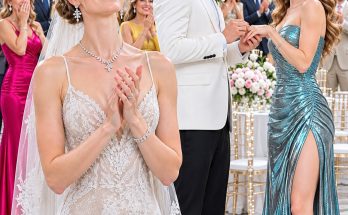
We walked up the remaining steps together while behind us the agents led Preston and Cassidy toward a waiting black sedan. The crowd parted for us in a hush that slowly turned into applause, scattered at first, then swelling, a sound I had never imagined I would hear on that carpet.
I did not turn around to wave. I walked into the ballroom with my back to the world and the phoenix glowing on my skin.
Epilogue: What the Fire Left
The trial lasted four months. Preston pleaded guilty to wire fraud, securities fraud, and forgery in the second week. Because of the amount stolen, and because he had used client trust funds, the judge sentenced him to nine years in federal prison. Cassidy took a plea deal and testified against him, and received eighteen months and a restitution order she would spend most of her thirties paying.
Hale Capital was dissolved. Ashford Group acquired the client accounts that could be saved, and every investor whose money had been taken was repaid in full, which was the part I cared about most. I had insisted on it. Gideon agreed in under a minute.
The divorce took even less time. Preston didn’t contest a single clause. I kept the apartment we’d bought together, sold it two months later, and rented a small place with tall windows on the Upper West Side. I painted one wall yellow, for no reason except that I wanted to.
A week after the gala, a thick cream envelope arrived at my office. It was from the jeweler who had made the phoenix. Gideon had commissioned it, I learned, three weeks earlier, after I told him the scars had ended my modeling career and my marriage on the same day.
Ms. Hale, the note read. The design came from your own surgeon’s photographs. We did not cover the scars. We honored them. The piece is yours to keep, or to return to the sea of jewelry that tells women what to hide. Your choice. With respect, Etienne Lavoisier.
I kept it, of course. But I also did something I’d never thought I would do.
Six months later, I stood on a small stage in a hospital auditorium in Boston, in front of two hundred burn survivors and their families, wearing a gown with a low back. I told them I had spent five years hiding from a mirror because a man told me I was ugly, and that the ugliest thing in my life had never been my scars. It was the voice that taught me to be ashamed of them.
A young woman in the third row, no older than twenty, her arms wrapped in compression sleeves, was crying quietly. When I finished, she stood up, rolled one sleeve to her elbow, and held up her arm, scars and all, to the whole room.
Nobody said anything. Nobody needed to. The applause came on its own.
Afterward, Gideon found me in the lobby, holding a paper cup of terrible hospital coffee.
“I came to tell you the Ashford Foundation just approved funding for a burn-survivor surgery fund,” he said. “Fifty million over ten years. In your name, if you’ll permit it.”
“Don’t put my name on it.”
“No?”
“Put the names of the surgeons,” I said. “And the nurses. And the people who sat beside those hospital beds at three in the morning. They’re the ones who did the work.”
He smiled, the rare, real kind. “You know, you’re the only person who has ever turned down a monument.”
“I don’t need a monument,” I said. “I already carry one.”
He looked at me for a long moment, then glanced, almost shyly, at the low back of my dress.
“Vivian,” he said, “would you let me take you to dinner? Not as your boss. Not as anything else you need me to be. Just as a man who has admired you for a very long time.”
I took a sip of the terrible coffee. For five years I had flinched from every hand that came near my back. Now, in a hospital lobby, with the winter light on my scars and nobody to perform for, I realized that I wasn’t afraid.
“I’d like that,” I said.
Preston once told me no one would ever want to look at my skin.
He was wrong about that, too. But the most important thing I learned was that it never mattered who looked. What mattered was that I finally did.
The End.