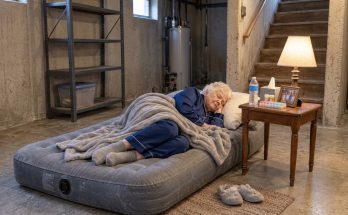
I lay still, listening.
Cupboards opened.
A pan touched the stove.
Then I heard Margaret call from downstairs.
“Claire? Would you like some breakfast?”
I stared at the ceiling.
It was the first time she had asked me that question.
I did not answer immediately.
There was something painful about realizing how little it would have taken to make my first days home different.
A warm meal.
A comfortable bed.
Someone who asked what I needed.
None of those things required a second refrigerator.
They only required consideration.
I settled June, washed my face, and went downstairs.
Margaret stood beside the stove making oatmeal.
She had arranged two bowls on the counter.
“Ethan called,” she said.
I stopped near the table.
“Is he all right?”
“He's fine. He sounded tired.”
I nodded.
She stirred the oatmeal.
“He didn't sleep much.”
Neither had I.
I wanted to say so, but I was weary of measuring suffering.
“I hope he gets some rest,” I replied.
Margaret turned off the stove.
For a few moments, she seemed unsure what to do.
Then she placed a bowl in front of me.
“I made yours with cinnamon.”
“Thank you.”
She sat across from me.
Her gray hair was pulled into a loose knot. Without her usual carefully arranged clothes and jewelry, she looked older than she had the day before.
I wondered whether Ethan's leaving had frightened her.
She had surrendered her apartment believing she was securing a permanent home with her son.
Now she was living in a house where the woman who owned it no longer trusted the promises that had brought her there.
“I never expected things to end up this way,” she said.
I stirred my oatmeal.
“Neither did I.”
Margaret looked down at her hands.
“Ethan always tries to take care of me.”
“I know.”
“He worries.”
“I know that too.”
She glanced toward the hallway.
“After his father died, he became very protective.”
I waited.
“He was fourteen. Too young to carry all that responsibility, but he tried. If something needed fixing, he fixed it. If I was upset, he wanted to make it better.”
She paused.
“I suppose I became accustomed to that.”
I thought about the man who had canceled my recovery assistance rather than disappoint his mother.
The boy Margaret described was easy to recognize.
But I could not allow his childhood responsibilities to justify the choices he made as an adult.
“Ethan was a child when he lost his father,” I said. “He shouldn't have had to take care of everything.”
Margaret nodded.
“He wasn't supposed to.”
“But now he's a husband and a father. He needs to understand that helping you doesn't mean taking something away from us.”
She looked at me.
I continued carefully.
“And you need to stop accepting things that don't belong to you just because he offers them.”
Her face tightened.
“You mean the bedroom.”
“Yes.”
She studied the bowl in front of her.
After a while, she spoke.
“I liked the room.”
I hadn't expected such a simple admission.
“The bed is comfortable,” she continued. “The bathroom is nearby. And after spending years worrying about rent, it felt good to have somewhere settled.”
I listened.
“I told myself you wouldn't mind because you were young and healthy.”
I almost laughed.
Young and healthy.
I had just undergone surgery to deliver twins.
“Margaret, I was recovering from an operation.”
“I know that now.”
“You knew it before.”
She did not argue.
The silence that followed was uncomfortable, but I let it remain.
Finally, she said, “I suppose I didn't want to think about what it meant for you.”
There it was.
Not an excuse.
Not a claim of misunderstanding.
An acknowledgment.
I looked toward the refrigerator carrying her name.
“I found the note you wrote on the receipt.”
Margaret's eyes lifted.
“What note?”
“Permanent arrangement, after babies come.”
Her face changed.
“Oh.”
“You expected to stay indefinitely.”
“Yes.”
“Did you ever intend to ask me?”
She took a long breath.
“I thought Ethan had settled it.”
“Did you want to know whether I agreed?”
She looked away.
“No,” she admitted. “I don't suppose I did.”
It was not the apology I had wanted.
But it was the first honest conversation we'd had since I returned from the hospital.
I finished my breakfast.
Then I told her what would happen next.
I had already arranged another conversation with the attorney. Ethan and I would need to address our finances and his continued relationship with the girls.
Margaret's housing situation would also need a proper solution.
I was willing to allow reasonable time for that to happen, provided we all respected clear boundaries during the transition.
But I would not continue living under the arrangement Ethan had created.
Margaret listened without interrupting.
When I finished, she looked toward the staircase.
“I suppose I'll need to find another apartment.”
“Yes.”
She pressed her lips together.
“I don't know whether I can afford the rents around here.”
“Then Ethan should help you review your options. He made you a promise he hadn't discussed with me.”
She nodded slowly.
“I'll speak to him.”
I rose carefully from the chair.
As I reached the hallway, Margaret called my name.
“Claire?”
I turned.
She looked embarrassed.
“Would you like me to take June for a little while so you can shower?”
I hesitated.
Then I nodded.
“Yes. That would help.”
It was a modest beginning.
I did not mistake it for a repaired relationship.
But for the first time, she was asking rather than deciding.
Over the next several days, I learned how different life could feel when I stopped trying to protect everyone from the consequences of their own choices.
Tessa came in the mornings.
The postpartum helper visited on scheduled days.
A neighbor brought homemade bread and a container of stew.
I accepted those gestures without apologizing.
Ethan called every evening to ask about the girls.
At first, the conversations were strained.
He would ask whether Nora and June had eaten and whether they were sleeping.
I would answer, then ask when he wanted to visit.
Sometimes he seemed relieved that I was willing to discuss the babies without reopening our argument.
Other times, I could hear him waiting for reassurance that everything would return to normal.
I never gave it.
Not because I wanted him to suffer.
Because the old normal was exactly what had brought us here.
On Wednesday afternoon, he arrived carrying diapers, wipes, and two packages of baby clothes.
He stood awkwardly on the porch.
“Can I come in?”
I opened the door wider.
“Of course. The girls are awake.”
He followed me into the living room.
The two bassinets stood near the sofa, where Tessa had helped me arrange them for the afternoon.
Ethan approached Nora first.
“Hello, sweetheart.”
She turned her head toward his voice.
He smiled.
For a moment, I remembered the man who cried when the nurse first placed our daughters in his arms.
That man had been real.
The husband who bought a separate refrigerator had been real too.
I was learning not to erase one version of Ethan to make the other easier to understand.
He sat with Nora while I prepared June's bottle.
After a while, he asked, “How are you feeling?”
“Still sore. A little better.”
“Are you getting any sleep?”
“Not much, but the help has made a difference.”
He nodded.
“I've been thinking about that service.”
I waited.
“I shouldn't have canceled it.”
“No,” I said. “You shouldn't have.”
He looked at the baby in his arms.
“I thought Mom would do everything.”
“I know.”
“I didn't think about how much work two babies would be.”
I placed June's bottle on the table.
“Ethan, I told you repeatedly that we would need help.”
He nodded.
“I know.”
“You were there when the doctor explained my recovery.”
“I know that too.”
“Then I need you to understand that the problem wasn't simply not knowing. You chose not to listen.”
He looked ashamed.
I wanted to comfort him.
That habit was almost automatic.
But I resisted it.
He needed to sit with the discomfort long enough to understand what had caused it.
After a few minutes, he asked if he could change Nora.
I handed him a clean diaper.
He completed the task slowly, checking everything twice.
Then he looked up.
“Can I come tomorrow?”
“Yes.”
He hesitated.
“Would you mind showing me the feeding schedule?”
I brought him the notebook.
We went through it together.
He asked questions.
I answered.
There was nothing dramatic about the afternoon.
No declaration.
No sudden reconciliation.
But when he left, both girls had been fed, changed, and settled.
For the first time since their homecoming, Ethan had spent an afternoon behaving like a father who understood that caring for his daughters required more than loving them.
That evening, I felt something unfamiliar.
Not forgiveness.
Possibility.
The next important conversation happened three days later.
Margaret had asked Ethan to meet her in the kitchen.
I was upstairs resting when she knocked on the office door.
“Claire, would you join us for a moment?”
I looked at her.
“Is something wrong?”
“No. I think we need to discuss the apartment.”
I followed her downstairs.
Ethan sat at the table with his laptop open.
Several rental listings were displayed on the screen.
Margaret lowered herself into a chair.
“I've found a place near the library,” she said.
She slid a printed page toward me.
It described a small one-bedroom apartment in a building with an elevator.
The monthly rent was more than she had paid before, but it was within reach if she adjusted her budget.
Ethan had offered to help with the moving expenses and the initial deposit.
I looked at the photograph.
The building had a small garden and covered parking.
“Have you visited?”
“Tomorrow,” Margaret replied.
I nodded.
“It looks pleasant.”
She folded her hands.
“I don't want you to think I'm doing this because you've frightened me.”
I waited.
“I'm doing it because I don't think staying here will make any of us happy.”
Ethan looked down.
Margaret glanced at him.
“I wanted to live near you. I thought being in the same house would make us close again.”
Her voice softened.
“But I didn't think enough about the family you'd already built.”
Ethan stared at the table.
“Mom, you don't have to say that.”
“Yes,” she replied. “I do.”
I looked at her in surprise.
She continued.
“I should have asked Claire whether she wanted me here permanently. And when I saw how uncomfortable she was after coming home, I should have offered to move out of the bedroom.”
She turned toward me.
“I'm sorry.”
The words were simple.
They did not undo anything.
But I appreciated that she had finally said them without adding an excuse.
“Thank you,” I replied.
Ethan rubbed his forehead.
“I made the arrangements.”
Margaret nodded.
“You did.”
“I told you it was okay.”
“You did.”
He looked at her.
“Then why are you acting like this is all your fault?”
She gave a sad little smile.
“Because I was old enough to know that being offered something doesn't always mean it's right to take it.”
I looked at Ethan.
He had spent our marriage treating his mother's wishes as obligations that could not be questioned.
Now she was telling him something he had refused to hear from me.
His expression changed.
For the first time, I saw him considering the possibility that saying no to his mother could be an act of responsibility rather than betrayal.
Margaret signed the lease the following week.
She moved into the apartment after we had checked the practical details and agreed on a date.
Ethan arranged the moving company and paid the agreed expenses from his own funds.
Tessa came to help me with the babies while the movers carried Margaret's furniture downstairs.
I stayed out of the way.
My incision was healing, but I had no intention of lifting boxes.
Margaret had packed her belongings neatly.
Her framed photographs went into a cardboard box.
Her books filled two smaller cartons.
The lamp she had placed on my nightstand was wrapped in a blanket.
Before leaving, she came into the office.
I was sitting beside June's bassinet.
Margaret held something folded in her hands.
It was my gray cardigan.
“I washed this,” she said.
I took it.
“Thank you.”
She looked around the little room.
“I'm sorry you had to spend your first days with the girls in here.”
I looked at the daybed.
“So am I.”
She nodded.
Then she asked, “May I come visit them sometimes?”
I met her eyes.
“Yes. We'll arrange visits together.”
Her expression softened.
“I'd like that.”
After she left, Ethan stood in the hallway outside our bedroom.
For several moments, he didn't move.
Then he stepped inside and looked around.
The bed had been stripped.
The unfamiliar lamp was gone.
The dresser had been cleared.
The room looked strangely empty, as though it had been waiting for us to decide what it was supposed to become.
Ethan turned toward me.
“I'll help put everything back.”
I nodded.
“Thank you.”
He looked at the bassinets in the office.
“Do you want me to move them today?”
“Not by yourself. Tessa can help, and I want to make sure the room is arranged safely.”
“Okay.”
There was that word again.
Only this time, it sounded like agreement rather than surrender.
We spent the afternoon making the bedroom ready.
Ethan washed the sheets and helped move the bassinets.
Tessa checked that the walkways were clear.
I arranged the girls' supplies within comfortable reach.
When the room was finished, I stood in the doorway and looked at the two small beds beside ours.
The curtains were open.
Sunlight crossed the quilt Grandma had made years before.
My own pillows rested against the headboard.
The room smelled of clean cotton.
I felt the tightness in my chest ease.
It was the same room I had expected to return to after the hospital.
But I was not the same woman who had left it.
I had learned how easily a familiar home could become unfamiliar when the people inside stopped treating one another with care.
And I had learned that reclaiming a space did not automatically repair what had happened there.
That evening, Ethan prepared to leave.
He had not asked to move home.
I was grateful.
As he reached the front door, he turned.
“Claire?”
“Yes?”
“Do you think we'll ever be okay again?”
I looked at him.
“I don't know.”
He nodded slowly.
I could see that the answer hurt.
But I wasn't willing to offer comfort by making a promise I could not yet keep.
“I do know that what happens next matters,” I added.
He looked up.
“You can't apologize once and expect me to forget. I need to know that when something difficult happens, you'll talk to me instead of deciding for me.”
He listened.
“And I need to know that our daughters will always be your responsibility, even when someone else wants your attention.”
His eyes moved toward the bassinets.
“They will be.”
“I hope so.”
He swallowed.
Then he said something I had waited weeks to hear.
“I was wrong.”
I remained quiet.
He continued.
“I knew you didn't want Mom living here permanently. I told myself you'd accept it once she was settled.”
My throat tightened.
“I thought if I made the arrangements before the babies came, it would be too difficult to change them.”
The admission hurt more than I expected.
It confirmed what the refrigerator receipt had suggested.
He had not merely avoided a conversation.
He had counted on my exhaustion.
Ethan's eyes filled.
“I told myself I was protecting Mom. But I was taking advantage of you.”
I looked away for a moment.
He didn't come closer.
He didn't ask me to make him feel better.
Finally, I said, “Thank you for telling me the truth.”
He nodded.
Then he left.
I stood at the doorway long after his car disappeared.
There were moments when I still wanted to call him back.
Not because everything had been resolved.
Because I missed the marriage I thought we had.
But I knew that allowing him to return simply because we were lonely would not guarantee a different future.
I went upstairs and lay down in my own bed.
Nora stirred beside me.
June slept quietly.
For the first time since bringing them home, I could reach both bassinets without twisting painfully around a desk.
The relief was so ordinary that it brought tears to my eyes.
Over the next month, Ethan and I worked through the financial consequences.
The stainless-steel refrigerator was returned to the retailer under its return policy, with a restocking deduction.
The refund went back into the recovery fund.
The extra mattress was sold after Margaret settled into her apartment.
We could not recover the full cost.
The contractor's work remained part of the house, although most of it had never been necessary for the girls or me.
Ethan reviewed the remaining expenses with me and agreed to restore the money over time using his personal spending budget and planned contributions.
We put the arrangement in writing.
It was not a punishment.
It was a record of how we intended to repair a financial decision that had been made without joint consent.
Our attorney helped us understand how to handle the household accounts and the children's expenses during our separation.
We kept the girls' needs outside any disagreement over the marriage.
Ethan contributed to their care regularly.
He purchased supplies when needed.
He participated in appointments whenever possible.
And, perhaps most importantly, he began keeping track of what the girls needed without waiting for me to assign him every task.
At first, he made mistakes.
He packed the wrong size diapers for an outing.
He forgot an extra set of clothes.
Once, he arrived without the bottle supplies we had discussed.
In the past, he might have become defensive.
Instead, he corrected the mistakes.
He made a checklist.
He asked questions.
He learned.
I noticed the change, but I was careful not to confuse basic parental responsibility with extraordinary heroism.
The girls deserved a father who knew their routines.
That had always been part of what he promised when we decided to become parents.
One Saturday morning, when Nora and June were nearly two months old, Ethan arrived for a scheduled visit.
He brought a small bag containing everything the girls needed for the afternoon.
He washed his hands, checked the notebook, and asked whether I had eaten.
I told him I hadn't yet.
“I can make breakfast,” he offered.
I hesitated.
Then I nodded.
He prepared scrambled eggs and toast while I fed June.
The kitchen smelled of butter.
Sunlight moved across the counter.
For a moment, the scene reminded me of our early years together.
But there was an important difference.
Ethan wasn't cooking because he wanted praise.
He wasn't announcing what a sacrifice he was making.
He was making breakfast because someone needed to eat.
When he brought the plate to the table, he sat across from me.
“I've been talking to someone,” he said.
I looked up.
“A counselor?”
He nodded.
“I realized I've spent most of my life trying to stop Mom from being disappointed.”
I put down my fork.
He continued.
“When Dad died, I promised her I'd always take care of her. I was a kid, but I thought it was my job to keep everything from falling apart.”
I listened.
“Whenever she was unhappy, I felt like I'd failed.”
He looked toward the living room, where Nora lay quietly in her bassinet.
“Then I married you, and I started doing the same thing. Only instead of helping Mom deal with disappointment, I tried to make sure she never experienced any.”
I felt sadness rise inside me.
Not just for myself.
For the boy who had carried an impossible responsibility.
And for the man who had allowed that responsibility to become an excuse for hurting the family he had chosen.
“Ethan,” I said, “you can love your mother without giving her whatever she asks for.”
He nodded.
“I'm beginning to understand that.”
I looked at him for a moment.
“And you can love me without expecting me to accept whatever you decide.”
He met my eyes.
“I know.”
There was no grand declaration.
No sudden embrace.
We finished breakfast while the girls slept.
Sometimes that was enough.
Margaret also began changing how she approached our family.
She called before visiting.
She asked what the girls needed.
When she brought food, she made enough for everyone and placed it in our refrigerator without assigning ownership.
Her first visit to the house after moving out was awkward.
She stood near the kitchen doorway holding a container of chicken soup.
“I wasn't sure whether you'd want this,” she said.
I looked at the container.
“Did you make it?”
“Yes.”
“Then thank you. That would be helpful.”
She smiled faintly.
I placed it beside the other food.
Later, while she held June, Margaret glanced toward the empty space where the stainless-steel refrigerator had stood.
“Looks better without that enormous thing,” she said.
I looked at her.
“Yes,” I replied. “It does.”
She gave a small, embarrassed laugh.
Then she grew serious.
“I've been thinking about what I said when you came home.”
I waited.
“About separate families.”
I nodded.
“I shouldn't have said it.”
“No,” I agreed.
She looked down at June.
“Those words weren't fair to you. Or to the girls.”
I watched her gently stroke the baby's blanket.
“I wanted to be important to Ethan,” she admitted. “And when he made arrangements for me, I enjoyed feeling that way.”
Her voice trembled slightly.
“I didn't stop to think that he was making you feel unimportant.”
I took a moment before answering.
“Margaret, I never wanted to take your place in his life.”
She nodded.
“I know that now.”
“You don't have to compete with me for his love.”
She looked at me.
“And you shouldn't have had to compete with me.”
For the first time, I believed she understood.
Forgiveness did not happen immediately.
There were still uncomfortable afternoons and conversations that left me tired.
But the relationship gradually became something different.
Margaret was a grandmother.
I was the girls' mother.
Ethan was their father.
We no longer needed to pretend those roles were interchangeable or that loving one person required diminishing another.
Three months after the twins came home, Ethan and I began attending marriage counseling together.
I had made it clear that counseling was not a guarantee that I would take him back.
It was an opportunity to find out whether we could build a marriage that was different from the one we had been living.
During one session, the counselor asked when I first felt that Ethan had stopped treating me as an equal partner.
I expected to describe the refrigerator.
Instead, I remembered smaller moments.
The holiday plans changed without asking.
The weekends spent visiting Margaret even when I had other commitments.
The family decisions presented as finished arrangements.
The times Ethan called me difficult because I wanted to discuss something before agreeing.
I had not recognized those moments as a pattern.
The refrigerator had merely made the pattern impossible to ignore.
I told the counselor about them.
Ethan listened.
Sometimes he became defensive.
Sometimes he looked ashamed.
But gradually, he stopped trying to explain every decision as an act of kindness.
He began admitting that avoiding conflict with his mother had often meant creating conflict with me.
And that he had expected me to absorb it quietly.
One afternoon, the counselor asked him a question.
“What would you do differently if your mother needed help finding housing tomorrow?”
Ethan thought for a long time.
Then he answered.
“I'd talk to Claire before promising anything that affected our home.”
The counselor nodded.
“And if Claire disagreed?”
He looked at me.
“I'd listen to why.”
I felt something loosen inside my chest.
It was a small answer.
But it was different from the ones he had given before.
He was no longer describing marriage as a situation where one person made decisions and the other learned to accept them.
He was beginning to describe a partnership.
By the time the girls were four months old, I had recovered enough to take them for short walks in the neighborhood.
Some mornings, Tessa joined us.
Other days, Ethan came by and pushed the stroller.
The girls had begun smiling more often.
Nora loved looking at the leaves moving above her.
June seemed happiest when someone spoke softly to her.
I watched them discover the world and felt grateful that their earliest months had not been entirely defined by the conflict surrounding their homecoming.
There had been difficult days.
There had also been warm baths, clean blankets, quiet songs, and the steady affection of people who loved them.
I was proud of that.
Not because I had managed everything alone.
Because I had finally allowed myself to accept help and set limits when help came with conditions.
One evening, after putting the girls down, I sat with Ethan on the back porch.
Grandma's roses were blooming again.
He had brought a small notebook containing the latest account balances and the payments he had made toward restoring our savings.
We reviewed them together.
The recovery fund had not yet returned to its original balance, but the plan was being followed.
He closed the notebook.
“Can I ask you something?”
“Yes.”
“Do you think I could come home?”
I looked out at the garden.
I had known the question would come eventually.
We had been living separately for months.
He had continued paying his share of family expenses, showing up for the girls, attending counseling, and making changes that were inconvenient enough to require genuine effort.
I missed having him nearby.
But I also valued the peace I had found.
“What would coming home mean to you?” I asked.
He considered the question.
“Being your husband. Being the girls' father. Sharing the work and the decisions.”
I turned toward him.
“And your mother?”
“She has her apartment. I'll continue helping her when she needs it. But I won't promise her anything that affects us without talking to you.”
I nodded slowly.
He reached for my hand, then stopped.
“I'm not asking you to forget what happened.”
“Good,” I said.
“Because I don't want to forget it either.”
I looked at him.
He continued.
“I never want to be the man who made his wife come home from the hospital and wonder whether she was welcome.”
My eyes filled.
For a long moment, I couldn't answer.
Finally, I said, “I want to believe we can make this work.”
He nodded.
“But I need us to continue counseling. I need us to keep our financial decisions transparent. And if we disagree about something important, I need you to stay in the conversation.”
“I will.”
I looked at him carefully.
“I don't need another promise you make because it's what I want to hear.”
He swallowed.
“I know.”
“I need you to do it.”
He nodded again.
This time, I believed he understood the difference.
We did not make a final decision that evening.
Over the following weeks, we worked through the practical details of living together again.
We discussed childcare.
We reviewed the household budget.
We agreed on visiting arrangements with Margaret.
We talked about what would happen if either of us felt that old patterns were returning.
And we continued counseling.
Eventually, I agreed that Ethan could move home on a trial basis.
I did not make the decision because I was afraid to be alone.
I had already learned that I could manage with the right support.
I made it because I had seen enough consistent change to believe there was something worth rebuilding.
The day he returned, there was no celebration.
He carried his bags upstairs and put his clothes away.
Then he came downstairs and asked whether the girls needed changing.
June did.
He took her without waiting for instructions.
I watched him settle her on the changing mat.
He spoke softly while fastening the diaper.
Afterward, he carried her into the living room and sat beside Nora.
For a moment, I stood in the doorway.
The house was quiet except for the ticking clock and June's small sounds.
There was no second refrigerator.
No handwritten division of the household.
No mother-in-law occupying our bedroom.
Only the four of us, learning how to live together with more care than we had shown before.
A few weeks later, Margaret came for Sunday lunch.
She brought a casserole and a small bouquet of flowers from her apartment building's garden.
Tessa joined us.
Ethan prepared the salad while I set the table.
Margaret sat with the girls, telling them a story about how their father used to hide his shoes whenever he didn't want to go to school.
Tessa laughed.
Ethan pretended to be embarrassed.
I watched them from the kitchen.
For years, I had believed a happy family meant everyone getting along all the time.
I knew better now.
A family could disagree.
People could have different needs.
A mother could worry about growing older.
A husband could struggle with obligations carried from childhood.
A wife could need rest, respect, and support.
None of those needs required someone else to disappear.
What mattered was whether we were willing to listen before making decisions that affected one another.
After lunch, Margaret offered to wash the dishes.
Ethan joined her at the sink.
I went upstairs to feed Nora.
When I came back down, I found Margaret drying a plate.
She looked toward the refrigerator.
“Do you remember that awful stainless-steel thing?” she asked Ethan.
He glanced at me.
“Yes.”
Margaret shook her head.
“I don't know what we were thinking.”
Ethan placed a clean glass on the counter.
“I do,” he said quietly. “We were thinking about ourselves.”
She looked at him.
Then she nodded.
He turned toward me.
“And we forgot who else lived here.”
For a moment, nobody spoke.
I didn't need to add anything.
They had finally said aloud what I had struggled so hard to make them understand.
That evening, after everyone left, I stood alone in the kitchen.
Our old refrigerator hummed softly beside the pantry.
Its dented door was covered with photographs of Nora and June, appointment reminders, and a small drawing Tessa had made of the four of us.
There were no names declaring who owned the food inside.
I opened it and found containers of soup, vegetables, fruit, and leftovers from lunch.
On one shelf sat a small container of chicken stew.
Margaret had labeled it with the date and reheating instructions.
I smiled.
Once, labels had been used to divide us.
Now they simply helped us remember what was inside.
Ethan entered carrying June.
“Nora's asleep,” he whispered.
“Good.”
He looked at the open refrigerator.
“Are you hungry?”
“A little.”
“I can warm up the stew.”
I handed him the container.
He set June safely in her bassinet and began preparing dinner while I poured two glasses of water.
It was such a small, ordinary moment.
And yet I remembered the day I had stood in that same kitchen, newly home from the hospital, holding a baby while my husband told me to purchase separate food for myself and our daughters.
I remembered how exhausted I had been.
How badly I had wanted someone to say they were glad we were home.
How I had looked at an empty refrigerator and wondered when I had become an outsider in my own family.
That woman had frightened me with her quietness.
I had mistaken her single word, “Okay,” for surrender.
But it had been the beginning of something else.
The moment I stopped arguing long enough to see what was happening.
The moment I began gathering facts instead of accepting explanations.
The moment I decided that peace purchased with silence was not the kind of peace I wanted my daughters to inherit.
Ethan placed a warm bowl on the table.
“Here you go,” he said.
I sat down.
“Thank you.”
He smiled.
Then he pulled out the chair beside me.
From the living room came the tiny sounds of our sleeping daughters.
Outside, Grandma's roses moved gently in the evening breeze.
I knew our marriage would require continued work.
Some hurts took longer to heal than others.
There would be difficult conversations, disagreements, and moments when the old habits tempted us to choose the easier path.
But something fundamental had changed.
Ethan no longer believed that taking care of his mother meant neglecting his wife.
Margaret no longer expected love to be measured by how much space she could claim in our home.
And I no longer believed that being a good wife required me to accept whatever other people decided.
Our daughters were too young to remember the refrigerators.
They would not remember the argument in the kitchen or the morning their father walked downstairs and found the financial records spread across the table.
They would grow up hearing other stories.
About their grandmother's garden.
Their aunt's Sunday visits.
Their father's terrible singing.
And the old house with roses beside the porch.
Someday, when they were old enough to understand, I might tell them what happened when they first came home.
Not to make them distrust the people who loved them.
But to teach them something I had learned much later than I should have.
A home is not made safe merely because it has walls, furniture, and enough food.
It becomes safe when everyone inside is treated as someone who belongs.
And no one should ever have to earn that belonging by making themselves smaller.
I looked across the table at Ethan.
He reached for my hand.
This time, I let him take it.
Not because everything had been forgotten.
But because, after a long and difficult beginning, we were finally learning how to make room for one another.
Disclaimer: This fictional story was created with AI assistance for entertainment. Names, characters, dialogue, and events are fictional. Any resemblance to actual people or events is coincidental.