Then I removed my glasses and looked at both of them.
“I love you, and I’m not going to hold this against you forever. But I won’t be told to earn my keep again. If you need help, ask me honestly, and I’ll tell you what I can do.”
Michelle lowered her head onto the old kitchen table and began crying. Todd placed his hand on her back while I went to the kitchen and brought out an apple pie I’d made earlier that afternoon.
We spent the rest of the evening talking about ordinary things, including the children’s school activities and the coming holidays. For the first time since I’d moved, I felt that my daughter and I were beginning to understand each other again.
The following Tuesday, Sadie arrived carrying a backpack nearly as large as herself. She immediately noticed the wooden swing hanging from my little front porch and asked whether it belonged to me.
“It certainly does, sweetheart. And you’re welcome to sit on it whenever you visit.”
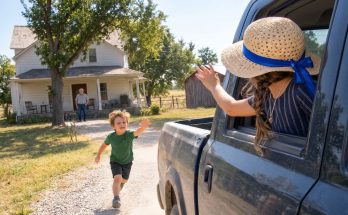
We spent the morning watching grain trucks arrive at the elevator, and Sadie insisted on knowing what each vehicle carried. Later, we walked to the elementary school, where Eli spotted me waiting near the entrance and ran straight into my arms.
His excitement reminded me how much I’d missed being part of their everyday lives. I was no longer simply the grandmother who occasionally sat in a corner of their parents’ living room.
Now I had a home they could visit, and our time together belonged to us.
A few days later, Michelle came to my door with another request. She explained that she and Todd hadn’t enjoyed an evening alone since before Sadie was born and wondered whether I’d consider keeping both children overnight.
“Mom, would you want to watch them Saturday night? You can absolutely say no.”
I smiled because she’d finally understood the difference between asking for help and expecting it.
“I certainly can say no, honey. But this time, I’m going to say yes.”
That Saturday, I spread every quilt I owned across my tiny living room floor and welcomed my grandchildren for their first sleepover.
Later that night, Eli asked me a question about Michelle’s basement that made me realize how carefully I needed to explain why I’d chosen to live alone.
PART 5: THE LITTLE HOUSE WHERE EVERYONE WAS WELCOME
That Saturday evening, I transformed my tiny living room into a sleeping area for Sadie and Eli. Since my house had no spare bedroom, I spread several thick quilts across the floor, placing the wedding-ring quilt my mother had made on top.
The children thought sleeping on the floor was an adventure, especially when I announced that we were having pancakes for supper. Afterward, we played cards, washed sticky faces at the kitchen sink, and watched the grain elevator lights glowing through the window.
When bedtime arrived, I settled onto the couch while my grandchildren curled up beneath the quilts. Sadie stared around the room, apparently surprised that she could see nearly everything from where she was lying.
“Grandma, is this your whole house?”
“It certainly is, sweetheart. Every bit of it.”
She considered my answer before smiling.
“I like it. I can see you from everywhere.”
Her innocent words touched me more deeply than she could possibly understand. For years, I’d worried that living in such a small place might seem like a failure, but my granddaughter saw something entirely different.
Then Eli raised his head from his pillow and asked a question I’d been dreading.
“Mom said you were supposed to live in our basement, but you didn’t want to. Didn’t you want to live with us?”
I reached down and gently brushed his hair away from his forehead. I knew I needed to explain my decision without making him believe I’d rejected him or his sister.
“I wanted to live close to you, Eli. But having my own house means you can come visit me whenever you want, and we can spend time together because we choose to.”
He remained quiet for a moment, considering my explanation. Then he gave me an answer that made my throat tighten.
“I’d come visit you on purpose, Grandma. Even if you lived inside the grain elevator.”
I laughed and told him the elevator would probably charge far more rent than I could afford. Both children giggled before settling beneath the blankets, and soon their breathing became slow and peaceful.
Around two in the morning, a freight train passed through town, rattling the windows and waking Sadie. She sat upright with her hair sticking in every direction, frightened by the unfamiliar noise.
“It’s only the train, sweetheart. It comes through every night.”
“Is it telling us goodnight?”
“I believe it is.”
She climbed onto the couch and nestled against me, falling asleep before the last railroad car disappeared into the darkness. I held her close and thought about Dale, wishing he could have witnessed how much happiness our grandchildren had brought into this little house.
In my mind, I told him that I’d finally found somewhere I belonged. The accounts at Brandt’s Feed Store were balanced, Michelle and Todd were getting their finances under control, and our grandchildren were sleeping safely beside me.
Most importantly, nobody expected me to earn the right to be there.
The following morning, Michelle arrived to collect the children before church. Through the kitchen window, I watched her approach the porch step that Todd had recently repaired using one of Dale’s old tools.
She could see us through the screen door, with Sadie and Eli sitting at the kitchen table in their pajamas while I prepared another batch of pancakes. Although the door was already open, Michelle stopped on the porch and knocked.
“Come on in, honey. There’s plenty of breakfast for everybody.”
She entered, kissed both children, and then leaned over to kiss my cheek. Without hesitation, she took the fourth chair at the table, and we shared breakfast while the first grain trucks of the morning arrived outside.
That small gesture meant more to me than any apology could have. My daughter finally understood that my home was mine, and entering it was an invitation rather than an entitlement.
At sixty-seven, I had two rooms, two brass keys, and a porch swing overlooking the grain elevator. I paid just $400 a month after exchanging my bookkeeping skills for a rent reduction, and I spent Tuesdays and Thursdays enjoying my grandchildren.
My life was modest, but it belonged to me in a way it never had before. I no longer needed to choose between maintaining my independence and loving my family.
I had spent most of my life believing that being needed meant making sacrifices without question. Now I understood that real love allowed people to help each other without turning affection into an obligation.
And whenever my family wanted to see me, they walked up my single porch step and knocked.
I always opened the door.