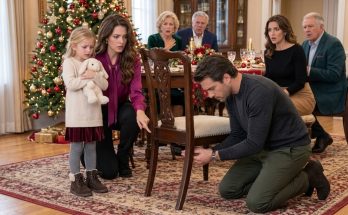
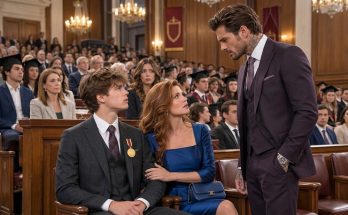
But my voice remained steady.
“I’d like to make a toast.”
Everyone looked up.
Joan smiled warmly.
“Oh, how sweet!”
Grant leaned back in his chair.
He seemed amused.
I raised my glass.
Then I looked directly at him.
“My dear husband, Grant…”
He smiled.
I thought about our wedding day.
The promises he’d made.
The future we’d imagined.
The day we brought Hazel home.
And the woman named Tessa.
For six days, I’d carried the truth alone.
Now, surrounded by the people who loved us, I was finally ready to speak.
I took a slow breath.
“Before I say anything else, I want to thank everyone for coming tonight.”
My mother smiled.
Grant reached for his wineglass.
I continued.
“Marriage is built on trust. On honesty. On keeping promises even when life becomes difficult.”
Grant’s smile began to fade.
I looked straight into his eyes.
“And sometimes, the most important things we learn about a person are the things they never intended for us to hear.”
His hand stopped moving.
The room grew quiet.
Then I said,
“Six days ago, Grant, you forgot to hang up the phone.”
His expression changed instantly.
I watched the color drain from his face.
His mother slowly lowered her glass.
My father stopped chewing.
And for the first time all evening, my husband had absolutely nothing to say.
I placed my glass on the table.
Then I asked the question I’d been holding inside for nearly a week.
“Would you like to tell everyone who Tessa is, or should I?”
Nobody moved.
Joan’s eyes went from her son to me and back again. “Grant? Who is Tessa?”
“Mom, it’s not what…”
“I recorded it,” I said.
I hadn’t planned to say that part so soon. But I’d kept my promise to myself: no one would twist this later. I took my phone from my pocket, set it on the white tablecloth between the candles, and pressed play.
His own voice filled the room.
“I can’t stand being around her anymore. Honestly, I think I hate her.”
My mother’s hand went to her mouth.
“Yes. I’ll divorce her. Then I’ll marry you.”
I stopped the recording.
The only sound was Hazel, who stirred in my mother’s arms and let out a small, sleepy whimper, as if she, too, had heard.
Grant found his voice first, and it came out cracked and small.
“You recorded my private call?”
“You were the one who left it connected,” I said. “I just pressed a button.”
“Maggie, please. It was a joke. We were blowing off steam. I didn’t mean any of it.”
“You said her name,” I said. “You said you’d marry her.”
“Honey,” Joan whispered, “is it true?”
Grant looked around the table, searching for a friendly face. He didn’t find one. My father had set down his fork and folded his hands, a posture I’d only seen when he was trying not to say something he’d regret. Russ stared at the tablecloth. Joan’s eyes had filled.
“There’s no one,” Grant said weakly. “It was just talk.”
“There’s a Tessa,” I said calmly. “Tessa Whitaker. She works in your regional office. You’ve been taking her to lunch since March. You bought her a necklace in August on our joint card, and I saw the charge, and I told myself it was a gift for your mother.”
Joan flinched.
“It wasn’t for me,” she murmured.
“No,” I said. “It wasn’t.”
Grant pushed back his chair. “This is insane. You’re doing this in front of our parents? On our anniversary?”
“You chose the date,” I said. “You’ve been spending our anniversary somewhere else for months.”
I reached under my napkin and slid a thin folder across the table.
“Everything is in there. A consultation with an attorney from Tuesday. Copies of our accounts, the necklace receipt, and a letter from me. I’m not asking you to do anything tonight. I just didn’t want you to be able to say you didn’t know.”
He stared at the folder as if it might bite him.
“You’ve been planning this for six days.”
“I’ve been planning it for two years,” I said, and was surprised to find it was true. “I just didn’t know it until I heard you laugh.”
PART 3
What Came After
I wish I could say the evening ended with a dramatic exit and a slammed door. Real life is quieter than that.
Grant stood for a long moment, looking at his mother, then at mine. My mother had not said a word, but she had crossed the room and was standing beside my chair, one hand resting on my shoulder, Hazel tucked in her other arm. That was how I knew whose side the room was on.
“I’ll go,” Grant said finally.
“I think that’s best,” said my father, in a voice so gentle it was almost worse than shouting.
Joan didn’t follow her son to the door. She stayed at the table, staring at her untouched pie, and when the front door clicked shut she said, very softly, “I raised him better than that.”
“You did,” I said. “People make their own choices.”
She reached across the table and took my hand. Her fingers were trembling. “I’m so sorry, Maggie.”
“It isn’t yours to be sorry for.”
“I’m sorry anyway,” she said. “And I’m not going to take his side.”
Russ cleared his throat. “Neither am I.”
I had braced for many things that night: tears, accusations, the old script where the wife who tells the truth becomes the problem. I had not expected two people I’d feared losing to simply sit beside me and stay.
We finished the pie. It seemed wrong to waste it. Nobody spoke much, but Russ told a story about the first time Grant had broken a window as a boy and tried to blame the neighbor’s cat, and for a minute we all laughed in the sad, grateful way people do when the worst has already happened.
The next weeks were not graceful.
Grant stayed with a coworker and texted me long messages at two in the morning. Some were apologies. Some were excuses. A few were angry, accusing me of humiliating him. I didn’t answer any of them. I forwarded everything to my attorney, a calm woman named Dr. Patricia Lowell, who had practiced family law for twenty-five years and had a framed saying on her desk: Be kind. Keep records.
I did both.
The divorce was filed in November. Because we lived in a state where marital assets were divided fairly, not punitively, I didn’t get anything extra for the affair itself. That surprised me at first. Dr. Lowell explained it plainly.
“The court cares about money and children, not who behaved worse,” she said. “But your documentation is excellent, and the financial trail helps. He spent marital funds on this relationship. That matters.”
It mattered. The necklace, the hotel charges, the dinners on the joint card, all of it was accounted for. When the settlement came, Grant agreed to repay a portion without a fight. His lawyer had apparently seen the recording and advised him that a judge might not look kindly on the voice that said I think I hate her about the mother of his infant daughter.
We agreed on shared custody with a schedule built around Hazel’s naps and feedings. For the first months, his visits were supervised at his parents’ house, an arrangement Joan insisted on. She sat in the corner with her knitting and watched her son learn how to change a diaper, which, it turned out, he’d never done.
I thought I’d feel triumphant when I saw him struggling with the tabs. Instead, I just felt tired.
“Does she always scream like this?” he asked once, bouncing a red-faced Hazel in his arms.
“Only when she can tell you’re nervous.”
He looked at me, startled, and I saw something in his face I hadn’t in a long time: a flicker of the man I’d married, the one who used to stay up late making me laugh when I was sick with the flu.
It wasn’t enough to undo anything. But I was glad it was still in there, for Hazel’s sake.
Tessa, I heard later, left the company. I never spoke to her, and I didn’t want to. Someone told me she’d moved to another city when she learned Grant had lost his promotion after an HR review of the expense charges. I took no pleasure in it. I had spent so many nights imagining her face, and when the real story came, she turned out to be exactly what she’d always been: a person who had made a careless choice with someone else’s family.
The harder reckoning was my own.
For months, I replayed the signs I’d ignored. The late nights. The cologne. The passcode. I had a long, painful conversation with my mother in which I admitted that I’d noticed all of it, and had told myself I was being dramatic.
“You weren’t dramatic,” she said. “You were tired, and you were hoping.”
“Hoping for what?”
“That the man you married was still in there.”
I thought about that for a long time.
One Year Later
On the night of what would have been our third anniversary, I put Hazel to bed in the little yellow room I’d painted myself. She was a year and two months old, with wild curls and four brand-new teeth, and she had just learned to say Mama and no, in that order, and with equal conviction.
“Mama,” she said sleepily, pointing at me.
“That’s right, sweet girl.”
“Mama.”
“I’m here.”
She giggled and closed her eyes.
I stood in the doorway for a while, listening to her breathe.
Downstairs, my mother had left a casserole in the oven and a note on the counter: Eat something. Love you. My parents lived ten minutes away now. Joan came on Thursdays and Russ on Saturdays, and the four of them had settled into an unlikely, tender alliance around the one small person who belonged to all of us.
My phone buzzed with a message from Grant.
Happy anniversary. I know it isn’t one anymore. I just wanted to say I’m sorry. Not for being caught. For all of it. You deserved better. Hazel does too, and I’m trying.
I read it twice.
Then I typed back, slowly:
Thank you. I hope you keep trying. She’s a wonderful little girl.
I didn’t write anything else. There was nothing else I owed him.
I set the phone down and walked to the window. The yard was dark and quiet, and the autumn air smelled like woodsmoke and cold leaves.
A year ago, standing at that dining table with my glass raised, I’d thought the toast was about him. About finally saying the words he’d never intended me to hear.
I understand now it was about me.
It was the first time in two years I had said something true, out loud, in a room full of people, and let it stand.
Behind me, down the hall, Hazel sighed in her sleep.
I turned off the light, went downstairs, and ate my mother’s casserole by myself at the kitchen table, with a candle burning and nobody to perform for.
It was, I decided, the best anniversary dinner I’d ever had.
THE END