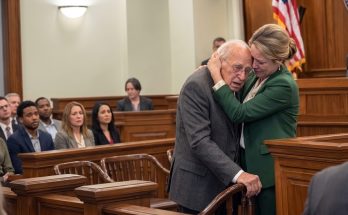
I began crying as I read those words because I knew Robert would have welcomed Linda back without hesitation. He had spent years wondering whether she was safe, while she had apparently convinced herself that he’d chosen to forget her.
The following morning, I called Linda and told her about the letters. At first, she seemed skeptical, but when I read passages from several of them, her breathing became uneven and she began to cry.
“Robert never stopped trying to reach you, Linda. He invited you to our wedding, told you about Emily, and kept writing long after you stopped answering.”
Linda remained quiet for several moments before admitting that she’d received some of those letters. She hadn’t responded because she believed Robert would eventually disappear from her life again, and refusing his attempts at reconciliation had seemed safer than risking another disappointment.
“I thought if I stopped caring first, it wouldn’t hurt so much when he forgot about me.”
Her confession helped me understand how fear had shaped her decisions, although it couldn’t undo the damage. She had spent nearly fifty years protecting herself from an abandonment that Robert had never intended, and he’d died without knowing that his little foster sister had become connected to our family.
I told Linda that I was sorry they had lost so much time, but I also made it clear that her painful history didn’t justify what she’d done to my home. She had deceived Emily and David, invaded my privacy, and removed reminders of a man who had loved her throughout his life.
After ending the call, I arranged for every exterior lock to be changed and disabled the spare keys previously held by family members. I also explained to Emily that rebuilding my trust would require more than an apology because she’d allowed other people to make decisions about property that didn’t belong to her.
My daughter listened without arguing, which was a welcome change from her reaction the previous day. She admitted that she’d accepted Linda’s explanations too easily and hadn’t considered how violated I would feel returning to a house filled with strangers.
For the first time since coming home from Florida, I felt that my boundaries were being taken seriously. Yet I also knew that the story between Robert and Linda wasn’t finished, because the letters had revealed a love that neither distance nor silence had managed to erase.
PART 5: THE PHOTOGRAPH AND THE SECOND CHANCE
A week after the reunion, Emily returned to my house carrying groceries, cleaning supplies, and an envelope containing money toward the expenses caused by the unexpected guests. She apologized sincerely for giving away my spare key and acknowledged that she’d treated my home as though it were available for anyone who needed it.
I appreciated her effort, but I explained that trust couldn’t be restored simply by replacing damaged belongings. For years, I’d tried to support my daughter while respecting her independence, and I expected her to show the same consideration toward mine.
Emily accepted that without arguing and promised never to share access to my home again. We spent the afternoon talking about Robert, and she admitted that seeing his photographs removed had affected her more deeply than she’d initially understood.
Several days later, a handwritten letter arrived from Linda. I recognized her name on the envelope and considered setting it aside, but eventually I sat down with a cup of tea and read what she’d written.
Linda accepted responsibility for entering my house without permission, misleading Emily and David, and inviting relatives who had no idea they were unwelcome. She also apologized for hiding Robert’s photographs, acknowledging that her grief had never given her the right to interfere with mine.
She explained that seeing the house Robert had shared with me had awakened feelings she’d avoided for decades. Every room represented a part of his life she’d refused to know, and instead of facing that regret honestly, she’d attempted to control the situation.
I found myself thinking about the frightened teenage girl Robert had once described, the one who had arrived at his family’s Pennsylvania farmhouse unsure whether anyone would truly care for her. That girl had grown into a woman who expected rejection so strongly that she’d spent much of her life pushing away the very person who wanted to remain close.
Her suffering didn’t excuse her actions, but it helped me understand why the photograph had frightened her. She hadn’t simply recognized her younger self; she’d been confronted with evidence of a relationship she’d spent nearly fifty years pretending no longer mattered.
I decided to make Linda a copy of the photograph June had discovered. On the back, beneath Robert’s original message about hoping his little sister would someday come home, I wrote five words of my own.
“He meant it. — Carol”
I mailed the photograph without including a long explanation because Robert’s handwriting already said everything I wanted Linda to understand. Whatever mistakes had separated them, he had never stopped considering her his sister.
Several weeks passed before Linda called me. She sounded nervous and asked whether I might be willing to meet her for coffee, somewhere neutral where we could speak without involving the rest of the family.
“Carol, I know I don’t deserve another chance after what I did, but I’d like to talk if you’re willing.”
I didn’t agree immediately because I still remembered the shock of finding fifteen strangers in my home. I also remembered the missing photographs, the broken frame, and the dismissive way Linda had treated me when I first returned.
But I didn’t refuse her request either. I told her I needed more time, and she accepted my answer without trying to pressure me.
That evening, I stood beside the mantel and looked at Robert’s photograph, grateful that it was once again where it belonged. I thought about the years he’d spent searching for Linda and wondered what he would have said if he’d known that the sister he missed had been standing beside him at our daughter’s wedding.
I couldn’t give them back the years they’d lost, and I couldn’t pretend Linda’s behavior hadn’t hurt me. But I could protect my home, insist on respect, and still leave open the possibility that someone might eventually earn forgiveness.
At sixty-two, I had learned that compassion didn’t require surrendering my boundaries. I could acknowledge Linda’s pain without allowing it to become an excuse for violating my privacy, just as I could love Emily without accepting every decision she made.
When I returned from Florida, I believed the greatest shock of my vacation would be discovering fifteen strangers sleeping beneath my roof. Instead, I uncovered a family connection that had remained hidden for almost fifty years, along with proof that Robert had never abandoned the little girl he’d once promised to protect.
One of those unexpected guests had been part of my husband’s family long before she became part of mine. And although I wasn’t ready to welcome Linda into my home again, I was beginning to understand that some doors could remain locked while the possibility of reconciliation stayed open.