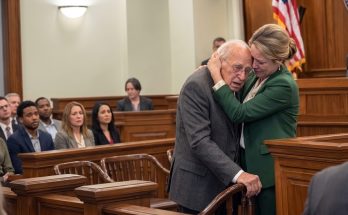
With her consent, officers searched her handbag and recovered Sadie’s passport, the disputed guarantee documents, and notices concerning Lucas’s debts. Deputy Miller returned the passport to me and explained that both relatives would be questioned about the suspected financial fraud and custodial interference.
“Paul, please don’t let them take us away. I was only trying to protect our family,” Irene pleaded.
I couldn’t accept her explanation. She’d threatened to use my daughter to force me into guaranteeing Lucas’s debts, and I was no longer willing to mistake manipulation for love.
I left without arguing and drove directly home to Sadie.
Part 3: The Plot Hidden Behind the Bermuda Tickets
When I returned home, Sadie was building a tower of wooden blocks beside Brenda. She immediately asked whether I’d found her passport, and I showed her the small blue booklet before promising that nobody would take her on an unauthorized trip.
“Do I still have to go on the airplane tomorrow, Daddy?”
“No, sweetheart. You’re staying home with me, and we’ll only travel together when we both know where we’re going.”
She relaxed against my shoulder, and I finally understood how frightened she’d been. My daughter had spent the morning believing that revealing Grandma’s secret might cause me to abandon her.
Over the following month, investigators uncovered the full extent of Irene and Lucas’s scheme. Lucas’s construction company had accumulated serious debts over eighteen months, including unpaid subcontractors, equipment repossession notices, and expensive private loans.
Irene had secretly contributed nearly $200,000 from her retirement savings to keep his business operating. Every payment had been justified as a temporary rescue, but the company’s financial condition continued deteriorating.
After I refused to guarantee his construction bond, Lucas began searching for alternative sources of money. He eventually learned that Hannah had established a substantial inheritance trust for Sadie, although its independent trustee controlled every distribution.
The trust was irrevocable and intended exclusively for Sadie’s welfare. Even as her surviving parent, I couldn’t simply withdraw its principal to rescue another relative’s business.
Lucas initially tried obtaining information directly from the trustee, but his requests were rejected. Irene then offered to stay with Sadie during my Minneapolis conference, giving them access to my home while they believed I’d be absent.
The investigation established that Irene had instructed Sadie to steal my filing key so she could retrieve sensitive financial records. Those documents included information Lucas needed to prepare a fraudulent loan application.
He used my tax returns, corporate ownership statements, and a copied signature to support the $400,000 guarantee submitted to Keystone Commercial Capital. Irene presented herself as my representative and claimed I couldn’t be contacted because I was traveling.
Fortunately, Keystone’s risk officer requested independent verification before releasing funds. That inquiry reached my company’s finance department and helped prevent the fraudulent transaction from proceeding.
The Bermuda itinerary served an even more disturbing purpose. Irene had contacted an acquaintance with a seaside property near Hamilton and arranged accommodation for herself and Sadie.
She claimed the trip would help my daughter recover emotionally from losing her mother. In reality, investigators discovered that Irene and Lucas intended to use Sadie’s presence abroad as leverage to force my financial cooperation.
Their plan depended on frightening me into signing a guarantee or attempting to release trust funds in exchange for bringing Sadie home. They’d apparently assumed that controlling my daughter would give them control over my decisions.
Investigators noted that the proposed travel arrangements lacked proper parental authorization and might have encountered difficulties during departure procedures. Nevertheless, those possible obstacles didn’t diminish the danger they’d created.
Irene possessed Sadie’s physical passport and had previously been authorized to collect her from school. Without Sadie’s warning, my mother might have removed her from home long before anyone realized what was happening.
The evidence against Irene and Lucas continued accumulating. Keystone preserved the loan application and security footage, while the school supplied records of Irene’s false medical appointment request.
Investigators also recovered messages exchanged between my mother and brother. One conversation revealed that Irene had already taken the passport and intended to use Sadie’s overseas trip to pressure me into supporting Lucas’s business.
Reading those messages was devastating because they treated my little girl as an instrument for solving an adult financial crisis. The relatives who claimed to love her had been willing to frighten and manipulate her for money.
I knew then that protecting Sadie required more than recovering her passport. I needed to rebuild the sense of safety my own family had destroyed.
Part 4: The Price of Protecting My Daughter
In the weeks after Irene and Lucas were questioned, Sadie began meeting with a licensed child psychologist experienced in helping young children process frightening family experiences. I wanted her to understand that she’d done nothing wrong by telling me about the brass key.
She often worried that Grandma was lonely or crying because nobody would visit her. Sometimes she wondered whether Uncle Lucas’s financial problems were somehow her fault because she’d revealed the secret.
“Did I make Uncle Lucas lose his company, Daddy?”
“No, Sadie. Adults make their own decisions, and they’re responsible for what happens afterward.”
Brenda and I repeated that reassurance whenever Sadie needed to hear it. I also participated in parent counseling sessions so I could better support her recovery without pressuring her to discuss events before she felt ready.
Our household routines changed considerably. I removed Irene from every school pickup authorization, replaced the exterior locks, and transferred sensitive estate records to secure storage.
My corporate partners reviewed our financial safeguards to prevent additional fraudulent guarantees involving my ownership interests. I also delegated much of my out-of-state travel and arranged professional childcare with thoroughly vetted caregivers.
Before Hannah died, I’d relied on my mother because her help made our family feel connected during a painful period. I now understood that familiarity alone wasn’t enough to establish trust.
The legal proceedings continued over the following year. Lucas faced charges connected to the fraudulent loan application and attempted identity misuse, while prosecutors pursued separate allegations against Irene involving custodial interference and the plan to pressure me through Sadie.
Their communications, financial records, and the evidence recovered at Keystone formed the foundation of the cases. Both eventually accepted plea agreements resulting in criminal convictions and significant financial penalties.
Lucas received an eighteen-month custodial sentence, and his construction company collapsed under outstanding debts, creditor claims, and other financial obligations. Irene exhausted much of her remaining money on legal expenses and penalties before losing the townhouse she’d occupied for fifteen years.
I testified truthfully whenever required, but I refused to guarantee Lucas’s debts or provide funds to protect the family’s reputation. Several relatives criticized that decision, claiming I should show greater compassion because Irene was elderly.
I explained that compassion didn’t require exposing my daughter to someone who’d threatened her safety. Whatever my relatives believed about forgiveness, Sadie’s wellbeing remained my responsibility.