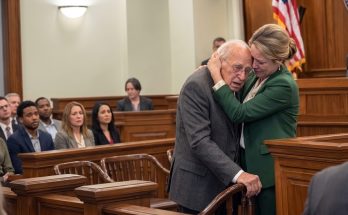
“Daniel, I need legal guidance about a potential conflict of interest. I had a personal encounter with one of the officers whose command is under review.”
Brooks acknowledged my concern and arranged the consultation. I had no intention of using my position to punish Richard for insulting me, but I also wouldn’t protect him from an independent investigation.
By Sunday afternoon, counsel confirmed that I could deliver the scheduled general briefing if I disclosed the encounter and avoided substantive decisions concerning Richard’s command. Rear Admiral Sullivan would oversee the independent review and any related recommendations.
That same afternoon, Richard sent Olivia another insulting message. He claimed Ethan deserved a bride from a more respectable family and attached a photograph of me at Friday’s dinner.
“Some people forget their place.”
Olivia showed me the message, furious that Richard continued trying to humiliate us. I assured her that I wouldn’t retaliate personally, although Monday would reveal something he clearly didn’t understand.
“Rank doesn’t excuse poor character, sweetheart.”
Later, Brooks called to confirm the briefing arrangements and the independent team’s collection of additional procurement records. I instructed him to ensure every officer followed the established procedures without exception.
As I looked toward my dress uniform hanging in the closet, I knew Richard would soon discover how mistaken his assumptions had been.
PART 3: THE GENERAL HE NEVER EXPECTED TO SEE
At exactly eight o’clock Monday morning, Captain Richard Whitmore entered the joint command briefing room wearing his immaculate Navy service dress uniform. According to Colonel Brooks, Richard spent several minutes boasting about his influential contacts and assuring junior officers that the assessment would be a routine formality.
“Washington knows my record. Nobody is going to question my leadership.”
His confidence lasted until the doors opened and the assembled officers were called to attention. I entered wearing my Army Service Uniform, with three silver stars displayed on each shoulder.
Brooks formally introduced me to the room.
“Ladies and gentlemen, Lieutenant General Victoria Hayes, chair of the Joint Readiness Assessment Panel.”
Richard’s expression changed immediately as he recognized the woman he’d insulted at his dining table three nights earlier. His smile vanished, and he remained standing after I invited everyone to sit.
“General… Hayes?”
I acknowledged him with the same professional courtesy I extended to every officer present.
“Captain Whitmore.”
He struggled to find his words, apparently realizing how seriously he’d misjudged my position. When he attempted to explain that he hadn’t known who I was, I calmly confirmed that I understood.
Before beginning the briefing, I addressed the potential conflict of interest. I explained that Richard and I had encountered each other socially over the weekend and that I’d already disclosed the interaction to military counsel.
“For transparency, I will not participate in findings or disciplinary recommendations concerning Captain Whitmore’s command. The independent review will proceed under Rear Admiral Sullivan.”
Richard appeared relieved, perhaps believing my withdrawal meant he would escape scrutiny. In reality, the arrangement ensured that his command would be assessed without any personal influence from me.
Rear Admiral Sullivan stood and opened a folder containing the preliminary findings. He explained that investigators had identified discrepancies involving procurement approvals, inventory shortages, and possible retaliation against civilian employees.
“Captain Whitmore, these matters require formal investigation, and several witnesses have provided contemporaneous records supporting the concerns.”
Richard immediately rejected the allegations, insisting they were baseless. Sullivan remained composed and explained that relevant financial documents had been independently authenticated.
As the implications became clear, Richard accused me of orchestrating the investigation because of Friday’s dinner. I reminded him that our encounter was precisely why I had removed myself from decisions concerning his command.
“No, Captain. Friday night is the reason I am not deciding your case.”
Sullivan then announced that Richard had been temporarily relieved of command pending further proceedings. His access to certain procurement systems had been suspended, and the matter had been referred to the appropriate investigative authorities.
Richard protested that the decision was unfair, but Sullivan explained that it had already been reviewed through the proper chain of command. Nothing about the action depended on my personal feelings.
Desperate, Richard turned toward me and mentioned that his son was engaged to my daughter. The same man who had dismissed Olivia’s family now seemed to believe that relationship should protect him.
“Victoria, please. Ethan is going to marry Olivia.”
I remembered my daughter’s tears, Richard’s insulting remarks, and Ethan’s silence during dinner. I told Richard that he’d judged us without knowing anything about our lives.
“You told me my daughter didn’t understand what a real family looked like.”
He lowered his gaze and offered a hurried apology. I couldn’t help noticing that his regret appeared only after he learned my rank and faced professional consequences.
“You’re apologizing to a general because you’re afraid of what happens next. You should have respected Olivia’s mother when you believed she was nobody important.”
I then instructed Sullivan to continue according to established procedures and left the briefing room. Richard’s career would be determined by the evidence and the appropriate authorities, not by my anger.
PART 4: THE CONSEQUENCES OF ARROGANCE
The events of Monday morning quickly changed the Whitmore family’s circumstances. Richard had entered the assessment expecting his reputation and professional connections to protect him, but the independent investigation continued examining his command’s financial and administrative practices.
The allegations involved more than questionable purchases. Investigators were also reviewing complaints from civilian employees who claimed they’d experienced retaliation after raising concerns about spending and missing supplies.
I received only the information necessary for my official responsibilities because I’d deliberately separated myself from decisions involving Richard. Maintaining that boundary mattered to me, even after everything he’d said about Olivia and me.
Over the following months, investigators examined procurement records, witness statements, and the command’s financial controls. The process took time, but it eventually substantiated multiple violations and several retaliation complaints.