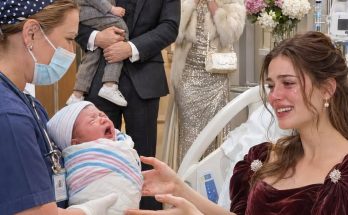
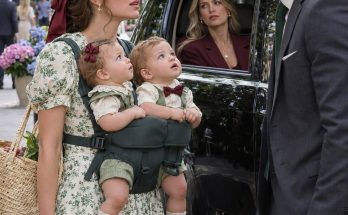
Then he left.
My mother stayed beside me, helping me hold the girls. She also found the gold-wrapped chocolate bar Andrew had packed for our celebration and placed it within reach.
I couldn’t bring myself to open it.
After my discharge, I spent seven weeks at Helen’s house.
The first two weeks were exhausting. Between feeding two newborns, recovering from surgery, and trying to understand what had happened to my marriage, I barely slept.
Andrew sent messages every day.
He asked about the girls, checked whether Nora was gaining weight, and arranged practical things we needed. He never demanded forgiveness.
At first, I didn’t respond.
Eventually, I began sending photographs of Ivy and Nora.
On the tenth day, he left a cooler of prepared meals on my mother’s porch, with a note explaining that he wouldn’t come inside unless I invited him.
My mother read it and looked at me.
“Emma, I don’t think Andrew is a terrible man. But he did something terrible. Those aren’t the same thing.”
I knew she was right.
Two days later, Daniel called.
He told me what had happened when Andrew arrived at his house.
Andrew had confronted him with the cropped photograph, demanding to know whether they’d had an affair. Daniel reminded him that he’d been standing beside us at the barbecue.
According to Daniel, Andrew eventually remembered the moment and realized his mother had misled him.
He’d sat on Daniel’s front steps crying, horrified that he’d abandoned me after surgery.
Daniel was still angry about the accusation, but he wanted me to know Andrew had begun recognizing his mistake before receiving my call.
On the fifteenth day, I allowed Andrew to visit the twins for one hour.
He arrived exactly on time.
After washing his hands, he sat in my mother’s armchair holding Ivy. He studied her face and quietly began crying.
“She’s grown so much,” he whispered.
“Almost a pound.”
“I missed it.”
“Yes,” I answered. “You did.”
He didn’t argue.
Over the following weeks, he returned every Saturday. Eventually, I let him stay longer and help with feedings.
One cold November afternoon, we sat on my mother’s back steps while the girls slept.
Andrew told me he’d confronted Carol and made it clear she wouldn’t see our daughters without my permission.
He’d also started seeing a therapist twice a week.
“I finally understand something,” he said. “I wasn’t really afraid you’d betrayed me. I was afraid I wasn’t enough for you.”
I looked at him.
“The worst part wasn’t just that you left. It was that I needed you, and you weren’t there.”
He nodded through tears.
“I can’t change what I did. But I can show up every day from now on.”
For the first time since the hospital, I believed he understood the damage he’d caused.
“That doesn’t fix everything,” I said.
“I know.”
I watched the bare branches moving above us.
“But it’s a start.”
Part 5: My Husband Begged for a Second Chance After Abandoning Our Newborn Twins—But I Made Him Earn My Trust Again
I returned home during the first week of December, when Ivy and Nora were seven weeks old.
It wasn’t because I’d forgiven Andrew completely. I still remembered waking up from surgery and finding his chair empty. But after watching him show up consistently for our daughters, I wanted to see whether he could become the husband and father we’d once imagined.
Before moving back, I wrote down four conditions.
We would attend couples counseling every week for at least six months. His mother would not enter our home, and any visits with the twins would require my approval and our supervision.
Andrew also had to answer my calls, even if he could only speak briefly. Most importantly, if he ever questioned something about me again, he had to come directly to me instead of believing someone else’s accusations.
He read the conditions carefully and signed the paper without arguing.
Our first weeks together were uncomfortable.
Andrew slept in the guest room, giving me space while we adjusted to life with two newborns. But whenever one of the girls cried during the night, he was usually the first person to reach the nursery.
I heard him whispering to them through the darkness.
“Daddy’s here. I’ve got you.”
He kept showing up.
In December, Carol mailed us a Christmas card.
She wrote that she wanted to meet her granddaughters and was willing to accept whatever conditions we considered appropriate.
It wasn’t a genuine apology, but it was the first time she’d acknowledged that she couldn’t dictate our decisions.
I didn’t respond immediately.
Meanwhile, Andrew’s friendship with Daniel remained strained.
They barely spoke for almost three months. Then, one Sunday in January, Daniel arrived with his five-year-old son, Theo, who had brought two stuffed giraffes for the twins.
Andrew apologized again.
Daniel listened before suggesting they start by having coffee together.
It wasn’t an instant reconciliation, but they were finally talking.
The moment that truly changed something between Andrew and me happened late one February night.
Nora had caught her first cold and had been crying for hours. By two in the morning, I was so exhausted that I went into the bathroom and sank onto the cold tile floor.
I sat there with my face in my hands.
A few minutes later, Andrew appeared in the doorway.
He didn’t ask me to explain. He didn’t promise that everything would suddenly become easier.
He simply sat beside me.
It reminded me of a night years earlier, after another failed fertility treatment, when he’d found me crying on our bathroom floor and stayed with me until I could breathe normally again.
Then he reached into his robe pocket.
He was holding the gold-wrapped caramel chocolate bar he’d packed for the day our daughters were born.
“I found it in your drawer,” he said softly. “I wasn’t sure whether you still wanted it.”
I stared at the wrapper.
“It was supposed to be for afterward.”
“I know.”
“I didn’t know when afterward was.”
Andrew looked at me.
“Maybe tonight.”
I slowly opened the chocolate bar and broke it in half.
We sat together on the bathroom floor, sharing it while both girls finally slept.
After a while, I rested my head against his shoulder.
He stayed beside me without saying another word.
In March, Andrew moved back into our bedroom.
We continued attending counseling, and he kept the promises he’d made. We still disagreed sometimes, but he no longer avoided difficult conversations or allowed his mother to interfere.
That same month, we agreed to meet Carol at a coffee shop for forty-five minutes.
Andrew and I stayed together with the girls throughout the visit. Carol held each granddaughter briefly and respected the boundaries we’d established.
Before leaving, she thanked me.
I wasn’t ready to call it forgiveness, but it was progress.
Now our daughters are eight months old.
Ivy is adventurous and constantly trying to climb out of her crib. Nora is quieter, watching everything with the same thoughtful expression she had as a newborn.
Last week, I found Andrew sitting on the living room floor, reading Nora a picture book about farm animals.
He was making ridiculous animal noises when she reached up and wrapped her tiny hand around his finger.
Andrew stopped reading.
His eyes filled with tears as he looked toward me.
“Emma, look.”
I was already watching.
For years, I’d believed that love meant staying together through every difficult moment. What happened after our daughters’ birth taught me that love also requires accountability, boundaries, and the willingness to rebuild trust after it’s been damaged.
I couldn’t erase the hours Andrew had abandoned us.
But I could recognize the effort he’d made since then.
And as Nora held tightly to her father’s finger, I saw something I’d once feared we’d lost forever.
This time, when our daughter reached for him, Andrew was there.