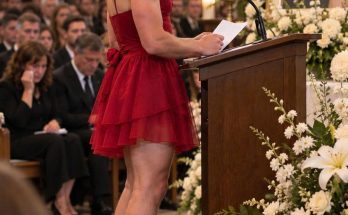
I rose carefully from my chair, trying to ignore the sharp pain shooting through my bad knee.
“Yes, Your Honor, I am ready,” I replied in a calm tone.
Before I could say another word, Judge Prescott reached for the thick case folder on his bench.
“Actually, Commander, before you respond, there is something in this file that your parents apparently do not realize I already know,” the judge announced.
The entire courtroom fell into dead silence.
Judge Prescott removed an official county document from the folder.
I immediately recognized Grandpa Vernon’s bold signature across the parchment.
Then I turned my eyes toward my father.
The instant his eyes landed on that notarized paper, the color drained completely from his face.
PART 2
Judge Prescott held the deed carefully by its edges, giving everyone in the room time to absorb the tension.
The signature at the bottom was unmistakably Vernon Merrick, written with his signature broad loops and a final stroke that slanted upward across the parchment.
“This is a notarized conveyance recorded with the county clerk in May of 2012,” Judge Prescott announced, looking directly at my parents.
Dad swallowed hard, leaned toward his counsel table, and said,…
“That… that can’t be right, Your Honor. My father never told us about any deed.”
“I’m sure he didn’t,” Judge Prescott said dryly. “Mr. Dunmore, you represent the plaintiffs. Did you review the county land records before filing this complaint?”
The lawyer beside my father was a thin man with a damp forehead, and he had clearly been hoping to be ignored. He rose halfway. “We relied on our clients’ representation that title remained in the family, Your Honor.”
“In the family,” the judge repeated. “Mr. Merrick, was it your understanding that you owned this farmhouse?”
“We managed it, sir. It was my father’s. A son inherits.”
“Not when his father conveys it to someone else during his lifetime, and records the deed.” The judge set the parchment down. “Vernon Merrick transferred the property at 400 Sycamore Ridge Road to his granddaughter, Harriet Merrick, in May of 2012. The deed was properly notarized and recorded. Your name appears nowhere on it.”
My mother made a small, strangled sound. Her pearls clicked against her fingernails.
I stood very still. I hadn’t known the date, only that Grandpa Vernon had put a key in my hand the week before I shipped out and said, “Don’t let anyone talk you out of it, Harry.” I had never gone looking for the paperwork. I had trusted him.
“Commander,” Judge Prescott said, and his voice changed. It wasn’t kind, exactly, but it had stopped being merely official. “Do you have records of the property taxes?”
“I do, Your Honor.” I reached into my folder. “Every payment since 2013. Paid from my account at the Navy Federal Credit Union, including the years I was deployed.”
I handed the bundle to the bailiff. He walked it to the bench.
The judge turned the pages slowly. Treasurer’s receipts. Bank statements. Insurance premiums. A roofing invoice from 2016, and a receipt for the well pump I’d had replaced from a hospital bed, over the phone, with a nurse holding the receiver to my ear.
“Mr. Merrick,” he said, without looking up, “your complaint states that you and your wife have paid every expense on this property.”
“We… paid some things.”
“Which things?”
My father opened his mouth. Nothing came out.
“Do you have a single receipt, Mr. Dunmore?”
“We, uh, we can supplement the record, Your Honor.”
“I’m sure you can.”
I should explain something about my father, because the story would make no sense without it.
Gerald Merrick sold insurance for thirty-one years and cared more about how things looked than how they were. When I enlisted, I wasn’t just disappointing him. I was embarrassing him in front of the men at his golf club. A Merrick daughter was supposed to marry a dentist, join the garden society, and bring a casserole to church.
I had instead gone to sea.
I understood, standing at that table, why he’d come here. He wasn’t a villain in the cinematic sense. He was a man who had spent his life believing that whatever Grandpa Vernon owned would pass to him, that the farm was his by right of birth order, and that his daughter was a temporary nuisance in the way.
And when he found out otherwise, he hadn’t gone to her. He’d gone to a lawyer.
“Commander,” the judge said, “I believe the court has the answer to the ownership question. But I’d like to understand the rest. Your parents’ complaint says the house has been vacant for years. Has it?”
“Not entirely, Your Honor.” I took a breath. “For the last six years, a retired sailor named Mr. Alvarez has lived on the property as caretaker. He’s a Vietnam veteran with no family. I let him stay in exchange for upkeep. He’s in the gallery.”
A gray-haired man in a worn blazer raised one hand from the third row. I hadn’t known he’d come.
“He cuts the grass and fixes what breaks,” I said. “I send the materials. He doesn’t pay rent. We both consider it a fair trade.”
Judge Prescott looked at Mr. Alvarez, then at my parents, and something in his jaw tightened.
“And why, Mr. Merrick, did you file this action now? After twelve years?”
My father’s lawyer leaned over and whispered in his ear. My father shook his head.
“Mr. Dunmore, if you wish to answer for your client, you may.”
The thin man swallowed. “My clients received an inquiry from a development company, Your Honor, regarding the acreage. A… Larkspur Land Partners.”
“An offer.”
“A substantial one.”
“For land your clients do not own.”
Nobody said anything.
“I see,” said the judge.
He did not make us wait long.
“The court finds,” Judge Prescott said, “that the plaintiffs have no ownership interest in the property at issue, that title has been vested in the defendant since May of 2012, and that the defendant has paid all taxes and carrying costs for the period in question. The complaint is dismissed with prejudice.”
My mother’s hand dropped from her pearls.
“I’m also inclined to look at the sworn statements in this filing,” he continued. “The assertion that the plaintiffs paid the expenses on this property appears to be unsupported, and the claim that the house was abandoned is contradicted by the record. Mr. Dunmore, I’d advise you to speak with your clients about the rules governing candor to this court. I’ll be reviewing whether sanctions are appropriate, and I’ll set that for a separate hearing.”
“Yes, Your Honor.”
“Mr. Merrick, Mrs. Merrick, you may not like this, but I’m going to say it anyway.” He folded his hands. “Your daughter is not an opponent. In my experience, a person who pays the taxes on a farmhouse for a decade, from a combat zone, is not abandoning it. She is keeping a promise.”
He paused. Then he did something I hadn’t expected. He leaned forward and looked at my ribbons.
“Commander, forgive me. Would you step closer?”