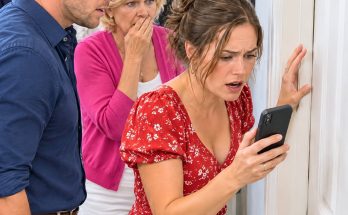
“He’s already stepping away from you,” said Brennan.
Russell looked at me, and for the first time in four years there was no performance in his face. I saw only fear, and under the fear, something worse: confusion, as though he truly couldn’t understand why I wasn’t grateful it had worked out.
“They were supposed to be fine,” he said. “Piper’s eight. She’s smart. I only needed a day.”
“Silas is eleven months old,” I said.
He had no answer.
The officers cuffed him in front of the elevator, in the soft hotel carpet quiet, and walked him out.
Part 5
The twins stayed in the pediatric ICU for four days.
Silas had it worse. He and his brother Theo had been severely dehydrated, with dangerously high sodium levels and heat exhaustion. Dr. Okonkwo explained it to me in the plainest words he could find, the way you do when you know a mother is holding on by a thread.
“We caught it in time,” he said. “Another twelve hours would have been a different conversation. But they’re stabilizing, and their kidneys are responding. Children that age are tougher than they look.”
I sat between the two cribs for ninety-six hours. I changed no diapers. I did nothing the nurses couldn’t do better. I just held a small hand in each of mine and counted breaths.
On the fifth morning, Silas opened his eyes, looked straight at me, and screamed for his bottle.
I laughed and cried until a nurse had to bring me tissues.
Piper had been admitted for observation and fluids. She slept for twenty hours straight. When she woke up, she looked at me with enormous, serious eyes.
“Mommy, I didn’t open the door,” she said. “Daddy said never to open the door to strangers.”
“I know, baby.”
“I tried to make the boys drink the water from the tub, but I was scared it was dirty.” Her voice wobbled. “Did I do it wrong?”
I climbed into the hospital bed beside her and held her face in both hands.
“You did everything right. You called me. You stayed with your brothers. You kept them together. You were the bravest person in that apartment.”
“I was scared the whole time.”
“That’s what brave means,” I said.
Part 6
The case moved quickly. The hotel footage, the utility recording, the battery-backed camera logs, and Russell’s own emails to his lawyer told the same story. A forensic accountant found that he had drafted the emergency custody petition two days before the power was cut, with blanks left only for “the date of discovery.”
The prosecutor, a calm woman named Ms. Delaney, offered Russell a plea. He refused it for six weeks, still certain he could talk his way out. Then his lawyer withdrew, and he took the deal.
He was sentenced to eleven years for felony child endangerment and unlawful restraint of minors. He lost all parental rights. The judge who had refused him custody months earlier read the order aloud herself.
“Mr. Hale,” she said, “you told this court you could handle your children alone. In my twenty-six years on this bench, I have rarely heard a statement more thoroughly disproven.”
Russell didn’t look at me when they led him out. I didn’t look at him either. I had spent too many nights looking at his face for answers that were never there.
Final Part
We moved in March.
Not far, only twenty minutes north, to a small brick house with a creaky porch and a maple tree in front. It had a kitchen window where I could see the backyard, a basement for the twins’ toys, and old-fashioned doorknobs with actual keys. No smart locks. No blackout blinds. I checked every window twice before we signed.
Silas and Theo grew fast. By summer they were crawling after the cat. By fall they were pulling themselves up on the coffee table and shrieking with triumph.
Piper went to therapy every Thursday with a gentle counselor named Dr. Marsh, who kept a jar of buttons and let her sort them by color. For the first few months, Piper wouldn’t sleep unless the hall light was on. She woke up screaming twice. She asked, again and again, whether the power might go out.
I bought her a lantern shaped like a moon. I showed her where it was, and where the flashlights were, and where the spare batteries lived. I taught her how to call 911 and then how to call me, and then how to call my sister, in that order, and I made her promise she’d never have to feel responsible for anyone’s life again.
“But I was good at it,” she said one night, in a very small voice.
“You were too good at it,” I said. “A kid shouldn’t have to be.”
On the first anniversary, we drove to the lake. The twins squealed in the sand and tried to eat it. Piper built a lopsided castle and stood guard over it like a queen. I sat on a blanket with a thermos of coffee and watched all three of them.
Piper came over after a while and flopped beside me, brushing sand off her knees.
“Mommy?”
“Yes?”
“I think I’m not scared of the dark anymore.”
I put my arm around her.
“Are you sure?”
She thought about it seriously, the way she thinks about everything now.
“Mostly,” she said. “But if I get scared, I’ll just tell you.”
“That’s exactly the right plan.”
She leaned into me. Out on the water, a sailboat leaned with the wind.
A year earlier, a coffee mug had shattered on my kitchen floor and I had run to a door that wouldn’t open. I had broken glass and metal and every rule of ordinary life to get through it. I would have broken a hundred more.
I never needed to ask what a mother is capable of. I only needed to hear one frightened little voice say Mommy, and I knew.
THE END