Chapter 3: The Anatomy of a Lie
The emergency Red Cross dispatch arrived at my desert operations center at five in the morning, local time. It consisted of a single typed page handed to me by my company commander: Dependent son hospitalized. Severe orthopedic trauma resulting from fall. Condition stable.
My commander moved mountains to approve emergency compassionate leave, but military logistics in a deployment zone do not bend easily to personal grief. The sustainment battalion was in the middle of executing a critical fuel transfer, and my relief sergeant could not reach our forward operating base for nearly three weeks. I spent nineteen days staring at the canvas ceiling of an operations tent, listening to the monotonous hum of diesel generators, living inside a hell of complete impotence.
When I finally secured an encrypted video connection to Micah’s room at the pediatric surgical hospital in Evansville, what I witnessed nearly drove me to my knees.
My vibrant, athletic boy was pinned to his hospital mattress beneath two massive external fixators—heavy titanium halos encircling both lower limbs, anchored directly into his crushed tibia and femur by steel pins driven through skin and bone. His athletic frame looked hollowed out, his complexion like damp chalk.
“Hey there, soldier,” I choked out, fighting with every ounce of my will to keep my face composed before the camera lens.
Micah’s lips parted. He strained forward, his neck muscles bulging with agonizing effort, but not a solitary syllable passed his teeth. Only a thin, raspy hiss of air escaped his throat.
Beside the bed, David leaned over, angling his phone closer to Micah’s mouth. “He can’t project his voice, Dani,” David said, his own voice sounding completely hollowed out by grief and exhaustion. “The pediatric specialists call it psychogenic aphonia. His vocal cords aren’t damaged, but the trauma of the impact and the fear shut down his motor speech control. He can only whisper.”
I pressed my face against the laptop screen in Kuwait. “Whisper it to me, baby. Tell your mom.”
And there, across eight thousand miles of encrypted digital satellite link, I listened to my son whisper the anatomy of his betrayal. He detailed the midnight wrecker, the saw screaming through the floorboards, the nine-minute video in the corncrib, the boot shattering his bedroom door, the four repetitions of our address into the phone, and the cold, dismissive words of his own aunt: Not tonight, kid. Go back to bed.
“I know her voice, Mom,” Micah rasped, tears cutting clean paths through the hospital pallor on his cheeks. “I’ve heard it across the kitchen table my whole life. It was Aunt Becky. She hung up and left me there.”
A heavy, suffocating silence settled over my station in Kuwait.
“Try once for me, son,” I urged softly, my heart breaking into shards. “Give me your real voice. Just one word.”
Micah clenched his fists into the hospital sheets until his knuckles turned white. His face flushed crimson. His jaw trembled. But the only sound that emerged into the sterile room was that terrible, phantom breath.
“That’s enough,” I told him, swallowing the hot bile rising in my throat. “Rest now. Mom is coming home.”
That night, alone in the operations office, I drafted a formal, meticulously worded inquiry to Alan Klene, the civilian director of the Brandon County Emergency Communications Center. Citing the Indiana Access to Public Records Act, I requested the raw master audio and system telemetry for the emergency call placed from our residence at 3:12 AM on the morning of June 24th.
Director Klene replied within forty-eight hours with an impeccably polite, bureaucratically polished letter. He expressed deep institutional sorrow regarding my son’s tragic accident. However, he regretfully informed me that due to a transient power surge affecting a single telecommunications console during that particular overnight shift, the audio file for that 41-second transmission had failed to archive to the optical storage servers. The hardware anomaly, he noted, had been identified, logged, and officially certified by the shift supervisor on duty.
Attached to the bottom of the PDF was the formal incident verification form.
I zoomed in on the signature block until the pixels blurred. The document was signed in precise, looping cursive:
Rebecca Haynes, Shift Supervisor, Operations Division.
I closed the laptop and leaned back in my steel folding chair. In the processing plant, I had dressed thousands of carcasses. I knew the visual difference between tissue that had deteriorated through natural decay and an incision made deliberately with a ten-inch boning knife. Machines do not conveniently lose a single 41-second transmission from a specific household while retaining every other call on an eight-hour shift.
Someone had systematically scrubbed that audio from the mainframe. Which meant the truth of what my son had whispered was entirely real.
When my deployment transport finally taxied onto the tarmac at the regional armory in late August, the gymnasium was packed with cheering families, homemade banners, and weeping spouses. I marched through the double doors in my desert camouflage uniform, my eyes cutting through the sea of civilians until I found the front row.
Micah sat in a high-backed wheelchair, his legs elevated in their external steel cages, holding a hand-painted cardboard sign across his lap: Welcome Home, SFC Mom.
I dropped my sea bag onto the polished basketball floor. I knelt before his chair, wrapping my arms around his shoulders, burying my face in the collar of his shirt while being intensely mindful of the steel pins protruding through his skin.
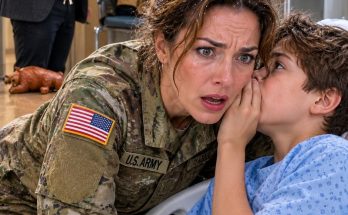
Micah pressed his face into my shoulder patch and whispered into my ear: “I watched the farm, Mom. Just like you said.”
“You did your duty, soldier,” I choked out against his neck. “You did your duty.”
Standing three feet behind the wheelchair were Heath and Becky. Heath was sporting a clean polo shirt, his face flushed, clapping me on the shoulder with a heavy hand. “Proud of you, sister! Hollis Creek’s finest returns!”
I took Heath’s hand in mine. I didn’t crush his fingers, nor did I let my eyes narrow. I held his palm for two seconds longer than normal, feeling the rough calluses on his knuckles where fresh pink scar tissue had formed over recently healed abrasions.
“Good to see you, Heath,” I said, offering a tight, unreadable smile. “I hear you’ve been real helpful around the place.”
“Just family taking care of family,” Becky beamed, stepping forward to offer me a tupperware container filled with her famous iced lemon pound cake. “We managed the storm while you were keeping us safe, Dani. Micah’s going to be just fine. Children have incredible resilience.”
I looked into David’s sister’s warm, brown eyes—the face that Brandon County considered the absolute benchmark of civic grace—and I felt a cold, predatory focus take root in my chest.
When we returned to our farmhouse that evening, the domestic landscape felt profoundly altered. David walked around our kitchen like a man navigating a minefield. Over the ten weeks I had been overseas, he had lived entirely inside his sister’s comforting, fabricated narrative. Becky had sat with him in the intensive care unit; Becky had brought hot casseroles to his doorstep; Becky had explained to the attending physicians that Micah had a history of sleepwalking as a seven-year-old at their family lake cabin. To accept our son’s version of reality meant David would have to confront the horrifying truth that his own flesh and blood had abandoned his boy to die on a cold patio to protect a trailer park criminal enterprise.
The following morning at dawn, I walked out to the pole barn.
The building had been scrubbed with industrial degreaser and high-pressure hot water. The concrete floor carried the faint, chalky white residue of chlorine bleach. The brass padlock was gone; my father’s garden tools hung neatly along the wall studs.
To an untrained civilian eye, the barn appeared pristine. But I had spent twenty years cleaning slaughter facilities where blood and tallow find their way into the most minute structural crevices. I dropped to my knees with an LED tactical flashlight.
Along the expansion joint running parallel to the north wall, where the pressure washer had merely driven debris deeper into the silicone seal, I extracted a dense line of fine, glittering metallic dust—the unmistakable swarf of severed catalytic converters. Under the flange of the central floor drain, wedged against the iron strainer, I discovered a sheared, high-temperature exhaust bolt and a crumpled fragment of stamped aluminum heat shield carrying a partial manufacturer part number.
And on the structural steel column nearest the sliding door, at the precise waist-level height where a tired mechanic would rest a hot reciprocating saw between cuts, the white enamel paint was blistered in a distinct, soot-rimmed circle.
I sealed the metal shavings, the bolt, and the scorched paint chips into our butcher shop’s airtight vacuum-seal bags, marking each with a waterproof marker just as I would log a prime cut of beef.
On Monday morning, I drove our shop’s refrigerated box truck down to Haynes Towing and Salvage.
I told the teenage mechanic at the front gate that I needed an old steel wheel rim to fabricate a custom hose reel for our wash-down bay. The kid barely glanced up from his phone and waved me toward the rear acres.
I walked the labyrinth of stacked wrecks until I reached the hydraulic car crusher at the very back of the property. Next to the industrial crusher stood a salvage heap—items cleared out of repossessed vehicles and cleared properties waiting to be pulverized: water heaters, threadbare sofas, and a stack of residential interior doors.
The third door down in the timber pile stopped me dead in my tracks.
It was an inexpensive, six-panel hollow-core door painted off-white. The structural lock-rail had been blown out from the exterior face, leaving a jagged crater of splintered wood fibers surrounding the brass handle hole. Low on the exterior panel, positioned exactly four inches below the knob line, was the distinct, oily imprint of a heavy lugged work boot.
I flipped the panel over. Pasted across the upper face, at the eye level of a fourteen-year-old boy, were three faded paper lane-assignment stickers from the Brandon County junior varsity track championships, alongside a strip of yellow masking tape marked in Micah’s untamed cursive:
Knock First, Man of the House.
I stood motionless in the salvage dust for a long time, listening to the wind rattle the chain-link perimeter. Then, with deliberate, measured movements, I lifted my son’s broken bedroom door, carried it back down the gravel access road to my refrigerated truck, and laid it gently onto a clean wool moving blanket in the bay.
I met Detective Joy Pierce an hour later in the empty parking lot behind a Baptist church on the county line. She drove an unmarked Chevrolet Impala and met me with the weary skepticism of a career investigator who had spent years fighting political machinery.
She climbed into the rear of my box truck. She held my evidence bags up to the sunlight, turning the sheared exhaust bolt over in her fingers. Then I drew back the moving blanket to expose the splintered door.
Pierce stood silent for two full minutes, her hand resting on the holstered sidearm at her hip.
“Fourteen months,” Pierce whispered, her voice tight with suppressed rage. “We’ve run this multi-county auto-theft task force for fourteen months. Three distinct times we developed actionable intelligence on consolidation garages—one in Lindley, an abandoned dairy barn out past the reservoir, a transmission shop near Dale. Every single time we secured our search warrants and staged sixteen deputies at five in the morning, the target buildings were completely cleaned out. Not a bolt left on the slab.”
She removed her reading glasses, rubbing the bridge of her nose.
“Every single operation required us to file an advance logistical operational notice into the restricted dispatch database twelve hours prior,” Pierce continued. “It’s standard officer safety protocol so the overnight dispatch supervisor can clear radio frequencies and coordinate emergency medical routing around the breach site.”
“The overnight supervisor,” I stated, my voice dead level.
“Becky Haynes,” Pierce said bitterly. “She was tipping off her husband from the communications console before our cruisers even left the motor pool.”
“Arrest them,” I said.
Pierce looked at me, her expression fraught with grim reality. “With what, Sergeant? A boot print on a hollow-core door that Heath will claim came from helping your husband move furniture? A scrubbed barn? A child’s testimony taken while he was heavily medicated, whispering in a hospital bed with his aunt holding his hand? Becky Haynes is the golden girl of this county. The county sheriff is running for re-election in eight weeks, and his campaign posters feature him shaking Becky’s hand at the courthouse steps. If I take this circumstantial file to the county prosecutor this afternoon, he makes a courtesy call to Director Klene. Klene alerts Becky. And before sunrise tomorrow, any physical evidence remaining in this county vanishes into Heath’s car crusher.”
I held the detective’s gaze. “What does it take to break her?”
“A full, un-tampered confession,” Pierce replied bluntly. “Her own voice on an open, un-scrubbed recording channel that cannot be deleted, witnessed by an authority she cannot compromise. And you can’t get that through a standard interrogation. The moment I read her her rights, she demands an attorney, and the wall goes up.”
Pierce climbed down from the truck bed and turned back to look at me. “I can’t help you orchestrate a trap, Sergeant. That violates every standard of my badge. That’s a career-ending federal lawsuit.”
“I never asked for your badge, Detective,” I told her softly. “Just keep your duty radio turned to the primary dispatch channel this Thursday night at a quarter past three.”
That evening, I carried our evidence bags and my son’s broken door directly into our home kitchen. I set the splintered wood right against our dining table, under the overhead light, and forced David to look at the crater in the lock rail. I forced him to look at the boot print that matched Heath’s heavy boots sitting on his sister’s porch.
David fell to his knees beside the dining table, his hands covering his face, sobbing until his breath rattled in his chest. The comforting fantasy he had inhabited for ten weeks collapsed into dust. When he finally stood up, his face was pale and resolute. He walked into our hallway, took his key ring from the wall peg, and detached a brass key secured to a small plastic sunflower—the matching key Becky had traded with him two decades ago so they could look after each other’s homes.
He placed the brass key firmly into my calloused palm and closed my fingers over it.
“Heath drinks a twelve-pack of lager every Thursday night watching late baseball,” David whispered, his eyes red and dry. “He sleeps like a dead man in his recliner. Becky’s shift runs midnight to eight.”