My husband looked at me like I was something broken and told me I was unstable. Then he informed me he had already filed for divorce and expected me gone by tomorrow morning. What he didn’t realize was that I earn $4.2 million a year.
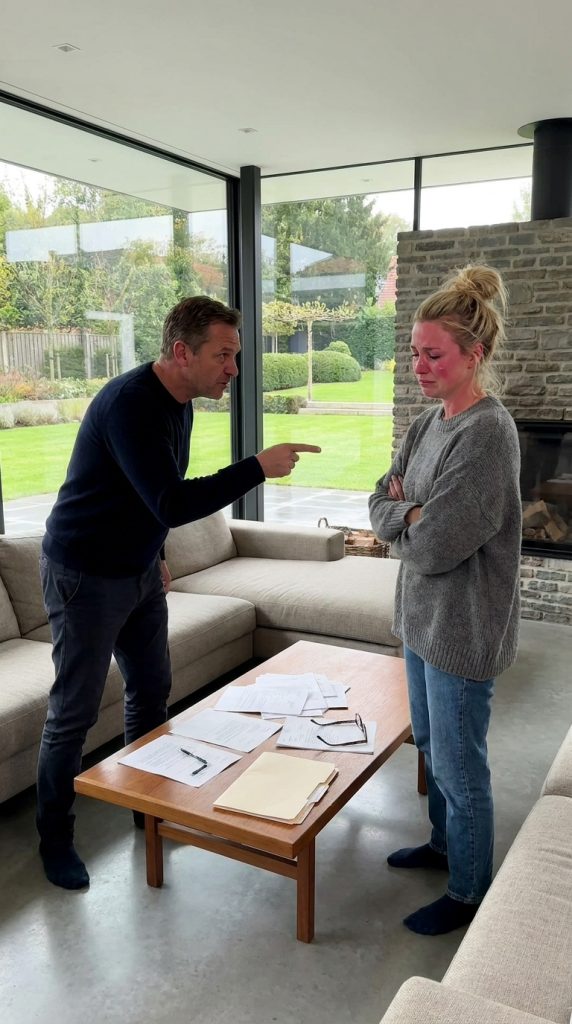
My name is Charlotte Hayes, and I was thirty-nine years old the night my husband decided my life was over.
He said it at exactly 7:14 on a Thursday evening in our kitchen, beneath the pendant lights I had selected, inside the house I had quietly financed piece by piece, one hand resting against the marble island as if he were announcing quarterly earnings instead of destroying a marriage.
“You’re unstable,” he said coldly. “I already filed for divorce. I want you out by tomorrow.”
For a moment, I genuinely thought I had heard him wrong. Not because our marriage was good. It had not been good for a long time. But because of the confidence in his voice. The certainty. The complete belief that I would break down, beg him for mercy, and ask where I was supposed to live.
I did none of that.
I simply stared at him.
His name was Grant Hayes. Forty-three. Commercial real estate. Designer watches, polished shoes, and the kind of smile that opened doors he had never truly earned. When we first met, he loved describing me as “creative but scattered.” At the time it sounded affectionate. Years later, I understood it was positioning. He had spent years shrinking me publicly, carefully shaping me into a smaller version of myself so he could look more competent, more grounded, more important.
The reality was much simpler. I worked from home because I owned a private market intelligence company that licensed advanced consumer behavior models to luxury retailers and venture-backed e-commerce firms. I never advertised it. I never posted about it online. My nondisclosure agreements were thicker than most mortgage contracts. Clients wired extraordinary sums into accounts Grant had never seen because early in our marriage we agreed to “simplify finances,” which really meant he controlled the visible household narrative while I allowed him to believe my work was boutique consulting with unpredictable income.
At first, I found that arrangement funny.
Later, I realized it protected me.
Grant loved appearing to be the obvious success in our marriage. He loved grabbing restaurant checks in front of friends. He loved talking about “carrying everything” while I smiled politely and let him perform. What he never understood was that the down payment for our vacation home came from me through an LLC he never bothered investigating, and the reason we survived his reckless development years was because I quietly covered far more than he ever imagined.
By the time he stood in our kitchen calling me unstable, I already suspected two things.
First, he was cheating on me.
Second, he believed I would walk away with nothing.
A manila envelope sat beside him on the counter. He pushed it toward me with two fingers.
“I told my attorney to make this simple,” he said. “Considering your condition, these terms are generous.”
My condition.
I opened the envelope. Divorce filings. Proposed terms. A temporary occupancy request demanding I leave the house within twenty-four hours “to minimize conflict.”
Then I saw it.
One line buried in the asset summary describing me as “currently non-income-producing.”
That was the exact moment everything changed.
Not because my heart broke.
Because I suddenly understood with complete clarity that my husband was not merely leaving me.
He was trying to erase me.
I turned one page, then another, before asking the only question that actually mattered.
“Grant,” I said quietly, “exactly how stupid do you think I am?”…
Part 2
Grant smiled after I asked him that.
Not warmly. It was the kind of smile men wear when they mistake a woman’s silence for weakness instead of strategy.
“Charlotte,” he said almost gently, “I’m trying not to make this uglier than necessary.”
I looked down at the documents again and felt something settle deep inside me. Not anger. Anger burns too hot. This felt colder than that. Sharper. Controlled.
The filing date was three days earlier. He had prepared everything before the confrontation, before the speech, before the insult. Which meant planning. Consultation. Someone had convinced him I was vulnerable enough to corner.
I kept reading.
There were references to my “recent emotional instability,” vague concerns regarding my judgment, subtle suggestions that I had contributed very little to our marital assets. It was expertly written in the way dishonest paperwork often is—smooth, polished, technically careful, designed to create suspicion long before proving anything.
“What condition?” I asked calmly.
Grant exhaled impatiently. “You know what I mean.”
“No,” I said. “Say it clearly.”
He hesitated.
That hesitation told me everything.
People telling the truth rarely fear specifics. People constructing narratives usually do.
“You’ve been erratic,” he finally said. “Withdrawn. Unpredictable. I’ve had to manage around you for months.”
I nearly laughed.
The truth was that during the last six months—while he slept with another woman and quietly prepared divorce filings—I had indeed become withdrawn. Because I noticed the second phone. The gym schedule that no longer matched his body. The unfamiliar perfume lingering on a jacket he claimed stayed at his office. And because my forensic accountant—hired through legal counsel he knew nothing about—was already reviewing suspicious transfers from one of our joint holding accounts.
He thought my silence meant fragility.
It actually meant evidence gathering.
There is always a moment during betrayal when heartbreak steps aside and logistics take control. Mine happened two weeks earlier inside a parking garage in Buckhead when I saw Grant climbing into a black Mercedes beside a woman I recognized from one of his development events. Tall. Elegant. At least ten years younger than me. Her hand already resting on his thigh before the door even closed.
I did not confront him.
I drove home, opened my laptop, and called Evelyn Cross—the best divorce attorney in Atlanta if you needed someone capable of smiling politely while dismantling a man’s entire life through procedure.
Evelyn listened for seven minutes before saying, “Do not tell him what you know. Start collecting timelines, account records, and anything showing concealment or patterns.”
So I did.
I documented hotel expenses disguised as client entertainment. Transfers routed through accounts he assumed I never checked. Payments for a downtown apartment leased beneath the name of a shell company tied to one of his business associates. But the ugliest discovery was this: he had consulted a psychologist from his litigation network—not for treatment, but for language.
Strategic language.
Phrases like instability. Difficulty regulating emotions. Erratic behavior. Enough to stain a reputation without needing to prove anything.
By the time he handed me those papers, I already had copies of every document secured in a folder Evelyn’s office labeled HAYES / PRIORITY.
Grant walked toward the wine fridge and poured himself a glass as if the matter was already settled.
“You can fight this,” he said casually. “But it’s not going to end the way you think.”
I watched him carefully over the paperwork.
“What exactly do you think I think?” I asked.
He gave a short, humorless smile. “I think you believe you’re more capable than you actually are.”
That line almost impressed me. It was so perfectly Grant. Not dramatically cruel. Intimately cruel. The kind of cruelty built slowly through years of study.
So I placed the packet down gently and said, “I’m not leaving tonight.”
He shrugged. “Then leave tomorrow.”
“No,” I replied. “You still don’t understand.”
Something in my voice finally made him pay attention.
He turned fully toward me, wineglass in hand.
And suddenly I realized something almost merciful in its clarity: Grant had spent our entire marriage talking only to the version of me he needed to exist in order to stay comfortable.
Not the actual woman standing in front of him.
The real woman had already hired legal counsel, secured financial records, copied evidence of his affair, and prepared a disclosure package capable of making his attorney physically sick.
I straightened slightly.
Then I said, “You should probably call your lawyer back. Tonight.”
For the first time all evening, Grant stopped looking confident.
Part 3
Grant did call his attorney that night.
I know because just after eleven, I heard him speaking through the cracked office door in a low, strained voice saying things like, “No, she’s being strangely calm,” and, “What do you mean that changes things?” while I sat in the guest room forwarding one final encrypted archive to Evelyn’s firm.
The next morning at 8:30, I left for downtown before he even came downstairs.
Not because he forced me out.
Because I had somewhere to be.
Evelyn’s office occupied the top floor of a glass tower overlooking Midtown Atlanta, the kind of place designed to remind everyone inside that outcomes could be purchased, sharpened, and professionally delivered. She was already waiting in the conference room when I arrived, dressed in navy, silver pen in hand, every movement precise.
“I reviewed his filing,” she said. “He made a mistake.”
“Only one?” I asked.
She almost smiled. “The worst possible one. He assumed discovery would help him.”
Then we began working.
I approved the response strategy, authorized immediate disclosure of my separate corporate income structures where appropriate, and signed motions challenging the occupancy demand, the defamatory instability allegations, and the incomplete financial disclosures within his filing. Evelyn’s forensic team had already prepared a preliminary comparison between what Grant reported, what he omitted, and what his transaction history contradicted.
When she slid the summary toward me, it was almost beautiful in its brutality.
Estimated annual personal income: $4.2 million.
Verified liquidity unknown to Grant: more than enough to survive any intimidation tactic.
Documented affair-related spending on housing and travel: extensive.
Exposure risk if false instability allegations proceeded formally: catastrophic.
Evelyn tapped the last line lightly. “If he keeps lying, this stops being expensive only financially.”
By noon, Grant knew everything.
Not because I told him.
Because his lawyer did.
I was sitting beside Evelyn when the speakerphone lit up with the incoming call. She glanced at me once, received my nod, and answered.
The attorney introduced himself as Daniel Mercer, counsel for Grant Hayes. His voice carried that tightly controlled tone lawyers use when their client has hidden something career-ending.
He did not ask whether my income disclosure was real.
He asked whether it was complete.
That may have been one of the most satisfying moments of my entire adult life.
Evelyn replied, “It is sufficient for present purposes. I would strongly advise your client to revise his assumptions immediately.”
There was a pause before Mercer carefully said, “My client was operating under a very different understanding of Mrs. Hayes’s financial position.”
Evelyn answered smoothly, “Yes. That seems to be a recurring problem.”
I stared through the glass wall at the city below and felt completely calm for the first time in months.
Grant came home early that afternoon.
I was already there seated at the dining table with my laptop open, untouched tea beside me, and a printed copy of the amended financial disclosure in front of me. He entered without speaking, dropped his keys too hard onto the counter, and stared.
I had seen him angry before. Men like Grant become angry privately all the time. But I had never seen him shaken. It transformed him. Removed the polish entirely.
“You lied to me,” he said.
I looked up slowly. “About what?”
“About everything.”
“No,” I replied calmly. “I allowed you to believe what was convenient.”
That hit him harder than yelling ever could have.
He paced once before turning back toward me. “You made me look like a fool.”
There it was.
Not guilt. Not shame over the affair. Not embarrassment regarding the false accusations.
Just wounded ego.
“You managed that perfectly well yourself,” I said.
His face flushed red. “Why didn’t you tell me?”
I closed my laptop carefully.
“Because you preferred me small,” I answered. “And eventually I got tired of explaining my size to men who only respect money once they believe it belongs to them.”
That was the first moment in years he had no immediate response. No polished tone. No smug correction. Only silence.
Then, because truth works best when delivered precisely, I continued.
“You called me unstable because you assumed I was isolated. You demanded I leave by tomorrow because you believed I had nowhere to go. You filed first because you thought surprise created control.” I slid the amended disclosure across the table. “What you actually surprised was a woman who can afford the best legal teams in three states and who already documented your affair, your omissions, and every false statement inside those filings.”
He never touched the paperwork.
Hours later, after locking himself inside the study making what I assume were panicked phone calls, I walked slowly through the house.
Not like someone being removed.
Like someone deciding what still deserved to follow her into the next chapter of her life.
The divorce lasted nine months. Grant settled before formal hearings exposed everything publicly. The affair partner vanished quickly once secrecy became liability. His public reputation survived, mostly, because men like him usually do. But privately, inside the rooms that mattered, people learned exactly what kind of strategist he became when he believed a woman had less power than he did.
As for me, I purchased a penthouse three blocks from my office and furnished it without asking anyone else’s opinion. I kept my company, my clients, my name, and my peace.
Sometimes people hear this story and assume the satisfying part was the moment Grant discovered the truth—that I earned $4.2 million a year and he had completely underestimated me.
It wasn’t.
The satisfying part came earlier.
It was the moment standing in that kitchen, divorce papers in my hands, when I realized his disgust had never reflected my value.
Only his need to believe it was smaller than his own.