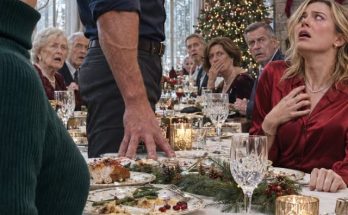
Chapter 2: The Breaking Point
The applause following Arthur’s toast had barely faded before the room resumed its loud, self-congratulatory hum. I slid into the lone empty chair at the very bottom end of the table—the spot closest to the kitchen door, conveniently positioned so I could jump up whenever someone needed more water, extra butter, or a fresh bottle of Cabernet.
My plate sat empty in front of me. I hadn’t eaten since a dry piece of toast at six in the morning, and my hands were shaking faintly from a mixture of low blood sugar and sheer, unadulterated exhaustion. Leo whimpered softly against my collarbone, chewing furiously on his tiny fist. I reached into the diaper bag slung over the back of my chair, pulled out a chilled teething ring, and gently guided it to his mouth.
“Honestly, Clara, can’t you keep that child quiet?” Aunt Margaret muttered from two seats down, wrinkling her nose as if Leo were a stray dog who had wandered in from the rain. “Julian was just telling us about his merger in Zurich.”
“He’s teething, Aunt Margaret,” I said softly, my voice tight. “He’s eight months old.”
“Well, some of us actually know how to manage our children,” she sniffed, turning her shoulder away from me. “When Julian was a baby, he never made a peep at the dinner table. Of course, we had a proper nanny. Something I suppose isn’t in the budget when you marry a foot soldier.”
A ripple of muffled laughter ran down my side of the table. I kept my eyes fixed on the tablecloth, tracing the faint damask pattern with my thumbnail. Just get through dessert, I told myself. Serve the crème brûlée, clean the kitchen, pack up Leo, and go home. Just two more hours.
It was the same mantra I had used at Thanksgiving. The same mantra I had used at Christmas. The same mantra I had used at Easter, Mother’s Day, and Arthur’s sixtieth birthday. Swallow the insult. Keep the peace. Protect their pride.
At the head of the table, Eleanor picked up her fork and knife. The dining room grew slightly quieter as she sliced into her portion of beef Wellington. I had spent forty-five minutes just getting the puff pastry lattice right, brushing it with egg wash twice so it would bake to a deep, gleaming amber. The center of the tenderloin was a textbook medium-rare, wrapped tightly in savory mushroom duxelles and thin Parma ham.
Eleanor lifted a small piece to her mouth, chewed twice, and stopped.
Her face twisted into a theatrical grimace. Slowly, deliberately, she placed her fork down, gripped the edges of her porcelain plate, and shoved it away from her. The heavy ceramic scraped across the polished mahogany with a harsh, grating screech that sliced right through the room’s conversation.
Every single head turned toward her.
“Eleanor, darling, what’s wrong?” Arthur asked, leaning forward with practiced concern.
“It’s inedible,” Eleanor declared, dabbing the corners of her mouth with her linen napkin as though she had just swallowed poison. “The pastry is soggy on the bottom, the beef is practically raw, and there’s far too much salt. Honestly, I don’t know why I ever let you near my kitchen, Clara.”
I stared at her plate from across the length of the table. The crust wasn’t soggy—I had baked it on a preheated steel sheet specifically to prevent that. And the beef was the exact medium-rare she had demanded three days ago.
“Mom,” I said, my voice trembling slightly despite my best efforts to keep it steady. “I checked the internal temperature with a digital thermometer. It was one hundred and thirty degrees. That’s medium-rare.”
“Are you calling me a liar in my own house?” Eleanor’s voice rose, sharp and venomous, echoing off the high crown-molded ceilings. She leaned forward, her diamond earrings catching the candlelight as her eyes locked onto mine with pure, unfiltered malice.
“You are a disappointment, Clara, and so is that useless soldier you married!” she sneered, her words ringing out like a slap across the face. “Look at you! Fatigued, broke-looking, draped in some miserable rag, chained to a baby you can’t even afford to raise properly! You can’t even cook a decent meal for the parents who gave you everything!”
The silence that lasted half a second was shattered by Julian’s loud, barking laugh.
“Careful, Aunt Eleanor,” Julian chimed in, leaning back in his chair and swirling his red wine with a smug grin. “If you’re too hard on her, she might ask her husband to borrow a government-issue MRE for dessert.”
That did it. The entire dining room erupted.
My aunts, uncles, and cousins cackled openly, some of them slapping the table, others raising their glasses in mocking agreement. Uncle Richard wiped a tear of mirth from his eye, shaking his head at me as if I were the punchline to a joke they had been waiting all evening to hear. Even my younger cousins, people I had babysat and bought graduation gifts for, were giggling behind their hands, exchanging smug, pitying glances.
Eleanor basked in the laughter, her chin lifted high. “At least Julian has the decency to appreciate what family means,” she continued, talking right over the chuckles. “He offered to buy us a vacation home in Cabo this year so your father and I can escape the winter, whereas your husband probably can’t even afford a bicycle! It’s pathetic, Clara. Truly pathetic. You’ve been riding on our coattails your whole life, and you can’t even manage to bring a little dignity to our anniversary.”
Something inside my chest didn’t break.
Breaking implies noise, mess, and pain. What happened to me in that dining room was the exact opposite. It was a sudden, absolute, bone-chilling freeze.
All the heat drained out of my cheeks. The exhaustion that had been weighing down my limbs like wet concrete vanished, replaced by a razor-sharp, hollow stillness. I stopped bouncing Leo. I stopped staring at the tablecloth. Slowly, I lifted my head and looked around the room—really looked at them—for the very first time in thirty years.
I looked at my mother, draped in emerald silk, sneering at me from beneath a chandelier I had paid an electrician two thousand dollars to install. I looked at my father, nodding in smug approval while sipping a three-hundred-dollar bottle of Bordeaux from a wine cellar I had kept from being repossessed. I looked at Julian, bragging about a Cabo vacation home he had no intention of ever actually buying, soaking up the adoration that should have belonged to the daughter who had sacrificed her twenties to keep this family from living in a motel.
They didn’t love me. They didn’t even like me.
To them, I wasn’t a daughter, a niece, or a sister. I was a convenient, quiet, pathetic ATM machine with a pulse—and the moment I stopped smiling while they kicked me, I was nothing more than an eyesore.
Ninety-six months, a quiet, cold voice whispered in the back of my mind. Six thousand, eight hundred dollars a month. Six hundred and fifty-two thousand, eight hundred dollars. Not counting the roof repair. Not counting the property taxes. Not counting the kitchen remodel.
And not a single “thank you” in eight years.
The laughter around the table was still tapering off into snickers and amused murmurs. Eleanor reached for her wine glass, satisfied that she had put me firmly back in my place.
I didn’t cry. I didn’t yell. I didn’t even flinch.
With eerie, unhurried precision, I pushed my chair back from the table. The legs slid smoothly over the hardwood floor. I stood up, reached behind my shoulders, and unclasped the buckles of Leo’s cotton carrier.
Leo had finally drifted off to sleep against my chest, his long dark lashes resting against his flushed cheeks. I lifted him gently, cradling his warm weight in my arms, and walked three steps over to Maya, my nineteen-year-old second cousin—the only person at the table who hadn’t laughed, her eyes wide and uncomfortable behind her tortoiseshell glasses.
“Maya,” I said, my voice so calm and flat it sounded like it belonged to a stranger. “Would you hold Leo for just two minutes?”
Maya blinked, startled, and immediately held out her arms. “Of course, Clara. I’ve got him.”
I transferred my sleeping son carefully into her lap, kissed the top of his soft, warm head, and straightened up. The chatter around the table had begun to falter, people noticing the strange, rigid shift in my posture.
“Where do you think you’re going?” Eleanor snapped, her eyes narrowing. “The dessert isn’t even plated yet.”
I didn’t answer her. I didn’t even look at her.
Instead, I reached into the pocket of my black wrap dress, pulled out my smartphone, and stared down at the glowing screen. My thumb hovered over the glass for a single heartbeat, unlocking my private wealth-management banking app with a deadpan, chillingly calm expression.
Across the table, Arthur frowned, sensing something was deeply, terribly wrong—though he had no idea that in the next ten seconds, his entire world was about to turn to ash.