HE CAUGHT HIS MAID TEACHING HIS BLIND DAUGHTER TO FIGHT—THEN THE TRUTH ABOUT HER PAST SHOOK HIS ENTIRE EMPIRE.
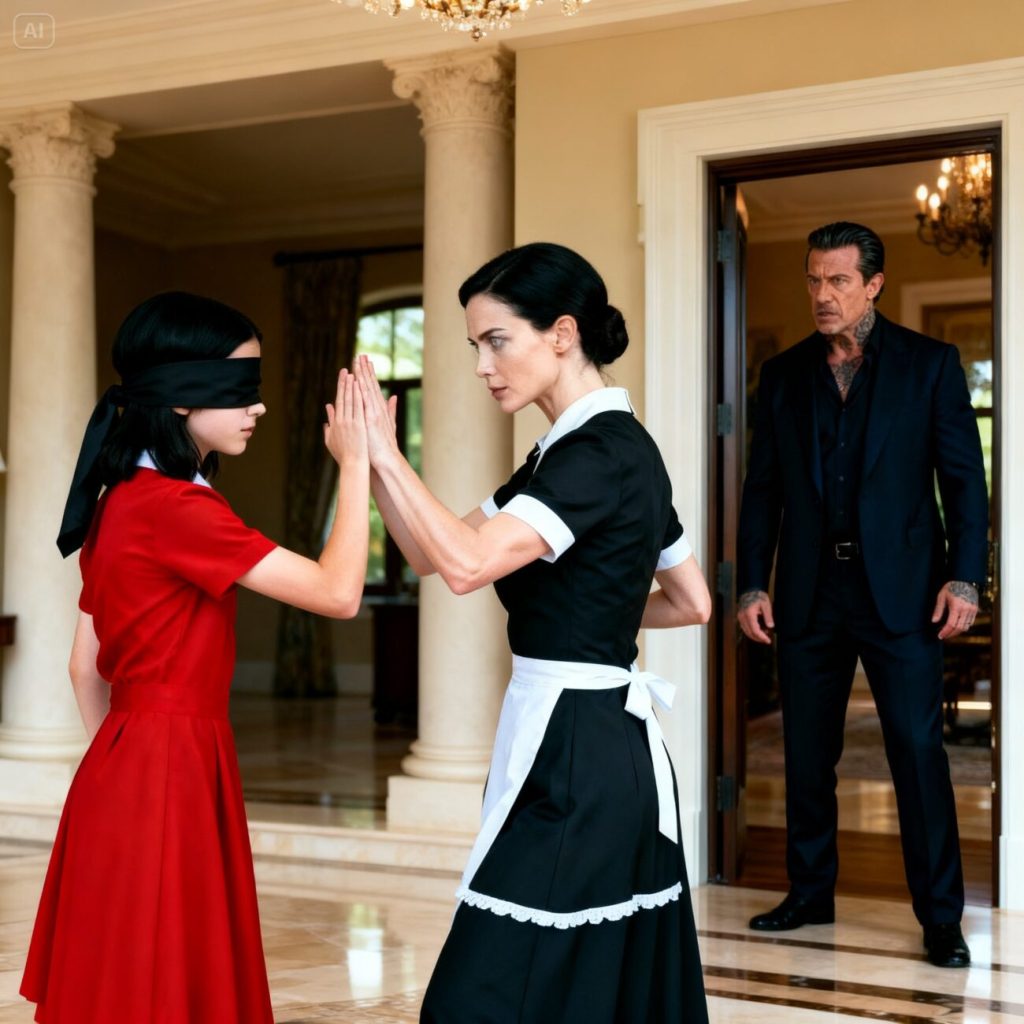
“Your enemies know you have a blind heir,” Isold said.
The words landed between them like a blade placed carefully on a table.
Marco’s expression did not change, but something behind his eyes sharpened.
For a long moment, the basement was silent except for the faint hum of the old heating pipes and the distant echo of Aurora’s footsteps disappearing above them.
“You should choose your next words very carefully,” Marco said.
Isold did not lower her eyes.
“I always do.”
He took one step closer. “Are you threatening my daughter?”
“No,” she said. “I’m telling you the truth everyone else is too afraid to say.”
His jaw flexed.
Isold’s voice remained calm, but there was steel underneath it now, the kind that had been forged long before she ever entered his house in a maid’s uniform.
“Every man who hates you knows exactly where to strike. Not your warehouses. Not your money. Not your men. Her.”
Marco’s hands curled slowly into fists.
“You think I don’t know that?”
“I think you know it so deeply it has made you stupid.”
The basement air changed.
Men had died for less than that sentence.
Marco moved before thought could stop him. In three strides, he closed the distance between them. His shadow fell over her. He was tall, broad-shouldered, dressed in a black shirt open at the throat, the sleeves rolled to his forearms, power radiating from him in a way that made even hardened soldiers look away.
Isold did not.
“You come into my house,” he said, his voice low and deadly, “lie about who you are, put a weapon in my daughter’s hands, and now you insult me?”
“I didn’t lie.”
“You said you were a maid.”
“I clean,” she said. “That part is true.”
His eyes narrowed.
“And the rest?”
A flicker passed across her face. So quick another man might have missed it.
Marco did not miss things.
Not when his daughter was involved.
“The rest,” Isold said, “is none of your concern unless it touches Aurora.”
“You made it my concern the moment you brought her down here.”
“She asked me to.”
Marco froze.
The words hit harder than he expected.
Isold continued, quieter now. “She found me practicing one night in the laundry room. She heard the movement. The rhythm. She knew it wasn’t cleaning.”
Marco’s chest tightened.
“She asked what I was doing. I told her the truth. Then she asked me if someone blind could learn.”
Isold looked toward the staircase where Aurora had gone.
“She didn’t ask because she wanted to fight, Mr. Bellini. She asked because she was tired of being afraid of rooms she couldn’t see.”
Marco swallowed.
It was not visible. Not much. But Isold saw it.
“She told me guards talk when they think she isn’t listening,” Isold said.
Marco’s expression darkened.
“She hears them call her a liability.”
His face went very still.
“Who?”
“That’s what matters to you?”
“Names.”
Isold’s mouth tightened. “You can punish the mouths if you want. It won’t change the thought. They see her as your weakness because you trained them to see her that way.”
Marco’s nostrils flared.
“I trained them to protect her.”
“You trained them to guard a fragile object. Not a person.”
“She is my daughter.”
“Yes,” Isold said. “And you love her like a prison.”
The silence after that was almost violent.
Marco looked as though he might tear the entire basement apart with his bare hands. But underneath the rage, there was something else.
Pain.
Raw, sudden, unwanted pain.
Because a part of him, a part he hated, knew she was right.
For twelve years, he had built his life around keeping Aurora safe. He had chosen her food, her staff, her routes through the mansion, the people allowed near her. He had turned every room into a controlled environment. Rounded corners. Soft rugs. No sharp furniture. No unpredictable dogs. No candles. No stairs without railings. No guests without background checks.
He had called it love.
And maybe it was.
But maybe love could still become a cage if fear held the key.
“She is blind,” he said, but the words sounded weaker now, even to him.
“She is blind,” Isold agreed. “She is not helpless.”
“You don’t know what people like me do to weakness.”
Isold’s eyes turned colder.
“I know better than you think.”
Something in her voice pulled him up short.
There it was again—that hidden history, that shadow behind the maid’s plain face.
Marco studied her carefully for the first time.
Really studied her.
The way she held herself with her weight slightly forward. The way her hands rested loose but ready. The faint scar along her wrist. The older one near her collarbone, half hidden by the fabric of her dress. The way her breathing never changed, no matter how close danger came.
This woman was not afraid of him.
Not because she was foolish.
Because she had survived worse.
“Who are you?” he asked.
Isold’s answer came too quickly.
“No one.”
Marco gave a humorless laugh. “No one teaches a blind child how to block a strike by listening to the air.”
“No one who lives in your world should stay unable to defend herself.”
“My world?” he repeated. “You say that like you’re not standing inside it.”
“I am standing in the ruins it leaves behind.”
For the first time, her composure cracked.
Only slightly.
But enough.
Marco saw grief there.
Old grief.
The kind that did not heal.
The kind that built walls inside a person and called them strength.
Before he could press further, a sound came from above.
A soft door closing.
Aurora.
Both of them looked toward the staircase.
“She’s listening,” Isold said.
Marco closed his eyes briefly.
Of course she was.
His daughter heard everything.
He turned back to Isold. “You will not train her again without my permission.”
“Then give me permission.”
“No.”
“Then she will keep asking someone else. Or she’ll try alone.”
Marco’s gaze snapped back to her.
Isold stepped closer now, lowering her voice.
“You can stop me. You can fire me. You can lock every door in this house. But you cannot stop what has already happened inside her. She has felt strength once. She will not forget it.”
Marco hated her for that.
Hated her because she understood Aurora in a way he had not.
Hated her because his daughter had changed in front of him, and he had been too afraid to see it.
“Get out,” he said.
Isold held his stare.
“Now.”
She nodded once, walked to the shelf, and placed the wooden baton down with careful respect. Not like a toy. Not like a weapon.
Like a promise.
At the bottom of the stairs, she paused.
“Your daughter is stronger than you know,” she said. “The question is whether you are brave enough to let her prove it.”
Then she went upstairs.
Marco remained alone in the basement.
For several minutes, he did not move.
The room still smelled faintly of dust, sweat, and old stone. On the concrete floor, Aurora’s baton lay where she had dropped it.
Marco walked to it slowly.
He bent down and picked it up.
The wood was warm from her hands.
Small hands.
His little girl’s hands.
But when he closed his fingers around the baton, he could still hear the crack of wood against wood. The perfect block. The certainty in her stance. The way she had moved not away from danger, but toward it.
His throat tightened.
He had thought he was terrified because Isold had put Aurora in danger.
Now he wondered if the truth was worse.
Maybe he was terrified because she had shown him Aurora did not need him as much as he needed to believe.
That night, Marco did not sleep.
He sat in his study long after midnight, the lights low, a glass of scotch untouched beside his hand. Rain slid down the dark windows in thin silver lines. The mansion was quiet, but not peaceful.
It had not felt peaceful in years.
A photograph of Aurora stood on his desk. She was seven in the picture, laughing on the garden steps with her face turned toward the sun. Her eyes, pale and clouded since birth, looked almost luminous in the afternoon light.
He remembered the day she was born.
He remembered the doctor saying the words congenital blindness with the careful tone people used when they were about to destroy you politely.
He remembered holding Aurora against his chest while her mother slept, whispering to that tiny, warm bundle that he would fix it.
He had been Marco Bellini. He had money. Doctors. Influence. Private planes. Favors owed by men in countries he had never visited.
Surely blindness was just another problem power could solve.
It was the first thing in his life that power could not touch.
And three months later, Aurora’s mother was dead.
A sudden fever after a minor surgery. Complications, they said. Rare, they said. Unpredictable, they said.
Marco had not believed in God since.
The study door opened.
No knock.
Only one man in the world entered that way and lived.
“You look terrible,” Vtor said.
Marco did not look up. “I feel worse.”
Vtor Bellini was not blood, but he had been family longer than most men survived around Marco. Ten years older, silver at the temples, lean as a blade, with eyes that noticed every lie before it was spoken. He had served Marco’s father, then stayed when Marco took the empire.
Sometimes Marco thought Vtor had raised him more honestly than his father ever had.
“You heard?” Marco asked.
“The night staff heard enough. So did half the security corridor.” Vtor crossed to the sideboard and poured himself a drink. “The quiet maid is not so quiet, it seems.”
Marco’s gaze lifted.
“You knew.”
Vtor did not answer fast enough.
Marco stood. “You knew she was training Aurora.”
“For three weeks.”
The room went cold.
“Three weeks?”
“I was told there were unusual sounds in the basement. I investigated.”
“And you said nothing?”
“I watched.”
“You watched my blind daughter being attacked with weapons?”
“Wooden training batons,” Vtor said calmly.
Marco slammed his hand on the desk.
The photograph of Aurora shook.
“Do not correct me.”
Vtor turned, glass in hand. “Then do not ask me questions if you only want your fear repeated back to you.”
Marco’s eyes darkened.
Any other man would have lowered his gaze.
Vtor simply sipped his drink.
Marco breathed once through his nose, forcing control back into his body.
“What did you see?”
Vtor’s expression softened, but only slightly.
“I saw your daughter fall six times and stand seven. I saw her listen better than most men see. I saw Isold strike hard enough to teach, not hard enough to injure. I saw discipline.”
Marco looked away.
“I saw something else,” Vtor added.
“What?”
“I saw Aurora happy.”
That, more than anything else, silenced him.
Vtor came closer and sat across from the desk.
“Marco, do you remember Carmine Russo?”
Marco’s jaw tightened.
Everyone remembered Carmine Russo.
A small-time boss in the eastern district. Loud, greedy, not clever enough to survive long but dangerous enough to cause damage before he fell. His son had been disabled, confined to a wheelchair after a childhood illness.
Last year, a rival crew had kidnapped the boy.
They sent him back in a box.
Marco still remembered the funeral. Carmine had screamed until his throat bled. Three days later, he burned down two restaurants, killed six men, and started a war that ended with his own body floating under Pier 18.
“Aurora is not Russo’s son,” Marco said.
“No,” Vtor agreed. “She is more valuable.”
Marco’s hands curled around the edge of the desk.
“She is not a bargaining chip.”
“To you, no. To your enemies, yes.”
“I have guards.”
“You have employees.”
“They are loyal.”
“They are paid,” Vtor said. “And money is not loyalty. It is a temporary opinion.”
Marco looked at him sharply.
“You taught me that.”
“And apparently you forgot.”
Vtor leaned forward.
“You can put fifty men around her. A hundred. It will not matter. A guard can be bribed. A gate can be opened. A camera can fail. A driver can take the wrong road. A cook can poison soup. A nurse can leave a door unlocked. You cannot outsource survival.”
Marco said nothing.
“You’re thinking like a father,” Vtor said.
“I am a father.”
“Then act like one who wants his daughter alive after you are gone.”
The words struck deep.
After you are gone.
Marco had imagined his death a thousand times. Bullets. Poison. Betrayal. A knife from a man smiling too closely. He had made arrangements for businesses, money, properties, safe houses.
But Aurora?
He had never been able to imagine that part all the way through.
Because every version ended in darkness.
“You think I should allow this,” Marco said quietly.
“I think you should stop confusing weakness with innocence.”
Marco looked at Aurora’s photograph again.
“She is twelve.”
“She is a Bellini.”
“I never wanted that for her.”
“No one asked what you wanted,” Vtor said, not unkindly. “This is the life she has. The question is whether you prepare her for it.”
Before Marco could answer, a soft sound came from the hallway.
Both men turned.
Aurora stood in the open doorway.
Her hair was loose over her shoulders. She wore a white nightdress and no shoes. One hand rested on the doorframe, not because she needed support, but because she liked to know where the world was.
Her face was pale.
Her chin was lifted.
“I don’t want dogs,” she said.
Marco’s chest tightened.
“Aurora.”
“I want teeth.”
Vtor looked away, and Marco hated him for hiding a smile.
Aurora stepped inside, navigating the room with quiet certainty. The edge of the carpet. Three steps. The corner of the chair. Four more to the desk. She stopped exactly in front of him.
“I heard everything,” she said.
“You should be asleep.”
“I’m blind, Papa. Not deaf.”
That one hurt because it was not defiance.
It was truth.
“Aurora, this world is not a game.”
“I know.”
“No,” he said. “You don’t.”
Her lips pressed together.
Marco came around the desk and knelt in front of her. He did that sometimes when she was younger, so she could touch his face and know where his voice came from.
Tonight, she did not reach for him.
“That training can hurt you,” he said.
“So can doing nothing.”
“You are a child.”
“I am your heir.”
The words hung in the room.
Marco stared at her.
Vtor became very still.
Aurora’s fingers tightened at her sides.
“I know you never say it,” she continued. “But everyone else does when they think I can’t hear. Heir. Liability. Weak spot. Blind girl.”
Her voice cracked on the last words, but she did not cry.
“I don’t want to be the place your enemies aim.”
Marco felt something twist inside him.
“You are not a weakness.”
“Then let me become strong.”
He closed his eyes.
For one second, he wanted to say yes.
Not because he trusted the world. Not because he trusted Isold. But because his daughter stood in front of him asking not for a doll, not for a dress, not for some pretty safe thing.
She was asking for herself.
For the right to belong to her own body.
“I will think about it,” he said finally.
Aurora’s mouth parted.
She knew what that meant.
It was not yes.
But it was no longer no.
She nodded once, very formally, and turned toward the door.
At the threshold, she stopped.
“Papa?”
“Yes?”
“When Mama died, did you wish I had been different?”
The question tore the air from his lungs.
Marco stood slowly.
“What?”
Aurora did not turn around.
“I heard Nonna say it once. Years ago. She said if I had been born normal, maybe Mama would have been stronger. Maybe she wouldn’t have given up.”
Marco’s blood turned to ice.
His mother had died three years ago. Lucky for her.
“Aurora,” he said, voice breaking despite himself, “look at me.”
She gave a sad little smile.
“I can’t.”
He crossed the room and knelt behind her, turning her gently by the shoulders.
“Then hear me,” he said. “Your mother loved you so much it frightened me. She did not die because of you. She did not suffer because of you. And I have never, not for one breath of your life, wished you were anything other than mine.”
Aurora’s mouth trembled.
“Then why do you hide me?”
That question he could not answer.
Not well.
Not yet.
So he held her.
At first she resisted, stiff in his arms. Then slowly, terribly slowly, she folded into him.
Vtor left without a word.
Marco stayed there on the study floor with his daughter until her breathing steadied against his shoulder.
But long after she returned to bed, her question remained.
Why do you hide me?
At dawn, Marco went looking for the truth.
The address Vtor gave him took him far from the polished violence of his own world. No marble. No gates. No men in tailored suits pretending brutality was business. Just narrow streets wet from morning rain, brick buildings with broken windows, laundry lines strung between apartments, and people who looked away when expensive cars rolled through.
The boxing gym was beneath an abandoned textile warehouse.
No sign.
Just a red door with peeling paint and the dull rhythm of fists hitting leather.
Marco entered alone.
The air inside was thick with sweat, old rubber, cheap disinfectant, and the metallic ghost of blood. Young fighters moved under dim lights, wrapping hands, skipping rope, throwing punches into cracked bags. They were thin in the way hungry men were thin. Not weak. Dangerous.
An old man sat behind a desk covered in papers, tape rolls, and unpaid bills. One eye was clouded. The other was sharp enough to cut.
When he saw Marco, fear passed over his face.
Then resignation.
“We paid last week,” the old man said. “Your collector came Thursday. I have the receipt.”
“I’m not here for money.”
The old man’s gaze narrowed.
“No Bellini walks into my gym for exercise.”
Marco pulled a photograph from his coat.
It was one of Isold from the staff files. Hair tied back. Plain dress. No expression.
The old man looked at it for half a second too long.
“Don’t know her.”
Marco sat down without being invited.
“I’m going to ask once politely.”
“Then what?”
“Then I ask as my father would have.”
The old man’s mouth tightened.
“You look like him when you say things like that.”
Marco hated how much that bothered him.
“She is in my house,” Marco said. “Near my daughter. I need to know who she is.”
The old man leaned back slowly.
“Is the girl safe?”
“My daughter?”
“The blind one.”
Marco went still.
“You know about her?”
“People talk.”
“Answer me.”
The old man studied him, then nodded toward the back wall.
“Third row. Bottom frame.”
Marco stood.
The wall was crowded with photographs. Fighters in rings. Winners with swollen eyes. Losers holding trophies like proof that pain had meaning. Some photos were fresh. Others had yellowed with age.
He found the frame.
And the world changed.
In the picture, a young woman stood in a brutal underground ring, one fist raised, blood running from her nose, eyes bright with a feral, terrible triumph. Her hair was cut short. Her body was lean muscle and scars. Around her, men screamed like animals.
But the eyes were the same.
Gray.
Cold.
Ancient.
“The White Wolf,” the old man said behind him.
Marco’s throat tightened.
He had heard the name.
Everyone had.
A decade ago, in the underground fight circuits, there had been rumors of a female fighter who moved like instinct made flesh. Undefeated. Untouchable. A girl who broke men twice her size and walked away without smiling.
Then she vanished.
Some said she died.
Some said she was bought by a foreign syndicate.
Some said she killed the wrong man and disappeared before revenge found her.
Marco looked at the photograph again.
“Isold.”
“That was her name before grief swallowed it.”
The old man sat heavily, suddenly looking older.
“She came here at sixteen with her little brother. Luca. Sweet kid. Sick lungs. Too smart for this place. She fought to feed him.”
Marco said nothing.
“She was special from the start. Not angry, not reckless. Most fighters come in here wanting to prove something. She came in wanting to survive. That’s different.”
The old man poured something from a flask into his coffee and drank.
“She won local fights. Then district fights. Then private bouts. Men started betting big money on her. Too big. The kind that attracts devils.”
Marco knew before he said it.
“The tournament.”
The old man looked at him.
“So you do remember.”
Marco’s stomach tightened.
Ten years ago.
His father had called it investment.
Entertainment for men with too much money and no conscience. Marco had attended one fight and left disgusted. He had told himself he did not approve.
But he had not shut it down.
He had not returned the profits.
He had used them.
“Tell me,” Marco said.
The old man’s voice hardened.
“Luca needed surgery. Expensive. Experimental. Switzerland, maybe Germany, I forget. Isold was desperate. The tournament organizers offered her a deal. Five fights. Win them all, and they pay for everything.”
Marco could see where this was going, and still he could not stop listening.
“She made it to the final,” the old man said. “Four fights. Four wins. Barely touched. The crowd loved her. Men like your father loved her because she made them money.”
Marco’s face went pale.
“Then they brought Luca in.”
The old man’s good eye glistened.
“She told him to stay away. But someone brought him. Promised him he could see his sister win. Maybe told him she wanted him there. I don’t know. But once he was inside, they used him.”
Marco’s voice came out rough.
“How?”
“They told her to throw the final. If she lost, Luca lived. If she won, the boy fought Constantine.”
Marco knew that name too.
Constantine had been a butcher disguised as a fighter.
“He was fourteen,” Marco whispered.
“Yes.”
The gym seemed to fade around him.
“And she?”
“She tried to lose,” the old man said. “I believe that. But the man against her didn’t know. He came to kill. Her body reacted before her heart could stop it. She won fast.”
The old man looked back at the photo.
“While she won, they put Luca in the ring.”
Marco closed his eyes.
He did not want to hear the rest.
He deserved to.
“He died calling her name.”
The old man’s voice broke.
“Isold fought her way out. Not like a champion. Like something already dead. Five men went down before she disappeared into the night. The White Wolf vanished with her brother’s blood still on her clothes.”
Marco stood motionless.
“My father funded it,” he said.
The old man laughed once, coldly.
“Your father profited. Your family profited. You tell me the difference.”
Marco had no answer.
The old man came closer, his voice low.
“You asked if you can trust her near your daughter. I’ll tell you this. Isold knows exactly what happens when a child is used as leverage by powerful men. If she is teaching your girl, it is not because she wants to turn her into a weapon.”
He pointed at the photograph.
“It is because she knows what happens to children who are never taught how to survive.”
Marco returned to the mansion changed.
Not visibly. Men like him learned early never to show wounds before knowing who might press them. He went through the gates, gave orders, signed papers, answered calls, and held meetings as if the world had not shifted beneath his feet.
But inside, something had cracked open.
At noon, he found Aurora in the music room.
She sat at the piano, not playing. Her hands rested above the keys, fingers hovering in silence.
“You went somewhere,” she said.
Marco stopped in the doorway.
“How did you know?”
“Your shoes sound different when you’ve been outside the city roads. There’s grit in the steps.” She tilted her head. “And you smell like old coffee and boxing tape.”
Despite everything, he almost smiled.
“I went to learn about Isold.”
Aurora’s face grew serious.
“And?”
“And I learned enough to know she has more reason than most to hate this family.”
Aurora turned toward him fully.
“Does she?”
“I don’t know.”
“She doesn’t hate me.”
“No,” Marco said softly. “She doesn’t.”
He crossed the room and sat beside her on the piano bench.
For a while, neither spoke.
Then Marco said the words before fear could stop him.
“You may continue training.”
Aurora went perfectly still.
“With conditions,” he added quickly. “I supervise when necessary. Vtor is informed of all locations. No blades. No firearms. Nothing that could permanently injure you.”
Her face began to brighten.
“And if Isold says a lesson is too dangerous—”
“I listen to her.”
“If I say stop—”
“You won’t.”
“Aurora.”
She smiled.
“I’ll listen.”
He exhaled.
“Then yes.”
For one second, his daughter looked younger than twelve.
Pure joy broke across her face.
She threw her arms around him so quickly he almost lost balance.
“Thank you,” she whispered.
Marco held her tightly.
His eyes burned.
“Do not thank me yet,” he said into her hair. “Strength has a cost.”
Aurora pulled back.
“So does helplessness.”
He had no argument left.
The first official lesson happened that afternoon in the inner courtyard.
Marco watched from the balcony, though he told himself he was only there to supervise. Below, Isold arranged bells, wooden poles, smooth glass pieces, and strips of hanging fabric along the cobblestones.
Aurora stood at the start of the path in training clothes, her hair tied back.
She looked nervous.
Excited.
Alive.
Marco gripped the railing.
“What is this?” he called.
Isold glanced up.
“A map.”
“It looks like an accident waiting to happen.”
“It is a controlled accident.”
“I don’t like controlled accidents.”
“You don’t have to like them.”
Vtor, standing beside Marco, coughed into his hand to hide amusement.
Marco glared at him.
Below, Isold touched Aurora’s shoulder.
“The world speaks,” she said. “Most people ignore it because they rely on sight. You don’t have that distraction.”
Aurora smiled faintly. “Most people don’t call blindness an advantage.”
“I’m not most people.”
“No,” Aurora said. “You really aren’t.”
Isold stepped away.
“There are bells around you. Some high. Some low. Glass on the ground. Smooth, but loud. Cloth hanging where sound disappears. Your task is to reach me without touching anything.”
Aurora swallowed.
“How?”
“Listen.”
Isold tossed a small stone.
A bell chimed.
Aurora’s head turned.
Another stone. Another bell. Farther away.
Then Isold clapped once.
The sound bounced off the walls, broke against columns, vanished in the hanging cloth.
Aurora frowned.
“It changes.”
“Yes.”
“The courtyard has shapes.”
“Yes.”
“I can hear the empty parts.”
A slow smile touched Isold’s mouth.
“Good.”
Marco watched as Aurora stepped forward.
First step.
Safe.
Second.
Safe.
Third.
A bell rang softly.
Aurora winced.
“Stop,” Isold said.
Aurora froze.
“What did you learn?”
“It was lower than I thought.”
“Why did you think wrong?”
“I followed the echo from the wall, not from the bell.”
“Good. Again.”
They repeated the path.
Again.
Again.
Again.
By the tenth attempt, sweat darkened Aurora’s collar.
By the fifteenth, she was breathing hard.
By the twentieth, Marco’s hands hurt from gripping the railing.
Then something changed.
Aurora stood at the beginning of the path and clicked her tongue.
Softly.
Once.
Twice.
The sound bounced back.
Her head tilted.
She clicked again.
Then she moved.
Not like a blind girl feeling her way through obstacles.
Like someone walking through invisible architecture.
She curved around the first bell. Stepped over the glass. Ducked under a hanging chime. Turned sideways before the cloth touched her cheek.
Not once did anything ring.
At the end, she reached Isold and laughed.
Not a polite laugh.
Not the careful laugh she used when adults tried to make her feel included.
A wild, breathless laugh.
“I heard it,” Aurora said. “The shape of it. The bell was like a shadow made of sound.”
Isold’s expression softened.
“That is the beginning.”
Aurora turned toward the balcony.
“Papa!”
Marco could not speak.
“Did you see?”
He swallowed hard.
“Yes,” he said, voice rough. “I saw.”
And he had.
For the first time, he had seen his daughter not as a child moving through darkness.
But as someone learning to make darkness answer her.
Rumors began three nights later.
They started where most dangerous rumors started: in a room full of cheap alcohol and men who thought speaking softly made them clever.
A kitchen boy told his cousin.
The cousin told a driver.
The driver told a woman whose brother ran messages for the Calibri family.
By morning, men in expensive suits were asking questions.
By afternoon, the name White Wolf had returned to the underworld like a match dropped into gasoline.
Marco learned of it from Vtor, who entered his office without greeting and placed three reports on his desk.
“Problem,” he said.
Marco looked up.
“You need new opening lines.”
“This one deserves the old one.”
Marco opened the first report.
Surveillance photographs.
His mansion gates.
Isold walking through the courtyard.
A red circle around her face.
His hand tightened.
“How many know?”
“Enough.”
Marco opened the second report.
Calibri informants. Russian channels. Dockside chatter.
The blind Bellini girl is training.
The White Wolf is back.
Bellini is preparing his heir.
Bellini is preparing for war.
Marco closed the folder.
“I am not preparing for war.”
“That has never stopped war from preparing for you.”
Vtor sat.
“The other families are nervous.”
“They should be.”
“They are not nervous because of your soldiers, Marco. They are nervous because of symbolism.”
Marco leaned back.
“Explain.”
“The White Wolf vanished after one of the ugliest underground scandals of the last decade. Everyone thought she was dead. Now she appears inside your estate, training your blind daughter, your heir.” Vtor tapped the folder. “To them, this looks like mythology.”
“Mythology?”
“A wounded beast returning. A blind heir becoming something unpredictable. A boss changing the rules.”
Marco rubbed a hand over his face.
“She is twelve.”
“She is a Bellini.”
“I’m getting tired of hearing that.”
“Then stop acting surprised when it matters.”
Marco stood and walked to the window.
Outside, Aurora and Isold were in the garden. Aurora was blindfolded, which would have seemed absurd if Marco had not begun to understand. Isold moved around her silently, tossing small stones at different angles. Aurora turned toward each sound, identifying distance, height, surface.
“She smiled yesterday,” Marco said quietly.
Vtor softened.
“I know.”
“No. Not like before. She smiled like she had discovered a door.”
“Then don’t close it.”
Marco looked down at his daughter.
“And if that door leads to a battlefield?”
Vtor came to stand beside him.
“Then better she learns how to walk through one.”
The invitation arrived four days later.
Not by mail.
Not by message.
By an emissary in a gray suit with six black cars behind him and the arrogance of a man protected by people who did not care if he lived.
Marco received him in the entrance hall.
Marble floors. High ceilings. Armed guards positioned with surgical precision. Isold stood unseen in the shadow of the upper corridor. Aurora was upstairs, supposedly in her room.
Marco knew she was listening.
The emissary placed a cream envelope on the hall table.
“A formal challenge,” he said.
Marco did not touch it.
“From whom?”
“A coalition of concerned families.”
Vtor, standing at Marco’s right, muttered, “Cowards hiding behind grammar.”
The emissary smiled thinly.
“The recent changes in your household have created uncertainty.”
“My household is not your concern.”
“When a major family brings in a legendary fighter to train its heir, everyone becomes concerned.”
Marco’s voice dropped. “Speak plainly.”
“Port territory. East section. Three families have submitted claims.”
“That territory is mine.”
“Was,” the emissary corrected.
The guards shifted.
Marco lifted one finger, and they stilled.
“The matter can be settled without open conflict,” the emissary continued. “Tournament rules. Neutral ground. One champion each side. Winner takes the disputed rights.”
Vtor laughed coldly.
“You cannot steal territory and call the theft disputed.”
“You can refuse,” the emissary said. “Of course. But refusal may be interpreted as weakness.”
Marco stepped closer.
The emissary’s eyes flickered toward the guards, then back.
“And war,” he added softly, “is rarely clean. Houses burn. Cars explode. Children get caught in situations adults started.”
The hall became silent.
Vtor’s hand moved slightly toward his jacket.
Isold’s shadow shifted above.
Marco smiled.
That was worse than rage.
“You came into my home to mention my child?”
“I mentioned no names.”
Marco grabbed him by the throat and slammed him against the wall so hard the framed painting beside them tilted.
Guns came up.
Inside.
Outside.
A dozen little red points appeared on Marco’s chest through the open doors.
He did not look away from the emissary.
“If her name exists in your mouth again,” Marco whispered, “I will remove the mouth.”
The emissary’s face reddened, but he still managed a smile.
“Eight days,” he rasped. “Old arena. Same one where the White Wolf lost her brother.”
Marco’s hand tightened.
Isold went completely still above them.
The emissary saw it.
His smile widened.
“Yes,” he whispered. “We know.”
Marco released him.
The man staggered, adjusted his collar, and picked invisible lint from his sleeve as though preserving dignity mattered.
“Eight days, Mr. Bellini.”
Then he left.
The cars pulled away through the gates.
Only when they were gone did Isold come down the stairs.
Her face was empty.
Too empty.
Marco turned to her.
“You heard.”
“Yes.”
“They chose that place deliberately.”
“Yes.”
“To hurt you.”
“No,” Isold said. “To control me.”
Vtor picked up the envelope and opened it.
His eyes moved over the page.
“It’s worse than expected.”
Marco took it.
The rules were simple.
Too simple.
One champion.
No firearms.
No outside interference.
Witnessed by representatives from all major families.
The location listed at the bottom made the paper feel heavier.
Marco looked at Isold.
“I won’t ask you.”
“You already have.”
“No,” he said. “I won’t use your pain like they are trying to.”
For the first time since he had met her, Isold looked almost humanly tired.
“If I don’t fight, who will?”
Marco did not answer.
One of his captains? A soldier? A man loyal enough to die but not trained enough to win?
They all knew the truth.
No one in the Bellini family could survive the kind of champion the coalition would send.
Except Isold.
Maybe.
Aurora appeared at the top of the stairs.
“I’m going too,” she said.
“No,” Marco and Isold said at once.
Aurora descended carefully, one hand on the rail, expression calm.
“This started because of me.”
“This started because greedy men smelled an excuse,” Marco said.
“They think I’m your weakness.”
“You are my daughter.”
“That’s not an answer.”
Isold turned to her. “Aurora, that arena is not a lesson. It is not training. It is a place where men go to forget other people are human.”
Aurora’s face tightened.
“Is that where Luca died?”
The name changed the air.
Marco looked at Isold.
Isold closed her eyes briefly.
“Yes.”
Aurora reached the bottom step.
“Then I need to understand what we’re facing.”
“No,” Marco said. “You need to stay safe.”
Aurora turned toward him.
“Papa, you promised.”
“I promised to let you train. Not walk into hell.”
“If hell knows my name, hiding won’t make me safe.”
Marco flinched.
Aurora walked toward Isold’s voice.
“How much can you teach me in eight days?”
Isold said nothing.
“How much?” Aurora repeated.
Isold looked at Marco.
A silent question.
A terrible one.
Marco wanted to say no.
Every bone in his body screamed it.
But he remembered Aurora’s question.
Why do you hide me?
He remembered her smile in the courtyard.
He remembered the way the emissary had spoken about children.
And he understood that the world had already found her.
The only choice left was whether she would meet it unprepared.
Isold’s voice was quiet when she answered.
“Enough to survive if you listen to every word I say.”
Aurora nodded once.
“Then teach me everything.”
For the next seven days, Aurora’s world became training.
Not exercise.
Not play.
Not even self-defense in the clean, gentle way rich parents purchased for nervous daughters.
Survival.
Isold stripped everything unnecessary from her.
No wasted movement.
No dramatic gestures.
No pride.
“Pride gets people killed,” she said on the first morning, circling Aurora in the basement. “Fear can keep you alive. Pain can teach you. Anger can fuel you if you control it. Pride is useless.”
Aurora listened.
She learned the sounds of shoes on marble, concrete, wet grass, carpet, gravel.
She learned how breath changed before a strike.
How fabric whispered when shoulders turned.
How silence could be a lie.
She learned that every person carried rhythm: heartbeat, breathing, weight distribution, small habits they did not know they had.
Vtor had a slight pause before stepping with his left foot.
Marco’s guards inhaled before drawing weapons.
Marco himself became terribly still before he moved.
Isold was the hardest to read because she had trained herself to become almost nothing.
But not completely.
No one was completely silent.
Not to Aurora anymore.
On the third day, Isold took her to an abandoned warehouse.
Marco argued for fifteen minutes.
He lost.
The warehouse was vast, echoing, filled with old machinery and broken skylights. Isold turned on radios, industrial fans, recorded crowd noise, static, clanging metal.
The noise swallowed everything.
Aurora panicked.
For the first time in days, she looked like a child again, hands pressed to her ears, breath coming too fast.
“I can’t hear,” she cried.
Isold’s voice cut through the chaos.
“Then stop trying to hear everything.”
Aurora froze.
“Find one thing.”
“What?”
“Me.”
For nearly an hour, she failed.
Again and again, Isold touched her shoulder from behind, tapped her knee, circled past her unnoticed.
Aurora grew frustrated.
Then angry.
Then quiet.
That was when she began to understand.
Underneath the chaos, Isold had a rhythm.
Slow breathing.
Light steps.
A heartbeat so controlled it almost frightened her.
Aurora stopped chasing sound and began separating it.
Layer by layer.
Static.
Metal.
Crowd.
Wind.
Water dripping.
A pigeon in the rafters.
Her own breath.
Isold.
When the next touch came, Aurora caught her wrist before it reached her shoulder.
The warehouse went silent.
Isold switched off the devices one by one.
In the sudden quiet, Aurora heard her own heartbeat pounding.
“I found you,” she whispered.
“Yes.”
Aurora smiled.
Then she heard something in Isold’s breath.
A break.
Tiny, but there.
“You’re crying,” Aurora said.
“No.”
“You lie badly when you’re sad.”
Isold gave a short laugh that sounded like pain.
They sat on the cold floor with their backs against old brick.
“My brother couldn’t do that,” Isold said after a while.
Aurora turned toward her.
“Luca?”
Isold said nothing for so long Aurora thought she would refuse.
Then she spoke.
“He was fourteen. Small. Sick. Brave in the foolish way children are brave when no one has taught them the cost.”
Aurora listened without moving.
“I fought because he needed surgery. I thought if I won enough, I could buy him a life outside all this.” Isold’s voice was flat, but Aurora could hear the grief beneath it. “They brought him to the final fight. Used him to make me lose.”
Aurora’s fingers curled against the floor.
“What happened?”
“I won.”
The words were empty.
Like a confession made in a church that had already burned down.
“My body chose survival before my heart could choose sacrifice. And while I was winning, they put Luca in the ring with a man who should never have been allowed near a child.”
Aurora’s eyes filled.
“He died?”
“Yes.”
“Because you won?”
Isold flinched.
Then Aurora reached for her hand.
“No,” Aurora whispered. “Because they were cruel.”
Isold inhaled sharply.
It was the first time in ten years anyone had said it that simply.
That gently.
That truthfully.
Aurora held her hand tighter.
“You’re not training me because you want revenge.”
“No.”
“You’re training me because no one trained him.”
Isold’s composure broke.
Just for a second.
Enough for Aurora to feel the tremor in her hand.
“Yes,” Isold said. “And because courage without skill is just another way to die.”
Aurora leaned against her shoulder.
“Then make me skilled.”
Isold looked down at the girl beside her.
Blind.
Twelve.
Born into danger she had never chosen.
And for one awful, beautiful moment, Isold did not see Luca dying.
She saw someone living.
“I will,” she whispered.
On the seventh night, the storm came.
Thunder shook the mansion. Rain lashed the windows so hard the glass seemed alive. The power flickered twice before the generators caught.
Aurora woke before Isold entered.
“I heard you outside the door,” she said.
“Good.”
“Is it time?”
“Yes.”
Aurora dressed without asking questions.
Training clothes.
Soft shoes.
Hair tied back.
Isold led her through sleeping halls, past guards pretending not to watch, up the narrow service stairs to the roof.
When the door opened, the storm hit like a wall.
Rain drenched Aurora instantly.
Wind shoved at her body.
Thunder swallowed the world.
She could not hear.
Not properly.
Her greatest strength disappeared in the noise.
Panic rose.
Isold leaned close, shouting, “This is your final test.”
Aurora barely heard her.
“Find me.”
Then Isold was gone.
Aurora stood alone on the roof.
Rain. Wind. Thunder. Her own breath. All of it too loud. Too much.
She clicked her tongue.
Nothing useful returned.
Again.
Nothing.
The storm ate the sound.
For a moment, she was just blind again.
Not gifted.
Not trained.
Not special.
Just a girl in darkness with danger around her.
Then she remembered Isold’s voice.
Find one thing.
Aurora stopped trying to defeat the storm.
She listened to it.
Rain on tile.
Rain on metal.
Rain on the low wall.
Rain on cloth.
Rain on skin.
There.
A difference.
Small.
Moving.
Warm.
She stepped toward it.
A baton struck her shoulder.
Pain flashed.
She stumbled but did not fall.
“Again,” Isold shouted.
Aurora turned.
Another strike came. She ducked too late. It clipped her arm.
She gritted her teeth.
Footsteps appeared behind her.
Not Isold.
Heavier.
A guard.
Then another.
Then two more.
Four opponents.
The old Aurora would have frozen.
The new Aurora breathed.
The first guard rushed too loudly.
She pivoted, let him pass, and struck the back of his knee. He dropped with a grunt.
The second came from behind. She heard his breath hitch before he swung. She fell low, swept his legs, and rolled away.
The third hit her ribs.
Pain stole her breath.
For a second, she almost cried.
Then she smiled.
Because pain meant she was still standing.
She clicked once into the thunder.
The sound broke apart, but not completely.
For half a heartbeat, the roof returned to her in fragments.
Two bodies closing.
One left.
One right.
She moved between them.
Their batons cracked together where she had been.
Aurora struck once, twice.
Both stumbled back.
Then there was only Isold.
Aurora knew because the guards stopped moving.
Isold’s voice came through the rain.
“Come.”
The fight lasted less than a minute.
To Aurora, it felt like an entire life.
Isold was faster than everyone. Quieter. Crueler in her precision. She pushed Aurora back step by step until Aurora’s heel touched the low wall at the roof’s edge.
Wind roared behind her.
One more step and she would fall.
Isold struck high.
Aurora dropped under the baton, caught Isold’s wrist, twisted, and turned.
Suddenly Isold was the one against the wall.
Aurora’s baton stopped at her throat.
The storm raged around them.
For a moment, neither moved.
Then Isold laughed.
Not coldly.
Not bitterly.
Proudly.
“You are ready.”
Aurora lowered the baton.
The words entered her like sunlight.
Downstairs, Marco waited in the entrance hall, soaked in worry though he had never stepped into the storm.
When Aurora returned drenched, bruised, and smiling, he stood too quickly.
“What happened?”
Aurora walked toward his voice.
“I passed.”
Marco looked at Isold.
The teacher nodded.
He wanted to be angry about the bruise on his daughter’s cheek.
He wanted to demand details.
He wanted to order everyone never to risk her again.
Instead he opened his arms.
Aurora stepped into them.
Marco held her carefully at first, then tightly when she whispered, “Papa, I wasn’t helpless.”
His eyes closed.
“No,” he said. “You weren’t.”
The arena waited underground.
It had not changed.
Isold knew because nightmares preserved details better than memory.
The same concrete mouth leading down.
The same damp cold.
The same iron smell.
The same fluorescent lights flickering like dying insects.
The same pit surrounded by rising benches where men once cheered for Luca’s fear.
Marco walked on Aurora’s left.
Isold on her right.
Vtor behind them with guards.
Aurora’s hand rested lightly on Isold’s sleeve. Not clinging. Mapping.
“How many?” Aurora asked.
Isold listened.
“Hundreds.”
“Heartbeats sound different in crowds.”
“Yes.”
“So many rhythms.”
“Do not follow all of them.”
“One thing,” Aurora said.
Isold’s mouth softened.
“One thing.”
They entered the main chamber.
The crowd roared.
Above the pit, in a private box, sat the men who had arranged the challenge. Antonio Calibri. Dmitri Volkov. Two southern bosses Marco despised. And a fifth man Marco did not recognize.
Vtor did.
His face changed.
Marco noticed. “Who?”
“Jean Moreau,” Vtor said quietly. “International broker. Weapons. Ports. People. If he is here, this is bigger than territory.”
Marco’s hand moved toward his jacket.
Vtor caught his wrist.
“Not yet.”
An emissary led them beneath the arena to a preparation room.
Bare concrete.
One bench.
One light.
One locked door.
Isold’s body went still as soon as they entered.
Marco saw it.
“What?”
“This is wrong.”
Vtor moved to the door.
Locked.
Marco’s eyes hardened.
Above them, the crowd noise shifted.
Then the lights went out.
Aurora reached for Isold instantly.
In the darkness, she heard what the sighted men did not at first.
Boots.
Many.
Fast.
The door exploded inward.
Men flooded the room wearing night-vision goggles.
This was not a tournament.
It was an execution.
Marco fired first.
Vtor second.
Isold moved like the woman in the photograph had come back from the dead.
She took a weapon from the first attacker, broke the second man’s arm, slammed the third into the wall, and pulled Aurora behind her without missing a step.
But there were too many.
The room was a trap.
A box.
A grave.
“We go up,” Isold snapped.
“To the arena?” Vtor shouted.
“They won’t slaughter us cleanly in front of five hundred witnesses.”
“They might.”
“Then we give the witnesses something worth seeing.”
Marco looked at Aurora.
“I’m sorry.”
She shook her head.
“Move, Papa.”
An attacker lunged at him from the side.
Aurora heard the knife leave leather.
She stepped between them.
Her small hand caught the man’s wrist. She turned exactly as Isold had taught her, used his weight, struck the nerve at his elbow, and sent the knife skittering across the floor.
Marco stared.
“Papa,” Aurora said sharply. “Move.”
He moved.
They fought their way through the tunnel.
Isold ahead.
Aurora close.
Marco and Vtor firing behind.
When they burst onto the arena floor, the crowd erupted into chaos.
People screamed. Cameras rose. Armed men appeared at exits.
More attackers poured from the tunnels.
Sixty at least.
Maybe more.
The private box remained calm.
That was how Marco knew.
They had planned this.
They wanted the Bellini family to die publicly.
Not in secret.
As a warning.
Aurora stood in the center of the pit, rainwater from the night before still seeming to live in her bones, the storm test echoing through her body.
This was louder.
Bigger.
Deadlier.
But not different.
She clicked her tongue once.
The sound snapped through the arena.
Returned.
Concrete.
Metal rails.
Bodies.
Weapons.
Positions.
Breath.
“Sixty-three,” she whispered.
Marco looked at her.
“What?”
“Sixty-three armed men. Twelve closest. Four above us. The man in the box is standing. His heart is fast.”
Isold’s eyes flicked to her.
Pride. Fear. Wonder.
The first attacker rushed because men like that always believed a blind child was an easy target.
Aurora stepped aside before he reached her.
She struck his shoulder. His arm went numb. His weapon dropped.
She kicked it away.
The crowd fell into stunned silence.
“I don’t want to hurt anyone,” Aurora called, voice shaking but clear. “But I will defend myself.”
Another man came.
Then two.
She moved between them like water finding space between stones.
Not strong enough to overpower.
Smart enough not to need to.
One fell.
Then another.
For one breathtaking moment, the entire underworld watched a blind girl dismantle the story they had written for her.
Weakness.
Liability.
Target.
No.
Something else.
Something they had not prepared for.
Isold stepped forward, her voice carrying across the pit.
“Ten years ago, a boy named Luca died in this ring because men in boxes decided children were useful tools.”
The crowd went silent.
“My brother had no training. No chance. Only courage. And courage was not enough.”
Her eyes lifted to the private box.
“Tonight, you tried again. You thought the child would break the father. You thought blindness meant helplessness. You thought grief would make me easy to control.”
She looked at Aurora.
“You were wrong.”
In the private box, Jean Moreau stood.
His face twisted.
“Kill them.”
Every weapon lifted.
Marco moved toward Aurora, knowing he would not reach her in time.
Then another voice thundered from the arena entrance.
“Federal police! Weapons down!”
The exits erupted.
Marco’s soldiers poured in from one side.
Federal agents from another.
Uniformed police appeared above, weapons trained down into the pit.
The crowd froze.
Attackers hesitated.
That hesitation saved lives.
Vtor stepped beside Marco with a phone in his hand.
“Every word,” he said quietly. “Every weapon. Every face.”
Marco turned slowly.
“You knew.”
“I suspected.” Vtor’s expression was grim. “When they chose this place, I knew it was not a challenge. It was theater. So I gave them a bigger audience.”
Agents stormed the private box.
Moreau tried to run.
Two officers forced him down.
Antonio Calibri shouted about lawyers until an agent read charges that made even his men pale.
Weapons trafficking.
Conspiracy.
Attempted murder.
Human trafficking.
Racketeering.
The list went on.
The underworld did not collapse in one night.
But something cracked.
Something old.
Something that had believed itself untouchable.
Marco barely heard any of it.
He crossed the arena floor to Aurora.
She was still standing in fighting stance.
Still listening.
Still ready.
He knelt in front of her.
“It’s over,” he said.
For a moment she did not move.
Then the strength left her body all at once.
She fell into his arms.
“I was scared,” she whispered.
Marco held her tightly.
“I know.”
“But I moved.”
“Yes.”
“Were you proud?”
His throat closed.
He kissed her hair.
“Proud is too small a word.”
Isold stood a few feet away, staring at the ring floor.
Marco looked at her.
For ten years, this place had owned her.
Tonight, she was still standing.
So was the child she had trained.
“Isold,” he said.
She looked up.
“Stay.”
Her expression hardened automatically.
“Not as staff,” Marco said quickly. “Not as a servant. As Aurora’s teacher. As part of this house, if you choose.”
Isold looked at Aurora.
The girl reached out blindly.
Isold went to her.
Aurora found her hand.
“Please,” Aurora said.
That word did what violence never could.
It broke through.
Isold knelt in front of her student.
“I came to your house wanting to hate him,” she said softly. “Maybe wanting to hate all of you.”
“I know,” Aurora whispered.
“But then you asked me if blind girls could learn to fight.”
Aurora smiled through tears.
“And you said yes.”
“No,” Isold said. “I said we would find out.”
Aurora laughed.
Isold’s eyes filled.
“We found out.”
She pulled Aurora into her arms.
In the middle of the arena where her brother had died, Isold held a girl who had lived.
And for the first time in ten years, the memory of Luca did not feel only like an ending.
It felt like a hand at her back.
Pushing her forward.
Three months later, the Bellini mansion no longer sounded the same.
Marco noticed it first in the mornings.
No more suffocating silence.
No more guards whispering around corners as if Aurora were a sleeping illness.
Now there was movement.
Training staffs striking mats. Bells chiming in the courtyard. Aurora’s laugh carrying through open windows. Isold’s voice correcting stance, breath, timing.
The guards no longer called Aurora a liability.
Not after four of them had been defeated by her on the roof.
Not after every major syndicate had seen footage of the blind Bellini heir standing in an arena surrounded by armed men and refusing to break.
Some feared her.
Some respected her.
A few were smart enough to do both.
Marco watched from the balcony one morning as Aurora completed the obstacle path that had once taken her hours.
Now she moved through it in less than a minute.
No bells.
No glass.
No hesitation.
At the end, Isold nodded.
“Again.”
Aurora groaned. “That was perfect.”
“Perfect once is luck. Perfect twice is skill. Again.”
Marco smiled.
Vtor appeared beside him.
“She sounds like you,” Marco said.
“Impossible. I am much kinder.”
Marco glanced at him.
Vtor shrugged. “Slightly kinder.”
Below, Aurora clicked her tongue and began again.
Marco watched her move.
Not away from danger.
Through it.
Beyond it.
Toward herself.
“Do you ever regret it?” Vtor asked quietly.
Marco did not pretend not to understand.
“Letting her train?”
“Letting go.”
Marco thought of the basement. The baton in Aurora’s hands. His own rage. His terror. His desperate need to keep her small enough to protect.
Then he looked at his daughter now.
Sweating.
Laughing.
Strong.
“No,” he said. “I regret waiting so long.”
In the courtyard, Aurora stopped suddenly and turned toward the balcony.
“Papa?”
“Yes?”
“You’re smiling.”
Marco blinked.
“How do you know?”
“I can hear it.”
Vtor chuckled.
Marco leaned on the railing.
“Then hear this,” he called down. “I’m proud of you.”
Aurora’s face softened.
Not with surprise this time.
With belief.
Isold stood beside her, arms folded, gray eyes watchful.
Marco nodded to her.
She nodded back.
There were still enemies.
There always would be.
The Bellini empire had not become clean overnight. Blood did not wash from stone because one man regretted where it came from. Marco knew that. He had a lifetime of debts to answer for and a daughter who now asked harder questions than any priest.
But the house was different.
Because Aurora was different.
Because Isold had turned grief into purpose.
Because Marco had finally learned that protection was not the same as control.
That love did not mean building walls so high no one could leave.
Sometimes love meant standing at the edge of the training floor, heart in your throat, while your child learned how to fall.
And then watching her rise.
Aurora lifted her baton.
“Again?” she asked Isold.
Isold smiled.
“Again.”
The baton moved.
The bell did not ring.
And somewhere in the silence that followed, Marco Bellini understood the truth that had shaken his entire empire.
His daughter had never been the weak point.
She was the reason the empire might finally become something worth saving.