The Eighteen-Year-Old Who Wouldn’t Let Them Be Split Apart
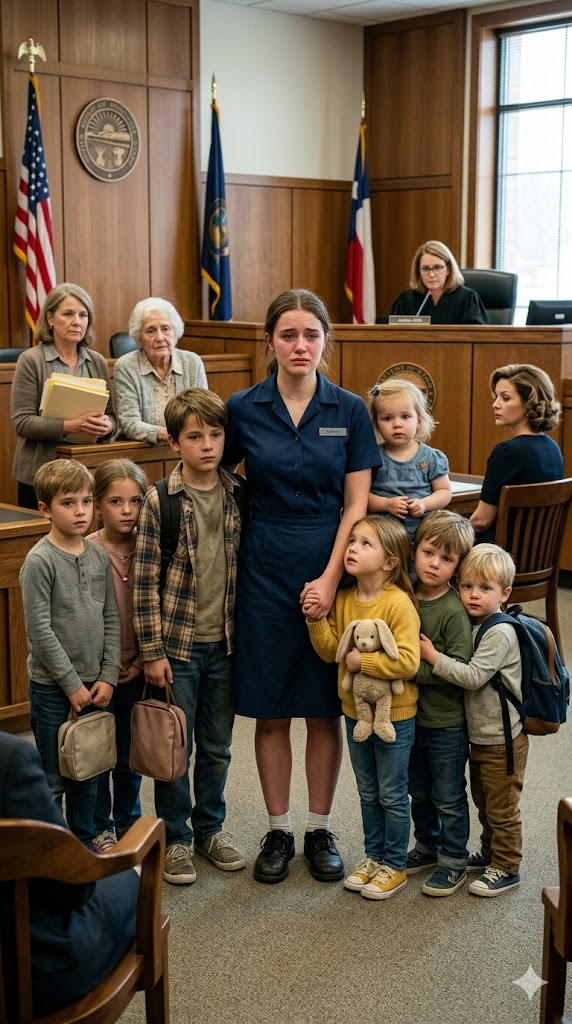
Harper Lacey was eighteen years old when her mother left before sunrise with a small suitcase, a new phone, and no promise that sounded real.
The house was still dark when Harper heard the front door click shut.
At first, she thought her mother was going to the gas station before work. Then she saw the bedroom drawers pulled open, the missing coat from the hallway hook, and the empty space where her mother’s purse usually sat.
By six in the morning, the baby was crying.
By seven, the twins were asking for cereal.
By eight, Harper understood something no eighteen-year-old should ever have to understand.
Her mother was not coming back.
She stood in the kitchen of their small rental duplex outside Dayton, Ohio, with baby Caleb pressed against her shoulder and six younger siblings staring at her like she was the only wall still standing between them and the rest of the world.
Her twelve-year-old brother, Rowan, asked in a thin voice, “Harper… what do we do now?”
Harper looked at the empty refrigerator, the stack of bills on the counter, and the little faces waiting for her answer.
Then she swallowed her fear and said, “We get through today first.”
The Lies Rowan Learned to Tell

Rowan became good at lying before he became good at algebra.
When teachers asked where his mother was, he said, “She’s working late.”
When neighbors asked why Harper was always the one carrying groceries, he said, “Mom’s schedule changed.”
When his little sister Millie cried at night and asked when their mother would come home, Rowan whispered, “Soon.”
But he knew “soon” was just a word adults used when they did not want to tell the truth.
Harper worked nights cleaning offices downtown. She came home before dawn with tired eyes, the smell of disinfectant on her sweatshirt, and just enough strength to make oatmeal, pack lunches, and braid Millie’s hair before school.
She watered down milk to make it last longer.
She cut one sandwich into four pieces and pretended she had already eaten.
She learned which church pantry opened on Wednesdays, which teacher kept extra snacks in her drawer, and which bus driver would wait an extra thirty seconds when the twins couldn’t find their shoes.
At night, after everyone slept, Harper sat on the bathroom floor with the faucet running so nobody would hear her cry.
Then she would wipe her face, stand up, and begin again.
The Neighbor Who Saw Too Much

Mrs. Evelyn Price lived next door and noticed things other people missed.
She noticed Harper leaving the house at midnight and returning before sunrise.
She noticed Rowan carrying trash bags that were too heavy for him.
She noticed Millie wearing the same purple sweater three days in a row.
One afternoon, Mrs. Price found Rowan sweeping the porch while the younger children played quietly inside.
She leaned on the fence and asked gently, “Honey, where is your mama?”
Rowan gripped the broom handle.
The lie came to his mouth, but it did not come out.
His shoulders dropped.
“She left,” he whispered. “Harper’s been taking care of us.”
Mrs. Price went still.
“All of you?”
Rowan nodded.
“There are seven of us,” he said. “Harper doesn’t sleep much anymore.”
That evening, Mrs. Price came to the door with soup, bread, diapers, peanut butter, and tears in her eyes.
Harper tried to refuse at first.
Mrs. Price stepped inside anyway.
“Child,” she said softly, “you are not supposed to carry a whole family by yourself.”
Harper looked down at baby Caleb in her arms.
“I know,” she whispered. “But if I put them down, I’m scared nobody else will pick them up together.”
When CPS Arrived

Two mornings later, a white county vehicle pulled up outside the duplex.
Harper knew before they knocked.
She had been expecting this kind of sound since the first day her mother left.
Two social workers stood on the porch with folders in their hands and careful expressions on their faces.
One of them, a woman named Ms. Whitaker, spoke kindly.
“Harper, we received a call of concern. We need to make sure the children are safe.”
Harper nodded.
Her hands were shaking, but she opened the door wider.
“They’re safe,” she said. “They’re fed. They go to school. I’m working. Mrs. Price helps us.”
The second social worker looked around the small living room, at the folded blankets on the couch, the children’s backpacks lined against the wall, and the baby bottles drying beside the sink.
“You are eighteen,” he said. “That is a lot of responsibility.”
Harper’s jaw tightened.
“I didn’t ask for it.”
The room went quiet.
Then Ms. Whitaker said the words that made every child freeze.
“There is a possibility the children may need temporary foster placements while Family Court reviews the situation.”
Millie began to cry.
The twins grabbed each other’s hands.
Rowan moved in front of the little ones like he could block the whole system with his body.
Harper pulled Caleb closer.
“Please don’t split them up,” she said. “They already lost their mother. Don’t make them lose each other too.”
The Mother Who Came Back for the Wrong Reason
That afternoon, just when the house had gone quiet, a black SUV stopped at the curb.
Harper stepped onto the porch and felt her whole body turn cold.
Her mother, Janelle Lacey, got out wearing sunglasses, a cream-colored coat, and an expression that looked more annoyed than ashamed.
A man waited behind the wheel.
Janelle smoothed her hair and glanced at the neighbors’ windows.
“I came to get some of my things,” she said.
Harper stared at her.
For a moment, she was not eighteen.
She was a little girl again, wishing her mother would choose her.
Then Caleb shifted in her arms, and the moment passed.
“You came back for clothes?” Harper asked.
Janelle looked away.
“Don’t start drama, Harper.”
Rowan stepped onto the porch behind his sister.
His voice was small, but steady.
“You left us.”
Janelle’s face hardened.
“I knew Harper would manage.”
The words landed harder than a shout.