The night my daughter-in-law told me to move into the basement, she said it with a smile so gentle you could almost mistake it for kindness.
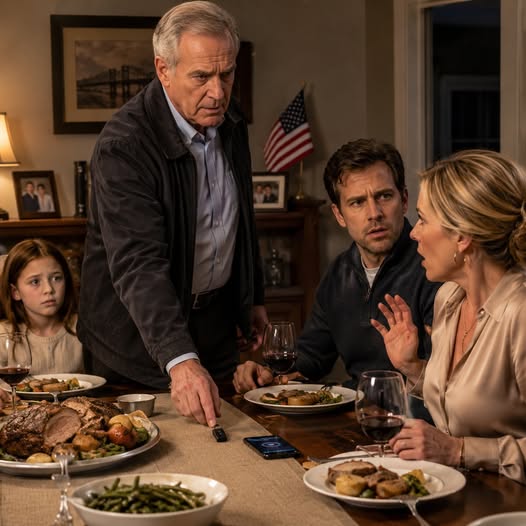
We were at dinner in the house I had helped pay for, eating chicken so dry it squeaked against the fork. My son Brennan sat across from me, cutting his food into careful squares the way he did when he did not want to look up. Reese, his wife, dabbed the corner of her mouth with a linen napkin and said, “Calvin, we’ve been thinking.”
I had learned by then that whenever Reese said we, she usually meant herself.
She reached across the table and touched Brennan’s hand. “With the baby coming, we’re going to need your room.”
There was no baby yet. Not that anyone had told me. No ultrasound on the refrigerator, no little socks tucked into a gift bag, no happy announcement with Avery jumping up and down. Just Reese’s smooth voice floating over the dinner table like a verdict.
Brennan kept his eyes on his plate.
“The basement has that little bathroom,” Reese continued. “And once we make it cozy, it’ll be perfect for you. Quiet. Private. You won’t have to deal with all the noise upstairs.”
I looked at my son.
He looked at the saltshaker.
My granddaughter Avery, eight years old and sweet as June corn, glanced from one adult to another with the nervous intelligence children develop when grown-ups are pretending not to fight.
I chewed slowly. Swallowed. Took a sip of water.
Then I nodded.
“That’s something to think about,” I said.
Reese smiled, pleased with herself.
She thought that nod meant she had won.
What she did not know was that by the time she asked me to trade an upstairs bedroom for a basement with a sump pump and a smell like wet cardboard, I had already met with my attorney twice. I had already opened a bank account an hour away. I had already rented a private mailbox at a UPS Store where nobody in that house could reach my mail.
And I had already copied every important document I owned onto a flash drive I kept hidden in the lining of an old work jacket.
They thought I was just a sad widower in slippers.
They had no idea I was done grieving in public.
My name is Calvin Mercer. I am sixty-eight years old, and for thirty-four years I ran a structural engineering firm in Cedar Rapids, Iowa. It was not a glamorous business. Nobody writes songs about men who calculate beam loads and argue with contractors about rebar grades. But bridges stayed standing because of my work. School additions passed inspection because I caught mistakes before they became disasters. A hospital wing on the east side of town still holds patients and nurses and night-shift vending machines because my drawings were right.
I am not, and have never been, a stupid man.
But grief can make you look like one.
My wife Hannah died in March.
Pancreatic cancer.
Eleven weeks from diagnosis to funeral.
Forty-one years of marriage reduced to pill bottles, insurance forms, folded blankets, church casseroles, and the sound of a hospital monitor going flat while I held her hand and asked the nurse if maybe the machine was wrong.
It was not wrong.
After Hannah died, people kept telling me I was strong.
I was not strong.
I was standing upright.
There is a difference.
For a while, I moved through the days like somebody had turned down the sound on the world. I let mail pile up on the kitchen counter. I left the television on just to hear another voice in the house. I opened the closet and smelled Hannah’s winter coat when I thought nobody would know.
That was when Brennan came to me.
“Dad, you can’t stay here alone,” he said.
He was standing in the kitchen of our old house on Linden Street, the one where Hannah had planted lilacs along the back fence and painted the downstairs bathroom yellow because she said old houses needed a little courage.
“You need family around you,” Brennan said. “Come live with us for a while.”
“For a while?” I asked.
“As long as you need.”
Reese stood behind him in the doorway with her arms folded over a cream sweater that looked too expensive to be comfortable. She was forty-one, a yoga instructor and wellness consultant, which seemed to mean she charged women money to tell them they were tired because of toxins. She drove a leased Range Rover, posted green drinks on her phone, and had the kind of smile people use when they want credit for being patient.
I never warmed to Reese.
Hannah used to say I was too quick to judge people.
“Calvin,” she told me once, after Reese corrected the way Hannah sliced a Christmas ham, “not every annoying person is secretly wicked.”
Maybe not.
But some are.
I sold the house on Linden Street because I was too tired to argue with people who said they loved me.
That sentence still hurts to write.
I sold the house where Brennan learned to ride a bike. The house where Hannah and I fought over paint colors and property taxes and whether the maple in the front yard needed trimming. The house where she once danced barefoot in the kitchen while a thunderstorm knocked the power out.
I got $420,000 for it. After the small mortgage and closing costs, I walked away with $378,000.
Brennan and Reese had just moved from their townhouse into a four-bedroom colonial out in Marion, one of those newer subdivisions where the trees look like somebody stuck pencils in the dirt and every mailbox matches. They said there would be plenty of room. They said Avery would love having Grandpa close. They said I would not feel alone.
I gave them $90,000 toward the down payment and moving costs.
Brennan hugged me so hard I could feel his ribs.
“Dad,” he said, “you don’t know what this means.”
I thought I did.
I thought it meant I was helping my son build a better life.
The house was nice in the way new houses are nice before anyone has really lived in them. Quartz counters. Wide kitchen island. Mudroom hooks with little brass labels. A front porch Reese decorated with two rocking chairs nobody ever sat in. She painted everything a color she called soft taupe, though to me it looked like wet paper.
They gave me the guest room upstairs.
Small, but clean. It had a window that looked over the side yard where a young maple tree shook in the wind. I put Hannah’s old reading chair by that window. Some mornings I sat there with coffee and watched the leaves tremble like they were trying to say something.
For the first two months, I tried.
I fixed the garbage disposal. Replaced a dishwasher gasket. Tightened the loose railing on the basement stairs. Drove Avery to dance class on Tuesdays because Reese had “client work.” Cooked dinner twice a week because Hannah had believed grief could sometimes be tricked with pot roast.
Avery liked my cooking.
Reese did not.
“Calvin,” she said one evening, staring at a slice of meatloaf as if it had offended her personally, “you don’t have to keep making these heavy meals. We eat clean here.”
Brennan gave a little laugh, then stopped when he saw my face.
That was how it started.
Not with screaming.
Not with slammed doors.
With little cuts.
Reese asking, in front of Avery, whether grandparents who moved in with their adult children ever felt displaced.
Reese telling Brennan, while I stood right there making coffee, that the upstairs hallway “smelled old.”
Reese saying, “Your dad is sweet, but he’s not really tracking things right now,” as if I were a dog who could not understand English.
Polite cruelty is still cruelty.
In fact, sometimes it is worse because it leaves you wondering if you are allowed to bleed.
Brennan rarely said anything.
That may have been the part that hurt most.
My son had been a loud child. A boy with grass stains on his jeans and opinions about everything. He used to defend me to his mother when I burned pancakes. He once told a teacher I could build anything in the world if I had enough lumber.
Now he sat quietly while his wife made me smaller by inches.
I told myself he was tired.
I told myself marriage was complicated.
I told myself Hannah would want me to be patient.
Then the bank statement came.
It arrived in June, forwarded from my old address on Linden Street. First Cedar Federal, the credit union where I had kept a checking account for thirty years.
I almost tossed it onto the pile with the rest of the mail.
But something made me open it.
There was a transfer listed near the middle of the page.
$6,400.
Sent to an account I did not recognize.
I sat at the kitchen table and read the line four times.
Then I called the credit union.
The woman on the phone was kind in that careful way bank employees get when they realize something has gone wrong.
She said the transfer had been authorized in person at the branch on May 18.
“By whom?” I asked.
A pause.
“By you, Mr. Mercer.”
“I was not at any branch on May 18.”
Another pause.
Then the questions came.
Had I given anyone power of attorney?
No.
Had I authorized anyone to access my account?
No.
Could someone have my identification?
I did not answer right away.
I went upstairs after that call and opened the lockbox I kept in the closet. My checkbook was gone. So was a folder holding copies of my driver’s license, Social Security card, and the closing paperwork from the sale of the Linden Street house.
I stood there staring into that box until my knees began to hurt.
Two days later, the fraud specialist called.
Security footage showed a woman in her early forties at the teller window. Dark hair. Expensive purse. She had my driver’s license. She signed my name. She told the teller her father was disabled and could not come in himself.
I knew before he finished.
Reese.
I did not confront her.
People imagine betrayal as a moment where you slam your fist on the table and demand answers. That is for people who still believe answers are enough.
I wanted evidence.
More than that, I wanted to know whether my son knew.
So I did the thing I had done all my working life.
I stopped guessing and gathered facts.
The next morning, I drove to a UPS Store across town and rented a private mailbox. Then I changed the mailing address on every financial account I had. After that, I called Phil Marchetti, the attorney who had handled my business affairs for twenty years.
Phil and I met at a diner near his office, the kind of place with laminated menus, bottomless coffee, and waitresses who remember whether you take cream.
He listened without interrupting.
When I finished, he took off his glasses and rubbed the bridge of his nose.
“Calvin,” he said, “you understand what this is?”
“Yes.”
“This is not a family misunderstanding.”
“I know.”
“She forged your signature. Used your identification. Took your money. If she crossed state lines with any of this, it gets uglier.”
“I know.”
“Then why haven’t you filed already?”
I looked down at my coffee.
“Because I need to know if Brennan is part of it.”
Phil’s expression softened for half a second, then hardened again.
“That answer may hurt worse than the theft.”
“It already does.”
Phil told me not to accuse anybody until we knew more. He helped me open a new account at a bank in Iowa City. My pension and Social Security went there. My brokerage statements went to the private mailbox. He contacted the credit union formally and started preserving records.
Then he told me to write everything down.
Dates. Comments. Missing papers. Odd conversations.
“Don’t let her know you’re watching,” he said.
So I watched.
I also bought a small voice recorder from a shop Phil recommended. It was no bigger than a pack of gum. I kept it in my shirt pocket whenever I was in the house.
For six weeks, I became quiet in a different way.
Before, my silence had been grief.
Now it was strategy.
I learned Reese had a brother named Cody in Phoenix. I learned Cody’s online business seemed to require a surprising amount of other people’s money. I learned Reese had not been on wellness retreats when she said she was. She had been flying to Arizona.
One Saturday afternoon, I sat at the kitchen table while the dryer thumped in the laundry room. Reese must have thought the noise covered her voice.
It did not.
“He’s basically a vegetable,” she said into her phone. “Since the wife died, he doesn’t track anything. And Brennan signs whatever I put in front of him.”
I held my coffee cup with both hands.
A vegetable.
That was what she called me.
Not old. Not grieving. Not difficult.
A vegetable.
The word should have made me explode.
It did not.
It made me cold.
Clear.
A bridge fails long before it falls. Hairline cracks. Rust at the joints. Weight placed where it should never be. By the time the public sees the collapse, the engineer already knows where the failure began.
In that moment, I knew where Reese had failed.
She had mistaken quiet for gone.
By late July, she stopped circling and started pushing.
The basement speech came first on a Wednesday night, after Avery went upstairs and Brennan found a sudden reason to take out the trash.
Reese sat across from me at the kitchen table with a mug of herbal tea.
“Calvin,” she said, “we want you to feel comfortable here.”
People who are about to make you uncomfortable often begin that way.
“That’s kind,” I said.
“With our family growing, we just need to be practical.”
“Growing how?”
She smiled.
“Well, Brennan and I are trying for another baby.”
Trying.
Not expecting.
Trying.
But in Reese’s mouth, even a possibility was enough to evict me from the upstairs.
“The basement has so much potential,” she said. “We could make it like your own little apartment.”
“It smells damp.”
“We’ll get a dehumidifier.”
“The sump pump runs all night.”
“That can be fixed.”
“One side is unfinished.”
“We’ll put up a partition. It’ll be cozy.”
Cozy.
That is a word people use when they mean small, inconvenient, and not theirs.
“There are two other bedrooms upstairs,” I said.
“Brennan needs his office.”
“The spare room is empty.”
“For now.”
I looked at her.
She smiled back.
It was not the basement she wanted.
It was the upstairs she wanted cleared of me.
If I slept below, I would not hear phone calls. I would not notice who came to the door. I would not see mail on the counter or papers on the kitchen island. I would become what she had already decided I was: something stored out of sight.
“I’ll think about it,” I said.
She reached over and patted my hand.
“We knew you’d understand.”
That night, I drove to the Walmart parking lot and called Phil.
“I’m ready,” I said.
He was quiet a moment.
“Once we move, this becomes real.”
“It’s already real.”
“You may lose your son for a while.”
“I may have already lost him.”
Phil sighed.
“All right,” he said. “Then we do it clean.”
Over the next two weeks, I gave Reese the performance she expected.
I smiled. I thanked her for green smoothies that tasted like mowed grass. I let her show me where my bed could fit in the basement. I told Brennan I appreciated them thinking about my comfort.
All the while, Phil was working.
He brought in a private investigator named Darren Mosley, a former state trooper with eyes like a locked door. Darren traced Reese’s trips to Phoenix, linked Cody to the receiving account, and found more transfers I had not yet noticed. Smaller amounts, spread out over time. A few hundred here. Two thousand there. Charges hidden under the fog of my grief.
Altogether, they had taken just over $30,000.
That was not counting the damage they were planning next.
Phil also reviewed the $90,000 I had given toward the house. Because I had documented it as a household contribution tied to my living arrangement, he believed we had grounds to pursue it in civil court if they pushed me out. He prepared the filings. He did not promise miracles. Good lawyers do not. But he promised pressure, and sometimes pressure is enough to make people who live on appearances panic.
And while Reese walked around upstairs planning where to move my winter coats, I put earnest money on a small ranch house outside Galveston, Texas.
Ten minutes from the Gulf.
A wraparound porch.
A fig tree in the side yard.
Hannah and I had talked about retiring near water for years. We never did. There was always work. Always Brennan. Always a roof to repair or a tax bill to pay or some practical reason to wait.
After she died, I thought our dream had died with her.
Then one morning, sitting in Hannah’s chair while Reese complained downstairs about my coffee being too strong, I realized something.
Hannah was gone.
But I was not.
I chose a Thursday in August.
Six months since Hannah’s funeral.
I told Brennan I wanted to cook a family dinner to mark it. He seemed relieved by the idea. Reese acted touched, which told me she believed the basement plan had softened me.
I made Hannah’s pot roast with carrots, pearl onions, and rosemary. I baked peach cobbler because Avery loved it. I opened a bottle of Cabernet Brennan liked and set the table with the blue plates Hannah bought years ago from a department store clearance rack.
At 6:30, we sat down.
For a few minutes, we were almost a family.
Avery talked about dance camp. Brennan asked if the roast needed more salt. Reese complimented the cobbler before she tasted it.
Then I put down my fork.
“I’ve made a decision about the basement,” I said.
Reese’s face brightened.
She leaned forward, hands folded under her chin like a woman waiting for applause.
“Oh, Calvin,” she said. “I’m so glad.”
“I’m not moving down there.”
The room changed.
It was small, but I felt it. A tightening in the air.
Brennan looked at me.
“Dad, we talked about this.”
“We did.”
“It makes sense.”
“No,” I said. “It makes sense for Reese.”
Reese blinked.
“Excuse me?”
“I said I’m not moving into the basement. I’m leaving the house entirely.”
Brennan stared.
“What does that mean?”
“It means I bought a house in Texas. I close in nine days.”
Avery gasped.
“Texas has beaches.”
“It does,” I said.
Reese laughed once. It sounded like a glass cracking.
“Calvin, you can’t make a decision like that without talking to us.”
“Why?”
“Because,” she said carefully, “you’re not in the right emotional state.”
There it was.
The door she always tried to open.
Grief as incompetence.
Age as permission.
I wiped my mouth with my napkin and set it beside my plate.
“Reese,” I said, “tell Brennan about Phoenix.”
Her face emptied.
Brennan turned.
“What Phoenix?”
“I don’t know what he’s talking about,” she said.
“May 17 and 18,” I said. “You flew to Phoenix to see Cody. The next day, $6,400 left my account through a transfer I never authorized.”
Brennan looked from her to me.
“Dad?”
I reached into my shirt pocket and placed the flash drive on the table.
“I have bank records,” I said. “Branch footage. Signed withdrawal slips. Travel records. Audio recordings. And an attorney who has been preparing this for weeks.”
Reese stood up.
“This is insane.”
Avery froze with her spoon halfway to her mouth.
I kept my voice gentle.
“Avery, sweetheart, take your cobbler into the living room for a few minutes. Put on your show.”
“Am I in trouble?”
“No,” I said. “Never.”
She carried her bowl away, glancing back once before disappearing around the corner.
When she was gone, Reese pointed at me.
“You are confused. Brennan, your father is confused.”
I looked at my son.
“Do I sound confused?”
Brennan said nothing.
So I took out my phone.
“I want you to hear something.”
I played the recording.
The dryer hummed in the background. Reese’s voice came through clear and bright.
“He’s basically a vegetable. Since the wife died, he doesn’t track anything. And Brennan signs whatever I put in front of him.”
Brennan’s face changed in a way I will never forget.
I had seen my son in pain before. A broken wrist at twelve. A failed business idea at twenty-eight. Hannah’s funeral.
But this was different.
This was the sound of a man realizing the person beside him had been speaking a language he refused to learn.
Reese whispered, “That’s not what it sounds like.”
I almost smiled.
Guilty people love that sentence.
Brennan’s voice came out low.
“You called him a vegetable?”
“She cut it,” Reese said. “He cut the recording.”
“There are nine more,” I said. “Some are worse.”
She turned on me then. The soft wife disappeared. The wellness voice vanished. What remained was smaller and uglier.
“You bitter old man,” she hissed. “You couldn’t stand not being the center of everything. You couldn’t stand that Hannah was gone and this wasn’t your house.”
Brennan flinched at Hannah’s name.
I did not.
“Keep talking,” I said. “The recorder is running.”
Her mouth closed.
For the first time since I moved in, Reese looked afraid of me.
Not because I was loud.
Because I was not.
At 7:15, the doorbell rang.
My sister Linda was there to take Avery for the weekend. I had arranged it earlier. Avery ran to her with a backpack, confused but happy to sleep at Aunt Linda’s because Linda always made pancakes shaped like lopsided animals.
I kissed my granddaughter’s forehead.
“I’ll see you soon,” I told her.
After the door closed, the house felt emptied of innocence.
Brennan sat at the table with both hands covering his face. Reese stood near the counter, arms crossed, breathing hard.
I said, “Phil will be here tomorrow morning at nine with paperwork. There are investigators involved. There will be civil filings too. I suggest you do not try to touch another account, another document, or another piece of mail with my name on it.”
Reese said, “You are destroying this family.”
“No,” I said. “I am refusing to be destroyed quietly.”
Then I went upstairs.
I packed one suitcase.
Before leaving the room, I sat in Hannah’s chair by the window. The maple leaves outside were moving in the dark.
For ten minutes, I cried.
Not because I was weak.
Because I wished Hannah could have seen me remember who I was.
The next morning, Reese was gone before Phil arrived.
She had taken two suitcases and left behind three drawers of yoga clothes, a half-empty bottle of expensive shampoo, and a house full of consequences.
By Tuesday, she was arrested.
Not in some dramatic scene with neighbors filming from the sidewalk. Just a clean, quiet arrest at a short-term rental outside Des Moines where she had gone to hide behind another lie. Cody was picked up in Phoenix the same day.
The investigation found I was not the first.
That part still turns my stomach.
Reese and Cody had a pattern. Older relatives. Vulnerable partners. People grieving, sick, embarrassed, or too proud to ask questions. Small withdrawals. Forged signatures. A little pressure here, a little confusion there. Nothing big enough at first to set off sirens.
Predators do not always look like monsters.
Sometimes they wear cream sweaters and ask if you want lemon in your water.
Brennan filed for divorce before the month was over.
The house in Marion did not survive the fallout. Without Reese’s income, with my $90,000 tied up in legal action, and with the mortgage sitting on numbers that only worked when everyone was pretending, Brennan had to sell. He took a loss.
He moved into a two-bedroom apartment near the dealership where he worked.
For a while, that gave me no pleasure.
Then, if I am being honest, it gave me some.
Not because I wanted my son homeless or broken. I did not.
But consequences are sometimes the only language adults understand.
Reese took a plea to avoid trial. She was sentenced to eighteen months in federal prison and ordered to pay restitution. The number on paper looked good. Numbers often do. Whether I ever see most of the money is another matter.
I stopped caring.
The money mattered less than the truth.
People think justice means getting back what was stolen.
Sometimes justice is making sure the thief cannot sit at your table and call you family.
Brennan and I did not speak for almost three months.
I let the silence stand.
I needed space to be angry without feeling guilty for it. He needed space to understand that not knowing is not the same thing as innocence. A man can fail you without plotting against you. The hurt lands either way.
In November, he called.
I was sitting on the porch of my little house outside Galveston, drinking coffee from a mug Hannah had bought me at a roadside pottery shop years before. The Gulf air smelled of salt and wet grass. A pelican folded itself out of the sky and dropped into the water like a sack of laundry with wings.
My phone rang.
“Dad,” Brennan said.
“Hello, son.”
His voice cracked on the second word.
“I didn’t know.”
“I know.”
“I should have.”
“Yes,” I said. “You should have.”
There was a long silence.
That sentence hurt him.
It hurt me too.
But there are some truths you cannot soften without turning them into lies.
Finally he said, “Avery misses you.”
“I miss her.”
“Spring break is in March.”
“I’ll meet her at Houston Hobby if you want to send her down.”
Another pause.
“Could I come too?”
Forgiveness is not a door you throw open.
Sometimes it is a chain lock you loosen one inch at a time.
“Yes,” I said. “You can come too.”
They came in March.
Avery ran into my arms at the airport so hard my glasses nearly came off. Brennan looked thinner. Older. Like a man who had been living inside his own mistake long enough to learn the furniture.
For four days, we lived simply.
We grilled redfish on the back deck. Avery dug for sand crabs and named each one before they disappeared. Brennan slept ten or eleven hours a night, the heavy sleep of someone whose body had finally found a safe room.
On their last morning, he and I sat on the porch with coffee.
Avery was asleep in the hammock with a book on her chest.
Brennan stared at her for a long time.
“I don’t know how to make it up to you,” he said.
“You don’t,” I told him.
He looked at me.
“You make it up to her.”
I nodded toward Avery.
“You raise her so she never learns to look away when someone she loves is being made small. That’s what you can do.”
His eyes filled, but he did not wipe them.
“I let it happen,” he said.
“Yes.”
“I was embarrassed by you needing us.”
That one hit harder than I expected.
“Why?” I asked.
He shook his head.
“I don’t know. Reese made it sound like you were taking over the house. Like we’d never have our own life. I wanted to be a good husband. I thought if I pushed back, I was choosing you over her.”
I looked out toward the water.
“A good husband does not stop being a son.”
He nodded.
“I know that now.”
Maybe he did.
Maybe knowing it came too late to save some things.
But late is not never.
I am sixty-nine now.
I live alone in a small ranch house ten minutes from the Gulf. The porch screens rattle when the wind comes off the water. The fig tree in the side yard produces more fruit than one man can sensibly eat, so in August I carry paper bags of figs to the neighbors.
There is a widow down the road named Marina who turns figs into preserves so good I once told her they should be regulated by the government. She laughed and gave me two jars.
Sometimes we sit on her porch in the evening and talk about the people we used to be married to.
Not every ending needs a wedding.
Some endings are just peace with better weather.
Brennan and Avery visit four times a year now. He is dating a kindergarten teacher named Patty. She is kind without making a performance of it. I told him not to rush. He said he had learned that lesson.
I still miss the house on Linden Street.
Every day.
I miss the lilacs. I miss the kitchen window. I miss Hannah’s yellow bathroom. I miss knowing exactly which floorboard creaked outside our bedroom.
But I do not miss being mistaken for furniture.
I do not miss being managed by people who used the word family when they meant access.
I do not miss the upstairs hallway where Reese said I smelled old.
Sometimes, on quiet mornings, I think about how close I came to letting the rest of my life be decided by people who had already written me off.
That is the part that stays with me.
Reese did not steal from me because she thought I was rich.
She stole from me because she thought I was gone.
Still breathing, still eating, still sitting at the table — but gone in the ways that mattered.
For a little while after Hannah died, she was not entirely wrong.
I had stopped opening mail. Stopped checking accounts. Stopped asking questions. I let other people speak for my future because I was too tired to use my own voice.
Grief explains that.
It does not excuse it forever.
The world does not stop requiring your attention just because your heart is broken. Bills still arrive. Papers still need reading. Accounts still need checking. Decisions still need making. And if you stop making them, someone else will make them for you.
They may not be kind.
So if you are near my age, or if you love someone who is, hear me.
Do not sign what you have not read.
Do not hand over your passwords because someone sighs and says you are old-fashioned.
Do not let a person move you from the center of your own life and call it care.
Keep your papers safe. Keep your mail private if you need to. Keep one trusted person outside the family who knows where the important things are. A lawyer. A doctor. A neighbor. A friend from church who notices when you stop showing up.
And pay attention to the language people use around you.
When help starts sounding like control, pay attention.
When kindness comes with a locked door, pay attention.
When someone says, “It’s for your own good,” and somehow they benefit most, pay very close attention.
They will count you out if you let them.
They will look at your slow mornings, your slippers, your pill organizer, your grief, and decide you have already left the room.
Let them think it.
Sit in your chair. Drink your coffee. Watch the leaves move.
But keep your eyes open.
Because one day, somebody may push too hard.
They may ask for your bedroom.
They may reach for your checkbook.
They may call you a vegetable while the dryer runs.
And that may be the day they learn the person they thought was finished was only resting.
I lost Hannah.
I lost the house where we built our life.
For a while, I nearly lost myself.
But I got myself back.
Now, most mornings, I sit on my porch with coffee while the Gulf wind moves through the screens. The pelicans dive like fools over the water. The fig tree leans toward the sun. Somewhere in the kitchen, Hannah’s old mug waits in the sink because I still hate washing dishes right away.
And every so often, when the light is just right, I feel her beside me.
Not as a ghost.
Not as some grand sign from heaven.
Just as the woman who knew me before grief hollowed me out.
The woman who would have told me to stand up sooner.
I think she would like this porch.
I think she would like Marina’s fig preserves.
And I know, without question, she would like the fact that I am still here.
Not in anybody’s basement.
Not waiting for permission.
Not finished.
Not even close.