I knew they had crossed a line before I saw a single face, because the brass cabin key was no longer hanging on its hook.
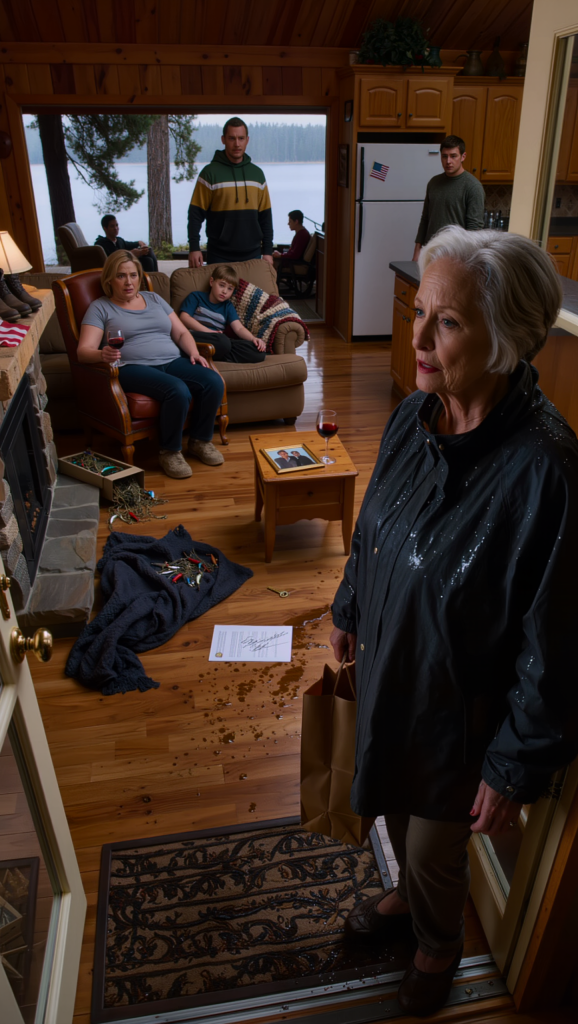
That key had belonged to my husband. For thirty-one years, it had hung beside the mudroom door at our place on Cedar Lake, Wisconsin, just below a framed photo of him holding a walleye and grinning like the whole Midwest belonged to him. I had not given it to anyone. I had not promised it to anyone. And yet, when I pushed open my own front door that Friday evening, I found a row of unfamiliar shoes by the fireplace, a half-empty case of beer beside my husband’s old boot tray, and laughter coming from my kitchen as if strangers had always known where the good wine glasses were kept.
Then my daughter-in-law’s mother looked up from my favorite chair and said, “Oh, good. You made it.”
That was the moment the house stopped feeling like mine.
For a second, I honestly thought I had walked into the wrong cabin.
Cedar Lake had a dozen rentals tucked into the pines, all cedar siding and screened porches and porch lights that looked soft at dusk. But mine was not the kind of place a person could mistake. The porch boards creaked in the same uneven rhythm they had since my husband, Raymond, rebuilt them after the spring flood of 1998. The old green canoe leaned under the eaves. The little iron bell beside the door still carried the dents from the summer our son Jason had used it as a target with his BB gun and lied about it with sawdust in his hair.
No, it was my place.
That was what made it worse.
I stood there with a brown grocery bag cutting into the crook of my arm, holding eggs, coffee, half-and-half, and the cinnamon rolls I always bought from the Kwik Trip outside Saukville before driving north. Rainwater dripped from my jacket onto the pine floor. Someone had kicked off a pair of white sneakers right in the middle of the entry rug. Someone else had left muddy boots on their sides beneath the bench where Raymond used to sit to lace his fishing shoes.
The cabin smelled wrong.
Not like cedar and lake air and the faint smoke of old fires in the stone hearth. It smelled like fast food, wet socks, perfume, and the kind of sweet boxed wine I had never bought in my life.
From the kitchen, a woman laughed. A man said, “Grab another bottle.”
Another bottle.
My bottle.
I set the grocery bag down slowly because my fingers had gone numb. Then I walked farther inside.
There were people everywhere.
A teenage boy I did not recognize was sprawled across my sofa with his shoes on the quilt my sister had sewn the year Raymond got sick. Two women stood at my counter eating pizza over paper plates, crumbs scattered across the granite like birdseed. A man in a Packers hoodie had my refrigerator open and was holding a jar of my homemade pickles up to the light, frowning as if deciding whether they were good enough for him. The dining table was covered in burger wrappers, empty soda cups, and a pile of damp towels.
And in the wingback chair beside the fireplace, where I had spent so many winter mornings with coffee and Raymond’s hand resting warm over mine, sat Denise Calder.
My daughter-in-law Emily’s mother.
She was barefoot, wearing fuzzy slippers I had never seen before, sipping red wine from one of my crystal glasses. A throw blanket lay puddled under her feet. Not just any blanket, either. Raymond’s blanket. The heavy navy one he had kept over his knees through the last winter of his life.
Denise smiled at me as though I had arrived late to her party.
“Oh, good,” she said. “You made it.”
I looked at her for a long second. “Made it?”
“Emily told us you might come by sometime this weekend.” She lifted the glass a little. “We didn’t know what time, so we went ahead and got settled.”
Settled.
That word landed in my chest with a quiet, ugly thud.
Behind her, someone turned down the Bluetooth speaker. Another person whispered, “Is that her?” as if I were the neighbor making trouble.
I looked around my own living room. Muddy footprints crossed the floor Raymond had sanded by hand. A wine stain darkened the rug beneath the piano he had bought used from a church in Sheboygan because he said every house deserved one beautiful thing nobody knew how to play. A black crescent burn mark sat on the butcher-block island where someone had set down a hot pan without a trivet.
I had not been gone from that house for a year. I had been gone for three weeks.
Three weeks since I had driven down to Milwaukee for a follow-up appointment, stayed at my condo, helped my neighbor recover from knee surgery, and told myself I would return to the lake when the rain let up.
Apparently, the rain had given other people permission to move in.
“Where is Emily?” I asked.
Denise waved one hand, casual as a queen. “Back in Milwaukee. She had work. Jason said it was fine.”
My son’s name came out of her mouth, and something inside me tightened.
“Jason said what was fine?”
“That we could use the cabin for a little while.” She leaned back in my chair. “We’re between places. It’s not like anyone was here.”
A man in the kitchen shut the refrigerator too hard. The bottles in the door rattled.
I turned toward him. “Who are you?”
He looked offended by the question. “Denise’s brother, Al.”
Of course. Denise’s brother, Al, standing in my kitchen with my refrigerator open and my pickles in his hand.
I could feel every pair of eyes on me. They were waiting for the scene. Older women are supposed to provide certain performances for certain kinds of people. We are supposed to tremble. Cry. Apologize for the inconvenience of having feelings. Maybe raise our voices so they can call us unstable later.
I did not do any of that.
I looked at Denise again. “Who gave you the key?”
Her smile slipped, but only slightly.
“Emily has one.”
“Emily does not have one.”
“She copied Jason’s.”
There it was.
The small, silver blade slid cleanly between my ribs.
Jason.
My only child. My boy who had once cried because he thought a dead moth on the porch needed a funeral. My boy who used to call this cabin “Dad’s heart with walls.” My boy who had apparently handed my home over like extra storage.
Denise must have seen something change in my face, because she put her wine down and stood, brushing crumbs off the front of her blouse.
“Look, Marian, we are not hurting anything. We’re family.”
I looked at the stain on my rug. The burn mark on my island. The blanket under her feet.
“Family asks.”
Her mouth tightened.
“We’re only here temporarily.”
“How temporary?”
She glanced toward the kitchen, where Al suddenly became very interested in reading the label on the pickle jar.
“A few weeks. Maybe until August.”
It was May 17.
The words did not come out of me at first. My body was there, standing in my own living room, but my mind had stepped backward, gathering evidence. Shoes. Wine. Burn mark. Blanket. Missing key. Jason’s permission. Emily’s copy.
People think anger is loud. Sometimes anger is a clerk behind a counter, calmly stamping every page.
Denise folded her arms. “Emily said this place would be hers eventually anyway.”
That was the sentence that did it.
Not the mess. Not the wine. Not even the key.
That sentence.
Because nobody says a thing like that unless a conversation has already happened without you in it. Nobody moves into a widow’s cabin and says “eventually” unless they have been counting your belongings before you are finished living.
For years, I had thought I was being generous. I paid for Jason’s dental work when his insurance changed. I covered half of Emily’s certification course because she said it would help them “get ahead.” I put birthday money into an account for their future house. I sent grocery gift cards when they were short, picked up the tab at restaurants, and swallowed little comments because I wanted peace.
Emily calling my furniture “old-lady museum stuff.”
Jason saying, “Mom, she didn’t mean it that way.”
Denise joking at Thanksgiving that I was lucky to have a son because “one day he’ll handle all that property for you.”
I had laughed then.
I was not laughing now.
I picked up the grocery bag from the floor. The eggs shifted softly inside the carton.
Denise tilted her head. “Where are you going?”
I did not answer.
“Marian?”
I walked back toward the door.
Behind me, somebody muttered, “Unbelievable.”
Then Denise called after me, “If you’re going into town, can you grab ice?”
My hand was already on the knob.
I stopped for half a second.
Not because I was hurt.
Because I was done.
Outside, the rain had settled into a fine mist. My SUV sat in the gravel drive beneath the dripping pines. Across the lake, someone’s pontoon boat bobbed against a dock, its blue cover shining in the dim light. Everything looked ordinary. That almost made it worse. The world had not cracked open just because my family had.
I put the grocery bag on the passenger seat and sat behind the wheel for a long moment without starting the engine.
My hands were steady.
That scared me more than shaking would have.
Then I drove.
I did not call Jason. I did not call Emily. I did not call the sheriff’s department, not yet. I drove south on Highway 57 with the wipers clicking, past bait shops, supper clubs, a church sign that read BE STILL AND KNOW, and a gas station where families in Brewers hoodies were buying snacks for the weekend. My phone buzzed twice before I reached the county line. Once from Emily. Once from an unknown number I assumed belonged to somebody still standing in my kitchen.
I let both go unanswered.
There are moments in life when everything you have tolerated lines up behind you like witnesses.
I had one of those moments somewhere outside Fond du Lac.
By the time I reached my condo in Milwaukee, night had settled over the city. The streetlights made little gold circles on the wet pavement. I parked in my underground garage, carried my groceries upstairs, and put the eggs away with the kind of careful calm people mistake for weakness.
Then I made tea.
I fed my old terrier, Louise, who gave me a suspicious look because dinner was twenty minutes late. I changed into dry clothes. I sat down at my kitchen table, opened my laptop, and pulled up my bank accounts.
The house fund was still there.
$72,436.18.
That number had taken me twelve years to build.
It had started after Raymond died, when Jason and Emily were still renting a small apartment near Wauwatosa and talking about buying a starter home. Jason never asked me for a fund. That was the part that made it tender. I had created it myself, a quiet gift waiting for the right day. Birthday checks I never handed over. Tax refunds. A portion of the money from selling Raymond’s truck. Little pieces of my future tucked away for theirs.
$72,436.18.
I had imagined surprising them at closing. I had imagined Emily crying, Jason hugging me too hard, somebody saying Raymond would have been proud.
Instead, Denise had sat in my chair and told me my cabin would be Emily’s eventually.
I stared at the number until the digits blurred.
Then I transferred every cent into an account with only my name on it.
Not out of spite.
Out of clarity.
After that, I logged into the cabin utilities. Electricity. Water. Internet. Trash. Streaming service. Security monitoring, which I had foolishly paused because the old cameras had been glitching and I had planned to replace them before summer.
One by one, I canceled every automatic payment that made free living possible.
If grown adults wanted to treat my home like a vacation rental, they could learn how expensive free really was.
My phone rang at 10:14 p.m.
Jason.
I watched his name glow on the screen until the call ended.
At 10:17, Emily called.
At 10:19, Jason again.
At 10:26, a text from Emily appeared.
What did you do?
I did not answer.
At 10:31, another.
My parents said you just walked out like a crazy person.
I sipped my tea. It had gone cold.
At 10:34.
Jason is freaking out. Call us.
At 10:40.
You’re being really unfair.
That one almost made me laugh.
Unfair is a strange word. People reach for it when a benefit disappears and they do not want to call it what it was.
I turned my phone face down, took a yellow legal pad from the drawer, and wrote four lines.
My cabin.
My money.
My peace.
My terms.
Then I underlined the last one twice.
I did not sleep well. Boundaries sound clean when people put them on coffee mugs and Instagram posts. In real life, they ache. They come with your child’s name lighting up your phone. They come with memories of fever nights, school concerts, scraped knees, and the terrible knowledge that love does not always make people fair.
At 6:20 the next morning, I woke with a headache and thirty-five unread messages.
Thirty-five.
I counted them before I opened any, and the number sat there like a warning.
Most were from Emily. A few from Jason. One from Denise, who had somehow gotten my number and written, We need to discuss this like adults.
I deleted that one first.
Then I read Jason’s.
Mom, please call me.
Mom, this is not what it looks like.
Mom, Emily is upset.
Mom, I know you’re mad but don’t do anything drastic.
I stared at that last word.
Drastic.
Moving people into my home without asking was apparently temporary. Taking my own money back was drastic.
By 8:15, Emily was pounding on my condo door.
Louise barked once, then retreated behind my legs as if even she had decided Emily was not good for the carpet.
I opened the door with the chain still on.
Emily stood in the hallway wearing black leggings, a beige trench coat, and the expression of a woman who had expected the world to move aside and found a locked door instead. Her hair was pulled into a tight ponytail. Her makeup was perfect. That always impressed me, even when I did not want it to. Emily could be angry enough to boil water and still look ready for a real estate brochure.
“Take the chain off,” she said.
“Good morning, Emily.”
“Don’t do that.”
“Do what?”
“Act calm. My parents said you embarrassed them.”
I looked at her through the gap. “Your parents are in my cabin without permission.”
She rolled her eyes so hard I almost saw the teenager she must have been before she learned polish could hide entitlement.
“Oh my God, Marian. Nobody was using it.”
“That is not your decision.”
“It’s family property.”
“No. It is my property.”
Her mouth opened, then closed. A neighbor’s door clicked somewhere down the hall. Emily lowered her voice.
“You’re making this ugly.”
“I did not move anyone into my home.”
“They needed help.”
“Then you should have asked me.”
She leaned closer to the door. “Jason said it was fine.”
“Jason does not own the cabin.”
“He’s your son.”
“And I am still alive.”
The hallway went quiet.
That sentence had come out softer than I expected, but it hit harder for it. Emily’s face changed, just for a second. Not guilt exactly. Alarm. As if she had heard the locked gate in my voice.
I unhooked the chain and opened the door, not because she deserved entry, but because I wanted her to stand in my home and hear me clearly.
She walked inside without waiting to be invited.
Some habits announce themselves.
I closed the door behind her and moved to water the basil plant on my kitchen windowsill. It gave my hands something to do.
Emily stood by the island. “You emptied the account.”
“Yes.”
“We’re supposed to close next month.”
“I know.”
Her laugh was sharp. “You know? That money was for our house.”
“That money was mine.”
“You told Jason you wanted to help us.”
“I did.”
“So now you’re punishing us because my parents stayed at a cabin you barely use?”
I set the watering can down.
The brass key from my condo sat in a small dish beside the sink. I thought of the missing cabin key, of Raymond’s empty hook, of Denise’s fuzzy slippers under my blanket.
“No, Emily,” I said. “I am protecting myself.”
She folded her arms. “From what?”
“From people who mistake access for ownership.”
She stared at me, and for the first time since she had married my son, I saw her recalculating.
Emily had always known how to push me. A sigh here. A wounded look there. A sentence that began with “I just thought family…” and ended with me writing a check, babysitting an argument, or swallowing disrespect because Jason looked tired.
But she did not know what to do with a version of me that had stopped negotiating with guilt.
“Jason is devastated,” she said finally.
“I imagine he is.”
“You’re going to ruin everything.”
“If everything depends on me being disrespected, then it was already ruined.”
Her face flushed.
“You know what? Denise was right. You do like control.”
There it was. The first thrown stone.
I picked up my mug and took a sip of coffee. It was too hot, but I did not flinch.
“Emily, your parents need to leave the cabin by Sunday evening.”
She blinked. “Excuse me?”
“Sunday evening. Six o’clock.”
“That’s impossible.”
“It is also final.”
“They have nowhere to go.”
“They had somewhere to ask before they moved in.”
She stared at me as if I had spoken a language she had no intention of learning.
Then she grabbed her purse from the counter.
“You’re going to regret this.”
I opened the door for her.
“No,” I said. “I already regret enough.”
She left without another word, heels striking the hallway floor in hard little cracks.
After the elevator doors closed, I stood in the quiet of my condo and felt the first tremor pass through me.
Not fear.
Grief.
A person can be right and still feel like something is breaking.
Jason arrived that afternoon looking ten years older than he had the week before.
I had not seen him in person since Easter, when he and Emily had come for brunch and spent half the meal arguing in tiny smiles. He had gained a little weight around the face, but his shoulders had gotten narrower somehow, pulled inward from years of apology. He stood in my doorway holding a Brewers cap in both hands like a teenager summoned to the principal’s office.
“Hi, Mom.”
“Hi, honey.”
The word slipped out before I could stop it. Motherhood is a reflex even when your heart is guarded.
He looked past me into the condo. “Can I come in?”
I stepped aside.
He sat at my kitchen table in the same chair Emily had refused to sit in because she said the cushion was too firm. His eyes were red. He had not shaved. There was a small coffee stain on his sweatshirt.
I put a plate of oatmeal cookies between us because apparently even boundary-setting mothers still feed their grown children.
He looked at the cookies and swallowed.
“Does it really have to go this far?” he asked.
I sat across from him. “Tell me what happened.”
He rubbed both hands over his face. “Emily’s parents lost their rental.”
“How?”
“The owner sold the duplex. They had thirty days.”
“And Emily decided my cabin was the solution.”
He looked down.
“She said it would only be for a few weeks.”
“Until August.”
His head lifted.
“That’s what Denise told me.”
He closed his eyes.
I waited.
Waiting is hard when you raised someone. You want to fill silence for them. Protect them from it. Lead them to the right answer the way you once led them across a street. But I had filled too many silences for Jason, and other people had moved into the empty spaces.
Finally he said, “I didn’t think it would turn into this.”
“What did you think would happen?”
“That you’d be annoyed. Maybe. But then you’d understand.”
“Understand what?”
“That they were desperate.”
I leaned back slowly.
“Jason, did you understand that I might be desperate to have one place in my life that still belongs to me?”
He looked at me then. Really looked.
I saw the answer before he gave it.
No.
He had not thought of that.
The realization settled between us heavier than anger.
“I’m sorry,” he whispered.
“Are you sorry because it hurt me, or because it became inconvenient?”
His face tightened.
“That’s not fair.”
“Maybe not. Answer anyway.”
He stared at the table. The kitchen clock ticked. Outside, traffic hissed along Prospect Avenue, ordinary city sounds carrying on through extraordinary family damage.
“I’m sorry because I should’ve asked,” he said finally. “And because I knew you might say no.”
There it was.
The truth did not roar. It entered quietly, then changed the room.
I nodded once. “Thank you for saying that.”
He exhaled. “Mom, they already unpacked.”
“That was a poor decision.”
“They can’t afford a hotel for long.”
“That is not my emergency.”
He winced as if I had slapped him.
I hated that.
I also meant every word.
He picked up a cookie, broke it in half, then did not eat it. “Emily says you canceled the utilities.”
“I canceled my automatic payments.”
“It’s the same thing.”
“No. It is the difference between generosity and obligation.”
He looked tired enough to fold.
“I don’t know how to fix this.”
“That may be the first honest thing anyone has said.”
He gave a short, miserable laugh.
I reached into the folder beside me and pulled out three printed pages. I had spent the morning assembling them. Ownership documents. Property tax statement. Insurance policy. Utility account summaries. A list of damages I had noticed during my ten-minute walk-through before leaving.
Jason stared at the pages.
“What is this?”
“Evidence.”
“Mom.”
“No. Listen to me.”
My voice stayed calm, but something in it made him sit back.
“The cabin is not an idea. It is not a family rumor. It is not an inheritance people can borrow early. It is a legal property, insured under my name, maintained by my money, and filled with things your father and I built our life around.”
He looked away at the mention of Raymond.
I did not let him.
“When Emily copied your key, that crossed one line. When you allowed her family to move in, that crossed another. When Denise told me the house would belong to Emily eventually, that crossed a third. I am telling you now, there will not be a fourth.”
His eyes shone.
“What does that mean?”
“It means I have hired a property manager. It means the locks will be changed Sunday evening. It means anyone still inside after six o’clock will be treated as trespassing.”
He stood so fast the chair scraped the floor.
“You can’t do that.”
“Yes, I can.”
“They’re Emily’s parents.”
“And I am yours.”
The sentence caught him mid-breath.
I had not planned to say it. Maybe the best truths never arrive politely.
He sank back down.
His voice, when it came, was small. “I didn’t mean to choose them over you.”
“I know.”
That was the part that hurt.
Cruelty is easier when it is deliberate. Neglect that arrives dressed as conflict avoidance is harder. It makes you explain your pain to people who swear they never intended it.
I pushed the folder toward him.
“Read this. Then go home and tell your wife what Sunday means.”
He touched the edge of the folder but did not take it.
“What about the house fund?”
There it was. The $72,436.18 entering the room like a third person.
I folded my hands.
“The fund is no longer available.”
His eyes closed.
“Mom, our lender was counting on that gift letter.”
“I never signed one.”
“We talked about it.”
“No. You assumed it.”
He looked at me, stunned, not because I was wrong, but because I was right.
“I was going to help you,” I said. “I wanted to. But I will not finance a life where I am treated as a resource instead of a person.”
His jaw worked.
“I don’t know what Emily will do.”
“Then maybe it is time you find out who you married when the answer is no.”
He flinched.
I wished I could take that one back.
I did not.
When he left, he forgot the cookie in its napkin and took the folder with him. I watched him walk down the hallway, shoulders bowed, and felt the oldest pain in the world: the pain of letting your child carry the consequences you used to catch.
Sunday arrived gray and wet, the kind of Wisconsin spring day that makes the whole world smell like worms and lake weeds.
I spent the morning at my kitchen table with my phone, my folder, and a cup of coffee I kept reheating because I could not make myself drink it. The property manager, a woman named Ruth Keller, called at nine to confirm she would meet me at the cabin. She had managed lake rentals for twenty years and had the voice of someone who had removed drunk groomsmen, raccoons, and one retired judge from places they refused to leave.
“Do you want the sheriff’s department on standby?” she asked.
I looked at the brass condo key in my dish and thought of the missing hook at the cabin.
“I hope we won’t need that.”
“That’s not what I asked.”
I almost smiled.
“Yes,” I said. “Please.”
Ruth gave me the number for a locksmith in West Bend named Carl, then told me something I wrote down because it felt like a commandment.
“Kind people need paperwork more than anyone.”
At 3:30, I drove north.
The farther I got from Milwaukee, the tighter my chest became. I passed the Culver’s where Raymond and I used to stop for custard on summer Fridays. I passed the billboard for the county fair. I passed a family in a minivan with bikes strapped to the back, and for a second I remembered Jason at twelve years old, asleep in the rearview mirror with his mouth open, sunburn on his nose, a baseball glove in his lap.
Memory can be cruel when you are trying to stay strong.
By the time I turned onto Cedar Lake Road, my hands had begun to ache from gripping the wheel.
The cabin lights were on.
Of course they were.
Music drifted through the trees before I even parked. A cooler sat on the porch. Someone had hung a wet beach towel over Raymond’s carved welcome sign, the one that read ELLIS CABIN in letters he had burned by hand because he refused to buy anything he could make himself.
Carl the locksmith was already there, sitting in a white van with CARL’S LOCK & KEY on the side. Ruth stood beside her Subaru in a rain jacket, a clipboard tucked under one arm. Behind them, a county deputy waited in his cruiser near the road, lights off.
Carl stepped out when I parked.
“You Mrs. Ellis?”
“Yes.”
He was in his fifties, with a gray beard and a Brewers jacket. He looked at the cabin, then back at me with the careful expression tradesmen develop when they can sense family trouble but know better than to ask for the story.
“You sure you want everything changed tonight?”
“Yes.”
“All doors? Garage? Shed?”
“All of it.”
Ruth came over. “They know you’re coming?”
“They were told six o’clock.”
Ruth checked her watch. “It’s five-twenty-five.”
Thirty-five minutes.
There it was again.
Thirty-five minutes between warning and consequence.
I stood at the bottom of my own porch steps and listened to the laughter inside. Somebody shouted over the music. A glass clinked. For one wild second, I wanted to get back in my SUV and leave. Let them have it. Let them have the towels, the porch, the good glasses, the whole exhausting mess. Peace at any price had been my specialty for so long that my body still reached for surrender like an old coat.
Then I saw the empty hook through the mudroom window.
The brass key was gone.
I climbed the steps.
Before I could knock, the door swung open.
Denise stood there in fuzzy slippers again, holding a wine glass again, as if she had decided repetition made ownership.
Her eyes moved from me to Carl to Ruth to the deputy’s cruiser down the drive.
Her smile vanished.
“You have got to be kidding me.”
“No,” I said. “I am not.”
Ruth stepped forward. “Mrs. Calder, I’m Ruth Keller, property manager for Mrs. Ellis. You were notified that you needed to vacate by six.”
Denise let out a loud, brittle laugh. “Vacate? We’re not renters.”
“That is correct,” Ruth said. “You are not.”
Behind Denise, Al appeared in the hallway. “What’s going on?”
“They’re trying to kick us out.”
His face darkened. “You can’t kick out family.”
I looked at him. “You are not my family.”
The sentence cut the air clean.
Denise’s eyes narrowed. “Jason said we could stay.”
“Jason was wrong.”
“You’re destroying your son’s marriage over a cabin.”
“No, Denise. I am protecting my home from people who entered it without permission.”
Someone inside said, “Start recording.”
A younger woman I recognized vaguely from Emily and Jason’s wedding raised her phone.
Ruth glanced at her calmly. “You can record. Please also record that you have been asked to gather your belongings and leave peacefully.”
Carl stood by the door with his toolbox.
Denise looked past me toward the deputy’s cruiser, then back at me.
“You called law enforcement?”
“I called a property manager. She made the proper arrangements.”
“Unbelievable.”
“What was unbelievable,” I said, “was finding you drinking my wine in my chair.”
Her face flushed.
“That chair? That blanket? Those glasses? You act like things matter more than people.”
I felt something in me go still.
“Things do not matter more than people,” I said. “But the way people treat things that matter to you tells the truth.”
She had no answer for that.
At 5:31, the house began to empty angrily.
Drawers slammed. Trash bags rustled. Al carried out two suitcases and muttered that people like me were what was wrong with America, though he had apparently enjoyed my American lake house just fine. The teenager from the sofa walked past with his earbuds in, dragging a duffel bag that scraped the wall. Denise’s sister came out with an armful of towels that Ruth politely removed from her hands because they were mine.
“These were in our bathroom,” the woman snapped.
“No,” Ruth said. “They were in Mrs. Ellis’s bathroom while you were using it.”
I almost loved her.
At 5:42, Emily called.
I let it ring.
At 5:43, Jason called.
I answered.
“Mom,” he said, breathless. “Please.”
I stood at the edge of the porch watching Denise shove clothes into the trunk of an old Buick.
“Jason.”
“Emily is hysterical.”
“That is unfortunate.”
“Her parents don’t have anywhere to go tonight.”
“They had from Friday to Sunday to make arrangements.”
“You know they don’t have money.”
“Then they should have been more careful with someone else’s kindness.”
He made a sound like he had been hit.
“Mom, please don’t do this to me.”
I closed my eyes.
There it was. The sentence he had not meant to weaponize and yet had carried sharpened into every room of my life.
To me.
As if my boundaries were something I was doing to him.
“Jason,” I said softly, “why is everybody else’s comfort more important than mine?”
Silence.
The rain ticked against the porch roof. Carl opened his toolbox. Ruth checked her clipboard. Denise shouted at someone to stop standing around.
On the phone, my son said nothing.
That silence answered more than any apology could.
I ended the call.
At 6:00 exactly, the last suitcase hit the driveway gravel.
At 6:03, Denise stormed back onto the porch.
“I need the key Emily gave us.”
“No,” I said.
She blinked. “It’s our copy.”
“It is an unauthorized copy of my key.”
“We paid for it.”
“You can frame the receipt.”
Ruth turned her face away, but I saw her mouth twitch.
Denise stepped closer. For the first time, I saw how tired she looked under the anger. Not poor, not helpless, not evil. Just a woman who had spent a long time confusing need with entitlement and had raised a daughter fluent in the same language.
“You think you’re better than us,” she said.
“No,” I said. “I think I own this house.”
Her eyes shone with furious tears, and for a moment I almost softened.
Almost.
Then she said, “Emily was right about you. You’re selfish.”
The old Marian would have defended herself. She would have explained widowhood, money, years of sacrifice, the loneliness of holidays when everyone assumes the grandmother is fine because she is useful. She would have tried to make Denise understand.
The new Marian was tired of auditioning for basic respect.
“You need to leave now.”
Denise stared at me for three long seconds.
Then she took the brass key from her purse and dropped it onto the porch boards at my feet.
It landed with a small, bright sound.
That sound stayed with me.
At 6:11, her Buick pulled away behind Al’s pickup and the borrowed minivan. The deputy gave a short nod from his cruiser before driving off. Ruth took photos of the porch, entryway, and living room. Carl began changing the locks.
I picked up the brass key from the wet boards.
Raymond’s key had been copied, handled, passed around, used by people who had never known the weight of it. But in my palm, cold and damp, it still felt like ours.
Not theirs.
Ours.
When the last vehicle disappeared through the trees, the quiet came down so suddenly I could hear the lake.
Not music. Not laughter. Not drawers slamming.
Water against the dock. Rain in the pines. My own breath.
I walked inside.
The cabin looked embarrassed.
That is the only way I can describe it. A house can feel ashamed when people mistreat it. The living room rug was stained in two places. The sofa cushions were shoved at odd angles. The fireplace mantel had a sticky ring where someone had set a drink on the walnut Raymond had oiled every fall. In the kitchen, a trash bag had split, leaving paper plates and chicken bones scattered across the floor. One cabinet door hung crooked. The butcher-block burn mark looked darker now that I stood beside it.
I went room by room with Ruth while she documented everything.
“Do you want to pursue damages?” she asked.
I looked at the chipped edge of my dining table.
“I don’t know yet.”
“That’s okay. We’ll get estimates.”
In the back bedroom, someone had used Raymond’s old tackle box as a nightstand. His lures, neatly sorted for years by color and size, were tangled in a bright metal nest.
That was when I cried.
Not loudly. Not dramatically. Just one hand on the doorframe, eyes burning, breath catching in a way that made Ruth quietly step back and pretend to study the closet.
I cried because grief is rarely about the first thing people think it is.
It was not about the lures.
It was about Jason at eight, sitting beside Raymond on the dock and learning how to tie a knot. It was about Raymond’s hands, broad and nicked from work, patiently untangling line. It was about the fact that my son knew exactly what that tackle box meant and had still allowed strangers to treat the cabin as available space.
Available.
That word followed me through the house.
My home had been available.
My money had been available.
My forgiveness had been available.
My silence had been available.
No wonder they were shocked when one of those things finally ran out.
I slept at the cabin that night after Ruth left and Carl finished. Not because it was comfortable, but because I needed the house to know I had stayed. That sounds foolish unless you have loved a place long enough for it to become a person in your mind.
I cleaned until midnight.
I threw away food. Folded blankets. Scrubbed counters. Opened windows despite the cold. At 1:15 a.m., I sat on the sofa beneath Raymond’s navy blanket, now washed and damp-smelling from the dryer, and held the brass key in my hand.
The new keys sat on the coffee table in a paper envelope.
The old one rested in my palm.
At two in the morning, with the lake black beyond the windows and the fireplace ticking softly as the last heat died out, I understood something I wish I had learned sooner.
People do not always take everything at once.
Sometimes they take one favor. Then one weekend. Then one apology you do not owe. Then one account, one room, one key, one version of you that says yes before you have time to remember you are allowed to say no.
By the time they reach for the house, they are only continuing what you trained them to expect.
That was the hardest truth.
I had helped build the doorway they walked through.
The next week was war disguised as family communication.
Emily texted first thing Monday morning.
I hope you’re proud of yourself.
Then:
My mother cried all night.
Then:
Jason can barely function.
Then:
We may lose the house because of you.
I read that last one three times.
The house.
Not a house. The house. As if the closing had already happened. As if $72,436.18 had been a birthright delayed by my inconvenient dignity.
I did not respond.
By Tuesday, Denise tried a different approach.
She sent a long message about family helping family, about hard times, about how I had “chosen property over compassion.” It contained no apology, no offer to pay for damages, and three separate mentions of how embarrassed she had been in front of her brother.
I forwarded the message to Ruth.
Ruth replied with one sentence.
Keep everything.
So I did.
Screenshots. Voicemails. Photos. Receipts. The estimate for cleaning came first: $640. Then the rug specialist: $380 if the stain came out, $1,200 if it did not. The cabinet repair: $275. The locksmith: $486. Security cameras: $1,100 installed. Replacement towels, missing cookware, the scratched hallway wall, the piano bench leg that now wobbled.
By Friday afternoon, the spreadsheet total sat at $4,932.
Not catastrophic.
Not small.
Enough.
But the larger number remained the one nobody wanted to say aloud.
$72,436.18.
That was the number around which Jason and Emily’s future had apparently been built without my consent.
On Friday evening, Jason came to my condo again.
He looked worse.
His hair was unwashed. His shirt was wrinkled. He had the same stunned expression Raymond used to have when hospital bills came in during the last year, that look of a man doing math against fear.
I opened the door before he knocked twice.
“Come in.”
He stepped inside, and Louise sniffed his shoes with suspicion.
“Emily doesn’t know I’m here,” he said.
That sentence told me more than he meant it to.
I made coffee. He sat at the table. Neither of us mentioned cookies.
After a minute, he said, “The closing is falling apart.”
“I’m sorry.”
He looked up quickly, as if checking whether I meant it.
I did.
Hurt has room for sadness. Boundaries do not require celebration.
“The lender needs proof of funds,” he said. “We were counting on the gift.”
“I know.”
“Emily says you’re doing this to humiliate her.”
“I am not that interested in Emily.”
He gave a tired, surprised laugh, then put his face in his hands.
“God, Mom.”
I let him breathe.
Finally he said, “I don’t know how my life got this tangled.”
The sentence came out so quietly I almost missed it.
I sat down across from him.
“Start with the first knot.”
He looked at me.
“What?”
“When did you first know something was wrong?”
He stared toward the window. Evening had turned the glass dark enough to reflect us back: an older woman with silver hair cut to her chin, a grown man hunched like a boy, a kitchen bright and clean because I had control over this one small room.
Jason swallowed.
“Before the wedding.”
My heart sank.
He kept talking.
“Emily got mad because I wanted Dad’s photo on the memorial table. She said it would make the reception feel sad.”
I remembered that. I remembered how Jason had told me the venue lost the frame, then later the photo appeared in a box under the guestbook table.
“I thought that was the planner,” I said.
He shook his head.
“She didn’t want it there. I didn’t want a fight.”
There are pains that arrive years late and still find fresh skin.
“What else?” I asked.
He gave a bitter little smile. “How much time do you have?”
“All night.”
And for once, he told me.
Not everything, maybe. But enough.
He told me about Denise calling him cheap when he pushed back on the rehearsal dinner cost. About Emily opening a store credit card in his name because “married people share things.” About her parents borrowing his truck and returning it with a dent they insisted had already been there. About every family crisis becoming his assignment because he was “good with money,” which apparently meant he was expected to find some.
He told me he had not wanted to copy the cabin key.
That one hurt visibly before he said it.
“She said it was just for emergencies,” he whispered. “Then her parents lost the rental, and she said if I loved her, I’d help. I told her we needed to ask you. She said you’d say no because you don’t understand what it’s like to struggle anymore.”
I looked around my kitchen, at the thrifted table I had sanded myself, at the dent in the refrigerator door I had never bothered to replace, at the framed photo of Raymond on the windowsill.
“I understand struggle,” I said. “I also understand asking.”
Jason nodded, tears standing in his eyes.
“I know.”
But did he? Truly? Or did he only know because consequences had finally arrived at his address?
That is the cruel part of repair. You have to decide whether someone is waking up or simply hurting.
I reached across the table and touched his hand.
“Jason, I love you.”
His face crumpled.
“I love you too, Mom.”
“I will help you think. I will help you plan. I will feed you dinner. But I will not give you that money.”
He closed his eyes.
“And I will not let anyone use the cabin.”
“I know.”
“Do you?”
He opened his eyes. “Yes.”
“Then say it.”
He stared at me, confused.
“Say what?”
“Say what is true.”
He swallowed hard.
“The cabin is yours.”
“And?”
“The money is yours.”
“And?”
His voice broke.
“And I should have protected both.”
There it was.
Not enough to fix everything.
Enough to begin.
I let him stay that night in the guest room because he asked like a son instead of a negotiator.
That distinction mattered.
I gave him clean sheets, a towel, and one of Raymond’s old sweatshirts I had kept in a cedar chest. He held it for a second longer than necessary.
“Smells like Dad,” he said.
“It smells like cedar chips and grief,” I said.
He laughed through his nose.
In the morning, we made pancakes. Not because pancakes solve anything, but because ordinary acts keep people from floating away. Jason stood at the stove flipping them badly while I sliced strawberries. For an hour, we did not discuss Emily, Denise, the cabin, or $72,436.18. We discussed the Brewers bullpen, the pothole outside my building, and whether Louise needed a haircut.
It felt like a fragile bridge.
I did not mistake it for land.
By noon, Emily knew he was there.
His phone lit up so many times it slid across the counter from the vibration.
He stared at it.
I did not tell him what to do.
Finally he picked it up and said, “I’m safe. I need space. I’ll come home tomorrow and we’ll talk.”
I could hear Emily’s voice rise through the speaker though I could not make out the words.
Jason’s hand tightened around the phone.
“No,” he said. “I’m not asking Mom for the money.”
A pause.
“No.”
A longer pause.
Then, quietly, “Because it was never ours.”
I turned away and rinsed the knife longer than necessary.
Some victories are too tender to watch directly.
The next two weeks did not heal anything neatly.
People love stories where one firm conversation changes a family forever. Real life is messier. Emily left messages that swung from fury to panic to wounded dignity. Denise threatened to “speak with someone” about tenant rights, then apparently spoke with someone who told her unauthorized occupation of a family cabin without a lease was not the noble legal hill she imagined. Al sent one text calling me a “class act,” which did not sound complimentary. I blocked him.
Ruth managed repairs and sent me updates with brisk competence.
The rug stain came out mostly. The cabinet door was fixed. The butcher-block island required sanding and resealing. The piano bench could be repaired. The tackle box took me one quiet afternoon to untangle, lure by lure, until my fingers smelled metallic and my heart had gone soft around the edges.
Jason slept at my condo three nights the first week, two the second. He went home in between. He and Emily fought. Then they went silent. Then they fought again.
I did not ask for details unless he offered them.
That was hard.
Mothers are investigators by instinct. We read faces, pauses, the way a child says “fine.” But Jason was forty now, and if he was going to become a man who could stand inside his own life, I had to stop rushing in with a flashlight every time I heard a noise.
On a Thursday afternoon in early June, my phone rang while I was at the cabin meeting the camera installer.
Emily.
I almost let it go.
Then I answered.
“Hello.”
Her voice was different.
Not sweet. Not angry. Smaller.
“Marian, can we talk?”
“I’m listening.”
“In person.”
I watched the installer screw a black camera beneath the porch eave, angled toward the driveway. The new brass key was in my pocket.
“About what?”
A pause.
“About what I did.”
I closed my eyes for a second.
Not because forgiveness rushed in. It did not.
Because accountability, even late, changes the weather.
“You can come to my condo at four,” I said. “Jason may be there if he chooses. Your parents may not.”
“I understand.”
That was new.
At 3:55, Emily knocked.
She did not pound. She did not text from the lobby asking why I was not downstairs already. She knocked like a person requesting entry.
I opened the door.
For a moment, I did not recognize her.
Not because she looked dramatically different, but because she had arrived without armor. No perfect trench coat. No sharp heels. No glossy smile. Her hair was pulled back loosely, and she wore jeans, a gray sweater, and no makeup except maybe mascara from the day before. She looked tired enough to be honest.
Jason stood in the kitchen but did not move toward her.
“Can I come in?” she asked.
“Yes.”
She stepped inside and stopped near the rug, as if unsure how far she was allowed to go.
I noticed that.
So did Jason.
We sat at the kitchen table. I did not offer coffee. That might sound petty, but hospitality can become a costume if you put it on too quickly. I wanted truth before comfort.
Emily folded her hands.
Then she said, “I was wrong.”
The words were quiet.
No speech before them. No explanation tucked around them like padding. Just four words placed on the table.
Jason looked down.
I waited.
Emily swallowed. “I should not have copied the key.”
The brass key in my pocket seemed to grow heavier.
“I should not have told my parents they could stay at the cabin. I should not have let them treat your home that way. And I should not have assumed the money was ours.”
Ours.
There it was, corrected and not corrected, because language takes time to unlearn.
I said, “The money was not yours.”
“I know.”
“Do you?”
She nodded, then looked at Jason. “I do now.”
He did not rescue her. That mattered too.
Emily took a breath. “After my parents left the cabin, they came to our apartment.”
I had known that from Jason, but I let her tell it.
“They stayed six nights. Six. And I thought I was going to lose my mind.” She gave a hollow laugh. “My mother rearranged my kitchen the first morning. My uncle slept on the couch and complained about the noise from the freeway. They ate everything, criticized everything, and every time I tried to set a boundary, my mother said, ‘We’re family.’”
Jason looked at her then.
Emily’s eyes filled.
“I heard myself in her,” she whispered. “That was the worst part.”
The room held still.
Some truths are too large for quick comfort.
She wiped under one eye with her sleeve.
“I kept telling myself you were overreacting because if you were not overreacting, then I had to admit I was acting like my parents. And I did not want to admit that.”
I looked at her carefully.
“Why did you copy the key?”
She flinched.
“Because I wanted options.”
There was an honest answer.
“Options for what?”
“For my parents. For us. For… I don’t know.” She rubbed her forehead. “I think I liked knowing there was somewhere we could go if things got hard.”
“You had somewhere you could ask to go.”
“I know.”
“No,” I said gently, “I need you to hear the difference. If you had called me and said, ‘My parents are in trouble. Is there any way they could stay at the cabin for one week while we figure this out?’ I might have said no. I might have said yes with rules. I might have helped in some other way. But you removed my choice.”
Her face crumpled.
“I know.”
“And then you acted offended when I took it back.”
She nodded, tears slipping now.
“I know.”
Jason sat very still beside her. I wondered how many times in their marriage he had waited for Emily to say those words and heard something else instead.
I leaned back.
“Emily, I am not interested in punishing you.”
Both of them looked up.
“I am interested in change.”
That sentence shifted something in the room.
Not forgiveness. Not yet.
Possibility.
Emily pressed both hands flat against the table.
“My parents left for Indiana,” she said. “My brother said they can stay with him for a month if they follow rules. They’re furious with me because I told them I couldn’t fix it anymore.”
Jason’s head turned.
“You didn’t tell me that.”
“I was embarrassed.”
“Why?”
“Because it’s what you’ve been trying to tell me for years.”
He looked away, jaw tight.
I watched the two of them across my table, and for the first time in a long while, they looked less like a polished couple performing adulthood and more like two people standing in the wreckage of habits they had inherited and mistakes they had made.
That did not make the damage disappear.
But it made honesty possible.
We talked for nearly two hours.
Real talking, not the family theater where everyone says soft words while smuggling knives under the table. Emily admitted she had treated my generosity as permanent infrastructure. Jason admitted he had agreed to things he resented, then blamed everyone else for his own silence. I admitted I had sometimes given money because it was easier than watching them struggle, and that ease had taught the wrong lesson.
That confession surprised Emily.
“You think you did something wrong?” she asked.
“I think I did something loving without enough wisdom.”
Jason closed his eyes.
I continued.
“When Raymond died, I was terrified of losing you too. So I made myself useful. Money, meals, favors, forgiveness. I thought if I was helpful enough, nobody would drift too far.”
My voice wavered on that last sentence.
Emily looked down.
Jason reached for my hand, then stopped, asking without words.
I gave him mine.
He held it carefully.
“I’m sorry, Mom,” he said.
“I know.”
This time, I believed him more.
Before they left, I set terms.
Not suggestions.
Terms.
“The cabin remains under Ruth’s management. Nobody uses it without written permission from me and a signed agreement. That includes you, Jason.”
He nodded.
“The unauthorized key copy is destroyed. Any other copies are returned. If I find out there are more, access ends permanently.”
Emily reached into her purse and placed a small silver key on the table.
“I only had this one.”
I looked at it but did not touch it right away.
A key can be small and still hold a whole betrayal.
“The house fund,” I said, “remains mine. I may choose to help my grandchildren with education someday if there are grandchildren. I may choose to help in an emergency. But no one should plan around my money.”
“We understand,” Jason said.
I looked at Emily.
She met my eyes. “I understand.”
“And if either of you speaks to me with disrespect, pressures me, or sends another family member to do it, I will end the conversation immediately.”
Emily nodded again.
Her face had gone pale, but she did not argue.
That was how I knew the apology might have roots.
When they left, the silver copy stayed on my table.
The brass key stayed in my pocket.
Two keys.
Two versions of the same door.
One taken.
One reclaimed.
Summer came slowly that year, as if even the weather did not trust us yet.
The cabin repairs finished by late June. Ruth found a retired couple from Madison who wanted a quiet long-term rental through September while their own condo was being renovated. Their names were Paul and Margaret Henson. They had references, no pets, and a written appreciation for “old houses with rules,” which made Ruth tell me they were basically unicorns.
They signed a lease.
A real one.
With dates, deposits, limits, and consequences.
The first time their rent payment hit my account, I stared at it for a long minute, not because I needed the money desperately, but because it represented something clean. Permission given. Respect written down. Adults behaving like adults.
Paul texted me a photo two weeks later of the sunrise over the lake. The dock was a black line against orange water. My hanging fern looked healthier than it had under my care.
Beautiful morning here, he wrote. Thank you for trusting us with the place.
I cried again, but that time it felt different.
Respect can make a person grieve too.
Jason began therapy in July.
He told me over lunch at a diner near Shorewood, as if confessing to a minor crime.
“I found a guy through my insurance,” he said, stirring his coffee though he took it black. “He specializes in anxiety and family systems.”
“Good.”
“You don’t think it’s weird?”
“I think it’s overdue.”
He smiled faintly. “Subtle.”
“I’m sixty-seven. Subtle is no longer in the budget.”
He laughed, and for a second I saw the boy again. But this time it did not break me. It warmed me.
Emily picked up extra shifts at the dental office where she worked as an administrator. She also started a weekend bookkeeping course through Milwaukee Area Technical College. Jason told me this, not Emily. I appreciated that she was doing the work without bringing me progress reports like receipts.
In August, she called to ask whether she could stop by.
I said yes.
She arrived with a small pot of lavender from the garden center. Nothing grand. Nothing expensive. The kind of gift a person buys because she noticed your balcony gets morning sun.
“I saw this and thought of you,” she said awkwardly.
I took it.
“Thank you.”
We stood there for a moment, two women who had been opponents before we had ever really been honest.
Then I said, “Would you like iced tea?”
Her shoulders loosened.
“Yes. Thank you.”
We sat on the balcony while traffic hummed below and the lake shimmered pale blue beyond the buildings. Emily wrapped both hands around her glass though the day was warm.
“My mother still says you overreacted,” she said.
“I assumed.”
“I told her we’re not discussing you.”
“That must have gone well.”
Emily laughed, a real laugh this time, tired but unpolished.
“She hung up on me.”
“Peaceful ending.”
“Honestly? Kind of.”
We sat in silence for a while.
Then she said, “How did you stay so calm at the cabin?”
I looked at the lavender between us, its purple flowers trembling slightly in the breeze.
“I was not calm.”
“You looked calm.”
“That is different.”
She nodded slowly.
“I was hurt,” I said. “Furious too. But I had finally realized that if I lost control of myself, everyone would talk about my reaction instead of your behavior.”
Emily looked down.
“I would have done that.”
“I know.”
She did not defend herself.
Growth often sounds like silence where excuses used to be.
I took a sip of tea.
“You do not have to scream to defend yourself,” I said. “Sometimes the strongest thing you can do is stop making your peace available.”
Emily sat with that for a long time.
Then she said, “I think I’m still learning what peace even is.”
That softened me more than an apology would have.
“Most of us are.”
By fall, life had settled into something I did not want to name too quickly.
Healthy, maybe.
Not perfect. Perfect is usually a performance waiting to collapse. But healthier. More honest. There were fewer surprise requests, fewer guilt-laced invitations, fewer conversations where everyone pretended not to know what was really being asked.
Jason called on Sundays because he wanted to talk, not because something was due. Sometimes he asked about Raymond. That was new. For years, he had avoided his father’s name as if grief were a room he might get locked inside. Now he asked small questions.
“What was Dad’s favorite supper club?”
“Did he really fall through the ice that one winter?”
“Why did he keep that ugly green canoe?”
Because he loved ugly things that worked, I told him.
Jason laughed so hard he had to clear his throat.
In September, the Hensons moved out of the cabin and left it cleaner than they had found it. Margaret wrote a note in careful cursive and placed it on the kitchen counter beside a jar of local honey.
Your home has a good spirit. Thank you.
I drove up the next weekend alone.
The trees had begun to turn, edges of yellow and red threading through the pines. The air smelled like woodsmoke and wet leaves. I parked in the gravel drive and sat for a moment, looking at the porch where Denise had dropped the brass key months earlier.
The towel was gone from Raymond’s sign.
The fern was thriving.
Inside, the cabin felt like itself again.
Not untouched. No place is untouched after violation. But restored. The rug had a faint shadow where the stain had been if you knew where to look. The island’s sanded patch was lighter than the rest of the butcher block. The dining table edge had been repaired, though my fingers could still find the seam.
I did not hate those marks.
They reminded me that repair is not the same as pretending damage never happened.
I unpacked a small bag, opened the windows, and made coffee though it was nearly five in the evening. Then I walked to the mudroom.
The hook beside Raymond’s fishing photo was empty.
I had left it that way all summer.
I took the brass key from my purse.
For a long time, I held it in my palm.
The key was ordinary to anyone else. Scratched brass, one worn edge, a little round head with a stamped number no locksmith probably cared about anymore. But to me it was the sound Denise’s copy made when it hit the porch. It was Jason saying the cabin is yours. It was Emily placing the silver key on my table. It was Raymond coming in from the dock smelling like fish and lake wind, hanging it there without looking because some gestures become part of a marriage.
I hung it back on the hook.
The small click it made was not dramatic.
Still, it felt like a door closing properly.
That night, I lit a fire.
I made soup from a grocery-store rotisserie chicken, carrots, celery, and noodles because I had no interest in becoming elegant at my age. I ate on the sofa with Raymond’s navy blanket over my knees and watched the sky darken over the lake.
At 7:12, Jason called.
“Are you at the cabin?” he asked.
“I am.”
“How does it feel?”
I looked around the room. At the piano. The repaired table. The clean hearth. The key on the hook.
“Quiet.”
“Good quiet?”
I smiled.
“Yes.”
He was silent for a second.
“I miss Dad there.”
“So do I.”
“I’m sorry I let them in.”
He had apologized before. Many times, in different ways. But this one felt unplanned, and that made it land differently.
“I know, honey.”
“I don’t think I understood what the place was to you.”
“No,” I said. “I don’t think you did.”
“I’m trying to understand now.”
“That matters.”
He breathed out.
“Emily wants to apologize again sometime. Not tonight. Just… eventually.”
I looked at the fire.
“Eventually can be a good word when nobody uses it to steal from the future.”
He was quiet, then gave a small laugh.
“I deserved that.”
“No. You needed to hear it.”
After we hung up, I sat there smiling into the fire because my son had laughed at something true instead of collapsing under it.
That is progress too.
Later, I walked out onto the porch wrapped in the navy blanket. The boards were cold beneath my socks. Across the lake, cabin windows glowed in scattered gold squares. Somewhere, a dog barked. A car moved slowly along the road, gravel crunching, then faded away.
I thought about $72,436.18.
At first, that number had meant love. Quiet, private love accumulated over twelve years, one deposit at a time.
Then it had meant leverage. A number other people had built plans around, a number that made them angry when it returned to the woman who earned it.
Now it meant something else entirely.
Proof.
Proof that I could change my mind. Proof that a gift is not a debt until it is given. Proof that love does not require you to finance your own erasure.
I did not know what I would do with that money. Maybe keep it for care I might need someday. Maybe help Jason later in a smaller, wiser way. Maybe take a trip to Maine, where Raymond had always wanted to see the rocky coast but kept saying we would go “next year” until next year ran out.
That was the thing about getting your life back.
At first it felt like loss.
Then, slowly, it began to feel like options.
In October, Emily invited me to dinner.
Not a family production. Not Denise. Not a restaurant chosen for appearances. Just her and Jason at a small Italian place in Bay View where the tables were close together and the waitress called everyone honey.
I almost said no.
Then I said yes.
Emily arrived before us. She had chosen a booth near the back and was already standing when I walked in. That small act mattered. Respect lives in the little things long before it proves itself in the big ones.
She hugged me carefully, giving me enough space to refuse.
I hugged her back.
Dinner was not miraculous. We did not become a perfect family between salad and tiramisu. Emily still talked too quickly when nervous. Jason still watched both of us as if tracking weather systems. I still felt my guard rise when Emily mentioned money, even though she was only talking about splitting the check.
But the check came, and Jason reached for it.
Emily put a hand on his wrist.
“We invited your mom,” she said. “We pay.”
Jason looked surprised.
So did I.
Emily’s cheeks colored. “It’s dinner, Marian. Not a peace treaty.”
Maybe not.
But I let her pay.
On the walk back to my car, Jason asked if I was okay.
“I am.”
“Really?”
I stopped beside the parking meter. The street smelled like rain and garlic from the restaurant kitchen. A bus sighed at the corner. Somewhere down the block, people were laughing outside a bar.
“Jason, I am not fragile.”
“I know.”
“Do you?”
He smiled sadly. “I’m learning.”
I touched his cheek the way I had when he was little. He leaned into it for half a second before stepping back, embarrassed.
Good, I thought.
Let him be a man and my boy at the same time.
The holidays came carefully.
Thanksgiving was at my condo, by my invitation, under my rules. Denise was not included. Emily did not ask. That absence sat in the room, but not heavily. More like an empty chair nobody pretended was accidentally there.
Jason made mashed potatoes. Emily brought green beans with almonds and did not comment on my stuffing recipe. I considered that restraint a seasonal miracle.
Before dinner, Jason stood in the kitchen doorway and looked at the table.
“What?” I asked.
He shook his head. “Just feels peaceful.”
Emily heard him and looked down.
I placed the gravy boat on the table.
“Peace is not free,” I said. “But it is worth paying for correctly.”
They both understood.
After dessert, Emily helped wash dishes. She was rinsing a pie plate when she said, “My mother asked if she could send you a letter.”
I dried a fork slowly.
“What kind of letter?”
“She says an apology.”
“What do you say?”
Emily turned off the faucet.
“I say she wants access to me again, and she knows apologizing to you would make her look better.”
I looked at her.
“That was honest.”
“I’m trying.”
“I can tell.”
She swallowed.
“I told her she could write it, but I wasn’t promising you’d read it.”
“Good.”
Emily smiled faintly.
“Boundaries are exhausting.”
“Yes,” I said. “So is living without them.”
She laughed softly, and the sound did not feel like mockery anymore.
That night, after they left, I found Jason’s note tucked under the sugar bowl.
Mom,
Thank you for dinner. Thank you for not giving up on me. Thank you for not saving me from what I needed to learn.
I love you.
J.
I read it twice.
Then I placed it in the drawer with Raymond’s letters.
Not because it fixed the past.
Because it belonged with things that mattered.
Winter settled over Wisconsin with its usual lack of mercy.
The lake froze hard by January. Snow piled against the cabin steps in photos Ruth sent after checking the heat and pipes. I spent more time in Milwaukee, where the sidewalks turned gray and everybody complained about salt stains as if we had not chosen this climate with our whole lives.
I did not see Denise.
Her letter arrived in February.
The envelope was pale blue, addressed in big looping handwriting. It sat on my counter for three days before I opened it.
The apology was half-real.
I will give her that.
She wrote that she had been embarrassed, that she had felt desperate, that she had handled things badly. She also wrote that I had “made a difficult situation more public than necessary,” which told me accountability had not fully unpacked its bags.
A year earlier, I might have responded with a long letter explaining how a person cannot be shamed by exposure unless something shameful happened first.
Instead, I folded the letter and placed it in a folder labeled CALDER COMMUNICATION.
Then I made coffee.
Not every apology requires a doorway.
In March, Jason and Emily moved into a smaller rental duplex in West Allis.
Not the house they had wanted. Not the image Emily had been trying to maintain. A modest place with a tiny yard, old radiators, and a landlord who lived next door and apparently loved rules more than Ruth did. Jason sounded relieved when he told me.
“It’s not fancy,” he said.
“Fancy leaks money.”
“That’s what I said.”
Emily, to her credit, did not ask me to help with the deposit.
I sent them a card with a Home Depot gift card inside for a modest amount and one sentence.
For paint, tools, or one good doormat. Congratulations on doing this yourselves.
Emily texted a picture two weeks later.
They had bought a blue doormat.
It said PLEASE KNOCK.
I laughed so hard Louise barked.
By spring, the cabin was booked for another rental season. Ruth had turned it into a tidy little income source with contracts, cleaning schedules, and rules printed so clearly even Denise could not misunderstand them. I still reserved certain weekends for myself. I had learned that protecting a place did not mean locking myself out of joy.
On the first warm weekend in May, almost exactly a year after I had found those shoes by the fireplace, I drove north again.
The world had gone green at the edges. Farm fields shone wet and dark. Red-winged blackbirds flashed along the ditches. At the Kwik Trip outside Saukville, I bought coffee, half-and-half, eggs, and cinnamon rolls, the same items I had carried into the cabin the night everything changed.
This time, when I opened the front door, the house was empty.
Properly empty.
The kind of empty that waits for you instead of being taken from you.
The brass key hung on its hook.
I touched it with one finger as I walked in.
“Hello, Raymond,” I said, because some habits deserve to stay strange.
I put groceries away. Opened windows. Swept a few dead bugs from the sill. Then I sat in my favorite chair with coffee while morning light moved across the floor.
The repaired burn mark on the island was barely visible now. The rug had faded enough that the old stain blended with the pattern. The piano bench stood firm. Raymond’s blanket was folded across my lap.
Everything carried a scar.
Everything still belonged.
At noon, Jason and Emily arrived for lunch.
They had asked three weeks earlier. Asked, not assumed. I had said yes. Ruth had sent them the guest agreement as a joke and Jason had signed it in blue ink and mailed it back with a note that said I deserve this.
When their car pulled into the drive, I felt my body tense out of old memory.
Then Jason stepped out holding flowers, and Emily lifted a paper grocery bag.
“We brought lunch,” she called. “And we are leaving by four, as agreed.”
I smiled despite myself.
“Very formal.”
Jason held up his hands. “We are fans of rules now.”
Emily rolled her eyes at him, but gently.
Inside, Jason stopped beneath his father’s fishing photo. His eyes moved to the key.
“You put it back,” he said.
“I did.”
He nodded. “Good.”
Emily stood beside him, quiet.
Then she said, “Thank you for letting us come.”
I looked at her.
“Thank you for asking.”
It was a small exchange.
It was also the whole story.
We ate sandwiches on the porch. Jason fixed a loose board without being asked, then asked if I wanted him to continue. Emily helped wash dishes and put every glass back exactly where she found it. At three-thirty, she began packing the lunch things without prompting.
Near four, Jason walked down to the dock alone.
I followed after a minute.
He stood with his hands in his pockets, looking out at the water. The lake was bright under the afternoon sun, small waves flashing silver.
“I keep thinking about that day,” he said.
“So do I.”
“I hate who I was in it.”
I stood beside him. “Good.”
He looked at me, startled.
I touched his arm.
“Not because I want you to suffer. Because if you hated it, you will not become comfortable with it.”
He swallowed.
“I don’t want to be that man again.”
“Then don’t.”
He nodded.
For a while, we watched a pair of ducks move through the reeds.
Then he said, “Dad would’ve changed the locks faster than you did.”
I laughed.
“He would’ve changed them, then offered everyone coffee while they packed.”
Jason smiled. “Yeah. That sounds like him.”
We stood there in the kind of quiet I had wanted for so long and had not known how to demand.
When he and Emily left at four, they hugged me on the porch. Emily’s hug was warmer than careful now, but still respectful. Jason kissed my cheek.
After their car disappeared through the trees, I went back inside.
The cabin was quiet again.
But this time, the quiet did not feel like aftermath.
It felt like answer.
I cleaned the lunch plates, wiped the counter, and checked the back door. Then I walked to the mudroom and looked at the brass key hanging beneath Raymond’s photo.
A year earlier, that missing key had told me something was wrong.
The copy had become evidence.
The return had become a choice.
Now, hanging there in plain sight, it had become a symbol of something I did not know I had needed at sixty-seven years old.
Permission.
Not from Jason. Not from Emily. Not from Denise. Not from the ghost of the woman I used to be, the one who thought love meant absorbing every inconvenience quietly until nobody had to notice she was tired.
Permission from myself.
To own what was mine.
To say no before resentment turned me bitter.
To help without handing over the steering wheel.
To love my son without financing his avoidance.
To forgive Emily slowly, with evidence, instead of rushing so everyone else could feel better.
To let Denise remain outside the door unless she learned how to knock.
I used to think family meant keeping everyone close no matter what it cost. I had been raised on that idea, the same way many women of my generation were raised on casseroles after funerals and handwritten thank-you notes and the belief that a good mother could stretch herself thin enough to cover every crack.
But a person stretched too thin does not cover cracks.
She becomes one.
That was what the cabin taught me.
Not all at once. Not gently. Through muddy footprints, a wine stain, a copied key, thirty-five unread messages, a Sunday deadline, and $72,436.18 that finally returned to the woman who had earned it.
Love needs generosity, yes.
But generosity needs a gate.
Otherwise, people who are hungry for more will call it a road.
That evening, I sat on the porch wrapped in Raymond’s blanket and watched the sun lower itself over Cedar Lake. The water turned copper, then rose, then dark blue. Somewhere across the cove, a child laughed. A screen door slapped shut. The first mosquitoes of the season found my ankles and reminded me Wisconsin never gives beauty away for free.
I raised a glass of wine, not the good crystal, just a sturdy tumbler Raymond would have approved of, and let the quiet settle around me.
I had not lost my family by standing up for myself.
I had taught them where the door was.
More importantly, I had remembered where I ended.
That was the real inheritance.
Not the cabin.
Not the account.
Not the key.
Self-respect.
And this time, nobody was getting a copy without asking.