I folded the ticket carefully and placed it inside my Bible between the Book of Psalms and an old church bulletin Walter once saved.
Then I rinsed my coffee cup.
The money didn’t make me reckless.
It made me cautious.
I researched private claims.
Read about trusts and estate protection.
Deleted browser histories.
Stored paperwork inside plain envelopes.
At 1:37 in the morning, after hearing Michael and Lindsey laughing downstairs while I lay awake in the room staged for photographs, I opened a notebook and wrote five sentences:
Stay quiet.
Find a lawyer.
Protect everything.
Buy a home.
Never ask permission again.
So when Michael finally asked me when I planned to leave, I was already prepared.
Not prepared to argue.
Prepared to stop pretending.
The room went silent after he spoke.
Lindsey stared at her plate too carefully.
My grandson stopped looking at his phone.
My granddaughter held her fork in midair.
Everyone expected tears.
Or guilt.
Or gratitude disguised as humiliation.
Instead, I placed the biscuit basket down carefully.
Folded my napkin once.
Then twice.
“Excuse me,” I said softly.
Outside, the Arizona air smelled like chlorine and hot pavement.
I sat beside the covered pool and thought about Walter.
Thought about how he used to squeeze my hand in grocery store checkout lines after forty-seven years of marriage.
Thought about how he would have never allowed anyone to make me feel unwanted in my own family.
Then I asked myself one question:
What would these people become if they knew I was rich?
The answer frightened me enough to stay silent.
The next morning before sunrise, I showered, dressed, and scheduled meetings with estate attorneys under my maiden name.
Lindsey came downstairs wearing heels and expensive perfume.
She looked surprised to find me sitting at the table with paperwork spread neatly around me.
For the first time in years, she looked at me like I might actually have a life she couldn’t control.
Rebecca Nolan was the third attorney I met and the first one who treated me like a competent woman instead of a confused elderly widow.
She had silver-framed glasses, organized folders, and the calm voice of someone who had seen families destroy each other over money many times before.
“Have you told anyone?” she asked.
“No.”
“Good,” Rebecca replied immediately. “Keep it that way.”
That became the foundation of my new life.
Within two weeks, the winnings were protected privately through trusts and legal structures Michael could never touch.
Every account was separated.
Every document secured.
Rebecca explained everything carefully.
The difference between generosity and guilt.
The difference between helping people and allowing them to consume you.
Then I found the house.
Four bedrooms.
Large kitchen.
Sunroom facing east.
Tree-lined street.
A porch wide enough for morning tea.
It looked exactly like the kind of place Lindsey used to describe wanting someday.
“Better neighborhood.”
“More charm.”
“Better for entertaining.”
“More status,” I always thought privately.
I toured the house alone on a Wednesday morning.
The hardwood floors creaked softly beneath my shoes. Lemon polish scented the air. Sunlight poured through the windows so warmly it almost felt alive.
On the kitchen counter rested an old brass key.
I touched it gently.
And for one brief moment, I was no longer a widow sleeping in someone else’s guest room.
I was Eleanor again.
Walter’s wife.
A woman with dignity.
A woman who still had choices.
I made a full cash offer through the trust that afternoon.
Three days later, Rebecca called.
“The house is officially yours.”
I sat on the edge of the guest bed after hanging up.
The room Lindsey liked to photograph.
I pressed the phone to my chest and cried.
Not because of the money.
Because for the first time since Walter died, I had somewhere that belonged to me again.
After that, the atmosphere inside Michael’s house changed strangely.
Breakfast appeared without asking.
Lindsey smiled more often.
Michael suddenly offered to help me with errands.
The grandchildren were encouraged to spend extra time with me.
Children always notice where power lives inside a household.
And adults become kind very quickly when they suspect money nearby.
One Saturday morning at 8:16, Lindsey entered my room without knocking.
I was packing a small suitcase.
A few sweaters.
My Bible.
Rebecca’s folder.
The envelope containing the brass key.
Lindsey noticed the key immediately.
“You bought a house?”
“I did.”
“With what money?”
There it was.
Not concern.
Calculation.
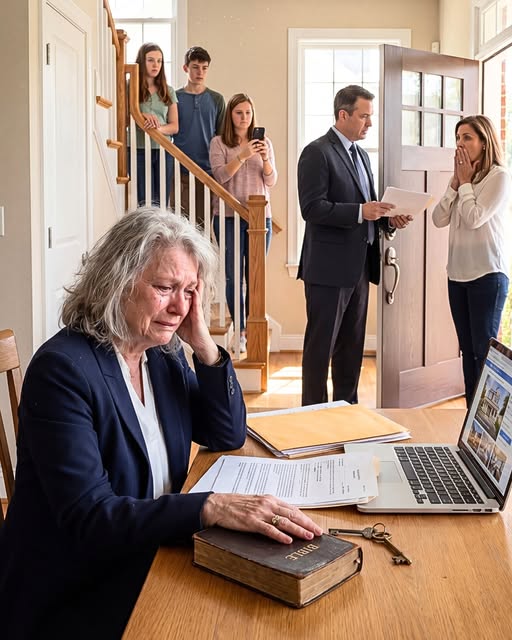
Before I could answer, the doorbell rang.
Michael shouted sleepily from upstairs.
I walked calmly downstairs.
Standing on the porch was a man in a gray suit carrying a folder.
Rebecca stood beside him.
Everything had been arranged carefully.
No shouting.
No confusion.
Witnesses.
The folder contained paperwork Lindsey never expected anyone to see.
Months earlier, she had secretly submitted paperwork on a luxury property, writing in attached notes that Michael’s mother would likely contribute “significant financial support” toward the purchase.
Michael read the documents twice.
The silence afterward felt enormous.
“Lindsey…” he whispered.
“I was going to explain.”
“Explain what?”
For the first time since I moved into their home, Lindsey looked uncertain.
Rebecca calmly placed another envelope on the table.
“Mrs. Hayes has formally changed residence as of today,” she explained. “Any discussions regarding financial matters or property access must go through legal counsel.”
Michael finally looked at me.
“Mom… did you come into money?”
His voice sounded young suddenly.
Almost frightened.
I thought about Walter’s porch.
The yellow kitchen.
Every ignored conversation.
Every dinner where I felt invisible.
“I found my freedom,” I answered.
Lindsey sat down hard on the staircase.
The papers slipped from her lap and scattered across the floor.
Proof.
Plans.
Calculations.
Michael didn’t yell at her.
That would have been easier.
Instead, he simply stood there realizing that every moment he stayed silent had slowly built this ending.
My granddaughter started crying quietly.
That nearly broke me.
I walked over and kissed her forehead.
“You can always visit me,” I whispered. “As long as you come because you love me. Not because someone sent you.”
Then I carried my suitcase upstairs one final time.
The room looked exactly as Lindsey preferred for photographs.
For the first time, I found that amusing.
I picked up my Bible and brass key.
Ran my hand across the perfectly staged bedspread.
And walked away.
Downstairs, Michael stood near the front door.
“Mom,” he said quietly, “I didn’t know she planned those things.”
“But you knew how she treated me.”
He lowered his eyes.
Because no amount of money could erase that truth.
Outside, the morning sun was already warming the driveway.
Rebecca opened the car door for me.
Before getting inside, I turned back and looked at Michael’s beautiful house.
White cabinets.
Black fixtures.
Three garage doors.
But never once a home for me.
Just the place where I finally learned that love without respect is only dependency wearing polite clothes.
When I arrived at my new house, the first thing I did was open every window.
Warm light flooded inside.
I placed the Bible on the kitchen counter.
Set the brass key beside it.
Then I made tea.
Not because Walter was there.
Because I still was.
A month later, Michael called again.
This time I answered.
He apologized.
Not perfectly.
Not enough to erase everything.
But honestly.
And for once, Lindsey’s voice wasn’t whispering in the background.
That mattered.
Now my grandchildren visit every Sunday.
We sit on the porch together beneath the trees.
One afternoon my granddaughter asked, “Grandma, does it feel different living here?”
I looked at the sunlight across the yard, the steaming tea in my hands, and the empty chair where Walter would have sat smiling.
“Yes,” I told her softly. “It feels like mine.”
And sometimes I still think about that dinner table.
About the moment everyone expected me to beg for space in a life that no longer welcomed me.
I didn’t beg.
I bought my own front door.
And for the first time in years, I became the person deciding who received the key.