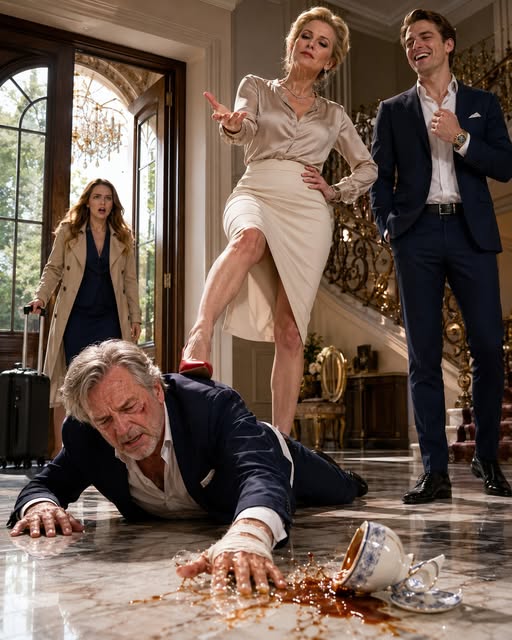
For one breath, no one moved. Even the curtains beside the tall windows seemed to stop breathing in the afternoon light. Vivian stood near the fireplace with her red heel half-raised, frozen between escape and denial. Marcus had gone so pale the arrogance slipped from his face like a mask dropped on marble.
I looked at my father.
His eyes were glassy with pain, but his voice had been steady enough. Not loud. Not dramatic. Just certain.
“She caused the accident,” he whispered again, as if the first time had stolen the last of his strength.
The officer stepped forward. “Mr. Whitmore, I need you to be very careful with what you say next.”
Vivian laughed once, too sharply. “He’s medicated. He doesn’t know what he’s saying.”
Dr. Lin turned on her. “According to the medication records your household submitted, he has been under-medicated for three weeks.”
Vivian’s lips parted, then closed.
My father gripped the arms of the leather chair. His left hand trembled violently, the same hand that had once signed checks, contracts, birthday cards, and the letter he sent me five years ago telling me never to come home if I could not respect his new wife.
I had kept that letter.
I had hated him for it.
Now I saw the man beneath it—broken, starved of medicine, buried under fear so long he barely remembered his own voice.
“The brakes,” he said. “She told Marcus they had to look natural.”
Marcus staggered back. “Shut up.”
That one command told everyone enough.
Vivian’s head snapped toward her son. “Marcus.”
The officer looked between them. “Mr. Whitmore, are you saying your car accident was intentional?”
My father closed his eyes.
The room vanished for me. I was seventeen again, standing in a hospital hallway, hearing Vivian sob beautifully into a handkerchief while telling everyone my father might never walk properly again. She had clung to me then. Called me poor child. Told me grief made people unstable when I asked why the security cameras outside the garage had been turned off that morning.
Everyone believed her.
Even Dad.
Or maybe he had only pretended to.
“It was raining,” Dad said. “She insisted I drive myself. Said the driver had the flu. I remember the hill. The brake pedal went soft. Then the guardrail.”
“Richard,” Vivian said, her voice dangerously soft.
But my father did not look at her anymore.
He looked at me.
“I woke up three days later. Vivian was beside my bed. She said Isabella had already asked about the will.”
My stomach turned.
I had been banned from his room before I could even see him.
“You believed her?” I asked, though I already knew the answer.
His face collapsed.
“I wanted not to,” he whispered.
The attorneys exchanged glances. One of them, Ms. Harper, the older woman with silver hair and eyes that missed nothing, opened her folder and removed a paper clipped packet.
“Officer,” she said, “we also have financial activity beginning two weeks after Mr. Whitmore’s accident. Transfers authorized under durable medical consent, signed by Mrs. Vivian Whitmore.”
Vivian lifted her chin. “I handled my husband’s affairs while he was incapacitated. That is not a crime.”
“No,” Ms. Harper said. “But forging an amendment to remove his daughter from medical visitation is. So is elder abuse. So is withholding prescribed medication. And if this allegation regarding the accident is substantiated…”
She did not finish.
She did not need to.
Marcus suddenly bolted.
Not toward the door.
Toward the suitcase.
He moved fast, wild with panic, but I had spent too many years imagining this moment to be unprepared. I kicked the suitcase shut with my heel and stepped back. The officer caught Marcus by the arm before he reached the folders.
Marcus swung.
It was pathetic and furious, like a spoiled boy striking at a locked door. The officer twisted his arm behind his back and drove him against the wall. One framed portrait of my father’s father rattled above them.
“Don’t touch me!” Marcus shouted. “You don’t know who I am!”
“I know exactly where your hands are going,” the officer said.
Vivian did not scream.
That frightened me more.
She watched her son being restrained with cold calculation, her eyes flicking from the officer to the attorneys, from the flash drive to Dr. Lin, from me to my father. I saw the machinery of her mind turning, choosing what to sacrifice.
Then she smiled.
Not at Marcus.
At me.
“You think you won because you brought papers?” she asked.
I said nothing.
She moved slowly toward the coffee table and picked up her purse. The officer noticed at once.
“Ma’am, leave that where it is.”
Vivian froze, but her smile did not fade.
“This is my home.”
“Not anymore,” I said.
Her eyes sharpened.
Ms. Harper stepped beside me. “Under the original trust provision and based on Dr. Lin’s emergency medical assessment, temporary control of the estate has transferred to Isabella Whitmore pending court review.”
For the first time that day, Vivian looked genuinely struck.
Not afraid.
Insulted.
As if the house itself had betrayed her.
“You?” she said. “A runaway little girl with cheap shoes and a rented apartment?”
I stepped closer. “A daughter.”
Vivian’s mouth twisted. “You stopped being that when you left him.”
“No,” my father said.
His voice was weak, but it cut through the room.
“She left because I failed her.”
The words hit me harder than Vivian’s insults ever could.
For years, I had imagined him saying them. In dreams. In arguments in my own head. In the mirror on nights when I hated how much I still wanted my father to choose me.
Now he had.
And it did not heal me.
It only opened the wound cleanly enough to see how deep it went.
Dr. Lin knelt beside him. “Richard, I need to get you to the hospital.”
“No hospital,” Dad muttered.
“Yes,” I said.
He tried to shake his head. “If I leave the house—”
“You’re not leaving it to them,” I said. “You’re leaving it to live.”
His eyes filled.
Vivian made a sound of disgust. “Touching. Truly. But before you write yourself into some tragic little reunion, Isabella, you should ask your father what else he signed.”
The room shifted again.
Dad went still.
I turned to him.
“What is she talking about?”
Vivian laughed softly. “Oh, Richard. You didn’t tell her?”
My father’s gaze dropped to the floor.
Marcus, still pinned near the wall, stopped struggling.
A cold thread slid down my spine.
Ms. Harper’s expression tightened. “Mrs. Whitmore, if you are referring to documents obtained under duress—”
“I’m referring to his confession,” Vivian said.
The word rang like a dropped blade.
My father closed his eyes.
“What confession?” I asked.
Vivian reached into her purse despite the officer’s warning. He moved, but she only withdrew her phone and held it up with two fingers.
“I have copies too,” she said, sweetly.
Ms. Harper stepped forward. “Do not play anything.”
But Vivian tapped the screen.
My father’s voice filled the room, thin and exhausted.
“I, Richard Whitmore, accept responsibility for the death of my first wife, Helena Whitmore…”
The world fell away.
My mother’s name moved through the air like smoke from a room I had locked years ago.
I heard myself say, “Turn it off.”
Vivian did not.
“…I ignored the warning signs. I knew the south balcony railing was loose. I failed to repair it. Helena fell because of my negligence.”
The recording stopped.
No one spoke.
I could hear my own heartbeat in my ears.
My mother had died when I was thirteen. A fall from the south balcony. A terrible accident, everyone said. My father had never spoken of it without turning gray. Vivian had entered our lives eighteen months later as the grief counselor recommended by a family friend.
My father was crying silently now.
“I was drunk,” he whispered. “The night before. Helena told me the railing felt loose. I said I would call someone in the morning. I forgot.”
Something inside me cracked—not cleanly, not completely, but enough for old anger to leak through.
“You forgot?”
He flinched.
“Mom died because you forgot?”
“I have punished myself every day,” he said.
“No,” Vivian said. “I punished you. Properly.”
Everyone looked at her.
She had made a mistake.
The words had come too easily, too honestly, slipping through the polished mask before she could stop them.
Ms. Harper’s eyes narrowed. “What did you just say?”
Vivian recovered quickly. “I meant he deserved guilt.”
But my father was staring at her with sudden horror.
“You knew,” he said.
Vivian looked away.
“You knew before the accident. Before Helena fell.”
She said nothing.
The silence answered.
Dr. Lin rose slowly.
My father’s voice shook. “I only told one person about that railing before Helena died.”
Vivian’s gaze returned to him.
And there it was.
Recognition again.
Not guilt.
Ownership.
“You were grieving,” she said. “People say many things.”
“You were her friend,” Dad whispered.
“She was weak.”
The officer stepped toward Vivian. “Mrs. Whitmore—”
“She had everything,” Vivian snapped, and the room finally saw her face without paint, without charm, without performance. “The house. The husband. The name. The daughter. She wore loneliness like jewelry and expected everyone to admire it.”
My chest tightened.
“You knew my mother?”
Vivian’s eyes slid to me. “Everyone knew Helena. That was the problem.”
I remembered flashes. A woman with dark hair standing near the garden gate. My mother closing the curtains when she saw her. My father saying it was nothing. My mother crying once in the pantry, then smiling when I walked in.
The past rearranged itself with a sickening click.
“You didn’t meet Dad after she died,” I said.
Vivian smiled faintly.
“No.”
My father looked as if the leather chair were swallowing him alive.
“She was obsessed,” he whispered. “Before Helena died, Vivian sent letters. Gifts. She said Helena stole the life meant for her.”
“That’s enough,” Vivian said.
But it was too late.
Ms. Harper had already signaled the second attorney, who was recording every word.
I stepped closer to Vivian. “Did you loosen the railing?”
For the first time, her smile faltered.
“Careful, Isabella.”
“Did you?”
Vivian’s eyes hardened. “Your mother should have stayed inside that night.”
The words went through me like ice.
Marcus shouted, “Mom, stop talking!”
But Vivian was breathing fast now, years of buried venom rising beyond control.
“She came out to accuse me. To tell me Richard had shown her the letters. To tell me she pitied me.” Vivian’s laugh cracked. “Pity. From a woman standing in a mansion she never earned.”
My father made a sound that was almost a sob.
“You were there,” he said.
Vivian’s face changed again.
She had not meant to give him that.
The officer spoke into his radio.
Marcus began cursing.
Dr. Lin moved between Vivian and my father.
And I stood in the center of the room, understanding that I had come home to expose abuse and theft, only to uncover the shape of my entire childhood.
My mother had not simply fallen.
My father had not simply remarried.
Vivian had not entered our family after tragedy.
She had been waiting beside it.
The officer took Vivian’s phone. She protested at once, but her voice had lost its silk. Marcus was handcuffed next, shouting about lawyers, about lawsuits, about how none of this would stand.
Vivian did not look at him.
She looked at me.
“You think this makes you powerful?” she asked quietly while the officer took her purse. “Power is not papers, Isabella. Power is knowing where every body is buried.”
I stepped close enough to see the fine cracks in her foundation, the tiny pulse beating at the base of her throat.
“Then I’ll start digging.”
Her lips curved.
“You won’t like what you find.”
The officer led her toward the door.
As she passed my father, he reached out—not to stop her, not to plead.
To ask one final question.
“Why?” he whispered.
Vivian paused.
For one second, the woman who had laughed at his weakness, stolen his fortune, isolated his daughter, and possibly murdered his wife looked almost tired.
“Because you chose her,” she said. “And after she died, you still chose her ghost.”
Then she was gone.
The house exhaled.
But nothing felt finished.
The ambulance arrived twelve minutes later. I rode with my father, holding a plastic bag of his prescriptions and a copy of the trust against my chest. He drifted in and out of consciousness, sometimes calling me Isabella, sometimes calling me Helena.
At the hospital, the nurses moved with efficient urgency. Dr. Lin stayed beside him, issuing orders, correcting dosages, demanding scans. I sat in the hallway while Ms. Harper spoke on the phone with the district attorney’s office.
My hands shook only after everything became quiet.
I had spent two months planning to save my father.
I had not planned to mourn my mother all over again.
Near midnight, Ms. Harper sat beside me with two cups of coffee neither of us touched.
“There will be a criminal investigation,” she said.
I nodded.
“Vivian’s statements today were significant, but not enough alone.”
“I know.”
“We need the old case file. Police reports, photographs, maintenance records, witness statements. Anything from the night your mother died.”
I stared at the white hospital wall.
“There was no case,” I said. “They called it an accident.”
“Accidents still leave records.”
I thought of my mother on the balcony, rain in her hair, facing the woman who wanted her life.
Then I thought of my father, drunk with guilt, easily manipulated because Vivian knew exactly which wound to press.
“She planned everything,” I said.
Ms. Harper did not soften it with comfort. “Likely.”
A nurse came out before dawn and told me my father was stable.
Stable.
Such a small word for a man whose life had been dismantled piece by piece.
I entered his room quietly. He looked smaller beneath the hospital blankets, but there was color in his face for the first time. His eyes opened when I touched his hand.
“Isabella.”
“I’m here.”
“I don’t deserve that.”
“No,” I said.
His eyes filled.
“But I’m here anyway.”
He nodded, accepting the mercy without mistaking it for forgiveness.
For a while, we sat in silence.
Then he whispered, “There’s a safe.”
I leaned closer.
“At the house?”
He shook his head weakly. “No. Helena’s studio.”
My breath caught.
My mother had painted in a small glass-walled studio behind the garden. After she died, Vivian locked it, claiming it hurt Dad too much to see. Eventually, ivy swallowed the path. I had not stepped inside since childhood.
“What safe?”
“Under the floorboards. She kept journals. Letters.” His voice broke. “She was afraid of Vivian before I believed her.”
I closed my eyes.
Of course she was.
My mother had tried to warn him.
And he had forgotten the railing.
“Why didn’t you tell anyone?” I asked.
“I went there after the funeral,” he said. “The safe was empty.”
The air changed.
I opened my eyes.
“What do you mean empty?”
His gaze shifted toward me, haunted.
“Someone got there first.”
My phone vibrated in my pocket.
Unknown number.
I almost ignored it.
Then a message appeared.
A photograph.
For a moment, I could not understand what I was seeing. A wooden floor. A square opening. A small metal safe.
Open.
Empty.
Then another message followed.
You should have stayed away, Isabella.
My blood went cold.
A third message arrived before I could breathe.
Your mother didn’t die because of Vivian.
She died because she found out what your father really did.
I stood so quickly the chair scraped against the hospital floor.
My father stared at me. “What is it?”
I looked at the message, then at the frail man in the bed, and for the first time that day, I wondered if Vivian’s final warning had not been a threat.
Maybe it had been an invitation.
Maybe she wanted me to dig because she knew the grave would not lead only to her.
And somewhere, behind all the evidence I had carried into that house, someone else had already begun removing the truth.
…If you want to know what happened next, please type “YES” and like for more.