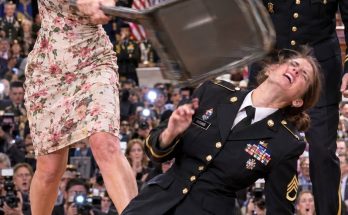
His eyes moved over me with the same cold disgust he used to reserve for muddy shoes on his pristine rugs. The dinner party had already begun. Two dozen guests stood beneath the warm glow of his dining room chandelier, holding crystal wine glasses and murmuring over expensive cigars and my sister Sarah’s vanilla perfume. Rain ticked rhythmically against the tall windows. Somewhere in the hallway, the grandfather clock counted seconds like it knew something terrible was about to fracture.
My father, Arthur, lifted his bourbon glass. “Look at yourself, Clara,” he said, loud enough for the closest guests to hear. “You shame this family.”
The room went silent so fast I could hear water dripping from the hem of my coat onto the marble.
I should have turned around. I had survived gunfire, screaming engines, and the kind of darkness that sits behind your ribs long after the sun comes up. I had pulled civilians through smoke while my shoulder burned beneath a makeshift field dressing. I had carried a little girl with one shoe missing across broken concrete. But standing in my father’s foyer, I was twelve years old again, waiting for him to decide whether I was worth loving.
“Dad,” Sarah whispered from the dining room archway. “Not now.”
Arthur ignored her. Even at seventy, he looked perfectly arranged. Navy blazer. Silver pocket square. CEO posture, retired but never surrendered. He had built three companies and raised three children with the emotional warmth of a corporate merger.
“You couldn’t even bother to change?” he asked.
“I came straight from base,” I said. My voice sounded calm. Training makes a body useful while the soul is somewhere else.
My older brother, Thomas, stared into his glass as if the answer to courage sat somewhere at the bottom of the bourbon. One of Arthur’s golf buddies glanced at my uniform and gave an awkward laugh. “Still doing all that tactical stuff?”
I tasted copper at the back of my throat. “Something like that.”
“You’re thirty-eight, Clara,” my father snapped, his mouth a tight line. “Most women your age have stability. A normal life. You mistake recklessness for purpose, disappear for months, come back looking half dead, and somehow expect admiration.”
“I didn’t ask for admiration.”
“No,” he said. “You clearly wanted attention. Please go clean up. You’re upsetting people.”
I walked past him before my face could betray me. The hallway smelled like lemon polish and old money. My boots were entirely too loud on the hardwood. Each step pulled at the torn muscle beneath my sleeve.
Halfway up the stairs, my phone vibrated.
Restricted number. My stomach tightened before I answered. “Captain Clara Bennett.”
The voice on the line was calm, official, and unmistakably senior. “Captain Bennett, this is General Sterling. The Joint Chiefs need you in Washington immediately.”
I stopped on the stairs. Behind me, my father’s party resumed in cautious fragments of laughter and clinking silverware.
“And Captain?” Sterling added. “What your team accomplished over there is no longer staying behind closed doors. The entire country is about to hear your name. But you need to brace yourself, because what else followed you home is going to tear your world apart.”
I stayed in the upstairs hallway after the call ended, staring at the rain sliding down the dark window glass. The house sounded distant from up there. Warm voices below. Ice in glasses. Sarah trying too hard to rescue the evening. My father laughing at something Thomas said, as if he had not just gutted me in front of strangers and gone back to his roast beef.
I stepped into the guest bathroom and locked the door. The woman in the mirror looked hollowed out. Soot lined my jaw. A thin cut sat near my hairline. I turned on the faucet, and the water ran pink when I scrubbed my sleeve.
Not my blood. Not all of it anyway.
The smell rose again, sharp and metallic, and suddenly I was back beside the extraction helicopter, one knee in the dirt, shouting for Jason over the rotors while the whole world turned orange. I gripped the porcelain sink. Breathe in for four. Hold. Out for four.
A knock came at the door. “Clare?” Sarah. Only she still called me that.
I opened the door. Her face fell when she saw my shoulder. “God, Clara. Let me look at that. I’m a doctor.”
“There isn’t time,” I said, pulling down my sleeve.
We went back downstairs because leaving would have become the story, and I was tired of being the problem in rooms where I had done nothing wrong. Dinner glowed beneath the chandelier. My father stood at the head of the table, holding court. He looked briefly at me as I sat down at the far end. Not guilty. Not sorry. Just inconvenienced.
Then the television in the adjoining sitting room interrupted the ambient jazz with a breaking news alert.
“Tonight, Pentagon officials have confirmed the success of a classified rescue operation involving American aid workers trapped overseas.”
My fork stopped halfway to my mouth.
“Sources describe the mission as one of the most dangerous extractions conducted this year.”
Arthur glanced at the screen with mild interest, completely unaware that while he was calling me an embarrassment, I had been standing inside that very broadcast.
Then the heavy oak front door groaned. The doorbell rang once. Heavy. The butler hurried from the side hall, his voice returning thin and nervous. “Sir? There’s a general here asking for Captain Bennett.”
The room went still. The kind of silence that presses against your ears until your own pulse feels too loud.
I stood carefully, my shoulder screaming. The foyer lights glowed amber as I walked toward the front door. Through the glass panels, I saw black government SUVs lining the wet curb. And in the entryway stood General Sterling. Four stars. Silver hair. Dress uniform.
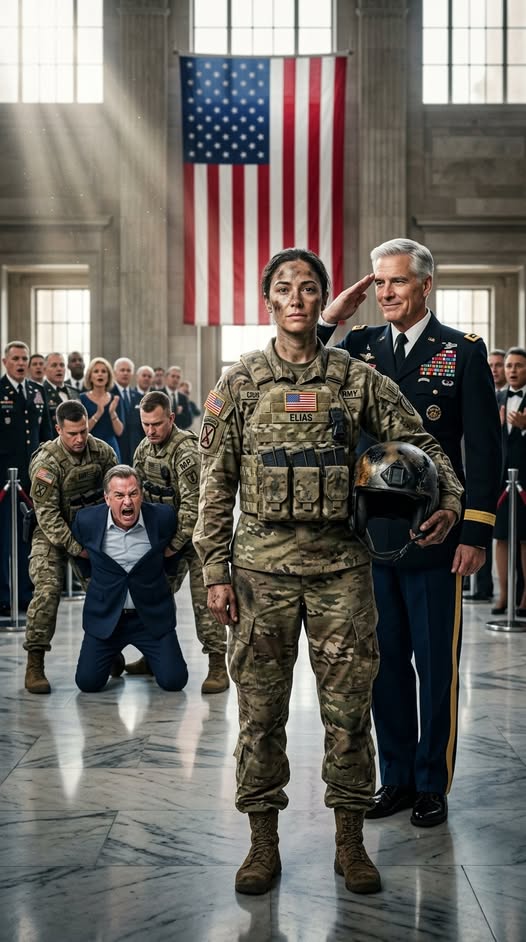
The second he saw me, his posture changed. Formally. In my father’s house, in front of my father’s guests, the four-star general raised his hand and saluted me first.
I returned it.
My father stepped into the foyer behind me, wearing his host smile. “General, Arthur Bennett.”
Sterling shook his hand briefly. Very briefly. “Mr. Bennett. I apologize for arriving unannounced, but Washington requested immediate transport for Captain Bennett.” He turned to the dining room, addressing the silent guests. “Eight hours ago, a humanitarian convoy was attacked. Captain Bennett led the extraction team. Five American civilians are alive tonight because your daughter moved toward danger when most people would have frozen.”
Sarah’s hand flew to her mouth. Thomas stood motionless.
“She refused extraction after sustaining injuries to recover the final survivors,” Sterling continued, his eyes locking onto my father’s pale face. “I’m sorry about Specialist Jason Miller, Captain.”
My hands curled into fists. “Thank you, sir.”
Arthur’s mouth opened, but no sound came out. His eyes darted to my bloody sleeve, finally understanding the cost of my dirt. He looked terrified.
I walked out the door toward the idling SUVs, refusing to look back at the man who only valued me when someone else told him to. But as I slid into the leather backseat, my phone buzzed. A text from Sarah.
Clara. Dad went into his study after you left. He was looking for something. I found it. You need to see this before you ever speak to him again. He’s been lying to us for years.
Washington looked entirely different after midnight. Cleaner, somehow. The monuments glowed pale and stoic against the wet darkness, and rainwater shimmered across the asphalt like liquid glass. From the back seat of the government SUV, I watched the city pass in blurred streaks of white and gold. General Sterling sat across from me in comfortable, heavy silence. It was soldier silence—the kind that instinctively knows some memories need breathing room before words can touch them.
My reflection stared back from the tinted window. Bruised. Hollow-eyed. A woman who had survived the fire but brought the smoke home with her.
After a grueling three-hour debriefing deep within the Pentagon, beneath fluorescent lights that flattened every face into a mask of exhaustion, I was finally transported to Walter Reed. The medical wing smelled of aggressive antiseptic, floor wax, and the stale coffee sitting on the nurses’ station. A surgeon meticulously restitched the torn muscle in my shoulder while I stared blankly at the ceiling tiles, trying desperately not to think about the coarse desert sand, or Jason Miller’s final, silent nod before the shockwave hit us.
By ten o’clock the next morning, my hospital room was a quiet tomb of beeping monitors. Then, the heavy wooden door pushed open.
My sister, Sarah, marched in, her usual polished demeanor entirely absent. She was followed closely by a pale, grim-looking Thomas.
“I told the floor nurse I was a doctor,” Sarah said abruptly, dropping a battered, blue metal box onto my rolling tray table. It hit the plastic with a dull thud. “Eat your terrible hospital sandwich and look at this.”
I recognized the box immediately. The paint was chipped at the corners. It used to hold my mother’s sewing needles. I remembered the soft, metallic rattle it made when she opened it at the kitchen table. A cold dread coiled in my gut. “Where did you get that?”
“Dad’s locked desk drawer,” Thomas said quietly, his voice lacking its usual courtroom confidence. “He left the key in the lock last night after the General humiliated him. He was drinking heavily.”
I reached out with my good arm and popped the latch. The faint, ghostly scent of lavender sachets drifted out, instantly transporting me back twenty years. Inside were envelopes. Dozens of them. Military stationery. Some unopened, their seals yellowed with age.
My fingers went completely numb as I picked up the top one. It was an invitation to my commissioning ceremony from over fifteen years ago. Attached to it with a rusted paperclip was a formal response card.
Declined. Written in my father’s sharp, precise handwriting.
I pulled another. An invitation to an awards banquet after my first deployment. Declined.
A letter from my first commanding officer praising my “exceptional leadership under fire,” asking for family contact info. Across the top margin, my father had written a single, devastating word: Unnecessary.
My heart didn’t break; it sank quietly, like a stone dropped into freezing, dark water. I had spent years meticulously building excuses for them. I told myself my family didn’t attend because travel was hard, because Dad was busy running his empire, because normal people didn’t understand military life. But here was the physical proof. Arthur Bennett hadn’t just ignored my life; he had actively stood guard at the door to ensure no one else could celebrate it either.
“I’m leaving,” I said, kicking my legs over the side of the hospital bed, ignoring the sharp spike of pain in my shoulder.
“You have fresh stitches,” Sarah protested, reaching for my arm.
“I have a ride,” I countered, grabbing my jacket.
Forty minutes later, Thomas’s car pulled up to the Bennett estate. The red brick and white columns looked exactly the same, but the illusion of respectability had rotted away. Arthur opened the front door before we could even knock. He looked hollowed out, his hair uncombed, his skin gray beneath the porch light. But when his eyes landed on the blue box in Thomas’s hands, a flash of old, desperate authority ignited.
“You had no right to go into my study,” he snapped.
“You kept my entire existence hidden in a sewing box, and you want to talk about rights?” I pushed past him into the foyer. My left arm was bound in a sling, but my patience was utterly extinct.
I marched directly into his study. The room smelled oppressively of cigar smoke, leather, and intimidation. “Open the bottom right drawer. Now.”
“Clara, please,” Arthur’s voice cracked. He stayed in the doorway, physically unable to cross the threshold.
“Open it!” I practically snarled.
Trembling, he slowly pulled a heavy brass key from his pocket and unlocked the massive mahogany drawer. It opened with a dry, wooden scrape. Inside were thick, manila folders. Labeled by year. 2010. 2011. 2012. My entire career, filed away like criminal evidence. Printed emails, local newspaper clippings he had secretly collected, medical updates from when I was injured in Kandahar—a roadside bomb injury he knew about but never called me to discuss.
At the very bottom, buried beneath the weight of his silence, lay a sealed envelope. My mother’s elegant handwriting covered the front. For Clara. When you are ready to stop asking him to be someone else.
I snatched it up. Arthur stepped forward, his face twisting into genuine, naked panic.
“Don’t read that,” he begged, his voice dropping to a desperate, ragged whisper. “Clara, I swear to you, if you open that letter, you will never be able to unsee what she left behind.”
I did not listen to him. I took my mother’s sealed letter and walked down the hall to the sunroom.
This was the place she used to sit when the chemotherapy made the stairs impossible. She would tuck a knitted blanket around her legs and watch the cardinals land in the dogwood tree outside. The room still smelled faintly of dust and dried hydrangeas. Arthur stood in the doorway, practically vibrating with a fear I had never witnessed in him. Sarah and Thomas flanked me like silent sentinels.
I broke the wax seal.
My Clara, the letter began, the ink strokes shaky but entirely deliberate. If you are reading this, Arthur has hurt you badly enough that someone finally forced open his vault. I hope it is me handing this to you, but time is a cruel thief.
I traced the letters with my thumb, my chest tight.
Your father loves you in the most useless, damaging way I have ever seen. He loves you with fear, and fear, when left unchallenged, metabolizes into control. He lost his brother David in uniform when he was young. A training accident they said, though Arthur never believed the official report. He never forgave the military for bringing grief to his mother’s door. When you chose to serve, he did not see your courage. He saw a folded flag that had not arrived yet.
I stopped reading. The silence in the sunroom was absolute.
That explains him, the letter continued, but it does not excuse him. Do not spend your life waiting for him to understand the language your soul speaks. Some people only recognize worth when the rest of the world applauds it. Live unapproved if you must. Live anyway.
I carefully folded the fragile paper. Outside, a light rain began to fall against the glass.
“You punished me for dying in your imagination,” I said, looking up at the man who had cast a long, suffocating shadow over my entire life.
“I thought if I didn’t encourage it, you might finally come home,” Arthur choked out, pressing the heels of his hands into his eyes.
“I did come home. Again and again. After deployments, after injuries, after Mom’s funeral. You just wanted me smaller.” I walked past him, feeling a strange, hollow lightness. The old, desperate bargain was permanently broken.
I slept at Sarah’s house that night, collapsing into a dreamless sleep on her guest bed. But by eight o’clock the next morning, the illusion of peace shattered.
My phone was a vibrating brick of notifications. The morning news cycle had caught the clean, sanitized version of the story. Major rescue. Hostile territory. Heroism. But at 10:42 AM, Thomas walked into Sarah’s kitchen. His face was white with a rage so pure it made him look like a stranger. He slid an iPad across the marble island.
“You need to see this,” he said, his voice trembling.
Father of Rescue Hero Speaks: “Our Family Always Believed In Clara’s Calling.”
I stared at the screen, my vision tunneling. There was a high-resolution photo of Arthur standing on his front porch earlier that morning, looking impeccably solemn and patriotic beneath a snapping American flag. The article quoted him extensively, detailing our family’s “quiet, unwavering support” and the “deep private concern every parent of a service member carries in their heart.”
My hands went ice cold. The coffee in my stomach turned to acid.
“He actually spoke to the press?” Sarah asked, horrified, reading over my shoulder.
He hadn’t just spoken to them. He had weaponized my survival. He had co-opted my blood, my trauma, and Jason’s death to launder his own reputation. He saw the world’s praise, and he moved toward it, deciding the safest place to stand was right beside me in the spotlight, even if he had spent thirty-eight years shoving me into the dark.
My phone rang, slicing through the kitchen’s tense silence. It was General Sterling.
“Captain Bennett,” he said, his tone clipped and grim. “A network crew is asking whether your father will attend the formal commendation ceremony tomorrow as your official family representative. Someone from his PR camp indicated he would be sitting front row. What’s your move?”
I looked down at the iPad, at the man who was currently stealing my truth to feed his insatiable ego. A cold, absolute fury settled into my bones.
“Tell security to let him in,” I said, my voice dropping to a dead, mechanical calm.
“Are you sure about that, Clara?”
“Yes, sir. Because tomorrow, he’s going to learn exactly what happens when you stand in front of an open microphone and lie about a soldier.”
I ended the call. Almost immediately, the screen lit up again. An restricted number.
I answered it, expecting another reporter. Instead, a distorted, heavily synthesized voice whispered through the speaker, the sound scratching against my ear like sandpaper:
“Captain Bennett. Your father didn’t just hide your mother’s letters. If you want the real truth about your mission… ask him what he did to Jason Miller’s deployment orders.” The line went dead.
The Hall of Honor was significantly smaller than people usually imagined. I had expected marble grandeur, echoing, cavernous ceilings, and flags tall enough to make everyone feel tiny and insignificant. Instead, it was intimate. Contained. It was a room designed so that grief could not hide in the back rows.
I stood in the staging area, adjusting the cuffs of my dress uniform. My shoulder throbbed with a dull, rhythmic ache, a physical reminder of the dirt, the smoke, and the cost.
Jason Miller’s widow, Claire, sat in the very front row. She was pale, dressed in stark black, holding her youngest daughter’s hand with a white-knuckled grip. Sarah and Thomas sat two rows behind them, looking profoundly uncomfortable under the glaring lights.
And right on the center aisle, wearing a bespoke charcoal suit and a perfectly calibrated expression of solemn, patriarchal pride, sat Arthur.
The digital voice from the burner phone had haunted me all night. Ask him what he did to Jason’s deployment orders. My father was a man of infinite reach and corporate ruthlessness, but manipulating military orders? It seemed impossible. Yet, as I looked at his composed, camera-ready face, a sickening knot tightened in my stomach. I hadn’t confronted him yet. I needed to survive this next hour first.
General Sterling approached the podium. He read the official commendation, his voice echoing off the polished wood paneling. He spoke of bravery, of suppressing fire, of the terrified civilians pulled from the concrete rubble. When he finally called me forward and pinned the heavy metal to my chest, his hands were remarkably steady. He stepped back and saluted.
I returned it, then stepped to the podium. The teleprompter screen embedded in the glass scrolled with my pre-approved, highly sanitized remarks.
I looked down at the text, then up at Arthur. I ignored the screen entirely.
“My father told me three nights ago that I shamed my family,” I said directly into the microphone.
A collective, sharp breath hitched in the room. The polished veneer of the ceremony cracked instantly. Arthur’s posture went rigidly stiff, his jaw locking. The network cameras stationed at the back of the hall suddenly swiveled, their red recording lights burning into my face like sniper dots.
“I believed him for a very long time,” I continued, my voice steady, carrying easily over the absolute, suffocating silence. “Because when you are fed criticism your whole life, you can mistake hunger for love. But this medal does not belong to a narrative of a family’s quiet support. It does not belong to PR statements. It belongs to Specialist Jason Miller, who gave his life so a little girl could go home.”
I looked directly into Arthur’s eyes. He looked utterly terrified. Not of being misunderstood. He was terrified of being fully, publicly seen.
“Do not,” I said, my voice dropping to a fierce, protective register, “turn his ultimate sacrifice into a cheap redemption story for people who only arrived after the applause began.”
I stepped back from the podium. The ceremony concluded in a haze of polite, deeply shocked applause. Nobody looked at Arthur.
Afterward, as the crowd thinned and the brass mingled, I walked toward the exit. Arthur was waiting by the glass lobby doors. In his hands, he held a massive bouquet of white roses—my mother’s favorite. He was actually trying to use her ghost as a shield.
“Clara,” he said, his voice stripped of its usual commanding baritone. “Please. I watched you up there. I was wrong about you. I’m trying.”
“I believe you’re trying now,” I said, stopping exactly three feet away, keeping a strict tactical distance. “But I also believe you only started trying when the world made it unbearable for you not to.”
I reached out and took the white roses from his hands. For a singular, pathetic second, a flicker of hope lit his aged eyes. Then, without breaking his gaze, I turned and laid the flowers beneath the memorial photograph of Jason Miller resting on a nearby table.
“I am your father,” he whispered, his voice finally breaking.
“You lost access to the version of me that kept waiting for you to act like it.” I turned away from him, walking toward the exit where Sarah and Thomas waited. I didn’t look back as the heavy glass doors hissed shut, leaving him completely alone in the lobby with his empty hands.
That night, I returned to my small, quiet house near the base. It smelled of stale coffee and laundry detergent. I placed my mother’s letter in my desk drawer. I was officially done bleeding for my father’s approval. The war with Arthur Bennett was over.
But as I sat at my kitchen table, staring at the rain lashing against the window, the heavy silence of the house was violently broken by a loud, rhythmic knock at my front door.
I glanced at the digital clock on the stove. 11:30 PM.
My heart rate spiked. I pulled my service sidearm from the biometric lockbox under the counter, keeping it concealed behind my back as I walked to the entryway. I pulled the door open just a few inches.
Standing on my porch, soaked by the rain, was an older man in a faded, military-issue field jacket. He looked at me with eyes that were identical to my father’s—the same sharp, calculating gray—though I had been told my entire life that this man was dead.
“Hello, Clara,” the man said quietly, stepping out of the shadows into the porch light. “My name is David Bennett. And your father and I have a hell of a lot to talk about.”
If you want more stories like this, or if you’d like to share your thoughts about what you would have done in my situation, I’d love to hear from you. Your perspective helps these stories reach more people, so don’t be shy about commenting or sharing.