I was twenty-five the morning my own family laughed at me in a courtroom.
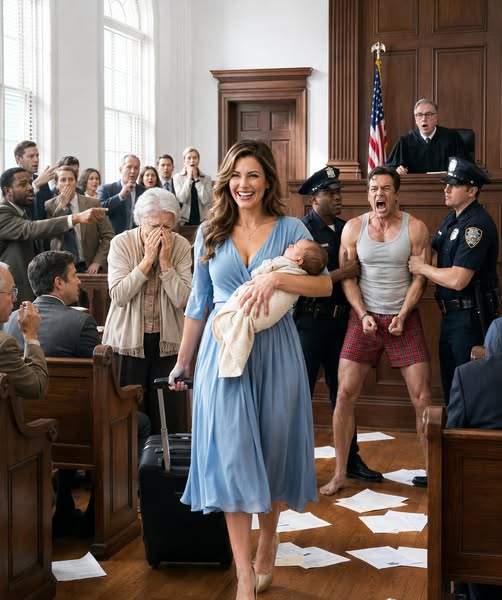
Their amusement bounced off the polished marble floors and dark wooden benches of the Fulton County Courthouse, sharp, careless, and cruel. It was a sound I had heard all my life, but under the cold buzz of fluorescent lights, it felt even uglier—like the building itself wanted to reject it.
My mother, Eleanor, leaned toward my older brother, Julian, covering her mouth with one manicured hand as if she were being discreet. But her whisper was meant to reach me.
“We’re going to strip her down to nothing,” she hissed, her pale eyes shining with satisfaction. “She’s too weak to put up a real fight.”
Julian gave a short, mocking laugh. He adjusted the lapels of his expensive suit—the kind bought with money that should have belonged partly to me—and looked over with pure pity.
I stood at the plaintiff’s table and did not react.
My hands stayed folded in front of me. My heartbeat remained steady despite the pressure of betrayal pressing hard against my chest. The courtroom smelled of lemon cleaner, old paper, and nervous sweat. For years, I had imagined courtrooms as places where truth survived. But standing there, I understood something else.
This was not a sanctuary.
It was a place where people came to be cut open.
My mother caught my eye and smiled as if I were something small and injured.
“Don’t worry, Victoria,” she said sweetly. “We’ll leave you enough to rent some tiny room somewhere. You’ve always been used to living off whatever scraps we gave you.”
I said nothing.
I let the silence sit between us.
My family had always mistaken my silence for weakness. They believed endurance meant surrender. They thought quiet meant empty.
It was the greatest mistake they had ever made.
At the front of the room, the bailiff cleared his throat.
“Calling docket 14B. Owens versus Owens.”
A few people in the gallery turned. The irony was obvious.
Family against family.
I picked up my slim leather folder and stepped toward the podium. My heels clicked against the marble in slow, measured beats.
Tap. Tap. Tap.
I was not rushing.
I was not hiding.
At the bench, Judge Harrison Vance reviewed the files before him. He was an older man with silver hair and tired, intelligent eyes—the eyes of someone who had spent decades watching people destroy each other in legal language.
When I stopped at the podium, he finally looked up.
My mother’s smug laugh died instantly.
For one brief second, the entire courtroom seemed to shift. Judge Vance’s gray brows lifted. His stern courtroom expression softened into something human and surprised. He leaned forward, staring directly at me.
“Victoria Owens?” he said, warmth entering his voice. “Is that really you?”
Behind me, I heard my mother inhale sharply.
Julian shifted in his chair.
The balance of power in the room changed in a single breath.
Because there was one thing Eleanor and Julian had never considered.
They remembered the frightened girl they had spent years crushing.
But they were about to meet the woman she had become.
Chapter 2: The Ghost of Excellence
Watching my mother’s confidence crack was both terrible and beautiful.
The second Judge Vance spoke my name like it mattered—not like I was a case number, not like I was an inconvenience—Eleanor’s composure began to fall apart. From the corner of my eye, I saw Julian lean toward her, his arrogance fading into alarm.
“Mom,” he whispered harshly. “How does the judge know her?”
For once, Eleanor Owens had no answer.
She sat frozen, lips parted, eyes blank with shock.
Judge Vance removed his glasses and let them hang from the chain around his neck. He studied me with the look of someone pulling an important memory from the back of his mind.
“Miss Owens,” he said gently, ignoring the frantic whispering behind me, “I haven’t seen you since the Vanguard Scholarship oral defense panel. Three years ago. You were the unanimous top candidate.”
A murmur passed through the gallery.
Eleanor stiffened.
Julian blinked as if the word scholarship and my name could not possibly exist in the same sentence.
For years, my family had told everyone I had failed out of university. They said I was directionless, lazy, incapable of winning anything on my own. They had hidden mail, intercepted letters, and buried every opportunity that proved otherwise.
“Yes, Your Honor,” I said evenly. “That feels like a lifetime ago.”
A small smile touched his face. “Time does pass, Miss Owens. But true excellence is not easy to forget.”
Julian could not stop himself.
“Excellence?” he scoffed loudly. “Her?”
Judge Vance turned toward him.
The warmth disappeared from his face, replaced by cold authority. He did not raise his voice, but his stare hit Julian hard enough to make him sink back into his chair.
“This court expects proper decorum,” he said quietly.
Then he looked back at me, his voice returning to respect.
“Please proceed, Miss Owens. Given the complicated nature of these filings, I would like you to present your timeline first.”
My mother sprang to her feet so quickly her chair screeched against the floor.
“Wait. I object. Why does she get to speak first? Julian and I filed the primary claim regarding the trust.”
Judge Vance did not even look at her.
“You will speak when instructed, Mrs. Owens. I am allowing the respondent to present first because I want her position clearly on the record. She is the respondent here. Not a defendant. Not a criminal.”
I saw the realization strike my mother’s face.
The judge was not going to be swayed by her tears, pearls, or performance.
He was already looking past the mask.
I opened the brass clasp on my leather folder. Inside were organized documents, certified timelines, and proof of a life my family insisted I could never have built. The papers felt solid beneath my fingertips.
“Whenever you are ready, Miss Owens,” the judge said.
I pulled out the first document.
I knew exactly how I wanted to destroy their lies.
Not with shouting.
Not with tears.
With paper.
With evidence.
With the sharp, silent weight of truth.
As I slid the first exhibit forward, I saw fear pass across my mother’s face.
She had walked into court expecting to watch me lose everything.
She had no idea I had already built the trap.
Part 2
My mother’s breathing became uneven as I placed the first document before the judge.
It was a thick certificate printed on heavy stock paper, embossed with a gold seal. My name appeared across the center in elegant lettering.
Judge Vance leaned forward and put his glasses back on. As he read, his expression softened with genuine pride—an expression I had almost forgotten could be directed at me.
“Ah,” he murmured. “Your academic merit award from the Vanguard Foundation. Summa Cum Laude. I remember signing this myself.”
A sharp gasp came from somewhere in the back of the room.
“What does some old school certificate have to do with the trust?” Julian muttered, panic cracking through his voice.
Judge Vance did not look at him.
“Establish your baseline, Miss Owens,” he said. “Continue.”
I placed the second document beside the first. It was a financial ledger from a certified forensic accountant. Clean, detailed, and untouched by my family’s corruption.
“This document, Your Honor,” I said, “shows my independent personal accounts over the last four years. These are the same accounts my mother and brother claim were funded by money I stole from the Owens Family Trust.”
Eleanor shot up as if burned.
“That trust was created by my late husband. I control it. She has no right to any of it.”
Judge Vance lifted one hand.
That small gesture silenced her.
Then he picked up the original trust charter from his own files and read the highlighted section aloud.
“The Owens Family Trust. Beneficiary Allocation. Beneficiary: Victoria Owens. Fifty percent equity stake upon her twenty-fifth birthday.”
The word beneficiary landed heavily in the courtroom.
Julian stammered. “That’s impossible. Mom amended the trust eighteen months ago. The new charter says everything—every asset and property—goes to me.”
Judge Vance lowered the document and looked over his glasses.
“Is that so?”
I reached into my folder and removed the third sheet.
It was the amended trust copy Eleanor had filed with the court.
Signed.
Dated.
And completely illegal.
I slid it forward.
My mother froze.
Judge Vance lifted the document, comparing the signature on the amendment with the signature on my scholarship certificate. The room seemed to grow colder.
When he spoke again, his voice was no longer curious.
It was sharp, controlled anger.
“This signature,” Judge Vance said clearly, “is not Victoria Owens’s handwriting.”
Whispers rushed through the gallery.
My mother’s lips trembled.
Julian clenched his fists on the table, finally understanding what was happening.
I leaned slightly toward the microphone.
“They forged my signature, Your Honor,” I said. “They created a false waiver to remove me from my inheritance, then filed this lawsuit claiming I stole money I had earned independently, hoping to drain my resources and silence me.”
Judge Vance placed the forged document back on the bench.
His eyes were dark now.
For the first time in my life, I saw my mother truly afraid.
“Mrs. Owens,” he said, his voice lower. “This is not a clerical mistake. This is not a simple family dispute over assets. Forging a trust document is a felony. You submitted fraudulent evidence to this court.”
My mother collapsed back into her chair.
Julian grabbed her arm.
“Mom,” he whispered desperately. “Say something. Fix this. Tell him it was a mistake.”
But Eleanor Owens had no story left to twist.
She opened her mouth, but only a dry, broken sound came out.
They were trapped beneath the harsh courtroom lights.
And for once, they were the ones with nowhere to hide.
The atmosphere in the courtroom changed.
It was subtle, but everyone felt it. The air tightened. The room seemed to hold its breath.
Judge Vance looked away from my trembling mother and focused on me.
“Miss Owens, for the record, did you ever authorize this amendment to the Owens Family Trust?”
“No, Your Honor,” I said. “I had no knowledge of it until the trust’s independent auditor contacted me and asked why I had voluntarily given up a seven-figure asset allocation. After that, I requested a full forensic review.”
I slid the bound audit report across the bench.
Judge Vance read the executive summary, his jaw hardening.
“This report,” he said, “details a systematic attempt to move one hundred percent of the trust’s assets and property holdings to Julian Owens without legal basis. It also states that the signature used to waive Miss Owens’s rights is inconsistent with every previous handwriting sample on file.”
Julian jumped to his feet.
“We did what we had to do,” he shouted. “She doesn’t deserve that money. She abandoned this family. She walked away and became nothing.”
Judge Vance’s eyes hardened.
“Sit down before I hold you in contempt.”
Julian dropped back into his chair, chest heaving, face flushed.
I did not turn around.
I did not match his anger.
I simply spoke to the judge.
“I did not abandon my family, Your Honor. I was pushed out. And when I refused to fall apart, they punished me for surviving without them.”
A murmur passed through the gallery.
The perfect image of the Owens family was cracking in public.
Judge Vance tapped his silver pen against the bench.
“Miss Owens,” he said slowly, “before I address sanctions for the forgery, I need to understand what you are seeking today. Do you want the court to restore the trust to its original terms? Do you want your fifty percent share reinstated immediately?”
Behind me, my mother gasped.
“No,” Julian whispered. “No, she wouldn’t dare take half. She doesn’t have the courage.”
But they did not know me anymore.
This had never been only about money.
Money was simply the weapon they used. What I wanted was my voice back—the voice they had tried to suffocate for years.
I took a slow breath.
I let the silence stretch.
I wanted them to feel the weight of it.
Eleanor leaned forward, her voice suddenly fragile.
“Victoria, please. Don’t do this to us. We were only trying to protect the family legacy. Don’t ruin your brother’s future.”
Julian forced a laugh. “Just admit you want the money. That’s what this performance is about, right?”
I ignored them and kept my eyes on the judge.
“Your Honor,” I said, “I do not want a single cent from funds tied to their manipulation.”
My mother exhaled in relief.
She thought she was safe.
She was wrong.
I reached into the back of my folder and pulled out another notarized document. I placed it gently before the judge.
Judge Vance picked it up. At first, he looked confused. Then his eyebrows rose.
“This is an independent commercial property deed,” he read aloud. “Registered entirely in your name. Dated two years ago.”
Julian frowned. “Property deed? What is this? Victoria doesn’t own property. She works retail.”
Judge Vance looked at him with icy contempt.
“According to the county registrar, your sister is the sole owner of a three-unit residential rental complex on Birch Street.”
My mother’s breath caught.
Julian’s mouth fell open.
“A complex?” Eleanor whispered. “With what money? How?”
For the first time, I turned to face them.
I let them see the woman they had created by trying to break me.
“The Vanguard scholarship I won,” I said. “The one you hid from me. The one you told everyone I lost because I was too lazy to study. It paid for my dual degree in business and finance. That degree helped me land my first investment banking job. The bonuses from that job bought the Birch Street property in cash.”
Their shock was complete.
For years, they had lived inside the lie they had built.
Victoria is weak.
Victoria is helpless.
Victoria is easy to control.
They forgot one simple truth.
Weak people do not build entire futures in the dark.
Judge Vance tapped the property deed lightly against the bench.
“Miss Owens,” he said respectfully, “given your independent financial stability and the fraudulent actions of the respondents, what exact remedy are you asking this court to grant?”
Julian stiffened.
Eleanor’s hands began to tremble.
They thought I would ask for the trust back.
They thought I wanted to bleed them financially.
But that was never my revenge.
I lifted my chin and told the judge exactly how I intended to dismantle them.
The judge’s question hung over the room.
What remedy are you seeking?
Every person in the gallery was watching me. I could hear my mother’s ragged breathing and the faint squeak of Julian’s shoes under the table. Even the court stenographer seemed frozen, waiting for the next words.
I folded my hands on the podium.
“Your Honor, I am not asking for my fifty percent allocation to be reinstated,” I said. “I do not want the trust.”
Eleanor made a shaky sound—half sob, half sigh of relief.
Julian’s shoulders dropped, and he wiped sweat from his temple.
In their greedy little minds, they thought they had won. They believed I was walking away from the money just to look morally superior.
They had no idea what was coming.
Judge Vance tilted his head.
“Then what do you want, Miss Owens?”
I opened the hidden inner pocket of my leather folder and removed one final thick envelope. It was sealed, notarized, and backed with formal legal documents.
Judge Vance broke the seal carefully and began reading.
His eyes moved quickly across the page.
When he looked back at me, surprise had shifted into admiration.
Julian could not bear the silence.
“What is it now?” he snapped. “What else did she fake?”
Judge Vance folded his hands over the document.
“Miss Owens has not forged anything. She has filed a petition for full financial autonomy and permanent, irrevocable removal from the Owens Family Trust.”
Eleanor gasped, clutching her pearls.
“Removal? No. Victoria, you can’t remove yourself. Do you understand what that will look like? People will ask questions.”
“She has every legal right to sever financial ties, Mrs. Owens,” Judge Vance said sharply.
Julian stood, calculating quickly.
“Fine. If she wants out, let her go. Then the trust defaults to me, right?”
Judge Vance looked at the forged amendment beside my petition.
“No,” he said. “Because the document attempting to give you sole ownership was fraudulently signed and is now part of a felony inquiry, this court cannot and will not enforce that reallocation.”
Julian’s face twisted.
“So everything goes to Mom?”
“No,” the judge said slowly. “Because the original co-beneficiary has legally withdrawn due to gross financial misconduct, the structural integrity of the trust is now void. Effective immediately, the Owens Family Trust is frozen pending full state review. None of you may access the funds, sell property, or draw dividends without explicit authorization from the State of Georgia.”
My mother cried out, covering her mouth.
Julian collapsed back into his chair, staring upward with wide, empty eyes.
They were not getting the money.
Not because I stole it.
Because their greed had triggered a complete legal lockdown.
They had locked themselves out of the kingdom they tried to steal.
Judge Vance looked at me again.
“Miss Owens, your request for financial independence is thoroughly supported. I am granting the freeze on the trust.” He paused. “But is that all you seek today?”
I met his gaze.
“No, Your Honor.”
Behind me, my mother whimpered.
Julian shook his head silently.
They could feel it now.
The truth was no longer rising.
It was coming like a wave.
And they had nowhere left to run.
Chapter 6: The Emancipation
The judge’s question seemed to drain the last air from the room.
Is that all you seek today?
My mother’s eyes filled with frightened tears. Her mascara had begun to smear into the lines of her face. Julian gripped the table so tightly his knuckles were white. The smug expressions they had worn when they entered court were gone.
I took a slow breath.
I did not need to shout.
Truth does not require volume.
“Your Honor,” I said, “I am also seeking formal legal protection.”
Julian laughed, sharp and nearly hysterical.
“Protection? From what?”
Part 3
“From you,” I said without turning around.
Judge Vance silenced him with one look.
I reached into the deepest pocket of my folder and removed a small, tightly bound stack of documents. These were not deeds or ledgers. They were emails, text messages, call logs, and voicemail transcripts—each one time-stamped, printed, highlighted, and organized.
I placed them before the judge.
“These are direct communications from my brother over the last twelve months,” I said. “They include threats, harassment, and repeated attempts to force me into signing over my independent assets. The behavior escalated because I refused to return to their control.”
Judge Vance picked up the stack and began reading.
With each page, his expression darkened.
“Those weren’t real threats,” Julian shouted. “I was angry. It was family stuff. People say things.”
Judge Vance did not look up.
“Threats of physical and financial destruction are still threats, sir. Family ties do not place you above the law.”
Eleanor reached toward me with a shaking hand.
“Victoria, please. Your brother didn’t mean those things. We were hurt. We were emotional. You know how families can be.”
I stepped aside, letting her hand close around empty air.
“You were emotional when you forged my signature to steal my future, Eleanor.”
Her face collapsed, and she buried it in her hands.
Judge Vance kept reading until he reached the final page: a voicemail transcript. His jaw tightened.
“You left a voicemail at two in the morning,” he said, reading aloud. “‘Sign the waiver, Victoria, or I swear to God I will make the rest of your pathetic life a living misery.’”
The gallery erupted in whispers.
Julian’s face went pale, then red, then pale again.
He stared down at his expensive shoes.
Judge Vance placed the documents aside and aligned them neatly.
“Miss Owens,” he said firmly, warmth returning to his eyes, “I understand your request for protection. The evidence is overwhelming.”
“Please, Victoria,” Eleanor sobbed. “Don’t do this. We’re your family.”
I swallowed.
The tightness in my throat was not doubt.
It was closure.
This was not revenge.
It was the act of finally choosing myself.
“Your Honor,” I said, “I am requesting a permanent restraining order against Julian Owens. I am also asking for complete and irrevocable legal distancing from my mother.”
Julian’s mouth fell open.
Eleanor’s sobbing turned louder, breathless.
But I was not finished.
There was still one final document.
I slid the last page forward with steady hands.
Judge Vance read the heading. His expression became solemn—the expression of a man witnessing something permanent enter the record.
“What is that?” Julian whispered.
Judge Vance cleared his throat.
“This is a formal declaration of adult emancipation and legal severance. Miss Owens is petitioning for the full dissolution of familial financial authority, future inheritance ties, and next-of-kin decision-making rights. In legal terms, she is severing the bloodline.”
Eleanor gasped as if she had been struck.
She lunged toward the wooden divider.
“Victoria, no. Please. You can’t erase us. You’re my daughter. You’re our blood.”
Slowly, I turned.
For the first time in twenty-five years, I truly looked at her.
The woman who birthed me.
The woman who belittled me.
The woman who tried to steal the ground beneath my feet.
And strangely, I felt no fire.
No hatred.
No sharp need to hurt her back.
Only release.
“I was your daughter when you needed someone to blame, Eleanor,” I said softly. “I was your daughter when you needed someone to steal from. But you were never my mother when I needed protection.”
Julian stood so abruptly his chair fell backward.
“So that’s it? You’re just walking away forever?”
I met his furious stare.
“I am done letting you decide what I am worth.”
Then I turned back to the judge.
Judge Vance uncapped his fountain pen. With clean, firm strokes, he signed the order. In the silence, the scratch of the pen sounded louder than a gavel.
It sounded like an iron door opening.
“Effective immediately,” Judge Vance declared, “Victoria Owens is legally, financially, and structurally independent. The permanent restraining order against Julian Owens is granted. The Owens Family Trust is frozen under state oversight. Let the record show that any future attempt by the respondents to coerce, threaten, or defraud the petitioner will result in immediate criminal consequences.”
The gavel came down.
Bang.
My mother wailed into the table.
Julian stared at me with hollow eyes, as if he were seeing the ghost of the girl he once controlled and realizing he could never reach her again.
I zipped my leather folder closed.
My hands were steady.
My heart was calm.
The panic that had haunted my youth was gone.
As I walked down the center aisle, my heels clicked softly against the floor. Tap. Tap. Tap.
Behind me, my mother cried.
Then Judge Vance called gently from the bench.
“Miss Owens.”
I paused and looked back.
He was smiling—the same proud smile he had given me three years ago at the scholarship hearing, when he had been one of the only people who believed I had a future.
“You always had far more strength than you realized,” he said.
I gave him a small, genuine nod.
Then I turned and pushed open the heavy courtroom doors.
Outside, Georgia sunlight spilled across the wide stone steps. The air felt warm, clean, and free of the tangled vines of my past.
They had entered that courthouse planning to strip me of everything.
Instead, their cruelty had done the one thing they never intended.
It had set me completely free.