The first scream came from the hallway at 2:13 a.m., thin and sharp enough to cut through steel, fatigue, and the practiced numbness of everyone on the maternity floor.
Sarah Bennett had just pulled one arm out of her scrub top.
That was how close she’d been to leaving.
After seventeen hours and forty-six minutes on duty, her shoulders throbbed, her lower back burned, and the skin beneath her gloves felt rubbed raw. She stood in the locker room under fluorescent lights that made everyone look half-dead, staring at her own reflection in the dented metal door. Thirty-four years old, green eyes bloodshot, dark brown hair hanging loose from a collapsing bun, freckles washed pale by exhaustion. She looked like someone who had run out of every spare part an hour ago and kept going anyway.
“I’m done,” she whispered to the empty room. “I am absolutely done.”
Her locker door clicked shut.
Then the scream came.
A heartbeat later, shoes pounded past outside.
Sarah didn’t think. She moved.
By the time she hit the hallway, Dr. Neil Hart was already rushing toward Labor and Delivery, his surgical cap in one hand, his face drained of color.
“Sarah!” he barked when he saw her. “We need you now. Twins. Severe distress.”
“How far along?” she asked, already running beside him.
“Twenty-eight weeks. Maybe twenty-eight and two. Placental bleeding. Fetal heart tones crashing.”
Her exhaustion vanished so completely it almost frightened her. It didn’t dissolve gradually. It snapped off.
Inside Delivery Room Three, chaos had shape and sound and smell.
A woman lay half-curled on the bed, hair plastered to her temples, face twisted with panic. Her name on the chart read Lauren Hayes, age twenty-nine. Her husband, Evan Hayes, stood near her shoulder, white-knuckled and helpless, his fear radiating so violently it seemed to shake the monitors.
“Please,” Lauren gasped as Sarah reached her bedside. “Please tell me they’ll be okay.”
Sarah took her hand.
It was the oldest lie she knew and the kindest one. “We’re going to do everything we can.”
Lauren searched her face like a drowning woman looking for shore.
Sarah held the look.
But behind her calm voice, the truth sat cold and hard inside her chest. At twenty-eight weeks, with both babies in distress, nothing was promised. Nothing.
The room erupted into motion.
The obstetric team assembled. Instruments clattered onto trays. Someone called for neonatal support. Another nurse read out blood pressure. Dr. Hart leaned over the monitor, jaw tight.
“C-section,” he said. “Now.”
The next ten minutes unfolded with the violent speed of emergency medicine—everyone moving fast, speaking faster, lives balancing on decisions too urgent to second-guess. Sarah helped position Lauren, helped steady her when another contraction ripped through her, helped strap, sterilize, adjust, soothe.
Over everything pulsed the fetal tracings.
One heartbeat too fast.
One too slow.
Then both wrong.
“Stay with me,” Sarah told Lauren as tears streamed sideways into her hair. “Look at me, not the lights.”
“I can’t lose them,” Lauren whispered.
Sarah squeezed her hand. “Then don’t let go yet.”
The incision was made.
The room went silent in the strange way operating rooms do when everyone is suddenly listening harder than breathing.
Then the first twin emerged.
Tiny. Slick with birth. Barely larger than a hand.
A girl.
For one terrible second, she made no sound.
Then came a ragged little cry—thin, furious, miraculous.
“That’s one,” someone said, voice shaking with relief.
But there was no time to hold onto it.
The second twin was delivered seconds later, and the silence around her was different. Heavier. Wrong.
She was smaller than her sister, frighteningly still, her skin dusky around the lips.
“Come on,” the neonatologist snapped, taking her. “Come on, sweetheart.”
The room divided.
Baby One to the warmer.
Baby Two to the resuscitation station.
Sarah stood between the two worlds for one split second and felt the shape of the night forming around her.
The girls were stabilized enough to transfer to the NICU before dawn.
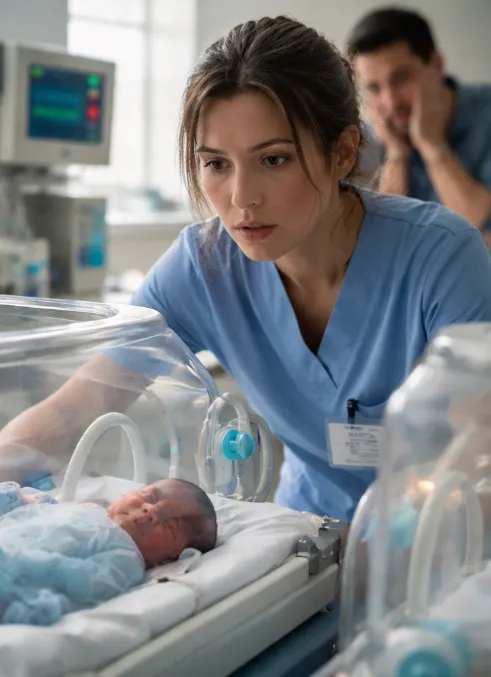
Lauren saw them only briefly—two swaddled, fragile little beings swallowed by tubing, plastic, and blinking machines. Evan kissed her forehead and followed the transport team, then stood outside the neonatal intensive care unit like a man who had arrived at the edge of some strange country where love wasn’t enough to gain entry.
By 5:40 a.m., the entire hospital seemed to know their story.
Premature twins.
Emergency delivery.
One stronger, one barely hanging on.
They were named a few hours later.
Lila Marie Hayes and Nora June Hayes.
“Which one is which?” Sarah asked gently when Lauren was finally wheeled into the NICU for the first time.
Lauren pointed with trembling fingers. “That’s Lila,” she said. “She kicked all through the pregnancy. She never stopped moving.” Then her eyes slid to the smaller incubator. “And that’s Nora. She was always quiet. But when she moved, she moved hard. Like she had something to prove.”
Sarah looked at the babies under the soft NICU lights.
Lila’s breathing was labored but rhythmic. Her tiny chest lifted and fell with stubborn consistency.
Nora’s breaths were shallower. Her oxygen levels wavered. Her heart rate rose and dropped in unpredictable bursts that made seasoned nurses glance twice at the monitors.
“She’s fighting,” Sarah said.
Lauren nodded, but her face said what mothers always know before anyone speaks it aloud.
Not enough.
The next four days settled into the brutal rhythm of neonatal crisis.
Morning rounds.
Lab values.
Ventilator adjustments.
Blood gases.
More medication.
Less response.
Lila improved by inches so small they would have been invisible to anyone outside the unit. Her lungs strengthened. She tolerated touch. Once, when Evan rested one finger against the incubator mattress, she flexed her whole hand around the air as if trying to reach him.
“See that?” he whispered, voice breaking. “She knows me.”
Sarah smiled. “Of course she does.”
Nora did not improve.
She dipped.
Recovered slightly.
Dipped again.
The physicians rotated through possibilities—sepsis, pulmonary complications, neurological insult, congenital weakness—each theory carrying new tests, new interventions, new guarded phrases.
On the fifth night, Sarah found Lauren sitting alone in the family room with a paper cup of coffee gone cold in her hands.
“She hates me,” Lauren said without looking up.
Sarah stopped in the doorway. “What?”
Lauren’s laugh was small and shattered. “Nora. She came too early because my body failed. She can feel it. That’s why she won’t stay.”
Sarah crossed the room and crouched in front of her. “Listen to me. Your daughter does not hate you. Your daughter is trying to survive in a body that arrived before it was ready. That is not your fault.”
Lauren’s mouth trembled. “Then why is Lila getting stronger?”
There was no clean answer. There never was. Biology had no kindness. Fate had no manners.
So Sarah only said, “Because they’re different girls. And different battles don’t mean different worth.”
Lauren cried then—not loudly, just quietly enough to sound like someone coming apart one thread at a time. Sarah stayed until she could breathe again.
That should have been the hardest part of the story.
It wasn’t.
By the seventh day, even optimism had begun to sound dishonest.
During rounds that morning, Dr. Hart stood at Nora’s incubator with the neonatologist, Dr. Priya Mehta, both of them scanning the chart with expressions that had gone beyond concern and into calculation.
“No meaningful response,” Dr. Mehta said softly. “Pressures unstable. Saturation falling despite support.”
Dr. Hart rubbed a hand across his mouth. “We keep trying.”
“We do,” Dr. Mehta agreed. But her eyes said the rest.
We are running out of things that matter.
That afternoon, Sarah finally took her break at 3:12 p.m.
She almost never took them on time. Today she took it because her hands had started trembling while drawing a blood gas and because she knew from experience that mistakes happened when people confused devotion with invincibility.
She bought tea from the vending machine, didn’t drink it, and stood by the NICU observation window instead.
The unit beyond the glass hummed quietly—monitors, ventilators, the low-frequency orchestra of technology trying to hold back mortality. Nurses moved in blue and green. Parents sat in recliners, praying in every posture human beings had invented.
Then Sarah noticed something strange.
Bed Nine was too quiet.
That was Nora’s station.
No physician.
No respiratory therapist.
Only the parents.
And the monitor.
Sarah’s tea hit the floor.
She was through the NICU doors in seconds.
Nora’s color had changed. Not fading slowly, but dropping out of her skin as if someone were turning down the light inside her. Pink to pale. Pale to gray. Gray to blue.
Her oxygen saturation was falling.
Eighty-two.
Seventy-six.
Seventy-one.
The alarm changed pitch.
Lauren looked up in terror. “She was fine—she was just fine—”
“She wasn’t fine,” Evan said hoarsely, backing away in panic. “Something happened—something happened—”
Sarah was already at the bedside, checking airway, tubing, sensor placement, chest movement.
“Nora, come on,” she whispered.
The monitor answered with a stuttering pulse.
Heart rate dropping.
Respirations slowing.
The edges of the room sharpened. Every sound became painfully distinct—the alarm, Lauren’s sobbing, the rustle of plastic, the sudden thunder of Sarah’s own heartbeat in her ears.
“Call Dr. Mehta!” she shouted to the nearest nurse.
“She’s in surgery!”
“Then get Hart!”
Lauren grabbed Sarah’s arm. “Do something!”
It was not an accusation. It was an animal cry.
Sarah looked at Nora.
Then at Lila in the neighboring incubator, tiny but stable, one hand curled near her face.
And something old unlocked in her mind.
Not a protocol.
Not an order.
A paper she had read years ago in graduate training and then again during an overnight continuing-education binge when she couldn’t sleep after her mother died. A case study from another country. Premature twins. Critical deterioration. Skin-to-skin sibling contact. Shared warmth. Shared regulation. A desperate, controversial intervention that wasn’t standard, wasn’t guaranteed, and wasn’t even accepted everywhere.
The memory came with absurd clarity: an old black-and-white image from the article showing one tiny infant draped beside another, as if biology remembered something medicine had forgotten.
Dr. Mehta had once called it “borderline folklore with a few promising data points.”
That was before this moment.
Sarah’s eyes flicked again between the twins.
One steady.
One dying.
And in the space between them, a terrifying possibility.
She turned to the parents. “I want to try something.”
Neither of them asked what.
Neither of them asked if it was safe.
Evan’s face crumpled. “Anything.”
Lauren nodded violently through tears. “Anything, please.”
Sarah sanitized her hands so fast the gel dripped from her wrists.
“Help me,” she told the other nurse who had rushed over.
They opened Lila’s incubator.
Then Nora’s.
The air felt electrically alive.
Sarah slid one careful hand under Nora’s impossibly light body. Even through layers of cloth and tubing, she could feel how little heat remained in her.
“Stay with me,” she whispered, and did not know which baby, which mother, or which God she was addressing.
Slowly—so slowly it felt like defusing a bomb—she placed Nora beside Lila.
The stronger twin shifted instinctively at the contact.
One tiny arm flexed.
The room held its breath.
For one second, nothing happened.
For two, nothing happened.
For three, the monitor shrilled again.
Lauren made a sound like she had been stabbed.
And then Lila moved.
It wasn’t much. Not cinematic. Not magical in any obvious way.
Just a fragile premature infant, acting on reflex or memory or some ancient cellular intelligence no one in the room understood.
Her arm slid across her sister’s chest.
And Nora’s heart rate changed.
Sarah stared at the screen.
Sixty-two.
Sixty-nine.
Seventy-four.
“Wait,” she said, almost too quietly to hear herself.
The saturation climbed a point.
Then another.
The alarm slowed.
Lauren clapped both hands over her mouth.
Evan whispered, “No.”
Lila pressed closer, her body curving against Nora’s side. It looked less like movement than recognition.
Nora’s chest shuddered.
Then rose.
A breath.
Small.
Uneven.
But hers.
Another followed.
The monitor steadied further.
Seventy-nine.
Eighty-three.
Eighty-eight.
The pitch of panic softened into rhythm.
Sarah stepped back as if she were afraid any sudden motion would break the spell. Her knees buckled anyway. She caught the side of the warmer, then slid down to the floor, tears burning hot and fast down her face.
Behind her, the crash team finally burst into the unit.
Dr. Hart took one look at the monitor, one look at the babies, and stopped dead.
“What did you do?”
Sarah laughed once, breathless and shaking. “I put her with her sister.”
He stared at her.
Then at the twins again.
Then said, with the helpless honesty of a man watching his training fail to explain what stood in front of him, “My God.”
The story should have ended there.
That was what everyone expected later—when word spread through Mercy General so fast it outran charting, policy review, and common sense. Nurses cried in supply closets. Residents retold the moment in stunned voices. Dr. Mehta read the vitals herself three times and then shut the chart because her hands were trembling.
By the next morning, Nora remained stable.
Not healed.
Not out of danger.
But alive.
And holding.
Dr. Mehta ordered modified co-bedding under constant supervision, documenting every minute. Lila and Nora remained side by side, separated only by the necessary lines and supports, close enough to share warmth and scent and the strange, silent communication that seemed to exist between them.
The improvement was not instantaneous after that. It came unevenly, uncertainly, in tiny steps.
But it came.
Over the next week, Nora’s oxygen requirements eased. Her color improved. Her heart stabilized. She tolerated touch. Once, while Sarah adjusted a blanket edge, Nora opened her eyes—not fully, just enough to reveal the dark blue-gray of premature infancy—and turned her face toward Lila before settling again.
The whole unit saw it. No one forgot it.
Mercy General wanted to document everything. Dr. Mehta contacted colleagues, requested older literature, reviewed protocols. Dr. Hart called it “an outlier worth understanding.” The hospital administration, predictably, called it “something to discuss very carefully.”
Lauren and Evan called it a miracle.
Sarah called it survival.
But when she stood alone at the twins’ bedside late at night, when the NICU hummed softly and both girls slept with the fierce fragility of those who had already fought too much, she couldn’t stop thinking about the moment before everything changed.
About the feeling she had known what to do.
Not guessed.
Known.
That unsettled her more than any miracle.
Three weeks later, both twins were still in the NICU, but the crisis had passed. Lila was feeding better. Nora was gaining weight. Lauren had started wearing real clothes again instead of the same sweatshirt for three days in a row. Evan laughed once, unexpectedly, when Lila sneezed and looked outraged by it.
The unit exhaled.
Sarah finally took two days off.
On the second evening, she opened the storage box she had not touched since her mother’s death.
It sat on the top shelf of her closet under old tax forms and a wool blanket. Dust coated the lid. Inside were the leftovers of a life reduced too quickly—photographs, recipe cards, a watch that no longer worked, a packet of letters tied with fading ribbon.
Sarah hadn’t gone looking for anything specific. She only knew something in her had been tugging at the memory she’d had in Nora’s room, and tugging harder each day.
At the bottom of the box she found an envelope she had never opened.
It was addressed in her mother’s handwriting.
For Sarah—only if you are ready.
Her pulse kicked.
She sat down on the floor before opening it.
Inside was a single letter and a newspaper clipping so old the edges crumbled when she touched them.
The clipping showed a grainy black-and-white photograph of a hospital ward from thirty-six years earlier. Two women stood beside a row of incubators. One of them was unmistakably her mother—Margaret Bennett, then twenty-eight, wearing a nurse’s uniform and looking impossibly young.
The headline read:
LOCAL NURSE DEFIES ORDERS DURING NICU CRISIS—TWINS SURVIVE.
Sarah stopped breathing.
She read the article once.
Then again.
In 1990, at St. Catherine’s Hospital in Milwaukee, a premature infant had crashed unexpectedly. Standard interventions failed. A nurse named Margaret Bennett had removed the baby from isolation and placed her beside her twin sister despite explicit objections from a supervising physician. The child stabilized. Both babies survived.
The article called Margaret reckless, intuitive, lucky, insubordinate, and possibly brilliant, depending on which quote Sarah read. It also mentioned, almost as an aside, that the incident had been quietly buried after legal review and never turned into formal policy.
Her hands shook so badly she nearly dropped the clipping.
Then she read the letter.
Sarah,
If you’re reading this, then something has happened that brought this memory back to you—or perhaps to me through you. There are things I never told you because I wanted you to become a nurse without inheriting my ghosts. But one ghost doesn’t like staying buried.
When you were born, you were not alone.
Sarah felt the room tilt.
She kept reading.
You had a twin sister.
The world narrowed to the page.
Her name was Nora.
Sarah made a sound she had never heard from herself before.
The letter blurred. She blinked hard and forced herself onward.
You were both born at twenty-nine weeks. You were stronger. She wasn’t. The doctor in charge was ready to let nature decide when machines could not. I was a nurse then. I was also your mother. I took Nora from her incubator and placed her beside you when no one was looking, because I had read one impossible paper and because I had no other prayer left. She stabilized for thirteen minutes. Thirteen beautiful minutes. Long enough for me to hold onto hope. Then she died.
Sarah’s vision tunneled.
The paper trembled in her hands.
I never forgave myself for failing her. And I never forgave the hospital for pretending the attempt meant nothing. The newspaper got parts of the story wrong. They thought I saved a stranger’s child. I let them think it. I had to keep my license. I had to keep raising you.
I am telling you this now because if you ever remember the study, or the instinct, or the certainty that some bonds reach farther than medicine can measure, I want you to know where it came from. Maybe knowledge travels through blood. Maybe grief does. Maybe love does. I do not know.
But if another Nora ever arrives in your hands, do not be afraid of what you know.
Love,
Mom
Sarah sat frozen on her apartment floor until the light outside the window changed from gold to blue.
Nora.
The same name.
The same crisis.
The same impossible instinct rising in her exactly when it was needed.
It was absurd. Impossible. Coincidental.
And yet the evidence lay in her lap, written in her mother’s hand.
When she returned to Mercy General the next morning, she went straight to the NICU.
The twins were sleeping side by side, their faces softer now, less burdened by the constant effort of staying alive. Lila’s arm lay across Nora exactly as it had the day everything changed.
Lauren smiled when she saw Sarah. “They’ve been waiting for you.”
Sarah swallowed. “How are they?”
“Hungry. Loud. Stubborn,” Evan said, grinning for the first time without fear underneath it. “Basically perfect.”
Sarah stepped closer to the incubator.
Nora stirred.
Opened her eyes.
And for one impossible instant, Sarah felt an electric chill run through her so sharply she had to grip the rail. The baby’s gaze fixed on her with startling calm. Premature babies didn’t really look at you like that. Not in any meaningful way.
But Nora did.
Then her tiny fingers flexed once, twice, as if beckoning.
Sarah reached into the incubator and touched the back of her hand.
Nora settled immediately.
Lila sighed in her sleep.
Behind Sarah, Dr. Mehta approached with a chart. “There’s something else,” she said, voice strangely careful. “The bloodwork we repeated yesterday—on a hunch after the co-bedding response.”
Sarah turned. “What about it?”
Dr. Mehta glanced at the babies, then back at her. “It makes no sense statistically. We’ve triple-checked. There was a lab mix-up possibility, but there wasn’t one.”
“What are you talking about?”
Dr. Mehta lowered her voice.
“Nora and Lila are not identical twins. We knew that. But the tissue markers we’re seeing show an anomaly—microchimerism far beyond what we’d expect. Cells exchanged in utero in unusually high amounts.” She hesitated. “The kind of transfer usually seen in twins who absorbed or lost a third gestation early.”
Sarah stared at her.
A third.
Dr. Mehta continued, unaware that Sarah’s pulse had begun to roar in her ears. “It’s rare. Very rare. But biologically, it suggests they were never only two.”
Sarah looked back at Nora.
At Lila.
At the tiny bodies pressed close together.
And suddenly the room, the letter, the old clipping, her mother’s grief, her own buried history, all of it snapped into one unbearable shape.
Another Nora had arrived in her hands.
Not metaphorically.
Not poetically.
But in a story echoing itself across generations with such impossible precision that reason had nowhere left to stand.
Three weeks later, the twins went home.
Mercy General called it a landmark case. Dr. Mehta began drafting a paper. Hospital administration approved cautious internal review of sibling co-regulation protocols in critical neonates. Lauren and Evan brought cupcakes shaped like stars for the unit and cried when they thanked Sarah because there was no vocabulary large enough for what they felt.
Before they left, Lauren placed Nora into Sarah’s arms for the first time without wires between them.
The baby weighed almost five pounds now. Warm. Real. Breathing in soft, even sighs against Sarah’s chest.
“She always calms for you,” Lauren said.
Sarah looked down at the infant’s face, at the tiny mouth, the dark lashes, the faint furrow between her brows that looked absurdly serious for someone so small.
Nora opened her eyes.
Held Sarah’s gaze.
And smiled.
Not a reflex. Not gas. Not random movement.
A smile so sudden and knowing it made Sarah’s blood go cold and hot all at once.
Then the baby lifted one small hand and pressed it flat against Sarah’s collarbone—exactly where, beneath her scrubs, Sarah wore a locket that had belonged to her mother and contained the only photograph of herself as a newborn.
A photograph taken beside an empty incubator no one had ever explained.
Sarah’s breath caught.
Lauren laughed softly. “See? I told you. She knows you.”
Sarah could not answer.
Because in that instant, with the baby’s hand over the old locket and those impossible eyes fixed on hers, she understood the final truth her mother’s letter had only circled around.
The miracle in Bed Nine had never been only about medicine.
It had never been only about twins.
It had never even been only about survival.
It was about a debt that grief had carried across thirty-six years.
A life that had flickered out after thirteen minutes and somehow—through memory, blood, instinct, or something far stranger—had found its way back to the one person who had lived on.
And as Sarah stood there shaking, holding the child whose existence had completed a pattern no human mind could have designed, she realized the most shocking thing of all:
She had not saved Nora Hayes because she remembered an article.
She had saved her because somewhere, impossibly, someone had remembered her.
My Mother-in-Law Said My Daughters Deserved Leftovers in Front of 40 Relatives—When I Walked Away, They Laughed. An Hour Later, Nobody at That Party Was Smiling. 029
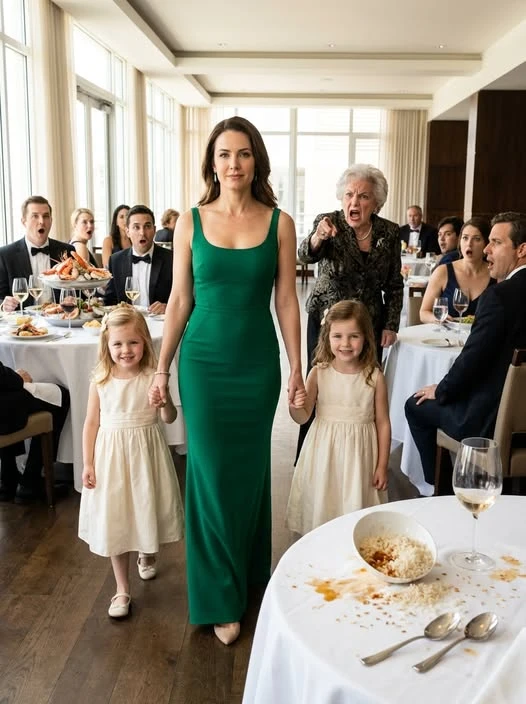
My mother-in-law took the shrimp away from my daughters in front of 40 relatives and said, “They eat leftovers” . My husband only asked me not to make a scene, but I calmly stood up, grabbed my purse, and left behind an envelope that would change the entire party.
“Don’t give shrimp to those girls. They’re not heirs to anything anyway!”
Margaret’s words h.i.t the table like a s/lap. The waiter froze with the garlic shrimp platter still in his hands while everyone in the restaurant turned to stare at the corner where Catherine sat with her two daughters.
Hazel, 8 years old, pressed her lips together to keep from crying. Sophie, only 5, bu/rie/d her face against her mother’s dress.
It was Mr. Walter’s 68th birthday, Catherine’s father-in-law. The family had rented a private room at an elegant seafood restaurant in Charleston. There was live music, expensive bottles of wine, trays of lobster, grilled fish, and tables decorated as if it were a wedding reception.
Catherine’s husband, Bennett, wandered between the guests with a huge smile, showing off his new shirt and gold watch.
“Today my father deserves the best,” he kept saying. “I’m taking care of everything. That’s what happens when you work as a sales manager.”
Catherine lowered her eyes.
Because she knew a truth none of the guests could imagine.
Bennett wasn’t paying for any of it.
Margaret walked over carrying a plastic plate with dry rice, cold beans, and two reheated pieces of chicken. She placed it in front of Catherine as if she were doing her a favor.
“This is for you and your girls,” she said with a twisted smile. “Don’t get confused. The good food is for the real family.”
Hazel looked at the plate, then at the tables where her cousins were eating breaded shrimp.
“Grandma, I wanted shrimp too,” she whispered.
Margaret laughed cruelly.
“Then ask your mother for some. Maybe instead of giving birth to girls, she should’ve learned how to bring money into the house.”
Some of the uncles laughed. Others pretended not to notice, staring at their phones or raising their glasses to avoid getting involved.
Catherine felt her face burn, but not from embarrassment.
From rage.
For nine years she had endured comments like that. That she wasn’t enough of a woman because she never gave Bennett a son. That her daughters were a burden. That she lived off whatever he gave her, even though the tiny amount he handed over each month barely covered school supplies, uniforms, food, transportation, and medicine.
What nobody knew was that Catherine had spent the last four years selling breakfasts and homemade meals to office workers. She woke up at 4 a.m., cooked in silence, delivered orders, and saved every peso in an account Bennett never checked because he was too busy calling her useless.
Martín stumbled over slightly drunk, a wine glass in his hand.
“What did you do now, Catherine?” he muttered. “Don’t start making faces. You came here to support the family, not to look pathetic.”
“Your daughters are hungry,” she replied quietly.
“My daughters wouldn’t be embarrassing me if you had been capable of giving me a son,” he snapped, not caring that Hazel heard every word.
Catherine felt her daughter’s hand trembling under the table.
Then Margaret grabbed the plate of cold rice and shoved it hard. The sauce spilled across Sophie’s legs, making the little girl scream in fear.
“Be quiet!” her grandmother barked. “It’s not like they served you poison.”
The room fell silent again.
Catherine slowly stood up. She cleaned Sophie with a napkin, picked up her purse, and looked at Bennett with a calmness that unsettled him.
“You’re right,” she said. “I didn’t come here to look pathetic today.”
He frowned.
“What’s that supposed to mean?”
Catherine took both daughters by the hand.
“I came to say goodbye.”
Bennett grabbed her arm.
“Don’t you dare embarrass me in front of my family.”
She pulled away without raising her voice.
“I’m not the one who’s going to be embarrassed.”
She walked out of the restaurant with her daughters while the music tried to continue, though nobody sang the same way anymore. Outside, she climbed into a taxi, and the moment the door closed, her phone started vibrating nonstop.
First Bennett called.
Then Margaret.
Then a cousin.
Then an uncle.
In less than fifteen minutes, she had 43 missed calls.
Catherine looked at her daughters, took a deep breath, and turned off her phone.
What that family didn’t know was that the real celebration was only just beginning.
What would you have done if someone humiliated your daughters like that in front of the entire family: stay and fight, or walk away without saying another word?