The inciting incident occurred on a suffocatingly humid Sunday evening in March. It was the birthday of my late husband, William. He had been gone for two agonizing years, his absence a hollow cavity in my chest that refused to heal. My daughter, Madeline, couldn’t bear the thought of me sitting alone in my quiet house with a lit candle and a ghost.
“Mom, please come over for dinner,” she had murmured over the phone earlier that week, her voice carrying a brittle, fragile frequency that I, to my eternal shame, mistook for shared grief. “I’m making Dad’s favorite. The braised short ribs.”
Madeline was thirty-two. She was a chemical engineer—a fiercely brilliant, resilient force of nature who, at the tender age of twelve, had won a state science fair by engineering a functional water filtration system out of crushed charcoal and river sand. That was the girl she was before she tethered her life to Spencer.
I pulled up to her sprawling luxury condominium in Houston just as the dashboard clock struck seven. The property was a masterpiece of modern architecture, funded almost entirely by the three-hundred-twenty-thousand-dollar liquid inheritance William had left her. Yet, the woman who opened the heavy oak door was a stranger wearing my daughter’s face.
She was draped in a long-sleeved silk blouse, an absurd sartorial choice given the oppressive Texas heat pressing against the floor-to-ceiling glass of the condo. Her hair, usually a wild, magnificent mane of dark curls, had been chopped into a severe, subdued bob that aged her by a decade. Her smile didn’t reach her eyes; it was a calibrated, mechanical twitch. And her gaze—anxious, darting, hyper-vigilant—kept flickering toward the hallway behind her before she dared to utter a single syllable of greeting.
Spencer glided into the foyer a moment later, flashing a smile so perfectly symmetrical it looked manufactured in a laboratory. “Mother-in-law. It is an absolute delight to have you in our home.”
Lurking just behind his shoulder was his mother, Constance. She was draped in exorbitant cashmere and suffocating pearls, styled less for a quiet family dinner and more for a charity gala where she could sneer at the waitstaff. She had been a widow for a decade. Her husband had allegedly “fallen down a flight of stairs,” a convenient, unwitnessed tragedy that left her wealthy and unquestioned—a narrative I had always found deeply, unsettlingly suspicious.
“Madeline has labored over such a lovely meal,” Constance purred, her tone dripping with saccharine venom as we moved to the dining room. “My son is infinitely fortunate to have secured such a dedicated wife.”
Dedicated. The word slithered down my spine like ice water. She weaponized the compliment, delivering it as though my brilliant, highly-educated daughter was a newly acquired domestic servant expected to earn her daily keep.
Throughout the meal, I chewed my food in suffocating silence. I watched Madeline serve the plates. Her hands, the hands that calibrated complex chemical equations at a prestigious firm, were trembling so violently the silverware rattled against the fine porcelain. Spencer consumed his meal without a single utterance of gratitude, his eyes locked on his plate. Constance, meanwhile, orchestrated a symphony of micro-aggressions. She critiqued the consistency of the sauce, the texture of the potatoes, the temperature of the bread, and even the “pedestrian” way the linen napkins had been folded.
With every surgical insult, my daughter seemed to physically shrink, folding inward like a dying blossom retreating from the sun.
Then came the catalyst. Madeline reached across the wide mahogany table to refill Spencer’s crystal water goblet. A micro-tremor seized her wrist. A single, solitary droplet of water escaped the pitcher and landed on the immaculate white tablecloth, leaving a dime-sized damp spot.
The dining room plummeted into a silence so absolute it rang in my ears. The hum of the central air conditioning suddenly sounded like a jet engine.
Spencer’s jaw clenched, a muscle feathering wildly beneath his ear. He meticulously placed his silver fork down, aligning it perfectly with the edge of the placemat. “Madeline,” he whispered, his voice a razor blade wrapped in velvet. “Look at what you did.”
My daughter’s lips parted, a desperate apology already forming on her tongue. She never had the chance to speak it.
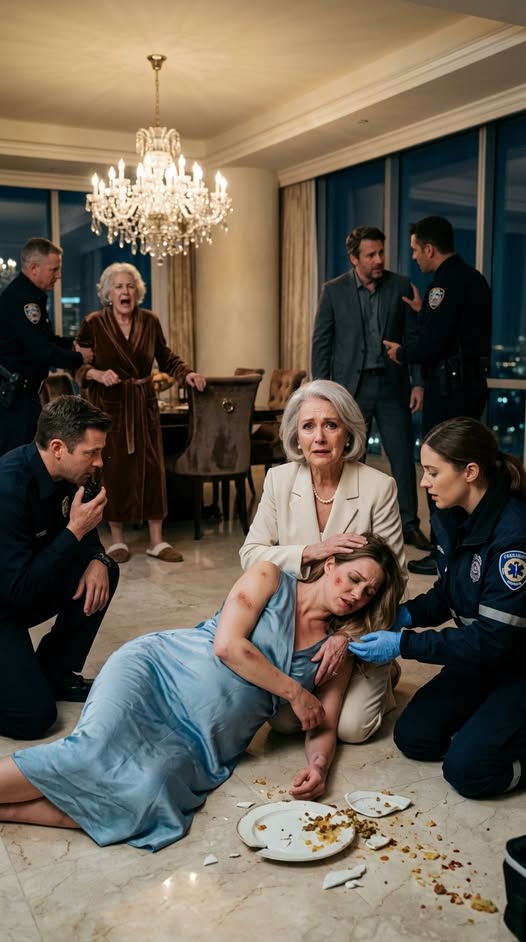
Spencer surged to his feet, his heavy oak chair scraping violently against the hardwood. He backhanded her across the face. The sickening crack echoed off the high vaulted ceilings. Before I could even draw a breath, he struck her again. And then a third time, with such unhinged, kinetic force that she was thrown off her chair entirely, collapsing in a heap onto the cold marble floor.
And then, a sound that will haunt me until my dying day pierced the room.
Constance was applauding. Three slow, deliberate claps.
“That is exactly how she learns,” the older woman declared, casually adjusting a pearl earring. “A clumsy, inattentive wife requires correction.”
For precisely thirty seconds, I was paralyzed. Not from terror. Not from shock. I froze because the courtroom strategist inside my brain had forcefully overridden the hysterical mother. After three decades of drowning in the trenches of family court, I knew exactly what I was witnessing.
This was not an isolated loss of temper. This was a choreographed ritual.
It was absolute coercive control. Humiliation as a subjugation tactic. A victim conditioned by chronic terror. An enabling matriarch providing psychological validation for the abuser. And I knew, with the chilling certainty of a forensic pathologist examining a corpse, that this was not the first time he had struck her.
I stood up. I didn’t shout. I didn’t scream. I pulled my smartphone from my blazer pocket, bypassed the lock screen, and dialed a number I knew by heart.
“Captain Miller. This is Katherine Mitchell,” I stated, my voice echoing like ice cracking over a frozen lake. “I need patrol units dispatched immediately to 345 Palm Avenue, Unit 802. Active domestic violence in progress. Physical assault with eyewitnesses.”
I lowered the phone, opened my voice memo application, hit record, and placed the device dead-center on the dining table, right next to the spilled water.
“Say it again, Spencer,” I commanded, staring directly into his hollow, arrogant eyes. “Repeat exactly what you just did to my daughter. And Constance, I want you to repeat, into this microphone, what you just articulated about my child requiring correction.”
The untouchable facade melted off Spencer’s face, replaced instantly by the panicked pallor of a cornered animal. “You… you can’t do this,” he stammered, taking a clumsy step back.
I didn’t blink. “I have legally and financially dismantled two hundred and eighteen men exactly like you. You just committed felony assault on my daughter in my presence. Your mother just provided an audible justification for it, rendering her a material witness, and quite possibly, a criminal accomplice.”
I abandoned them at the table and sank to my knees beside my daughter. She was curled into a fetal position on the cold marble, weeping without producing a single sound, her left hand clamped over her rapidly swelling cheek.
“Mom…” she breathed, the word a broken shard of glass.
“Do not speak, sweetheart,” I whispered, pulling her trembling frame against my chest, shielding her with my body. “From this second forward, I do the speaking.”
Spencer took a heavy, aggressive step toward us, his fists balling at his sides.
I didn’t look back. I simply raised a single index finger in the air. “Take one more step toward this woman, and I will have the district attorney append witness intimidation, terroristic threatening, and obstruction of justice to your rap sheet before the sun comes up.”
Constance’s aristocratic mask finally slipped, revealing the jagged, ugly truth underneath. “This is a private family matter, you hysterical woman,” she hissed, her voice vibrating with venom.
“No, Constance,” I replied, my voice dead and flat. “This is a crime scene.”
Seventeen minutes later, the flashing red and blue lights painted the walls of the condo. As the officers locked the heavy steel cuffs around Spencer’s wrists, he twisted his neck to look at me. He looked as though he wanted to incinerate me with his gaze.
“My family has profound political connections,” he spat, spittle flying from his lips onto the lapel of his tailored shirt.
I calmly picked up my phone and tapped the screen to save the audio file. “And I have irrefutable forensic evidence.”
As they dragged him through the foyer, I held my weeping daughter on the floor of the multimillion-dollar home she had financed, a home that had become her personal torture chamber. Her body vibrated with aftershocks of adrenaline and terror. And in that suffocating moment, I gently reached down to adjust Madeline’s collar, hoping to ease her breathing.
As her long silk sleeve rode up her forearm, my own breath hitched in my throat. Beneath the fabric, blooming across her pale skin, was a horrific tapestry of fading bruises. Purple, sickly yellow, and deep green. Finger marks. Defensive wounds.
This dinner wasn’t the beginning of the nightmare. It was just the first time he was arrogant enough to let the monster out in front of me. And as I stared at the yellowing bruises on my child’s arm, a sickening realization locked into place in my mind. This wasn’t just a loss of temper. This was a rehearsal. And I had just RSVP’d to a war I had absolutely no intention of losing.
The apartment was eerily silent now, save for the muffled, invasive whispers of wealthy neighbors gathering in the carpeted hallway outside. The braised short ribs had congealed on the fine china. The single candle on William’s birthday cake remained unlit on the kitchen counter. My husband should have been standing beside me, a broad-shouldered shield for his little girl. But he was buried in the earth, which meant tonight, I had to carry the crushing weight of my grief and the explosive, radioactive core of his posthumous fury all on my own.
I stroked Madeline’s damp hair, feeling the violent shudders wracking her spine. “Look at me, baby.”
She couldn’t. Her eyes were superglued to the marble floor where she had fallen, as if the cold stone was the only thing capable of absorbing her suffocating shame.
I slipped my fingers under her chin and applied gentle upward pressure. “No,” I commanded softly, ensuring my tone held zero pity, only absolute strength. “You do not look down. Not tonight. Not ever again.”
That was the moment the dam broke. It wasn’t a loud, theatrical wail. It was a total structural collapse. The brilliant chemical engineer, the woman who could map molecular structures in her sleep, folded into my arms like a frightened toddler waking from a night terror.
“I’m so sorry,” she sobbed, her tears soaking rapidly through the shoulder pad of my blazer. “I’m sorry, Mom. I thought if I was just better… I thought I could fix it.”
I clamped my eyes shut, a tear finally escaping my own stoic facade. I thought I could fix it. I had heard that exact, heartbreaking sentence from hundreds of shattered women sitting across the mahogany desk in my law office. But hearing it tear from my own daughter’s throat felt like swallowing a handful of broken glass.
“My sweet girl,” I whispered, kissing the crown of her head, inhaling the scent of her jasmine shampoo mixed with the metallic tang of fear. “You were never supposed to fix a man who derived his pleasure from breaking you.”
Her fists tightened in my lapels. “He wasn’t like this at first. In the beginning, he was… he was wonderful. He listened to me.”
“I know,” I interrupted gently. “They never are. If they showed you the monster on the first date, you would have run out the door.”
The paramedics breached the apartment shortly after the second patrol unit secured the perimeter. A female officer, her silver badge reading Jessica Lawson, knelt cautiously beside Madeline, speaking in low, modulated, trauma-informed tones. Meanwhile, her partner meticulously photographed the dining table—the spilled water, the shattered crystal goblet, the absolute asymmetry of a violently interrupted life.
I knew the protocol intimately. I had literally drafted the operational protocol for local domestic violence task forces. But knowing the sterile mechanics of the law offered absolutely zero anesthetic when the victim was the child whose scraped knees you used to bandage.
Officer Lawson looked at Madeline, her expression a mask of professional empathy. “Ma’am, do you consent to medical attention and a forensic evaluation at the hospital?”
Madeline didn’t answer. She looked up at me, her eyes wide and pleading.
That single, terrified glance illuminated the catastrophic depths of Spencer’s psychological warfare. He had systematically dismantled her autonomy over the past three years. She no longer trusted her own brain to formulate the word yes without permission.
I squeezed her uninjured hand, grounding her to the present reality. “Tell the truth, Maddie. Claim your reality.”
Madeline swallowed hard, a painful motion given her swelling jaw, looked at the officer, and whispered, “Yes.”
It was a microscopic victory. But it was hers.
The emergency room at Houston Memorial was a purgatory of flickering fluorescent lighting and the sharp, medicinal stench of bleach and iodine. The clinical exam confirmed my darkest, most suffocating fears. Fresh facial contusions. A lacerated inner lip that required three dissolving stitches. A superficial laceration near her temple from the violent impact with the marble floor.
And then, the hidden horrors were cataloged by the forensic nurse. Bilateral finger-pad bruising on her upper arms, indicating she had been violently shaken. Older, yellowing contusions along her ribcage. And most sickening of all, a circular, healing burn scar near her left wrist.
Madeline stared blankly at the sterile white wall and told the attending physician it was “a cooking accident with the gas stove.” The nurse paused her charting, her pen hovering over the clipboard, and met my eyes. We both recognized the precise, unmistakable geometry of a cigar burn.
I didn’t take a single note. I didn’t whip out my yellow legal pad. Because tonight, the attorney was locked in a mental cage, and the mother was fully in control.
Yet, the dormant lawyer in my subconscious orchestrated the background logistics. I mandated a forensic nurse examiner. I demanded high-resolution digital photographs with metric scale markers. I reviewed the discharge paperwork to ensure the diagnosis explicitly stated “Intimate Partner Violence / Physical Assault,” aggressively correcting a tired resident who had initially typed “domestic altercation.” I refused to let the medical record dilute his savagery.
At 1:43 a.m., sheer physiological exhaustion finally dragged Madeline into a medicated sleep on the narrow hospital cot. I sat vigil in a plastic chair, bathed in the sickly blue light of my smartphone screen.
There were fourteen missed calls from unlisted numbers.
Then, my screen illuminated with an SMS text. It was from Spencer.
You made a catastrophic mistake tonight, Katherine. This isn’t over.
A humorless, predatory smile stretched across my face in the dim room. No, you arrogant little boy. You did.
I took a screenshot, forwarded the threat directly to Detective Miller with a timestamp, and then permanently blocked the number.
At precisely 2:10 a.m., the phone vibrated again in my palm. This time, the caller ID displayed a name I recognized: Richard Montgomery. He was the silver-haired, impeccably tailored senior managing partner at the elite corporate law firm where Spencer was a rising star. I had crossed paths with Richard at various judicial charity galas over the decades. He was the prototype of a man who loudly championed “family values” on Sunday while billing exorbitant hours for extreme moral flexibility on Monday.
I accepted the call, pressing the phone to my ear.
“Katherine, my dear,” Richard’s voice oozed through the speaker, as smooth and toxic as a crude oil spill. “I was just awakened by some deeply concerning news. Spencer contacted me from holding. He claims there was a highly emotional misunderstanding at dinner, exacerbated by the grief of your husband’s passing.”
I stared at my daughter, her battered face resting against a plastic-wrapped ice pack, her lip split open and stitched.
“A misunderstanding backhanded my daughter three times hard enough to drop her to the floor, Richard.”
A calculated pause lingered on the line. “Katherine, please. I am certainly not defending violence. Heaven forbid. But you and I both know how these… domestic disputes can become legally complicated and unnecessarily public. We wouldn’t want Madeline dragged through the mud.”
There it was. The opening salvo of corporate reputation management. The invisible machinery of powerful men moving swiftly in the dark to protect their own.
I sat up straight in the uncomfortable plastic chair, my spine rigid. “Richard, listen to me very carefully, because I will only articulate this once. If your firm attempts to deploy private investigators to intimidate my daughter, if you pressure her to withdraw her statement, if you attempt to contact witnesses, bury evidence, or frame this felony assault as a ‘private marital squabble’ to protect your firm’s pristine stock price, I will unleash hell. I will file immediate ethics complaints with the State Bar, I will subpoena your internal communications, and I will leak every sordid detail to every Pulitzer-hungry journalist who has ever kept my number on speed dial for quotes on domestic violence reform.”
Silence suffocated the line. The kind of silence that costs a thousand dollars an hour.
Then, Richard spoke, his tone completely stripped of its false warmth. “There is absolutely no need for hysterical threats, Katherine.”
“You’re entirely right. It’s not a threat. Consider it formal legal notice.” I terminated the call, dropping the phone into my purse.
Across the sterile room, Madeline whimpered in her sleep, her brow furrowed in a dark, inaccessible nightmare. I stood up, walked to the reinforced window, and stared down at the sprawling, glittering grid of the city below.
For thirty-two years, I had preached to my clients that rage was a chaotic element; it had to be sterilized and managed to be legally useful. Tonight, I learned the truth. A mother’s rage didn’t need to be sterilized. It just needed to be aimed.
But as the sun began to bleed over the Texas horizon, painting the sky in bruised hues of purple and red, a sickening thought rooted itself in my mind. If he was bold enough to strike her in front of me, what was he doing behind the firewall of their bank accounts? The answer, I would soon discover, was far more terrifying than a closed fist.
The following morning, Spencer posted bail. It was as predictable as the sunrise.
Men of his socio-economic pedigree knew the choreography of the justice system intimately. Arrest. High-priced defense attorney. Cash bond. A freshly pressed navy suit for the walk out of the precinct. A mask of public devastation masking private vengeance. He couldn’t return to the Houston condo because Detective Miller had successfully secured an emergency Ex Parte Protective Order before the ink on the police report was even dry. Instead, he checked himself into a five-star suite in a luxury downtown hotel.
By noon, his proxy war had begun. He deployed flying monkeys—three distant relatives, two junior partners from his firm, and one mutual “friend” from Madeline’s country club. They bombarded my phone and email. They all wore different costumes, but sang the exact same insidious chorus:
He’s destroyed. He’s seeking counseling. Don’t ruin his career over one mistake. Think of the scandal. Not a single one of them asked: Is Madeline physically safe?
I screenshotted and archived every single message, building a digital fortress. Evidence of third-party contact violation.
Constance, having been released on her own recognizance pending further investigation into her complicity at the dinner, wasted zero time. By 1:00 p.m., she posted a sprawling manifesto on her private Facebook page:
A true mother knows when her devoted son is being destroyed by malicious, hysterical lies. Some women are raised with the grace to respect the sanctity of marriage. Others are raised by bitter women to weaponize the law for profit.
I read it twice. My pulse remained perfectly steady. I forwarded the screenshot to my closest colleague, Lauren Brooks, a defamation litigator who possessed a smile like a surgical scalpel.
Lauren texted back three minutes later: Delicious. Let the old bat keep digging her grave. Do not engage.
I didn’t. Engaging publicly was exactly the trap Constance was setting. She wanted me to descend into the mud, to look unhinged, so she could point to my reaction as proof of my instability. It was textbook DARVO—Deny, Attack, and Reverse Victim and Offender. I refused to play her game. I went to work instead.
My first tactical maneuver was physically extracting Madeline from the state of Texas entirely. Once she was medically cleared to fly, I flew her straight to my heavily secured craftsman home in Pasadena, California. I didn’t put her in the guest room. I put her in my master bedroom.
She stood in the doorway, clutching a small canvas duffel bag, looking hollow and desperately fragile. “Mom, no. I can’t take your bed. I’m already such a massive inconvenience.”
I dropped her bag onto the floor, walked over, and gripped her shoulders firmly. “You are my child. You are my blood. You are never, under any circumstances, an inconvenience.”
She shattered into tears again. It broke my heart to realize that she only cried when someone explicitly granted her the permission to take up space in the world. Spencer hadn’t just bruised her skin; he had systematically starved her ego until she felt like a walking apology.
Over the next forty-eight hours, I transformed my peaceful California home into a tactical command center. I procured a new smartphone and a clean laptop for her. We executed mass password resets, instituted dual-factor authentication on everything, placed hard freezes on her credit with all three bureaus, and hired a private security firm to install perimeter cameras around my property.
But I knew I couldn’t be her attorney of record. Loving the client makes for disastrous legal counsel. The wound was too close to the bone. So, I called Rebecca Thorne. Rebecca was a shark in a tailored suit, a divorce attorney who had never once in her illustrious career confused professional politeness with weakness.
When Rebecca arrived at my dining room table, she didn’t offer empty platitudes or sympathetic head tilts. She poured a cup of black coffee, looked Madeline dead in the eye, and asked the only question that mattered.
“Madeline, are there any financial accounts that Spencer has unilateral access to?”
Madeline shrank into her chair, her eyes darting away to the floral wallpaper. “He… he handles almost all of the household finances. He said he was better at it. He handles the investments.”
I closed my eyes, fighting a sudden wave of nausea. The inheritance.
William had worked himself into an early grave building a proprietary logistics software company. When his heart failed, he left Madeline six million dollars in a protected trust. I had begged her to keep it entirely segregated before the wedding. She had promised me she would.
“Maddie,” I said softly, dread pooling in my stomach. “The trust?”
“Spencer came to me about a year ago,” she whispered, twisting her pale fingers together. “He used all these terms. Tax optimization. Strategic family growth. Aggressive yield planning. He said that if I insisted on keeping the money completely separate, it meant I didn’t truly trust him. He said it meant I was already planning for our divorce.”
Rebecca’s pen scratched furiously across her yellow legal pad. I hated how agonizingly familiar the narrative was. Economic abuse rarely announces itself with a masked robbery. It slithers in through the backdoor of romance, framing financial independence as a fundamental betrayal of intimacy.
“We need a forensic accountant. Today,” Rebecca announced, snapping her notebook shut.
Enter David Clarke. David was a remarkably quiet, unassuming man with wire-rimmed glasses who possessed the emotional baseline of a spreadsheet. But beneath his mild, beige exterior was a bloodhound who could track a laundered penny through a hurricane. He set up his encrypted servers in my living room and began subpoenaing and dissecting bank records, wire transfers, property deeds, and hidden metadata.
On the third evening, the true scale of the horror began to unspool.
David pushed a printed ledger across the table, tapping a highlighted row with his pen. “I have located the first major bleed. Two hundred and ten thousand dollars, liquidated from Madeline’s primary Vanguard account and wired into an LLC registered in Delaware called S&C Strategic Holdings.”
“S and C?” Rebecca asked, her brow furrowing.
“Spencer and Constance,” I translated, tasting bitter bile in the back of my throat.
Madeline stared at the highlighted numbers as if they were written in ancient Sumerian. “He told me that was a low-risk commercial real estate fund. For our future.”
Rebecca looked up, her gaze piercing. “Did you physically sign the wire authorization, Madeline?”
Madeline nodded slowly, a look of profound sickness washing over her pale face. “I had a terrible flu a few months ago. I was running a 102-degree fever. I was so dizzy I couldn’t stand up. He brought the paperwork into the bedroom on a clipboard. He told me it was just routine rollover documents. I just… I just signed where he pointed so I could go back to sleep.”
My pulse drummed a frantic rhythm against my temples. A terrible flu. Coercion? Undue influence? Or had he deliberately drugged her to secure the signature? I kept my mouth shut. Speculation was useless; Rebecca and David were building the empirical cage, and they needed facts, not a mother’s paranoia.
Then came the second catastrophic hit. A four-hundred-eighty-thousand-dollar transfer to an offshore shell company in the Cayman Islands.
Then, a massive, highly leveraged line of credit taken out against the equity of the Houston condo.
Then, the liquidation of a high-yield college savings account William had optimistically set up for the grandchildren he would never meet.
Suddenly, Madeline clamped a hand over her mouth, shot out of her chair, and sprinted down the hallway. Seconds later, the sound of violent retching echoed from the guest bathroom.
I found her collapsed on the cold hexagonal tiles, sobbing uncontrollably into a towel. I knelt beside her, gathering her dark hair at the nape of her neck.
“I let him do this,” she wailed, her voice echoing mournfully in the small room. “I handed him the knife. I signed the papers. I’m an engineer, Mom. I’m supposed to be smart. I’m so stupid!”
I gripped her shoulders with enough force to ground her, forcing her to look into my eyes.
“Listen to me,” I commanded, my voice fierce and uncompromising. “Being abused, being manipulated, is not empirical proof that you are stupid. It is proof that a predator systematically studied where your heart was tender, where your empathy lived, and he weaponized it against you. He didn’t hack your bank account, Madeline. He hacked your love.”
She stared at me, her chest heaving, desperately trying to decide if she was worthy of believing that sentence.
I repeated it. Again. And again. Until the panic in her eyes began to recede, replaced by a flickering, microscopic ember of righteous anger.
When we returned to the dining room, David was staring at his laptop screen, completely motionless. The atmosphere in the room had plummeted ten degrees.
“David?” Rebecca prompted, sensing the shift. “What is it?”
He slowly turned the laptop to face us. “There is a secondary layer to S&C Strategic Holdings. It wasn’t just siphoning cash. There are active insurance policies.”
Rebecca leaned forward, her lawyer instincts flaring to life. “Life insurance? On whom?”
David looked directly at my daughter, his expression grim. “On you, Madeline.”
The air evacuated my lungs in a silent rush.
“What is the aggregate payout?” Rebecca asked, her voice dropping to a terrifyingly calm register.
“Two separate policies. Totaling three point five million dollars. The primary beneficiary is Spencer. The contingent beneficiary, in the event of his death or legal disqualification, is Constance.”
Madeline’s hand went completely limp in mine. “I never… I never took a medical exam. I never signed for life insurance.”
David adjusted his glasses, zooming in on a PDF document. “The signature blocks on these applications exhibit severe microscopic inconsistencies when cross-referenced with your verified signature on your driver’s license. The pressure points are wrong. The loops are disjointed. I strongly recommend immediate forensic handwriting analysis. They appear to be forged.”
“When were these policies bound and activated?” I asked, my voice sounding like it belonged to a complete stranger.
David checked the date stamp. “Exactly four months ago.”
My blood ran cold. Four months ago. I remembered that week vividly. Madeline had suffered a mysterious, severe “stomach virus” that lasted for three agonizing days immediately following a private dinner at Constance’s apartment. She had called me, slurring her words, sounding heavily sedated, insisting it was just food poisoning. I had grabbed my keys to drive over, but Spencer had intercepted the call, firmly insisting she was highly contagious and needed absolute isolation to recover.
I looked at Rebecca. She was already looking at me. We both saw the exact same horrifying, monstrous puzzle piece click into place.
Madeline backed away from the table, shaking her head violently. “No. No. He wouldn’t… he wouldn’t kill me. He just wanted the money.”
No. It is the most tragic word in the human vocabulary. It is the desperate fortress the human mind builds when the truth is simply too monstrous to integrate.
We were no longer fighting a messy divorce. We were racing against a clock. And according to the date on those forged policies, Madeline’s time was supposed to run out by the end of the month.
Two weeks later, the Los Angeles family court became a suffocating theater of tension for the protective order hearing. Spencer strutted through the heavy double doors wearing a bespoke charcoal suit, flanked by an elite legal team. He wore the practiced mask of a deeply misunderstood man. Sitting in the gallery directly behind him was Constance, draped in severe black, clutching a silver rosary like a theatrical prop. Two senior partners from Spencer’s firm sat nearby, silently projecting institutional power. I felt a cold smile touch my lips. Let power take a seat and watch itself bleed.
Madeline sat at the petitioner’s table beside Rebecca, her spine straight, her face an unreadable mask of determination. I sat in the front row of the gallery, close enough that she could feel my presence. The judge, Honorable Evelyn Carter, peered over her reading glasses at the mountain of exhibits.
Spencer’s lead defense attorney stood up, adjusting his silk tie. “Your Honor, this proceeding is a grotesque overreaction. What we have here is an isolated, regrettable domestic disagreement, weaponized by the petitioner’s mother—a woman whose entire career is predicated on destroying men.”
I didn’t flinch. Rebecca rose smoothly. “Your Honor, opposing counsel suggests Mrs. Mitchell’s profession somehow caused his client to violently strike his wife three times. The medical forensics, the financial audits, and the audio evidence demonstrate a chilling pattern of physical terror and multi-million dollar exploitation.”
“Audio evidence?” the attorney scoffed.
“Exhibit C, Your Honor,” Rebecca said, pressing play.
The courtroom amplified the recording. The sickening smack of flesh. And then, Constance’s voice: “That is how she learns. A clumsy wife needs correction.”
The atmospheric pressure inverted instantly. Spencer’s neck flushed red. Constance dropped her rosary, her face twisting in pure fury.
Judge Carter didn’t hesitate. The permanent protective order was granted. Spencer was barred from coming within five hundred yards of Madeline, ordered to surrender all firearms, and slapped with a total asset freeze on all joint accounts pending a criminal audit.
As the courtroom cleared, Constance marched toward me in the hallway. “You actually think you’ve saved her?” she spat.
I looked down at her. “My daughter saved herself. I simply answered the phone.”
“She is weak. She will come crawling back.”
I smiled faintly. “That has always been your pathetic strategy, hasn’t it? Break their legs, and demand gratitude for a crutch.”
Her face twitched violently. “William should have taught you humility.”
Hearing my dead husband’s name was a blow, but I let it fuel my ice. “William taught me the power of irrefutable evidence. Have a pleasant afternoon.”
But the courtroom victory was merely a diversion. While Spencer’s team fought the protective order, Detective Miller and the District Attorney’s Special Prosecutions unit were moving in the shadows.
At 6:00 a.m. the following Tuesday, heavily armed police executed simultaneous search warrants. They hit Spencer’s office, his hotel suite, and Constance’s luxury apartment. The news exploded: Prominent Corporate Attorney Arrested in Fraud and Domestic Violence Sting. His firm instantly placed him on indefinite leave.
The physical evidence was catastrophic. In Constance’s apartment, detectives found a lockbox with Madeline’s missing jewelry and blank prescription pads. In Spencer’s hotel, they found a burner phone.
Rebecca called me to review the extracted texts.
Spencer: She’s highly volatile. Constance: Escalate the timeline. Make her look medically unstable. Spencer: Her mother is a liability. Constance: The mother can be handled permanently once the payout is secure.
A cold sweat broke out across my back. I looked at Rebecca. “Flag my vehicle. Flag my house.”
“I already did,” she said grimly. “The DA is upgrading the charges to criminal conspiracy. They weren’t just silencing her; they were planning to bury you next to her.”
The wheels of criminal justice grind with an agonizing slowness. It took fourteen months of delayed motions and relentless psychological warfare before the trial finally commenced.
During that purgatory, Madeline painstakingly rebuilt her soul. She leased a sun-drenched loft in Old Town Pasadena, filling it with resilient orchids. She returned to her engineering firm, securing a promotion, and let her wild curls grow back in chaotic glory. We began taking morning walks, tackling the steep trails of the San Gabriel mountains.
There were brutal days where trauma dragged her into the dark. One morning on the trail, she stopped abruptly. “You should have known,” she choked out, tears springing to her eyes. “You’re a domestic violence expert! How did you look at me for three years and not see I was drowning?”
The accusation pierced my heart. “Because, Maddie… I wanted you to have the fairy tale so desperately that I intentionally blinded myself. It is the greatest failure of my life.”
She broke down, and we stood weeping on the dusty trail. It didn’t fix the past, but vocalizing the ugly truth gave her grief a solid foundation to stand on.
When the trial opened, the courtroom was packed. The prosecution’s case was a juggernaut of evidence, but the emotional anchor was Madeline. She took the stand for seven grueling hours, detailing the mechanics of his abuse. How he isolated her, tracked her GPS, forged signatures, and drained her father’s legacy.
The defense attorney attempted to paint her as too sophisticated to be manipulated. Madeline leaned into the microphone. “Sir, psychological abuse does not require the victim to be stupid. It requires the abuser to be incredibly patient, and entirely devoid of a conscience.”
I sat in the gallery, overwhelmed with pride. A warrior.
When I testified, the defense sneered. “Isn’t it a fact that you harbor a deep-seated bias against men? You orchestrated this setup!”
“I am her mother, and I love her,” I fired back. “But the evidence is entirely neutral. The audio recording is neutral. The forged life insurance policies are neutral. My maternal love does not make his felony violence imaginary.”
The prosecution’s masterpiece was Constance. Against advice, her ego compelled her to testify. She painted Madeline as a hysterical, career-obsessed woman.
Prosecutor Marcus Bennett played the audio. “Ma’am, what specific ‘correction’ did Madeline require?”
“It was a figure of speech,” Constance twitched.
Marcus pulled up the financial documents and the burner phone texts. “Were you planning to ‘handle’ Katherine Mitchell before or after cashing the three million dollar forged life insurance policy on her daughter’s corpse?”
Constance’s mask shattered. She gripped the stand, screaming, “That ungrateful bitch was going to ruin him! He deserved that money!”
The courtroom erupted into chaos. The damage was fatal. Spencer refused to testify.
The jury deliberated for less than three days. Guilty on aggravated domestic assault. Guilty on massive financial exploitation. Guilty on felony forgery. Guilty on conspiracy to commit insurance fraud.
Madeline gripped my hand fiercely. Spencer stared blankly, and Constance locked eyes with me as she was handcuffed.
A month later, Spencer was sentenced to fourteen years in state prison, Constance to eight.
Before handing over the deed to the sold Houston condo, Madeline, Rebecca, and I walked through the empty rooms. Madeline stood on the exact marble tile where she had been struck.
“I used to think this spot was the epicenter of my failure,” she murmured.
“And what is it now?” I asked.
She smiled softly. “It’s just a crime scene. And I’m the survivor who walked away from it.” She dropped the keys, turning her back on the past forever.
Three years after the steel doors locked behind Spencer and Constance, Madeline launched a commercial startup. She developed high-efficiency water purification systems for disaster relief zones. The twelve-year-old girl who manipulated sand and charcoal was now a thirty-five-year-old CEO with a wall of patents, and a board of directors who learned never to interrupt her.
She named it William ClearWater Labs. At the ribbon-cutting ceremony in Silicon Valley, I stood in the front row.
Madeline stood at the podium, radiant. “My late father taught me that clean water is a human dignity,” she projected. “My mother taught me that the law can be a battering ram to break down the doors that trap us. I am standing here because both my parents believed I was not put on this earth to shrink myself.”
I stifled a sob. Afterward, she handed me a framed photo from her middle-school science fair. On the back, she had written: Thank you for finding me again.
I clutched the frame. “No, my sweet girl. You fought your way back to yourself.”
I officially retired from litigation at sixty-four. With recovered funds, Madeline and I established a philanthropic foundation funding STEM education for young female survivors of domestic violence. Madeline insisted girls needed to learn that intellectual brilliance and absolute physical safety could coexist.
Eventually, Madeline began dating a pediatric oncologist named Daniel Hayes. He was deeply gentle, yet profoundly steady. The first time he picked her up, I sat him down and relentlessly cross-examined him regarding his conflict resolution strategies and maternal boundaries.
Daniel maintained eye contact. “Mrs. Mitchell, may I ask one question? How do I best support Madeline when the trauma ghosts wake up, and the present feels like the past?”
Madeline leaned against the doorframe, weeping silently. I poured Daniel a cup of coffee. He stayed because he never asked her to make herself smaller.
On my seventieth birthday, Madeline hosted a massive dinner party at her sprawling, warm Spanish-style villa. Daniel poured wine while Rebecca Thorne argued with Detective Miller on the patio. Madeline had made perfect braised short ribs. Nobody dared utter a critique.
Before cutting the cake, Madeline tapped her glass. “To my mother,” she began. “A woman who spent her life as a human shield for battered women, and still had the grace to accept she was blind to the pain in her own living room. But when the blindfold was ripped off, she went to war. She gave me the tools to prove I was worth saving.”
I pulled her into a fierce embrace. Later, after guests departed, Madeline walked me to the front porch. The air smelled of night jasmine.
“Mom? Do you think Dad would be proud?”
“He would be so proud his heart would burst. Of us.”
She breathed slowly. “I don’t hate Spencer anymore. I’ll never forgive him. But his ghost no longer lives inside my body.”
That is true freedom. Freedom is realizing trauma no longer holds the keys to the house. I squeezed her hand.
If anyone asks what transpired after an arrogant man slapped his wife while his mother applauded, tell them this: I dialed 911, froze the assets, exposed the conspiracy, and watched my daughter reclaim her soul. They forgot she was William’s daughter—a girl who knew how to purify toxic water. She learned to purge the poison from her life using the blunt force of the law and the one weapon Spencer could never break: her own voice.
If you want more stories like this, or if you’d like to share your thoughts about what you would have done in my situation, I’d love to hear from you. Your perspective helps these stories reach more people, so don’t be shy about commenting or sharing.