At 4:47 in the morning, Chase Donovan opened the one door in his Brookline estate that no one entered without permission and found a little girl sitting at his computer.
Not an assassin.
Not a federal agent.
Not a rival with a gun.
A child in a faded pink sweater, her brown hair tied into a crooked ponytail, her sneakers dangling a foot above the floor while the cold blue light of his private monitor washed over her face.
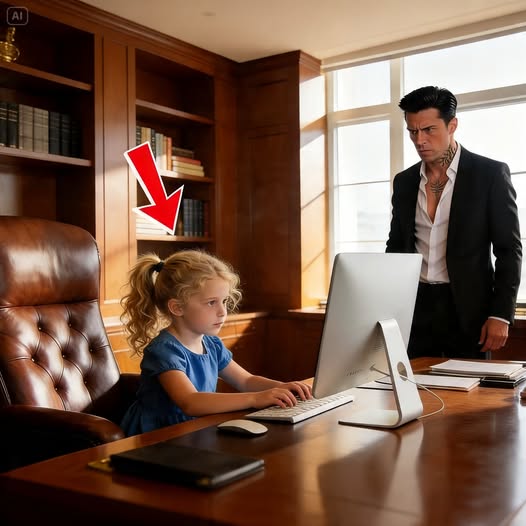
Chase froze in the doorway.
He had just spent three hours at a warehouse on the Boston docks listening to Carlo Ricciardi explain why a shipment had disappeared and why, somehow, no one was responsible. Chase had let the man talk. Then he had let him sweat. Then he had let him leave with both hands still attached, which in Carlo’s world counted as mercy.
All Chase wanted now was silence.
Bourbon.
The private room at the top of the stairs where no one knocked without permission and no one breathed near his desk without his code.
Instead, there was a child in his chair.
“Who let you in here?”
The words exploded out of him before his mind caught up. His voice filled the office the way it filled boardrooms, warehouses, and rooms where powerful men suddenly remembered they were mortal.
The little girl flinched.
Her shoulders jumped toward her ears. Her small hands trembled against the desk.
But her eyes never left the screen.
Chase’s right hand was already inside his coat, fingers brushing the Glock at his ribs. The motion was as familiar as breathing. Then his brain finally registered what his eyes were seeing.
A child.
Not a threat.
A child.
He let his hand fall slowly, like he was releasing something dangerous.
The girl swallowed.
“I just need one more minute, Mr. Donovan,” she whispered.
The name hit him harder than any weapon could have.
He had not introduced himself.
He had not spoken his name.
He had opened the door seventeen seconds ago, and somehow this little girl knew exactly whose chair she was sitting in.
Outside, snow pressed against the tall windows in slow, weightless spirals. It was the kind of storm that softened the world without becoming dangerous. Just enough white to make a man forget what kind of night he had come home from.
But Chase Donovan did not forget.
He stood at the threshold in a forty-thousand-dollar coat darkened by melted snow and understood, before fear had time to form, that he had walked into something he could not yet name.
The girl finally lifted her eyes from the monitor.
They were wide, brown, and far too steady for someone so small.
“Please,” she said. “Don’t turn it off.”
Chase stepped inside and closed the door.
The lock clicked behind him.
He did not look at her first. Old habits had rules. His eyes went to the ceiling. The lights. The corners. The smoke detectors. The bookshelf. The floor. The underside of the desk. Any place someone might have placed a camera, a listening device, a wire, a shape that did not belong.
No new scuffs.
No extra wires.
No unfamiliar objects.
The room had not been tampered with.
Only entered.
Only by this child.
Then Chase looked at her properly.
The pink sweater was worn thin at the elbows. The cuffs were tugged over her wrists the way children did when they were cold or trying to disappear into themselves. Her sneakers had once been white; now the toes were gray and the laces were fraying at the ends. Her ponytail tilted left because she had clearly tied it herself in the dark without a mirror.
She was thin in a way that had nothing to do with childhood and everything to do with missed meals.
Then Chase looked at the screen.
For one second, he stopped breathing.
It was not a public feed.
It was not the standard dashboard.
It was the internal CCTV archive, the one behind three layers of authentication, the one only two people in the house could open.
Chase.
And Vincent Caro.
The folder path across the top read: internal > library > late.
A folder Chase almost never opened.
A folder Vince had no business opening at four in the morning.
“Step away from the screen,” Chase said.
His voice came out flat and surgical.
The girl shook her head.
Not with defiance.
With fear.
The exhausted little shake of someone who had already measured every option and knew she could not survive the one being offered.
“If you turn it off,” she whispered, “tomorrow they’re going to say you killed someone.”
Chase forgot the next step he had been about to take.
He had spent his life listening for sentences like that. He had imagined hearing them from federal agents at his front door, rivals across a table, a voice on a wiretap played back in a basement.
He had never imagined hearing them from a child in a worn pink sweater.
She mistook his silence for danger.
“I’m Quinn,” she rushed. “My mom works here.”
Marlo.
The name came to him in pieces.
Hannah Marlo. Thirty-two. Four years on evening staff. Never late. Never asked for an advance. Never spoke unless spoken to. Single mother. Daughter with a heart condition. Bills from Boston Children’s Hospital that had stopped arriving at Hannah’s apartment eighteen months ago because Chase had quietly written an eighty-thousand-dollar check and instructed his accountant to bury it under miscellaneous estate expenses.
He had told no one.
Not Marcus.
Not Vince.
Not Hannah.
Especially not Hannah.
“Quinn,” he repeated.
Just the name.
He needed to hear it in his own voice.
She nodded once, watching him the way small animals watch large ones, trying to read movement before it happens.
Chase came closer, careful and silent. The girl did not flinch this time, but her hands tightened against the desk. Her sleeves rode up, and he saw her wrists, narrow as bird bones. His eyes dropped almost against his will to the front of her sweater.
Through the thin fabric, faint but unmistakable, ran the pale line of a surgical scar climbing her sternum.
A scar from a surgery he had paid for and never been allowed to see.
He came around the side of the desk and stopped behind the leather chair. He kept his hands where she could see them. He had learned long ago that hands in pockets read as threat to anyone who already had reason to be afraid.
And Quinn already had reason.
The screen showed footage from his private library. The timestamp read 11:32 p.m. from the night before. The angle was the wide camera hidden behind false molding above the second bookcase.
Almost no one knew that camera existed.
Chase had installed it himself three years earlier after his cousin Anthony had taken a contract to the wrong table.
In the frame, a man stood beside the fireplace.
A man in a dark sweater.
A man with Chase’s build.
Chase’s posture.
Chase’s slow tilt of the head.
Then the man spoke.
“Get rid of Voss tonight. Make it clean.”
It was Chase’s voice.
Every consonant.
Every flat New England vowel he had spent years in private school failing to soften.
Even the way he hit the word clean half a beat late.
Chase’s mouth went dry.
He had never said those words.
Not in that room.
Not in any room.
Daniel Voss had been chief counsel to the Donovan family for three decades. He had stood beside Chase’s father at his hospital bed and held the dying man’s hand through the last hour. He had read the will the next morning with a steady voice when Chase could barely keep his own together.
You did not get rid of Daniel Voss.
You died protecting him.
“Mr. Donovan.”
Quinn’s whisper pulled him back.
“Look. The dog.”
Her small finger lifted and touched the lower right corner of the screen.
Chase leaned in.
In the deep background of the shot, beyond the library doorway, a narrow strip of hallway appeared. Across it moved a pale yellow dog with a wide chest, gray muzzle, and a slight drag in the back left leg.
Old Bailey.
Twelve years old.
From the runt in a cardboard box on Chase’s twenty-fifth birthday to the heavy warm body that had finally settled in his lap one August afternoon and never lifted again, Bailey had been the one living thing in the estate that never cared what Chase was.
Five months ago, Chase had carried Bailey himself to the oak tree at the back of the South Garden.
He had dug the hole himself in short sleeves and summer heat while Marcus stood a respectful distance away and said nothing.
“I saw the grave,” Quinn said softly. “When I went with my mom to take out the trash. There’s a stone with a B on it.”
Chase could not answer.
For a moment, he could not find the muscles for speech.
This was not a simple hack.
It was not someone slipping into a server and changing a timestamp.
It was a constructed scene.
Old footage from a night when Bailey was still alive. Chase’s voice modeled and grafted on top. The date pushed forward. The lighting adjusted. The season disguised.
Someone had been building this since August.
Someone had spent the summer learning how to make him a murderer.
“How did you open this machine?” Chase asked.
His voice was harder than he meant it to be, but he needed the truth fast.
Quinn shook her head.
“I didn’t. It was already on. There was a man. He stood up and walked out, and he was in a hurry. He forgot to lock it.”
The room rearranged itself around those words.
Only two thumbprints opened that office.
Only two retinas were registered in the panel.
Chase’s.
And Vincent Caro’s.
Vince had carried Chase on his shoulders through that same hallway when Chase was six. Vince had been in the room when Chase took his oath at nineteen. Vince had stood beside him at his engagement announcement. Vince had been trusted by Chase’s father.
Until that morning, Chase had never wondered about him.
“What did he look like?” Chase asked.
Quinn tried to be exact.
“Tall. Taller than you. His hair was kind of gray on the sides but darker on top. He had a gold ring.”
She lifted her little pinky finger.
“Here.”
Chase did not move.
The ring had belonged to Vince’s father.
Vince had worn it every day since Chase was nine years old.
Chase opened the system log.
Clean white columns filled the screen.
Caro V. 03:54:17. Session terminated 04:41:02.
Vince had left this room six minutes before Chase walked into it.
Six minutes.
In Chase’s world, six minutes was the difference between getting away clean and dying in a parking lot.
Vince had not expected Chase back. The Ricciardi meeting at the docks had been scheduled to run until dawn. Everyone in the house had known that. Chase had cut it short because Carlo broke faster than expected.
Vince had believed he had the house to himself.
A small voice cut through the cold static in Chase’s head.
“He isn’t your friend, is he?”
Quinn looked almost apologetic, as if she were sorry to be the one to ask.
Chase looked down at her.
“I used to think he was.”
She nodded, filing that away the way she seemed to file everything.
“How did you get up here, Quinn?”
Now the words spilled out.
Her mother came at 3:30 for the admin floor. Hannah pushed the linen cart. Quinn climbed under the towels. Hannah did not know. When Hannah went to fill a bucket, Quinn got out. There was a little hallway near the back where the cameras did not see, and Quinn knew because she had stopped there before.
“Because last week I heard him,” she said.
“Heard who?”
“The gray-haired man by the laundry window. He was on his phone. I was outside. He didn’t see me.”
She drew a breath.
“He said, ‘Sunday night. Donovan won’t see it coming.’ Today was Sunday.”
Chase stood beside the child and understood she had carried this for seven days.
Seven days of knowing something dangerous.
Seven days of deciding what a seven-year-old girl was supposed to do with a sentence that could get a man killed.
He pulled a smaller chair from the corner and set it across from her. Then he sat, lowering himself to her height on purpose. He had interrogated grown men in basements, and he had learned early that frightened people locked up when power loomed over them.
“Quinn,” he said, using a softer voice than he normally allowed himself, “why did you come here to warn me? You don’t know me.”
She was quiet for a long moment.
Her hands twisted in her lap.
When she answered, she answered sideways, the way children do when the truth is too large to walk toward directly.
“A few months ago, my mom was crying at the kitchen table. She had hospital papers. The kind with red on the corner. She thought I was asleep.”
Chase did not move.
“Then one day the papers stopped coming. She held one up to the light like maybe something was behind it. Then she just sat there. After that, she told me, ‘Somebody nice helped us. One day, if you see somebody who needs help, you help them too. That’s how it works.’”
Quinn lifted her eyes.
“She didn’t say who.”
Chase kept his face very still.
“Last week, I asked my mom if the nice person was the man who owned the house. She didn’t say anything. She just went to wash dishes that were already washed. So I figured it out.”
Chase felt something move behind his sternum that he had no protocol for.
In thirty-seven years, no one had ever looked at him and seen someone who might need help. They saw leverage. Protection. Danger. A name to use. A name to fear.
Even Marcus Hail, who would step in front of a bullet for him, did so because Chase was the principal.
Not because he was Chase.
But this child had heard a phone call she should never have heard, connected a debt no one had explained, and decided to repay it.
“I’m sorry I came in here,” Quinn said quickly. “My mom is going to lose her job if you tell. Please, Mr. Donovan. She doesn’t have another one yet.”
Chase breathed in.
“Your mom is not going to lose her job, Quinn. I promise.”
The word landed hard in the room.
Promise.
Quinn studied him.
“Do you break promises a lot, Mr. Donovan?”
The question was not cruel.
It was not sad.
It was just a question from a child who had already learned adults said many things they did not mean.
“No,” Chase said. “I don’t.”
Then he stood.
Under the desk was a hidden button. One press alerted security. Two presses brought every armed man in the house to the door in under ninety seconds.
His thumb brushed the plastic.
Then he stopped.
Because the first body through that door would be Vince Caro.
Vince ran security.
Vince trained the men who answered.
Vince had personally interviewed every one of them.
The alarm would not bring help.
The alarm would bring the man who had spent five months building a film in which Chase ordered Daniel Voss’s murder.
And it would put Vince in a room with Quinn.
Chase let his hand fall away.
A child who had seen too much inside the house of a mafia boss was a life balanced on thread.
Chase had seen what the family did to threads.
He crossed to the door and turned the brass key in the old mechanical lock his grandfather had installed in 1961. The bolt slid into the frame with a satisfying weight. The electronic system would still report the door as unlocked to anyone watching downstairs.
Vince could stare at his screen all morning and see green.
Chase opened a lower drawer, removed a clean burner phone, and dialed a number from memory.
It picked up on the second ring.
No greeting.
“Sparrow,” Chase said. “Library. Twelve minutes.”
The line went dead.
Three words.
Marcus Hail would not need a fourth.
Chase turned back to Quinn.
“You’re hiding me, aren’t you?”
“I’m protecting you.”
She accepted the difference.
Then her chin lifted.
“Where’s my mom?”
Chase pulled up the interior CCTV grid on a second monitor. Nine camera tiles appeared. On tile four, ground floor, east corridor, Hannah Marlo knelt with a mop and bucket, scrubbing a stubborn mark near the kitchen archway.
She had no idea her daughter was three floors up in a room she did not know existed.
“She’s downstairs,” Chase said. “She’s all right. She doesn’t know yet.”
Quinn exhaled.
Chase opened a lacquered tin on the desk. Inside were shortbread cookies wrapped in wax paper, kept for nights when sleep was not an option. He slid one to her with a bottle of water.
“Eat. Then sit in the corner behind the bookcase. Don’t make a sound. Whatever you hear, don’t come out until I tell you.”
Quinn took the cookie carefully.
Then she climbed down and folded herself small in the corner, bottle clutched to her chest.
Chase watched her go and felt the strangeness of the moment.
In every previous version of his life, telling a witness to sit down and be quiet carried a threat.
This time, it carried only one wish.
Stay safe.
On the staircase camera, a tall figure began moving upward.
Silver at the temples.
Gold ring on the right pinky finger.
Vincent Caro was coming back.
At 5:02, Chase heard three soft taps on the office door.
Friendly.
Casual.
The knock of a man who had no reason to be nervous.
“Chase? You back, son? I saw the light from the landing.”
Chase lifted two fingers toward Quinn.
She understood instantly. She slipped from behind the bookcase and crossed the carpet on her toes, lowering herself behind the long sofa along the far wall. Her pink sweater vanished into the shadow.
Chase opened the door.
He filled the frame with his body, tired and casual, a man winding down after a long night.
“Something on your mind, Vince?”
Vince stood back from the threshold. He had changed his jacket since leaving the office earlier. This one was cream wool, soft at the lapel, the kind he wore when he wanted to look like a beloved uncle.
He smiled.
That smile had carried Chase through skinned knees at seven and broken jaws at sixteen.
“Just doing late rounds. Wanted to make sure you got in okay. Roads were ugly. How’d it go with our Italian friend?”
“He talked. He’ll call Monday.”
Vince chuckled.
Then his eyes moved.
Barely.
Past Chase’s shoulder. Toward the desk. The sofa. The corner.
Chase shifted a quarter inch to the right and closed the view.
“You want me to stay up?” Vince asked. “Walk through anything before you turn in?”
“No. Get some sleep. Long day.”
Vince nodded and turned away.
Then he stopped.
“Oh, hey. Did you happen to see a linen cart in the hallway when you came up? One of the night girls left one by the service stairs. Floor manager will want a name.”
Chase’s stomach went cold.
“I didn’t notice.”
“Strange place for it,” Vince said. “I’ll have someone check the badge logs in the morning.”
“Do that.”
Vince gave a small wave and left.
Chase waited until the silver head disappeared below the landing rail. Then he shut the door, bolted it, and pressed his forehead briefly against the cool wood.
Behind the sofa, Quinn whispered, “Does he know I’m here?”
“He suspects. He doesn’t know. There’s a difference.”
As Chase returned to the desk, he realized what was wrong with the conversation.
Vince had not asked about Daniel Voss.
Vince always asked about Voss in the morning. For six years, they had the same joke. Vince would lean in the doorway with coffee and say, “Our lawyer still alive?” Chase would answer, “Unfortunately.” And Vince would laugh.
That morning, the joke was gone.
The silence where it should have been was an answer by itself.
At 5:14, a hidden panel behind the bookcase scraped softly open.
Marcus Hail stepped through.
He was forty-two, tall, lean from old miles rather than gym hours, wearing a black leather jacket faded to the color of weathered slate. He had come fast, but he was not breathing hard. Marcus had been Chase’s most trusted man for fifteen years, a silence with shoes on, the kind of man who never wasted a question.
He registered the desk, the monitor, and then the little pair of sneakers visible beneath the sofa.
He did not ask.
Chase spoke low.
“She’s Hannah Marlo’s daughter. Quinn. She came in through the linen cart at 3:30. She saw Vince open my terminal at 3:54 and leave at 4:41 without locking it. She showed me what he was watching.”
Marcus looked at the screen.
Chase played the clip again.
The library.
The fire.
The man who looked like Chase.
The voice saying, “Get rid of Voss tonight. Make it clean.”
And old Bailey crossing the back of the frame.
By the time the video looped, Marcus’s jaw had tightened.
“This wasn’t done overnight,” he said. “Voice models this clean need two or three weeks of audio. Whoever cut it knew our internal camera coverage well enough to pick an angle with no overlap. This was patient work.”
“Where’s Voss?” Chase asked.
Marcus pulled out his phone and checked.
“No call last night. I sent him a confirmation on the Mendes file at 22:10. He didn’t read it. Tried him at 5:07 on my way over. Straight to voicemail.”
“Find him,” Chase said. “Not through the house. Not through Caro’s people. Use Reyes from the South End on a burner. I want eyes on Voss’s apartment, his car, his garage, his office, and the cabin in Vermont before the sun is up.”
Marcus nodded and began typing.
From behind the sofa, Quinn asked, “Is the lawyer alive?”
The question landed hard.
Chase met her eyes.
“I don’t know yet. But I’m going to find out.”
Quinn frowned, thinking.
“If they made a fake video that says you killed him,” she said carefully, “then they need him to actually be gone. Otherwise, he could just walk in and say it didn’t happen, right?”
The room held its breath.
Marcus looked at Chase.
“This kid,” he said quietly.
“I know,” Chase said.
Somewhere in Boston, the rest of the script was still being staged. Whoever held Daniel Voss did not need to keep him much longer. The fake video required a body, or at least a silenced witness.
The clock read 5:17.
They had less than nine hours.
At 5:32, Hannah Marlo finished mopping the east corridor and walked back toward the staff laundry room where she had left Quinn with a paperback and a juice box.
The book lay closed on the folding chair.
The juice box was untouched.
The cardigan Hannah had draped around her daughter was on the floor.
Quinn was gone.
Hannah did not scream.
A woman in her position did not run through a house like Chase Donovan’s shouting a child’s name. A woman in her position did not invite security to find a child who was never supposed to be there. If Quinn was discovered, Hannah would lose the job that kept them alive. Worse, her daughter would become a problem.
And people in that house did not enjoy problems.
Hannah checked the bathroom. Empty.
The supply closet. Empty.
The break room. Empty.
The alcove by the service stairs where Quinn liked to watch snow through the half window. Empty.
Three floors up, Chase watched her move across the camera grid like a moth trapped in a jar.
“She’s looking for the girl,” he said.
Marcus was already calculating.
“Vince has eyes on every grid. If we walk Quinn down to her mother in any corridor with a lens, we tell him everything.”
“Bring the mother up.”
Marcus nodded.
“I’ll intercept her at the laundry. Tell her there’s a problem at her apartment building. Pipe burst. The super needs her to call. I’ll bring her through the service stairs. The stretch between sublevel and three still has the dead camera from the October renovation.”
“Go.”
Marcus slipped back through the hidden panel.
Quinn watched Chase.
“Is my mom going to be really mad at me?”
“Yes,” Chase said. “But I’ll explain. She’ll listen.”
Quinn lowered her chin to the sofa cushion.
“She works fourteen hours a day. She doesn’t have time to be mad very long.”
The sentence settled in the room.
Chase had no answer for it.
He thought of his own childhood in that same house. The nursery. The rocking horse. The kitchen where the cook had let him steal raw cookie dough. The garden where someone was always watching so he would not skin his knee.
He had been served in every room where Hannah now served.
The same house.
Two childhoods.
Opposite ends.
Minutes later, the hidden panel opened again, and Hannah Marlo stepped into the office.
Her eyes found Quinn.
Her face did not go to anger.
It went straight to terror.
Hannah crossed the room in three strides and dropped to her knees, pulling her daughter into her chest with the careful violence of a mother making sure her child was still real. She checked Quinn’s shoulders, wrists, spine, palms, eyes. She smoothed hair behind one ear and held the back of Quinn’s head as if the child might dissolve if she let go.
Only then did Hannah look at Chase.
She stayed on the floor with her arms around her daughter.
“Mr. Donovan, I’m so sorry. I had no idea. She’s never done anything like this. I check on her every twenty minutes. I’ll resign. I’ll have my things out by noon. Please don’t make this hard on her. She’s only seven.”
Chase raised one hand.
“You’re not resigning, Hannah.”
Her sentence died.
In four years, he had passed her in hallways, nodded once or twice, signed her time sheet through assistants.
He had never said her name.
Now he said it like it mattered.
“Your daughter saved my life this morning. I owe her. I owe you.”
Hannah looked down at Quinn as if her daughter might translate.
Quinn squeezed her mother’s hand.
“Mom,” she whispered. “The person who paid for my heart surgery. It was him.”
Hannah stopped moving.
Her eyes filled.
Chase looked at the rug.
“I didn’t need you to know,” he said. “She figured it out.”
Hannah finally managed one question.
“Why? Why would you help us?”
Chase was silent for a long moment.
“There was a morning last spring,” he said. “I crossed the front hall. Quinn was sitting on the bottom step. She must have come in with you and gotten away.”
He paused.
“She looked up and smiled at me. Like I wasn’t the thing I am.”
Hannah pressed her fingers to her mouth.
She did not speak.
Her forehead came down gently against the top of Quinn’s head.
Then Marcus shifted, closing the moment.
“We have to find Voss. The clock is moving.”
Chase turned back to Hannah.
“I need to ask you something, and I need you to think carefully. Anywhere in this house, in the last few months, have you seen anything that did not make sense? A door that should have been open? A sound that should not have been there? Anything.”
Hannah looked down.
Then she began to search the house in her mind, room by room, the way only someone who had cleaned every inch of it could.
When she lifted her face, the answer was already there.
“There’s a room under the wine cellar. I don’t have a key. I’m not supposed to. Yesterday afternoon, I was washing the floor outside it, and I heard something inside. A chair. Like a chair fell over. Then someone breathing maybe. Then nothing.”
Chase’s gaze sharpened.
“I waited,” Hannah continued. “I went back to work. Then I told Vince at the end of my shift. I always report anything out of order. He laughed and said, ‘Stray cat got in through the air vent again, sweetheart. Don’t worry about it.’”
The wine cellar had been dug into bedrock beneath the south wing in 1923. Three connected chambers, low stone ceilings, walls of stacked limestone. It had held more family history than any archive. Hannah cleaned it twice a week.
She knew its corners better than anyone alive.
A modern steel door had been installed three years earlier at the end of a passage under the explanation of record preservation.
Vince had supervised the renovation.
Chase had signed the invoice without reading it.
“The keys are in Vince’s office safe,” Chase said. “Top floor. West corner. Behind the sergeant painting.”
“He’ll have changed the combination,” Marcus said. “More than once.”
“And he won’t be far from it,” Chase replied. “We need him out of the house.”
Chase picked up the internal phone and called the security office.
“Vince,” he said in the tone of a man calling a trusted lieutenant, “sorry to wake you. Bryant called back. The Italian wants you in person. Seven at Deaggio’s on Hanover Street. Says he won’t talk to anyone else. I told him you’d be there.”
There was a pause.
Two beats.
Three.
“At seven?” Vince said. “All right. Sure. Yeah.”
A quarter second too long.
Bryant was real. Deaggio’s was real. A 7 a.m. meeting was exactly the kind of thing Vince had handled a hundred times. If clean, he would have answered before Chase finished the sentence.
“Drive safe,” Chase said.
Vince’s black sedan rolled down the driveway at 5:58.
Chase pulled up the exterior road camera hidden across the street in a utility box. The sedan appeared, slowed, and turned left onto Heath Street.
Not downtown.
Not the harbor.
Not Deaggio’s.
A side road leading toward small commercial lots where nothing was open at six in the morning.
“He’s going somewhere to make a call,” Marcus said.
Chase turned to Hannah and Quinn.
“You two stay here. Bolt the door. Open for no one except me or Marcus through the back panel. I’ll come back.”
Quinn opened her mouth.
Chase shook his head once.
“I’ll come back, Quinn. I promise.”
Chase and Marcus descended through the service stairs along the back of the kitchen, then into the cellar through a low oak door. The temperature dropped with each step. The smell shifted to damp stone, old oak, and the papery sweetness of dust on wine labels.
They moved through the first chamber.
Then the second.
In the third passage, Marcus killed the flashlight.
The steel door waited at the end.
No camera above it.
No camera along the passage.
That alone was confession.
Marcus knelt and unrolled a canvas kit of lock picks, clean and oiled. He had grown up in Brooklyn before he grew up in anything else, and some lessons never left the hands.
Three minutes later, the bolt slid back.
The room beyond was small.
Thirteen feet square.
One yellow bulb.
A metal table.
A folding chair.
A plastic gallon jug of water on the floor.
And in the chair, slumped forward, wrists zip-tied behind him, mouth sealed with duct tape, sat Daniel Voss.
Alive.
Barefoot.
Bruised.
Breathing.
Chase crossed the room and dropped to his knees.
“Easy, Daniel. Easy. It’s me.”
He peeled the tape back as gently as if it were his own skin.
Voss made a sound that was half cough, half sob.
“Chase. Oh, thank God.”
Marcus cut the zip ties. Chase gave Voss water.
“How long?” Marcus asked.
“Last night,” Voss rasped. “After I left the office. Vince called. Said you needed me at the house for an emergency file. Federal subpoena. I came. Two men I’d never seen were waiting in the back hall. Needle in the neck. I woke up here.”
“What were they planning?” Chase asked.
Voss closed his good eye and gathered the words.
“They’re bringing me upstairs at two to the family meeting. I’m supposed to walk in and accuse you in front of the senior members.”
“Accuse me of what?”
“Ordering my death because I discovered you had been skimming from the family trust for three years. It’s fabricated. They have a video. A written statement they claim is mine. A witness ready to corroborate. The story is written end to end.”
Chase sank back on his heels.
This was not an attack.
It was a stage.
The blocking was set.
The lines rehearsed.
The witnesses cast.
Even the lawyer’s survival was optional.
If the live Daniel Voss would not read his lines, the dead one could speak through silence.
Voss caught Chase’s sleeve.
“One more thing. The one running this isn’t Vince. Vince is the hand.”
He drew a painful breath.
“It’s Celeste.”
The room held still.
Celeste Ashford.
Twenty-nine.
Only daughter of Robert Ashford, whose Rhode Island operation had hollowed out over the last decade as younger crews defected to stronger houses. Three years earlier, the old families had arranged a marriage between Chase and Celeste as a treaty in a long dress, an end to the small turf cuts that had bled both sides since the eighties.
Chase had agreed.
Celeste had agreed.
Their engagement had been announced at a dinner with white roses and a string quartet. Six newspapers carried the terrace photo: her hand on his sleeve, both of them smiling the kind of smiles people smile when a treaty is being photographed.
“She was never going to be a wife the way your mother was a wife,” Voss said. “I told you that the first month. You said she’d settle. She didn’t settle. She just got quieter. She wants the chair. Not after you die. She wants it while you watch.”
“How?”
“The video forces the marriage forward. She brings it to you privately two days before the wedding she already planned. Says she can make it disappear. Says she’ll stand beside you and swear it was doctored. But only if the ceremony moves up. Only if certain financial powers of attorney are signed before sundown.”
Voss swallowed.
“I drafted the standard prenup three months ago. She rejected six clauses. Together, the clauses she rejected would have given her signing authority on every operational account by the end of your first year of marriage. I started looking. I found three transfers from an Ashford shell to a numbered account paying Vince Caro’s mother’s nursing home in Quincy. The transfers started in August.”
August.
The month Bailey died.
The month the library had been quiet long enough for someone to film old footage and build a murder out of it.
“What does Vince get?” Marcus asked. “A seat?”
“A cut. His son moved up two ranks. Vince is tired. He has been tired for five years. She told him he could rest.”
Chase stood slowly.
He thought of Celeste the night before at the front door, cream coat, kiss on his cheek, telling him to drive safely. He had read her small smile as affection trying not to be theatrical.
Now he saw it for what it was.
The smile of a person watching a man walk into a room she had already decorated.
“We need to get him out,” Marcus said. “Safe house in Newton. Doctor on Beacon Street. Then we come back and tear her down.”
“No,” Chase said. “He stays.”
Marcus blinked.
“Down here?”
“The door locks again. The light stays on. He gets water, food, a blanket. From outside, nothing changes.”
“Chase—”
“The family meeting happens at two exactly as she planned.”
A thin cold smile touched Chase’s mouth.
“We just change who gets to deliver the closing argument.”
Twenty minutes later, the steel door closed once more on Daniel Voss, this time with water, a blanket, and Chase’s quiet promise that no one would come for him until they came together.
When Chase returned through the hidden panel, Quinn lifted her face from Hannah’s side.
“Are you okay?”
“I am,” Chase said.
He looked at her properly.
“Because of you.”
At seven, the office held four secrets instead of one.
Marcus brought coffee, buttered toast for Quinn, and clothes from the staff laundry. Voss was moved upstairs, not to a hospital, not out of the house, but into a hidden third-floor guest suite whose blueprints labeled it attic space. Vince had never had a key.
There, Chase formed the plan.
At two, the senior members would gather at the long table. Nine seats would be filled. Vince would stand behind Chase’s chair, as always. Celeste would sit at Chase’s right, where she had sat at every internal session for fourteen months.
The video was in her cloud. She had her fake affidavit. She had her moment ready. She would wait for Voss to be wheeled in, wounded and broken, to accuse Chase. Then she would step forward to defend him, on the condition that the wedding move up and the powers of attorney be signed.
“She’ll never get the chance,” Marcus said.
“She gets the chance,” Chase replied. “She just doesn’t get the result.”
Voss would not come in through the back in a wheelchair.
Voss would walk through the side door on his own feet.
By the time he spoke, the table would have already seen the video and what was wrong with it.
Marcus would bring three witnesses Chase trusted with his life: Uncle Patrick, Teresa Moretti from the North End, and Frank Caldera, none in Caro’s pocket, none in Ashford’s.
Then Chase turned to Quinn.
“You remember the dog in the video?”
She nodded.
“How many seconds after I say the bad sentence does he appear?”
Quinn closed her eyes. Her lips moved.
“About seven seconds,” she said. “Bailey ran across from the left to the right. He stopped a tiny bit in the middle. Then he kept going. He was kind of slow.”
Chase almost smiled.
“You know his name.”
“It’s on the stone with a B,” she said. “I told you.”
Marcus let out a breath that was almost a laugh.
“We have our best witness.”
“No,” Chase said immediately. “She is not in that room. Under no circumstances. She does not get within three corridors of that meeting. Her work is done. What she saw, we use. She does not stand.”
Marcus nodded.
Agreed.
Then Hannah asked if there was anything she could do.
Chase looked at her.
“Yes. You are the only person outside us who knows the wine cellar has a room with a man in it. You reported a sound to Vincent Caro and were told to ignore it. When the time comes, you walk into that meeting after Voss. You say what you heard yesterday. You say what Vince told you back. That’s all. You speak once. You sit down. You go home with your daughter.”
Hannah drew in a long breath.
“I can do that.”
“You can do more than that,” Chase said. “But that is what I’ll ask you to do.”
At 8:15, Vince’s sedan returned.
Chase went down to the security office carrying coffee like a man who had slept in his own house with nothing wrong inside it.
Vince was inside, coat half off, hand on the back of a chair. His smile arrived one beat late.
“Bryant didn’t show,” Vince said. “I sat at Deaggio’s for forty minutes. Carmen made me three espressos and apologized.”
“Could be a mix-up,” Chase said.
He let silence sit.
“Long day. Go lie down. Meeting moves at two.”
Vince did not lie down.
His eyes flicked.
Measuring.
“By the way,” he said casually, “have you talked to Daniel this morning? He owes me confirmation on the Hall file.”
There was no Hall file.
Vince had never asked Voss for numbers in fifteen years.
Vince was asking if Chase knew Voss was missing.
“I texted him at six,” Chase said. “He’s in court on the Salem motion. He’ll be back in time.”
“He responded?”
“Said he was almost at Suffolk County. Here by one-thirty.”
Vince smiled.
None of it reached his eyes.
“Good.”
Chase walked out, feeling Vince’s gaze between his shoulder blades all the way up the stairs.
Back in the office, Marcus was watching the monitor.
“He’s going to do it himself,” Marcus said.
“Yes. He can’t wait until two. The video and body have to align. If something feels wrong, he checks the body.”
“Then we let him go?”
“We give him exactly what he expects to see.”
They moved fast.
Back to the cellar.
Back to the room.
Voss’s spare jacket was draped on the folding chair. The jug returned to the floor. A single snapped zip tie left on the table, the kind a careless guard might leave behind. The yellow bulb stayed on.
At 9:02, the south wing camera caught Vince moving along the cellar corridor.
He paused at the steel door.
Unlocked it with a small brass key.
Opened it just enough for yellow light to cut across his shoes.
He looked in for four seconds.
He did not enter.
Then he closed and locked it.
By 9:14, he was back on the second floor, shoulders eased, phone already in hand.
“He thinks the play is still on,” Marcus said.
“The trap is set,” Chase replied. “Now we wait.”
At 11:00, Celeste Ashford arrived.
A black town car moved up the drive with the slow confidence of someone arriving, not rushing. The driver opened the rear door, and Celeste stepped into the pale morning light wearing a cashmere coat the color of crushed pomegranates, cream boots, leather gloves, and the calm of a woman who believed the cold had agreed not to touch her.
She crossed the front steps like she was already the woman of the house.
Chase met her in the front salon, positioned by the marble fireplace with a glass of water nearby, posed like a man who had been there awhile.
She kissed his cheek lightly.
“You look tired. Was last night difficult?”
“Ordinary.”
She laughed softly and touched his lapel.
“I’ve been thinking about the meeting today. Three years of promises, Chase. I think today is the day we finally walk toward something real. Don’t you?”
He understood the sentence.
It was the seed of the public speech she had planned. The you-and-me-against-the-scandal speech. The vows accelerated by crisis. The white roses she had probably already ordered.
“You’ve always been in a hurry, Celeste.”
“I’m practical. Hurry is what practical women look like to men who don’t have to be.”
“Voss,” Chase said lightly. “Will he be here?”
A muscle at her jaw moved.
“I was going to ask you. I need him to step through the prenup revisions before this afternoon. It would save a week of letters.”
“He’ll be in at two. Motion in Suffolk this morning.”
“At two,” she repeated, like confirming dinner.
Then she set her gloves on the side table, and for one quarter of a second her shoulders dropped.
Relief.
The plan was still alive.
When she left for the morning room, Marcus slipped in from the pantry hall before her perfume left the room.
“She has it staged,” he said. “I’m in her cloud. Three files. Fake clip. Fake signed affidavit in Voss’s handwriting style. Press release dated next Friday announcing the wedding. It autopublishes at four p.m. today unless she cancels it.”
“Don’t touch the files,” Chase said. “Don’t disturb the schedule. Today we let her own words walk in on their own feet.”
When Chase returned to the third-floor suite, Quinn was tucked under Hannah’s arm with a children’s book across their laps. Voss slept in the wingback chair under a folded blanket.
Quinn looked up.
“Was that her? The lady in the red coat?”
“Yes.”
“Is she your wife?”
“Almost.”
Quinn thought about that.
“Not anymore?”
“Not anymore.”
She nodded as if this were a reasonable update.
Then she lowered her voice.
“She smelled angry.”
Chase paused.
“What?”
“When grown-ups pretend to be happy, they have an angry smell. I don’t know what it’s from, but it’s there.”
Chase looked at the child for a long moment.
He had built his life reading small tells. A twitch at a mouth, a glance at a doorway, fingers tightening around a glass. He had paid specialists hundreds of thousands to do what this little girl did naturally.
Children, he realized, saw what adults had trained themselves not to see.
At two, the long conference room on the first floor filled.
It was the heart of the Donovan family, with a long oak table cut from a single tree felled on land the family once owned in western Massachusetts. Twelve chairs, twelve places, generations of decisions made under the chandelier.
Today, nine seats were filled.
Patrick Donovan, Chase’s uncle, sat at the far end with a leather portfolio he had not opened in six years.
Teresa Moretti, matriarch of the North End interests, sat across from him, silver hair pulled back, eyes already moving.
Frank Caldera leaned back with the deceptive ease of the man who had been Chase’s father’s closest friend.
The others were captains, advisers, keepers of small kingdoms within the larger one.
Celeste sat at Chase’s right in a black wool dress and a single strand of pearls.
Vince stood behind Chase’s chair, as he had stood for almost twenty years.
At first glance, he looked exactly the same.
Chase rose.
Every small movement around the table stopped.
“We are here this afternoon,” Chase said, “because of an urgent matter of internal security.”
Celeste’s eyebrows drew together just slightly.
This was not the opening sentence she had prepared for.
“In the last several months,” Chase continued, “a member of this family has been working in concert with an outside house. The goal was to remove me from this chair through a fabricated accusation. The instrument was a forged video prepared with patience and intended to be released in this room today.”
Silence.
No chair creaked.
No glass touched a coaster.
Celeste recovered first.
“Chase,” she said coolly, “that is an extraordinary claim. Do you have proof?”
“I do.”
Marcus stepped forward and opened a slim laptop connected to the wall screen.
The dark glass came alive.
The fake library footage appeared.
The fire.
The man by the mantel.
Then Chase’s voice filled the room.
“Get rid of Voss tonight. Make it clean.”
Someone at the far end drew a sharp breath.
Teresa Moretti’s eyes flicked once to Celeste.
Celeste did not move.
Behind Chase, Vince’s right hand found the back of the chair.
His knuckles whitened.
“Each of you,” Chase said, “is now looking at the document on which my removal was to be built. It was scheduled to appear in your inboxes within minutes of this meeting’s close. Some of you would have been called as witnesses. A particular voice in this room was prepared to verify it under family authority.”
Patrick Donovan spoke for the first time.
“Then who made it?”
“Two people,” Chase said. “One sits at this table.”
Celeste lifted her chin, her mouth shaping a polite, disbelieving smile.
“Before we name them,” Chase said, “I want every person in this room to look at the lower right corner of the frame. Second twenty-three. The hallway behind the library doorway.”
Marcus zoomed in and played it at half speed.
For seven seconds, the hallway was empty.
Then a pale yellow shape moved in from the left.
Old. Slow. Gray muzzle. Back left leg dragging slightly.
The dog paused in the center, lifted his head, then moved out of frame.
The room made one sound.
A collective breath releasing.
“That,” Frank Caldera said tightly, “is Bailey?”
“Yes,” Chase said. “Bailey has been dead for five months. I buried him under the oak in the South Garden in August. There is a stone with the letter B. Several of you have walked past it.”
He kept his eyes on the captains.
“The video was constructed from older footage. The voice was modeled. The timestamp was rewritten. The dog made it past the editor.”
Celeste laughed.
It came half a second late and half a tone wrong.
“So,” she said, “whoever made it. Who is that exactly?”
Chase turned his head.
“Two people. One of them is standing behind my chair.”
Vince’s hand remained on the wood.
His face did not change.
Every eye in the room lifted toward him.
“And the other,” Chase said, “is sitting at my right.”
Celeste’s smile froze.
The shape remained on her mouth, but no muscle behind it was holding it up.
Chase walked to the small side door in the wall and opened it.
Daniel Voss stepped into the room.
He had washed his face. He wore a clean shirt. His hair was combed back.
None of it hid what had happened.
The bruise on his cheekbone was dark plum. His left eye was half closed. His wrist was bandaged where the zip tie had cut. He walked with the careful steps of a man who had only recently remembered how to trust the floor.
Every senior member rose at once.
Celeste rose too.
Her face had gone paper-white beneath the rouge.
“Daniel,” she breathed perfectly. “Oh, Daniel, thank God. What happened to you?”
Voss did not look at her.
He walked to the head of the table and waited for everyone to sit again.
Then he spoke.
“Last night, I left my office at 21:15. I received a call from Vincent Caro, asking me to come to this house immediately for a federal matter. I came. I was met in the rear corridor by two men I had never seen. They put me on the floor. They administered an injection. I woke up in a locked room beneath the wine cellar.”
The room absorbed every word.
“I have been in that room since. I was given water twice in thirty-six hours. I was given one phrase as comfort. One more day.”
Voss’s good eye moved across the table.
“I was to be presented this afternoon as the wounded witness of a betrayal that has not occurred. I was to recite a statement I never wrote about embezzlement that has not happened by a man who has never given me cause to suspect him.”
He turned toward Celeste for the first time.
“Twice through that door, I heard the captain of this house speaking on the phone. The voice on the other end was female. I have known that voice for three years.”
He lifted one bandaged hand.
“That voice was yours.”
Celeste’s smile cracked.
“Daniel,” she said softly, “you’ve been through something terrible. You don’t know what you’re saying.”
Marcus pressed a key.
A second recording played.
Vince’s voice came first.
“Tomorrow at two, then. Same plan.”
Then a woman’s voice answered.
Low.
Clear.
Familiar to everyone in that room.
“When Voss comes in and gives the statement, Chase will have no exit left. Make sure there are witnesses. I’ll step forward immediately to defend him. On the condition we marry within the week. After that, everything routes through me.”
The recording cut.
No one breathed.
Then Hannah Marlo entered through the side door.
She wore a clean gray dress. Her hands trembled at her sides, but her chin did not. Marcus had brought her from the third floor moments earlier, with Quinn safely locked upstairs.
“Yesterday afternoon,” Hannah said, voice steadying as she spoke, “while cleaning the corridor outside the cellar archive, I heard the sound of a chair falling inside a locked room. I heard a person breathing. I reported it to Mr. Caro at the end of my shift. He told me it was a stray cat. He told me not to worry about it.”
She did not look at Vince.
She did not need to.
Vince moved.
One step backward.
His weight shifted toward the door.
Marcus was already there.
He crossed in three steps and stood in the doorway, one hand loose, the other inside his coat.
Vince stopped.
“Sit down, Vincent,” Patrick Donovan said quietly.
Vince did not sit.
But he did not move again.
Celeste lifted her chin.
“This is a coordinated attack against me. My father will hear about this. The Ashford House will not—”
“Your father heard about it at seven this morning,” Chase said.
She stopped.
“I called him myself. He listened. He thanked me for the courtesy of the warning. He will not stand behind you. He has more to lose than you do.”
Celeste sat.
It was not graceful.
It was the motion of legs that had stopped working.
The council voted the way it had voted for four generations.
No raised voices.
No hands.
One nod from each of the nine in order of seniority, beginning with Patrick.
The engagement was annulled.
Celeste Ashford was barred from any property owned by the Donovan family, in any state, under any name, for the rest of her life.
Vincent Caro was remanded to the internal discipline of the house. No charge would be filed in Massachusetts. The matter would be settled by the family, and the result would be permanent and never discussed.
The senior members rose and left in the order they had entered.
Frank Caldera paused at Chase’s shoulder and squeezed it once, hard.
Teresa Moretti touched two fingers to her temple in a small private salute.
Patrick Donovan said nothing at all, which from him was the highest thing he had ever said.
Vincent Caro was walked out by two of Marcus’s men through the side door.
He did not look back.
Celeste was escorted by a third.
Her cream gloves remained folded on the table where she had left them.
She did not ask for them.
When the door closed, Chase stood alone in the meeting room.
The wall screen had gone dark.
The chandelier hummed.
Outside, the snow had stopped.
Beyond the windows, the South Garden lay under a thin white blanket, and near the oak, a small gray stone caught the last of the afternoon light.
At nine that night, Chase climbed the back stairs to the third-floor suite.
The house had emptied itself slowly. Frank left at five. Patrick stayed in the salon until seven, sipping brandy and asking no questions. By eight, the kitchen staff had been sent home with two weeks’ pay and instructions not to discuss what they had not been there to see.
Only the people who knew everything remained.
Chase knocked once.
Hannah called him in.
The room was quiet. Voss had been moved to a private medical suite Marcus kept in Newton for emergencies that did not belong in hospitals. The folded blanket remained on the chair where he had left it.
Hannah sat on the loveseat by the window. Quinn slept against her side, wearing one of the clean cotton shirts Marcus had brought upstairs. Hannah’s hand moved again and again through her daughter’s hair, grateful for the motion itself.
Chase sat opposite them.
For a while, no one spoke.
Then Hannah said softly, “She really did love your dog. She drew him once. Yellow with a black nose. I didn’t know whose dog it was.”
“That’s how children love,” Chase said. “They don’t need a reason.”
Another silence passed.
Then Chase said, “Hannah, I don’t want you cleaning the floors of this house anymore.”
She looked up.
“There’s a small property north of the city,” he continued. “It belonged to my grandmother. Two bedrooms. A garden. A public school three blocks away. It’s been empty since spring. I would like you and Quinn to live there. I’d like to put you on payroll as estate manager, not housekeeping. The salary will be ten times what you make now. The hours will be yours.”
Hannah did not answer immediately.
“I don’t want charity, Mr. Donovan,” she said. “I’ve spent four years not asking anyone for anything. I’d like to keep doing that.”
“This isn’t charity.”
“What is it, then?”
Chase waited until she looked at him.
“Balance.”
He did not say Quinn had saved his life and perhaps the house along with it.
He did not say there was no number large enough to pay that debt.
He did not say that for the first time in years, he had seen the shape of a world where power could protect something other than itself.
He only said what mattered.
“You earned it.”
Three months later, Sunday morning arrived clean and quiet.
The snow that had buried the city in February had melted into the soil. Crocuses were pushing green tips along the stone wall by the driveway. The sky over the suburbs north of Boston was pale and washed blue, as if the season had finally decided to begin.
Chase drove himself.
He had given his driver the day off, as he had every Sunday for the last twelve weeks.
The road curved between bare maples just beginning to remember their leaves. At the end of the narrow gravel lane stood a small white clapboard house with a blue door.
Quinn was already outside.
She wore an apron three sizes too large, the strings wrapped twice around her waist and tied in a careful bow. Flour streaked her cheek. Her hair was in two uneven braids.
When she saw the car, she threw both arms overhead and waved like she was guiding in an airplane.
“Mr. Chase! You’re on time!”
Inside, the kitchen smelled of butter and brown sugar. Hannah lifted cookies onto a cooling rack and smiled when Chase entered. It was an easier smile than any she had given him in the four years before.
The new job suited her.
The mornings with her daughter suited her.
The shadows under her eyes were gone.
Quinn had gained seven pounds in twelve weeks. Her pediatrician used words like good progress and steady gain. She was in second grade at the public school down the street now, with two best friends named Sophie and Madison. The surgical scar remained. It always would. But it sat on a chest that had filled out and a heart the cardiologist had recently described, with surprise, as strong.
Chase placed a small package on the kitchen table.
“For you,” he said. “It isn’t expensive. I thought you should have a good place to draw.”
Quinn opened it.
Inside was a soft brown leather notebook with a gold Q pressed into the cover. Under it lay a tin of twenty-four colored pencils, each sharpened to a perfect point.
She did not say thank you.
She did something better.
She climbed onto the chair, leaned across the table, and threw both arms around Chase’s neck.
The hug was loud with happiness.
Uncomplicated.
Fearless.
It was the first time in thirty-seven years a child had wrapped her arms around him out of pure joy, asking nothing.
For one second, Chase did not know where to put his hands.
Then he placed one against the back of her head and the other along her warm shoulder, and he held her as long as she wanted to be held.
They sat around the small kitchen table and talked about nothing, the way people who trust each other talk about nothing.
The squirrel raiding the bird feeder.
The teacher who praised Quinn’s spelling.
The daffodils that would come up next month if the weather held.
Chase had changed, too.
Marcus Hail was now formally first lieutenant, recorded in council and family records. Daniel Voss had returned to his desk, bruises healed, authority quietly expanded. Voss drafted a new structure, and Chase signed it before March.
Every decision of consequence now required two signatures from different chains of trust.
There were no more rooms with only two keys.
Celeste Ashford lived under quiet supervision at her father’s estate in Newport. The Ashford operation dissolved by the end of the second week.
Vincent Caro was simply gone in the way the family said gone, and his name was no longer spoken in the long meeting room.
When it was time for Chase to leave, Quinn followed him to the door with a folded piece of paper.
“I made you something.”
He opened it.
It was a drawing of his house.
But it was not exactly his house.
This version had more windows than the real one, and every single window was filled with bright yellow. No dark squares. No hidden rooms. No shadows.
At the top, in careful seven-year-old letters, she had written:
YOUR HOUSE.
“I drew all the lights on,” Quinn said, “so nobody can hide anything in it anymore.”
Chase looked at the drawing for a long moment.
Then he folded it once.
Then again.
He slid it into the inside pocket of his coat, on the left side, where it lay flat against his chest.
“Thank you, Quinn.”
“Same time next Sunday?”
“Same time next Sunday.”
He drove home through early afternoon light with the drawing very light in his pocket and very heavy at the same time.
For the first time in years, he did not feel like he was returning to the estate.
He felt like he was leaving a place called home.
Power had not protected him.
Money had not protected him.
Security, blood, loyalty, fear, and every locked door in that old Brookline house had failed.
A seven-year-old girl in a worn pink sweater, with a memory of a dead dog crossing a hallway he should not have been able to cross, had done what an empire could not.
She had looked closely.
She had seen the truth.
And because of her, every light in Chase Donovan’s house finally came on.