White paint, a faded blue company logo, a deep dent near the rear tire—the kind of service vehicle no one in Beacon Hill would bother to study for longer than a few seconds. But on my phone screen, streamed from the hidden camera above my building’s grand entrance, it looked like a weapon pointed straight at my life.
My father, Robert, climbed out first. He wore the tailored navy blazer he saved for moments when he needed strangers to mistake him for an honorable man.
My mother, Margaret, stepped out behind him with a sleek leather folder tucked under her arm like legal armor. Then came my younger sister, Madison, hiding half her face behind oversized designer sunglasses, blonde hair blown out to perfection, one hand wrapped around an iced matcha latte she definitely had not bought with her own money.
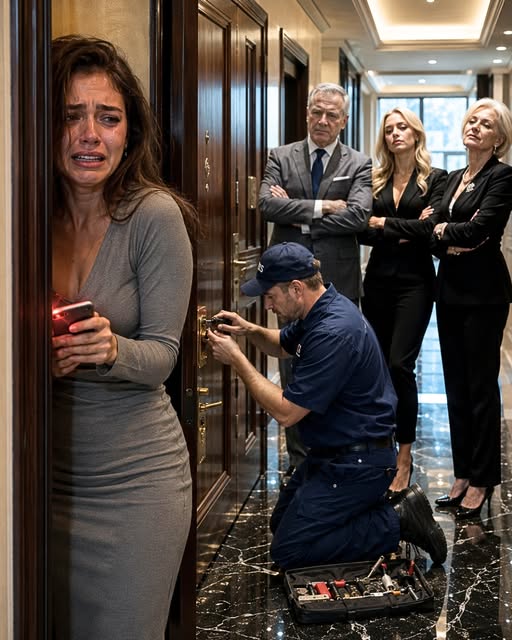
She tilted her head back and studied the stone facade of my building as if she were already imagining where her furniture would go.
I was sitting in a bland hotel room ten minutes away, dressed in black slacks and a crisp blouse. My open suitcase lay on the floral bedspread as a decoy, just in case anyone came asking questions. London did not exist. The flight confirmation I had sent to the family group chat the week before was fake, pieced together from an unfinished travel booking I had never paid for.
My real trip was about to happen in an elevator.
I zoomed in on the live feed and hit record. I knew the apartment cameras were already saving everything to a secure cloud server, but I needed to feel myself capturing them. The hallway camera on my floor activated as the motion sensor blinked. A second later, the mahogany elevator doors opened, and my family appeared with the locksmith trailing behind them, visibly uncomfortable.
Robert looked irritated, not anxious. That was the detail that chilled me first. He did not look like a man about to break the law. He looked like a man correcting a clerical error.
“Apartment 9C,” he told the locksmith, his voice echoing through the marble hallway. “My daughter is overseas. We’re handling the property sale on her behalf.”
Margaret opened the leather folder. “We have the authorization right here.”
A broken laugh almost escaped me. Not because it was funny, but because my mother lied with such calm certainty that, for one disorienting second, I wondered if they had managed to convince themselves it wasn’t theft. That was always their trick. They never stole from me; they “reallocated family resources.” They never betrayed me; they “made practical choices.”
Madison stood behind them, scrolling aggressively. “Can we speed this up? The realtor gets here at eleven.”
The realtor.
They were not just breaking in to frighten me or pressure me later. They had already scheduled the sale of the apartment my Grandpa Henry had left to me. My home had become an appointment on their calendar, placed somewhere between brunch and a hair appointment.
My hands stayed strangely steady as I reached for my purse. I took out my keys, the police report I had filed two days earlier, a notarized copy of the deed, and a small, yellowed envelope Grandpa Henry’s attorney had given me after the will reading.
I had never opened it.
On the front, in my grandfather’s shaky handwriting, were the words:
Only when they make you doubt yourself.
Back then, I thought he meant grief.
Now, watching the locksmith press a drill toward my deadbolt, I understood.
On the screen, the locksmith paused. “Are you completely sure this is legal, sir?”
Robert gave him the condescending smile he used on waiters and bank tellers. “Young man, I’m her father. Do you really think I would break into my own daughter’s apartment?”
Margaret touched the locksmith’s arm with her manicured fingers. “Emily is… emotional. We’re just trying to keep a sensitive family situation from becoming worse.”
There it was.
Emotional.
The word they had used against me my entire life whenever I objected to being treated like an emergency fund with a pulse. I was emotional when Madison spent my graduation savings on a wellness retreat. I was emotional when my parents skipped my college ceremony because Madison had broken up with her boyfriend. I was emotional when Grandpa Henry left me the apartment and Margaret asked whether I planned to “do the right thing for the family.”
The locksmith still looked uneasy, but he turned on the drill.
That was when I called the officer whose business card sat beside the untouched coffee on my hotel desk.
“Officer Reed? This is Emily. The people I warned you about are at my apartment door right now. They’re drilling the lock. I’m on my way.”
I hung up, grabbed my bag, and walked to the hotel elevator with a calm that felt almost inhuman.
By the time I drove out of the parking garage and into the pale Boston morning, I realized something important.
I wasn’t crying.
I was ready.
Thomas, the doorman, nearly dropped his clipboard when I walked through the revolving doors.
“Miss Emily? I thought you were traveling.”
“So did they,” I said quietly.
His face changed. He knew enough. Buildings like mine had ears, and families like mine spoke too loudly when they believed staff did not matter.
I raised one finger. “Do not call upstairs. Do not warn them.”
Thomas nodded. “The police arrived three minutes ago. They’re in the service corridor, just like you asked.”
I took the service elevator with Officer Reed and his silent, broad-shouldered partner. No one spoke. The only sound was the hum of the elevator and the heavy pounding of my heart as the numbers climbed.
Five.
Six.
Seven.
Eight.
Nine.
The rear doors opened into the private corridor.
My front door was ajar. The lock was mangled, the frame splintered.
I stepped inside and felt rage flash so hot that my vision almost went white.
Madison stood in the middle of my bright living room, holding one of Grandpa Henry’s framed photographs. It was the picture of him teaching me chess when I was nine, his rough hand guiding mine over a wooden knight.
“God, this place is depressing,” Madison said, tossing the frame onto a chair. “Once we clear out all her old-man stuff, we can stage it properly.”
Margaret stood near the piano with my first-edition poetry books in her arms, ready to dump them into a plastic bin. Robert was gesturing toward a sharp-suited realtor while two movers stood awkwardly in the hall with flattened boxes.
No one saw me.
Their arrogance was loud enough to cover my arrival.
“Take the piano too,” Robert ordered. “It’s a Steinway. Worth plenty.”
Margaret frowned. “Emily will lose her mind over the piano, Robert.”
“Emily loses her mind over everything,” he snapped.
Madison laughed. “Just tell her I need the money for my startup. She always gives in eventually.”
I stepped out of the foyer shadows.
“Not today.”
The room froze.
Margaret dropped the books. They hit the floor with sharp, ugly thuds. Robert turned slowly, and for the first time in thirty-two years, I saw my father without a prepared speech. His face was blank with shock.
Madison lowered her sunglasses. “Emily?” she breathed, as if I were the intruder.
I looked at the broken doorframe. The boxes. The realtor clutching his sales packet. Then I looked at my father.
“London was lovely,” I said flatly. “Very short trip.”
His neck flushed red. “What is the meaning of this?”
“I was about to ask you the same thing.”
Officer Reed and his partner stepped inside, their boots heavy against the floor. The impact of the uniforms was immediate. The locksmith went pale. The movers lifted their hands and backed against the wall. The realtor took two quick steps backward, suddenly desperate to disappear.
Margaret recovered first. Manipulation was muscle memory to her. She touched her pearl necklace and summoned tears instantly.
“Oh, Emily, thank God you’re here. We were only trying to help.”
“By destroying my lock?”
“Your father was worried. You weren’t answering properly. We thought—”
“Stop.”
I did not scream. I didn’t need to. The word cut through the room cleanly.
Margaret blinked, her mouth snapping shut.
I turned to the officers. “I am the sole legal owner of this apartment. Two days ago, I filed a report stating that I believed my family planned to enter illegally and remove my property while pretending I was out of the country. The original deed is in my bag. The hidden cameras recorded the forced entry, property damage, and their stated intention to sell a unit they do not own.”
Robert laughed sharply. “This is ridiculous. Officers, this is a private family matter.”
Officer Reed rested one hand on his belt. “Sir, forcing entry into a private residence with hired workers is not a family matter. It’s a crime scene.”
Madison stepped forward. “Forced entry? Emily, don’t be dramatic. We had authorization.”
I pointed to the ruined deadbolt. “Then why did you drill my door?”
For once, Madison had nothing to say.
Margaret’s tears spilled faster. “You don’t understand the pressure we’re under. Madison has debts. Serious debts. We were going to explain everything once you came back.”
“After the apartment was sold?”
“We would have given you your fair share,” she pleaded.
The silence that followed was suffocating.
Robert shot her a venomous look. Margaret froze, realizing too late what she had admitted in front of two police officers.
My share of my own property.
I looked toward the small smoke detector near the hallway arch. “Thank you for saying that clearly for the audio.”
Madison’s eyes darted upward, then to the thermostat where another hidden lens sat. Her face twisted.
“You recorded us?”
“You broke into my home.”
“You set a trap!”
“No, Madison,” I said quietly. “I left you alone with your own character. It did the rest.”
Robert stepped toward me, fists clenched. Officer Reed immediately moved between us.
“Sir, I strongly suggest you stay where you are.”
My father’s face darkened with the familiar rage I had seen all my life. But this time, it was directed at someone with the authority to stop him.
“Emily,” he said in a low voice, “you are making a mistake you won’t be able to undo.”
It was not an apology.
It was a threat.
My heart hammered, but my hands stayed steady as I pulled out Grandpa Henry’s old envelope.
Robert saw the handwriting and went still. The anger left his face, replaced by fear.
Margaret gasped. “Where did you get that?”
I ran my thumb over the words.
Only when they make you doubt yourself.
“I think it’s time we find out what you’ve been hiding.”
The paper tore loudly in the silent room. Inside were three things: a letter, a brass key, and a folded document with a notary seal.
I opened the letter. Grandpa Henry’s blue ink was shaky, but his meaning was clear.
My dearest Emily,
If you are reading this, your parents have finally tried to take what I protected for you. I wish I were surprised. I am only sorry.
I left you the Beacon Hill apartment because it was never meant to belong to them.
My throat tightened, but I kept reading.
Your father demanded that I put the deed in his name when you were nineteen. Your mother cried and begged me to think of poor Madison. I refused because I had spent years watching them strip pieces from you and call it love.
The room blurred. The police, the movers, the realtor—all faded. There was only the blue ink.
There is a safe deposit box at Commonwealth Trust Bank, legally transferred to you after my death. The key is enclosed. Inside are records of every loan I gave your parents, every bailout I funded for Madison, and the injunction your father signed after attempting to fraudulently mortgage this apartment. If they make you feel cruel for defending your life, remember this: generosity without consent is theft.
I stopped reading.
Tears burned my eyes, not from grief, but from validation.
I had not imagined it.
I had not been too sensitive.
I had been prey.
Robert stood frozen. Margaret looked suddenly old. Madison looked between them, finally realizing her golden life had been built over a sinkhole.
I handed the notarized document to Officer Reed. “This shows a history of attempted fraud involving this property.”
Robert snapped. “That old man was bitter and senile.”
“He was the only person here who ever told me the truth.”
“He poisoned you against your own blood,” Margaret cried.
“No,” I said, gesturing toward the boxes and the broken door. “You did that yourselves.”
Madison’s voice rose. “So what now, Emily? You want me ruined? You want your own sister on the street?”
There it was again.
Madison’s crisis. Madison’s tears. Madison’s emergencies. The old lever they had pulled all my life.
“You’re thirty-two, Madison,” I said. “If you end up on the street, it’s because you keep mistaking other people’s bank accounts for your personal safety net.”
She recoiled like I had struck her. No one had ever spoken to her plainly before.
Margaret stepped in front of her. “You cannot speak to your sister that way.”
“I can speak to a woman who hired strangers to pack my private belongings while I was supposedly over the Atlantic any way I want.”
The officers began separating everyone for statements. The locksmith shoved the fake authorization paper into Officer Reed’s hands, swearing he had been lied to. The realtor fled toward the service elevator. My family stood in separate corners of my home, each playing a different version of innocent.
Robert was offended.
Margaret was wounded.
Madison was betrayed.
None of them were sorry.
That was the final lock clicking shut inside me. I had always thought that if I caught them clearly enough, if I proved everything beyond denial, shame would finally enter the room.
But shame needs a door, and my family had bricked theirs shut years ago.
Officer Reed approached me. “Miss Emily, given the evidence and forced entry, do you want to press charges?”
Margaret gasped. “Emily, no.”
My name.
The old spell.
I looked around my home. At the Steinway. At the books. At the shattered doorframe, broken because my father believed my boundaries were decorative.
“Yes,” I said. “Arrest them.”
Madison screamed. Robert cursed. Margaret sank against the wall.
I felt no rush of victory.
Only the final, quiet sound of a vault closing.
The next morning, running on two hours of sleep and adrenaline, I took the brass key to Commonwealth Trust Bank. In a private viewing room, I sat with an estate litigator named Rebecca Lane, a woman with silver glasses and the calm expression of someone who made wealthy families very nervous.
We opened the safe deposit box.
It was not filled with sentimental objects. It was an arsenal.
Ledgers. USB drives. Velvet pouches. A manila envelope labeled For Emily’s Counsel.
Rebecca reviewed the documents one by one. With each page, her eyebrows lifted slightly higher. My parents had borrowed enormous amounts from my grandfather. Madison’s abandoned master’s degree in London. A down payment for their beach house in Nantucket. Money to bury Madison’s DUI.
Every loan had a signed contract.
None had been repaid.
Then Rebecca pulled out a leather-bound folio from the bottom of the box. She read the first page and removed her glasses.
“Emily,” she said. “This changes everything.”
“What is it?”
She turned the document toward me. “Your grandfather didn’t just leave you the apartment. He created a family trust before he died. It was funded with commercial properties in South Boston, an index portfolio, and a warehouse district. The income was meant to support your education, maintain the apartment, and begin annual distributions to you at twenty-five.”
I stared at the numbers.
Millions.
“I never received anything.”
Rebecca’s eyes hardened. “Because according to this ledger, your father redirected every cent.”
The forensic accounting took ten days.
The results were brutal.
Rebecca uncovered the architecture of my family’s theft. My trust distributions had been routed through a shell consulting firm owned by one of Robert’s golf friends. From there, the money paid for Madison’s luxury apartment in Cambridge, Margaret’s failed boutique investments, and the mortgage on the Nantucket house.
The total stolen from me was not a misunderstanding.
It was $1.8 million.
When Rebecca showed me the final spreadsheet, I did not cry. I sat in her glass office overlooking Boston and felt my entire past rearrange itself. All the years I struggled to pay bills, skipped dental appointments, bought discounted groceries, and told myself hardship built character—while my grandfather’s protection funded Madison’s handbags and my parents’ dinner parties.
When the investigation expanded to wire fraud and embezzlement, my family changed tactics. Bullying had failed, so they turned to public sympathy.
Texts came first.
Your mother is having panic attacks.
Your father’s heart condition is worse. Are you happy now?
Madison is falling apart. How can you be so cruel to your own blood?
Then Margaret posted on Facebook.
It was a Christmas photo from ten years earlier, all of us smiling in front of a huge tree. The caption was theatrical perfection.
“There is no pain like being misunderstood and persecuted by a child you loved with your whole heart. We pray for healing, truth, and compassion to return to our family.”
She did not name me.
She did not need to.
By noon, the comments were full of people calling me cold, selfish, ungrateful, and cruel.
I sat on my sofa and watched the likes rise.
Then I opened my laptop.
I didn’t write a defense.
I uploaded forty-seven seconds of footage.
Robert’s voice: “Take the piano too. It’s valuable.”
Margaret’s voice: “We have the proper authorization right here.”
Madison’s voice: “Can we hurry this up? The realtor is coming at eleven.”
No caption.
The internet did the rest.
Within forty-five minutes, Margaret deleted her post. By sunset, relatives who had called me heartless were sending embarrassed apologies.
Madison texted once.
You destroyed us.
I replied:
No. I recorded you.
Then I blocked her.
Two days later, Robert’s attorney requested mediation. Rebecca advised me to attend so they could speak on the record.
We met in a conference room at the prosecutor’s office. A black audio recorder sat in the center of the table. Robert looked smaller in his gray suit. Margaret clutched tissues in both hands. Madison did not come.
Robert sat across from me and skipped hello.
“This has gone too far, Emily. You are destroying this family’s legacy.”
I looked at the recorder’s blinking light. “We agree on that.”
Margaret began crying. “We made mistakes. We are only human.”
“Mistakes are forgetting dry cleaning,” I said. “Forging documents, breaking into my home, and stealing nearly two million dollars from a trust is a criminal enterprise.”
Robert slammed his palm on the table. “You always were dramatic. We were holding that money to protect the family.”
“Protect it from what?” I asked. “My independence?”
“From your selfishness,” he snarled.
There it was.
I could be robbed, and I was selfish for noticing.
“Did you ever plan to tell me the trust existed?”
Silence.
I gave a bitter smile. “That’s what I thought.”
Margaret reached toward my sleeve. I pulled away.
“Madison needed help,” she whispered.
“Madison needed consequences.”
Robert leaned forward. “What do you want, Emily? You want to send your parents to prison?”
“I want every stolen cent returned to the trust. I want the Nantucket house sold to repay it. I want felony pleas. And I want you to stop using the word family as a shield for theft. Refuse, and we go to trial. I will sit in the front row every day.”
The meeting ended in curses and sobs.
I walked out lighter than I had felt in years.
That night, my apartment intercom buzzed.
“Miss Emily,” Thomas said, tense, “your sister is downstairs. She says she won’t leave until she gives you something.”
Curiosity is dangerous, but human. I let Madison come as far as the hallway. I left my reinforced front door open and stood where the visible security camera could capture everything.
The elevator opened.