I came to my son’s house in a wheelchair, begging for a place to stay.
He looked at me like I was a burden and closed the door in my face.
The next morning, I found an old card that had belonged to my late husband and took it to the bank.
When the manager saw it, he stood so fast his chair fell backward.
“Ma’am,” he whispered, “there is something you need to see.”
Eight months after my husband, Arthur, died, I still caught myself listening for him in the quietest parts of the day.
I would hear the refrigerator hum in the kitchen or the furnace click on beneath the floor, and for one hopeful second, I would think he was moving around in another room.
Then the house would settle again, and I would remember that I was alone.
Arthur and I had been married for forty-three years.
We had never been wealthy, but he had always made me feel safe.
He kept careful records, paid every bill before it was due, and stored important papers in labeled folders inside the old wooden desk in his office.
Whenever I teased him about being overly cautious, he would smile and say, “You’ll thank me when neither of us has to hunt for anything.”
After he died, I avoided that office whenever I could.
His reading glasses were still folded beside the lamp.
A paper coffee cup from his final week at home sat near the edge of the desk because I had never found the courage to throw it away.
The chair still carried the faint shape of his shoulders in my memory, even though no one had sat there for months.
I thought the hardest part of widowhood would be stretching my small Social Security check far enough to cover the bills.
I was wrong.
The real difficulty was discovering how many ordinary tasks had quietly depended on two people.
Arthur had changed the furnace filters, carried laundry baskets upstairs, reached the high shelves, and driven whenever the weather turned bad.
Without him, every small problem seemed to grow teeth.
Still, I managed.
I clipped coupons, turned down the thermostat, and learned exactly which grocery store marked down bread on Wednesday mornings.
I told my neighbors I was doing fine because admitting otherwise felt like surrendering the last piece of the life Arthur and I had built.
Then, on a rainy afternoon, I fell outside a grocery store.
I had one hand on the shopping cart and the other wrapped around a paper bag when my shoe slid across the wet pavement.
The bag split open as I went down.
A jar rolled beneath a parked car, oranges scattered across the lot, and pain shot through my hip so sharply that I could not breathe.
People rushed toward me.
Someone held an umbrella over my face while another person called for help.
I remember staring at the gray sky and thinking that I needed to get up before my milk spoiled.
I could not move.
The fall shattered my hip.
Three surgeries followed, each one described to me in calm medical language that did nothing to make the fear smaller.
Afterward came months of rehabilitation.
I learned how to shift my weight, how to move from a bed to a chair, and how to ask strangers for help with things I had done alone since I was a child.
The therapists were patient, but every small success carried its own humiliation.
Standing for ten seconds felt like a victory until I remembered that I used to walk through an entire supermarket without thinking about it.
By the time I returned home, the wheelchair had become part of my daily life.
My two-story house became a trap almost immediately.
The bedrooms were upstairs.
The full bathroom was upstairs.
Arthur’s office was upstairs too, along with the linen closet, my winter clothes, and most of the life I could no longer reach.
I began sleeping on the couch whenever I was too tired to struggle with the narrow temporary arrangement a neighbor had helped me create downstairs.
I washed at the kitchen sink and kept medicine in a basket beside the television.
Neighbors carried in groceries, picked up prescriptions, and took my trash cans to the curb.
Every act of kindness made me grateful, but it also reminded me that the help should have been coming from someone else.
My son, Daniel, lived less than thirty minutes away.
Arthur and I had raised him in that house.
We had stayed awake through his childhood fevers, paid for braces when money was tight, and sat through school concerts where he played the wrong notes with absolute confidence.
When he needed help buying a home for his own family, Arthur and I gave him what savings we could spare.
Daniel had called it a loan because accepting a gift made him uncomfortable.
Arthur had never pressed him for repayment.
“We’re helping our son build something,” he told me. “That matters more than a schedule.”
After my accident, Daniel visited twice.
The first time, he brought a bag of groceries and spent most of the visit answering work messages.
The second time, he stood near the front door with his keys already in his hand.
Each visit was shorter than the last.
He blamed work, the children, traffic, and his schedule.
His wife, Melissa, mostly stared at her phone and made quiet remarks about how depressing my house had become.
She said the living room felt dark, although the curtains were open.
She suggested I get rid of Arthur’s things because “clutter can make grief worse.”
I knew she was not talking about clutter.
She wanted the house to stop reminding her that I had needs.
For weeks, I told myself Daniel was overwhelmed.
He had a job, two children, and a mortgage.
I knew family life could become exhausting.
I made excuses for him because excuses hurt less than the truth.
When I finally admitted I could not manage alone, I called him.
My hand shook as I held the phone.
“Daniel, I need help.”
“What kind of help, Mom?”
His voice sounded cautious rather than concerned.
“I need somewhere to stay. Just temporarily, until I figure things out.”
There was a long pause.
I could hear movement behind him and Melissa saying something I could not make out.
Daniel lowered his voice.
“I need to talk to Melissa.”
“Of course,” I said. “I’m not asking forever. Maybe a week or two. I just need time to make a plan.”
“I’ll call you back.”
He never did.
That evening, I kept the phone beside me on the couch.
Every time headlights moved across the front window, I looked at the screen.
No call came.
The next morning passed, then lunchtime, then most of the afternoon.
By four o’clock, I understood that silence was his answer.
I could have called again, but I was tired of asking permission to matter.
Instead, I packed one small suitcase.
It took nearly an hour because the clothes I could reach were scattered between a downstairs coat rack, a laundry basket, and a few drawers neighbors had helped me move.
I packed medicine, two nightgowns, a sweater, and the framed photograph of Arthur that usually sat beside the couch.
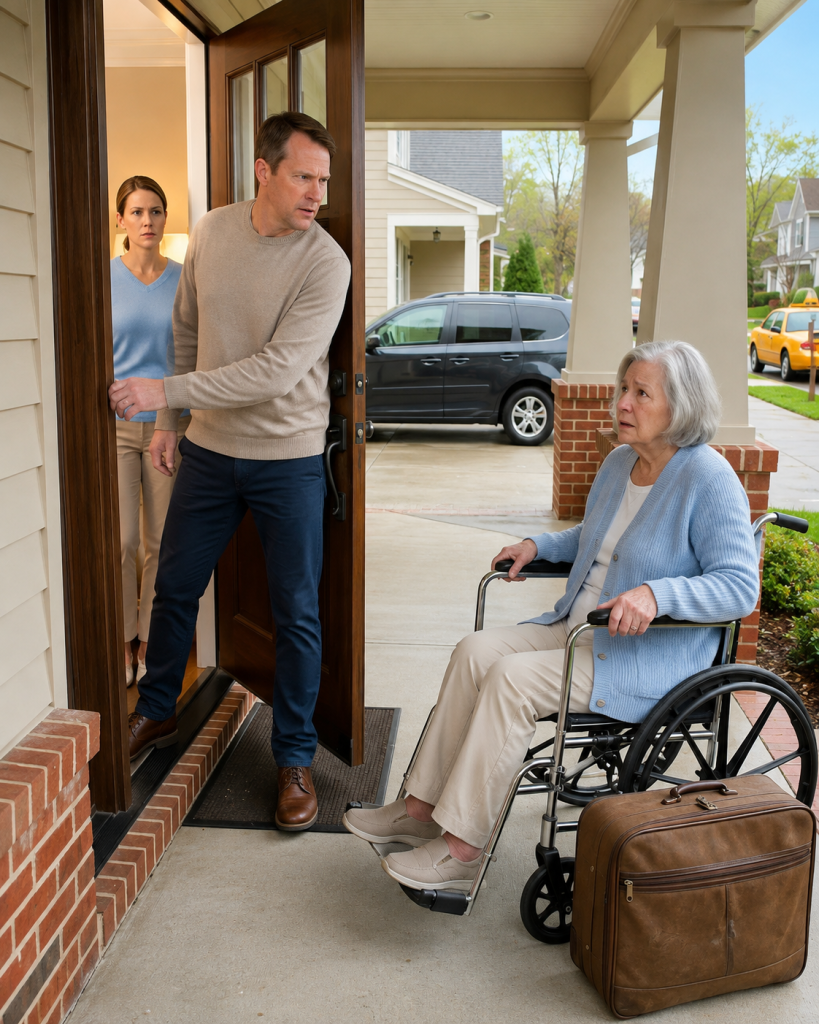
Then I hired a cab and went to Daniel’s house.
I hoped seeing me sitting alone in that wheelchair would remind him that I was not asking a stranger for charity.
I was asking my son.
The cab stopped beside the driveway just before dinner.
Daniel’s family SUV was parked near the garage, and warm light spilled from the kitchen windows.
Through the glass, I could see movement around the dining table.
For a moment, the scene looked so normal that I almost felt foolish for being afraid.
The driver placed my suitcase beside me and asked whether I wanted him to wait.
I looked toward the front porch.
“No,” I said. “My family is home.”
Daniel opened the door after the second ring.
I watched recognition cross his face, followed immediately by irritation.
“Mom, what are you doing here?”
“I came to see my family and ask for help.”
“You can’t just show up like this.”
He stepped onto the porch and pulled the door nearly closed behind him.
Through the narrow gap, I saw Melissa watching from the hallway.
My grandchildren appeared behind her for only a second before someone hurried them away.
The movement hurt more than Daniel’s words.
They had seen their grandmother at the door, and the adults had decided they should not come close.
“I called you,” I reminded him.
“I said I would talk to Melissa.”
“And then you disappeared.”
His jaw tightened.
“We’ve been busy.”