“Neither did Brooklyn.”
My sister became quiet.
“My six-year-old daughter watched Mom beside the ventilator while Kevin and I were asleep.”
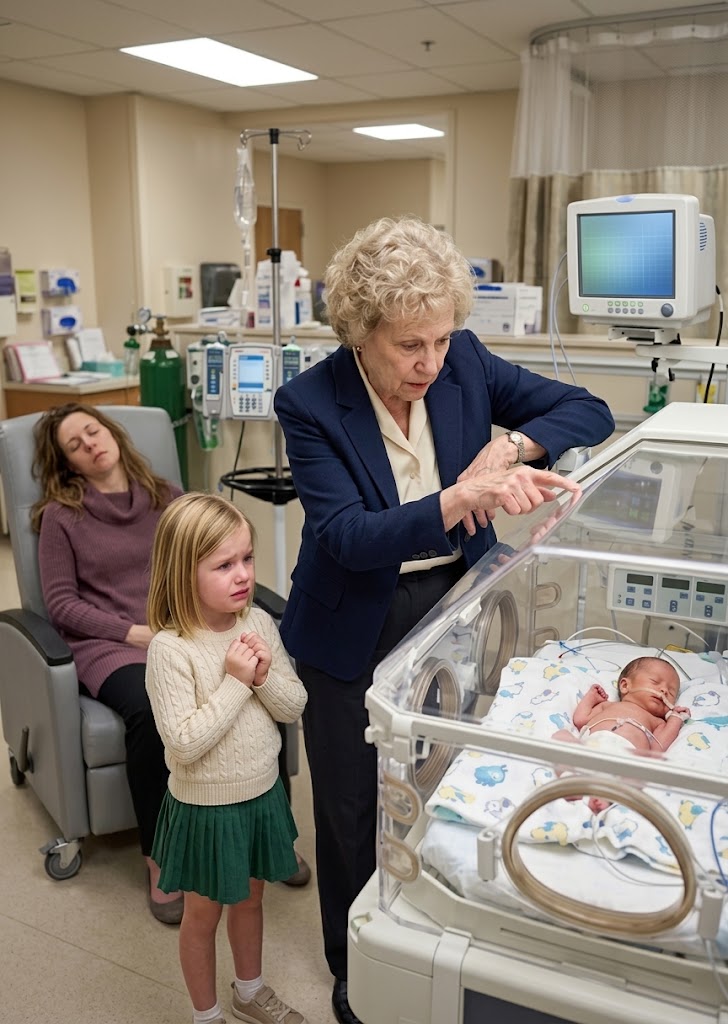
Courtney whispered that she was sorry, but I was no longer interested in apologies that required me to make everyone else feel better. My priority was Rosalie’s safety and making sure Brooklyn understood she had done nothing wrong by telling me what she witnessed.
Later that afternoon, hospital security informed us that my mother would not be permitted back into the restricted area. The incident had also been formally documented, including her unauthorized entry, the timing of the ventilator alarm, and Brooklyn’s account.
The medical staff remained careful about what could actually be proven. Nobody could say from the available records precisely what my mother had done to the tubing, but they could confirm she had no authorization to enter the room or touch Rosalie’s equipment.
That distinction mattered to me.
I did not need to invent something worse than the truth.
The truth was already enough.
That evening, Rosalie remained stable. Gloria even told us her numbers continued moving in the right direction, although the doctors were not ready to make promises about when she could breathe without assistance.
Brooklyn sat beside me drawing a picture for her sister.
“Mommy?”
“Yes, baby?”
“Are we still a family if Grandma is mad at us?”
I looked at Kevin, then at Rosalie inside the incubator.
“Yes. Family isn’t only Grandma and Grandpa.”
Brooklyn considered that before adding Kevin, Rosalie, and herself to the picture.
Then she drew me beside them.
For the first time, I realized how much of my adult life had been spent believing my parents could decide whether I belonged. My mother’s message—show up or stay out of our lives—had worked because she expected exclusion to frighten me back into obedience.
It did not anymore.
The following morning, Rosalie’s doctor gave us the news we had been waiting for. If her progress continued, they could soon begin reducing some of the ventilator support and see whether her lungs were ready to do more work independently.
I was holding Brooklyn when my phone displayed a voicemail notification from an unfamiliar number.
Kevin played it beside me.
My mother’s voice came through.
“You’ve told everyone your version. Now I’m going to tell mine.”
She claimed she had already spoken to people about what happened and intended to prove I was twisting an innocent grandmother’s visit into something sinister. Then she said one final thing before the recording ended.
“You should ask Courtney what she left out.”
I immediately looked at Kevin.
Courtney had already admitted our parents discussed the hospital before Mom arrived.
But apparently, there was still something my sister had not told me.
And when I called Courtney back, the first words out of her mouth made me realize my mother was right about one thing.
There was another part of that night I still did not know.
Part 5 – Courtney’s Final Confession Changed What I Thought My Mother Had Come to the NICU to Do
Courtney was silent for several seconds after answering my call, and I immediately knew my mother had been telling the truth about one thing: my sister had left something out. She had already admitted our parents discussed confronting me before Mom came to the hospital, but there had been another conversation after I blocked their numbers that Courtney had been too ashamed to tell me about.
“Mom wasn’t only angry because you missed my gender reveal.”
I tightened my grip on the phone.
“Then why did she come?”
Courtney explained that Mom saw my decision to stay with Rosalie as another example of me choosing Kevin and my daughters over the family. After I blocked everyone, she apparently became determined to prove that I could not simply shut her out whenever I disagreed with her.
“She said she was going to make you listen.”
“Did she say anything about Rosalie?”
Courtney hesitated.
“She said if you were so obsessed with sitting beside that machine, she would go there herself.”
That sentence made Kevin look toward the incubator.
Courtney insisted she never heard Mom say she intended to harm Rosalie or interfere with the ventilator. What she did hear was Dad encouraging her to confront me and promising they would support each other afterward if I accused Mom of crossing a line.
That explained their behavior the following morning.
Before I even knew my mother had entered the NICU, my parents had already begun building the argument that I was dramatic, selfish, and twisting an innocent visit into something malicious.
“I should have warned you,” Courtney whispered.
“Yes. You should have.”
For once, I did not soften the truth to make my sister comfortable.
Courtney apologized for her messages about the gender reveal and admitted she had spent years accepting our family’s pattern because being the favored daughter benefited her. I appreciated that she finally acknowledged it, but I told her an apology would not automatically restore trust.
The hospital’s review eventually established what could and could not be proven. My mother had knowingly bypassed a visitor restriction, entered Rosalie’s room while we slept, approached her incubator, and was present around the time the ventilator registered an alarm.
What the available evidence could not establish was exactly what she intended when she touched something near the tubing.
I accepted that uncertainty.
I did not need to transform what happened into something more dramatic to justify protecting my children. An adult who had already been told she could not enter had secretly approached my medically fragile newborn’s equipment, and my six-year-old had been frightened enough to pretend she was asleep.
That was enough.
My parents continued trying to contact us through other relatives, but Kevin and I stopped participating in arguments about whether Mom “meant well.” We kept the hospital restrictions in place and made decisions based on what gave Brooklyn and Rosalie the safest, calmest environment.
Several days later, the doctors began gradually reducing Rosalie’s ventilator support.
I stood beside her incubator with Kevin while Brooklyn watched from her chair.
“Is Rosie getting better?”
“She’s trying really hard.”
Brooklyn smiled.
“I knew she could do it.”
Progress came slowly, but Rosalie continued improving. Each small change felt enormous, and for the first time since her birth, I began allowing myself to imagine carrying her outside the hospital.
One afternoon, Brooklyn climbed onto the chair beside me.
“Mommy?”
“Yes?”
“Are you mad I told you about Grandma?”
I turned toward her immediately.
“No. I’m glad you told me.”
“Even though she’s your mom?”
I took her hand.
“Especially then. If an adult does something that scares you or feels wrong, you can always tell me. You never have to protect someone just because they’re family.”
Brooklyn nodded and leaned against me.
That was when I realized how different I wanted her childhood to be from mine.
I had spent years protecting my mother’s image, explaining away her cruelty, and believing that keeping the family together required someone to absorb whatever everyone else refused to confront. Brooklyn had broken that pattern simply by telling the truth about what she saw.
Weeks later, Rosalie was finally strong enough to leave the NICU.
Kevin carried our bags while I held her against my chest, and Brooklyn walked beside me proudly announcing to every nurse who smiled at us that she was Rosalie’s big sister.
My mother was not waiting outside.
Neither were my father or Courtney.
For once, their absence did not feel like rejection.
It felt peaceful.
My mother had once texted that I needed to choose my priorities.
Standing outside the hospital with one daughter holding my hand and the other sleeping safely against my chest, I realized she had accidentally given me the easiest decision of my life.
I chose my children.
And unlike the family I grew up trying desperately to please, I would never make them wonder whether they had to earn the right to be chosen.